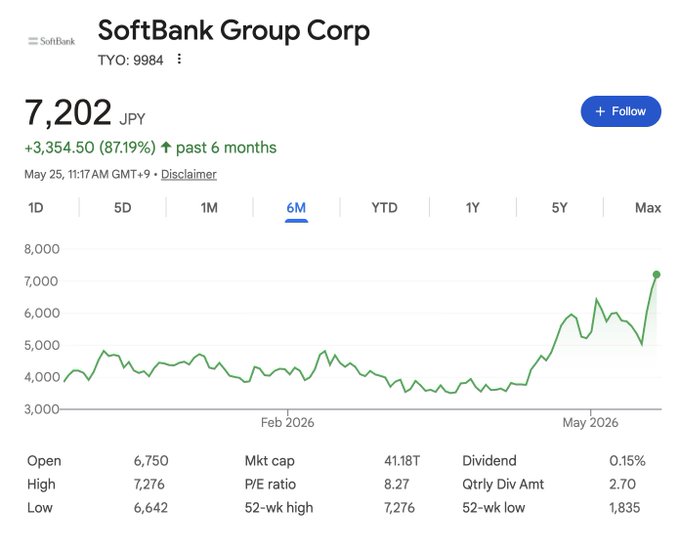
The Nikkei 225 rose over 3%, and SoftBank continued to hit record highs, gaining 40% in three trading days. However, this isn't just a simple sentiment-driven rally; the market is actually revaluing Masayoshi Son's two trump cards: ARM and OpenAI.
Let's look at how explosive ARM's performance has been.
Its stock price has surged 46% in the past five trading days, directly boosting SoftBank's asset value. The acquisition of ARM cost approximately $31 billion, and based on current market capitalization, the unrealized profit is close to $250 billion.
From $31 billion to $250 billion, a textbook example of a successful investment! 😂
Now let's look at OpenAI. SoftBank officially disclosed a cumulative investment of $34.6 billion, with a fair value of $79.6 billion according to financial statements, resulting in a book profit of approximately $45 billion. However, if we roughly calculate based on OpenAI's latest valuation of $852 billion, the unrealized profit has already exceeded $58 billion.
Here comes the most outrageous part:
A rough calculation shows that the ARM and OpenAI holdings alone are now worth over $370 billion—but SoftBank's entire market capitalization is only $250 billion.
In other words: these two investments alone are already worth more than the entire SoftBank company. The rest of the business is practically free or even a loss.
But rather than marveling at SoftBank's record highs, we should be more concerned about what Masayoshi Son will do next.
Everyone knows his style—when he has money, he wants to do big things. Last time, with too much cash, he directly acquired ARM. This time, with over $300 billion in unrealized gains as leverage, he's already pushing Stargate and sweeping up AI infrastructure everywhere.
If he uses the paper profits from ARM and OpenAI to further leverage and go all in on next-generation AI infrastructure, SoftBank might not just be a stock issue—it's becoming the Berkshire Hathaway of the AI era.
Of course, it could also become the next, enlarged version of WeWork. Masayoshi Son, for him, is either a legend or a flop; there's no middle ground.
Therefore, SoftBank's record high is not essentially "rising along with the AI concept," but rather the market is betting on one thing: whether Masayoshi Son will become the biggest winner in this AI cycle.