avatar
Elite🏝
23,494 Twitter followers
Follow
Onchain is the next online •|• Alpha & Threads •|• Researcher •|• Marketing •|• #AI •|• My tweets are NFA •|•
Posts
avatar
Elite🏝
01-12
Thread
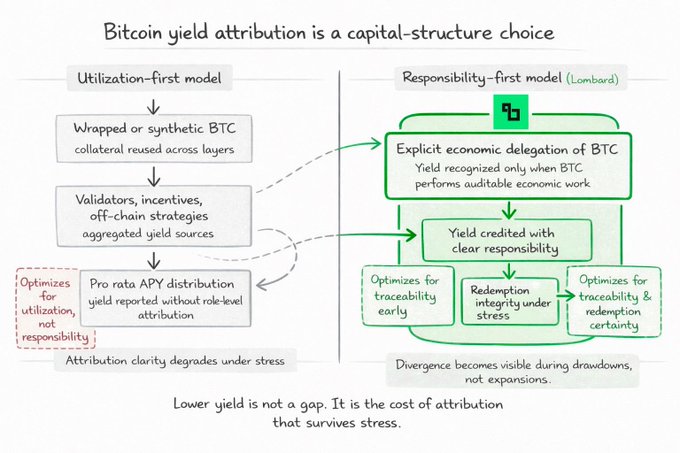
Bitcoin yield is often misframed by analogy. Most restaked $BTC models implicitly assume $BTC yield should resemble $ETH yield; maximize utilization, reuse collateral, and abstract attribution across multiple layers. @Lombard_Finance takes the opposite stance. It treats yield as something that must be earned through defined economic work and attributed conservatively. That difference is not cosmetic. It is architectural. ••• — 📌 The Utilization-First Model In most restaked $BTC designs, yield attribution is indirect. $BTC is wrapped or synthetically exposed to validator activity, protocol incentives, or off-chain strategies. Yield is then aggregated and distributed pro rata. The accounting is functional, but attribution is weak. The system can report an APY without clearly answering where the yield originated or which layer absorbed risk. This model optimizes for utilization. It does not optimize for attribution clarity. When conditions are stable, that distinction is easy to ignore. Under stress, it becomes visible. — 📌 $BTC Yield With Clear Responsibility Lombard uses a different constraint set. Yield on $LBTC is only recognized when $BTC is deployed into explicit, auditable economic functions inside the system. Reuse is bounded. Recursive leverage is avoided. If $BTC cannot be cleanly tied to productive activity that survives adverse conditions, it does not count toward yield. This makes Lombard’s yield slower and smaller. It also makes it legible. The protocol is structured around capital responsibility, not yield amplification. Yield is attributed based on what $BTC did, not on how much $BTC was present. — 📌 Why Yield Is Lower by Design Lower yield is not an implementation gap. It is a filtering mechanism. Lombard deliberately refuses yield that relies on: + hidden leverage + maturity mismatches + redemption fragility + attribution by aggregation If the protocol cannot explain where yield came from during a drawdown, it compresses yield early rather than masking risk. That tradeoff prioritizes redemption reliability over headline returns. — 📌 Where the Models Diverge The divergence between models shows up most clearly under stress. Restaked $BTC systems tend to maintain yield optics longer, even as redemption paths narrow and attribution becomes ambiguous. Lombard accepts the inverse outcome. Yield compresses earlier so that accounting remains coherent later. This is not a philosophical choice. It is a capital-structure choice. — 📌 Who Lombard Is Built For These design choices determine which capital the system attracts. + Speculative capital optimizes for yield curves. + Institutional-grade capital optimizes for traceability and redemption certainty. Lombard is built for the second group. This is why $LBTC is not framed as “$BTC with yield.” That framing invites comparison to utilization-maximized models. $LBTC is better understood as $BTC with auditable economic delegation, where yield is a secondary effect. ••• — 📌 Conclusion @Lombard_Finance isn’t trying to maximize yield. It’s trying to be clear about risk. Who took it. Where it sits. And whether it still holds when things break. That’s rare in crypto. It’s standard in systems built to last.
BTC
0.52%
loading indicator
Loading..