avatar
岳小鱼
Follow
Web3 PM | 项目投研 | 空投猎人 | 从互联网大厂到Web3创业公司🚀持续输出优质内容累计100万字,微信公众号【岳小鱼】主理人
Posts
avatar
岳小鱼
12-23
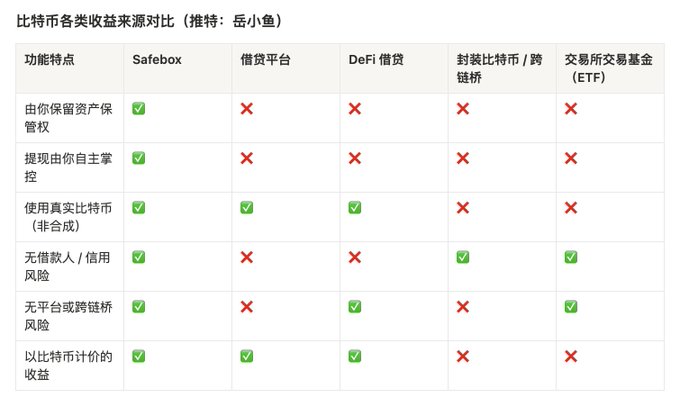
What are the main ways to generate returns when holding Bitcoin assets? Currently, there are four main types: 1️⃣ Lending platforms: Returns come from interest payments made by borrowers. 2️⃣ DeFi lending: Similar to centralized lending platforms, but with a decentralized operation. 3️⃣ Bitcoin wrapping/cross-chain bridges: Introducing Bitcoin into ecosystems across different blockchains, with returns from cross-chain DeFi market making/staking fees. 4️⃣ Exchange-traded funds (ETFs): Introducing Bitcoin into the traditional stock market, with returns from net asset value growth and dividends. However, each of these return methods has its own problems. Centralized lending: Requires fund custody and transfer, facing platform collapse and borrower defaults. On-chain lending: These systems introduce liquidation mechanisms, collateral volatility, and dependence on borrowers, posing risks such as smart contract vulnerabilities and liquidation. Blocked Bitcoin or bridge-based systems: Have issues with cross-chain bridge security, contract risks, and de-encapsulation delays. ETFs: ETFs deprive users of direct ownership of Bitcoin. Currently, we see Goat Network's Safebox exploring a new path. @GOATRollup Safebox is the only financial product that integrates custody guarantees, zero borrower risk exposure, and BTC-denominated returns. Where does Safebox's return come from? It actually comes from Goat Network's transaction fees, MEV, and sorter rewards. Safebox's annualized return is between 1.5% and 2%, but this is a native BTC annualized return, and it's risk-free. Goat Network is encapsulating the value captured by its network into a BTC financial product; this approach is quite ingenious. This product is currently in beta testing; we can provide a detailed review later. twitter.com/yuexiaoyu111/statu...
BTC
2.46%
avatar
岳小鱼
12-20
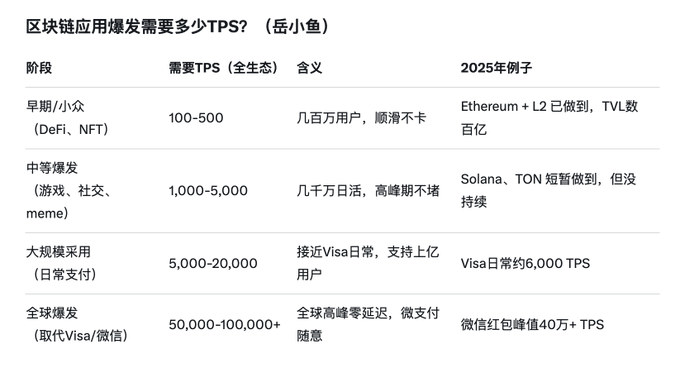
There seems to be a misconception in our industry regarding the high performance of blockchain. This is also a consensus within the industry: the faster and cheaper the underlying public blockchain, the better. Blockchain is becoming increasingly faster and cheaper, but is this really useful? After so many years of development, from the public blockchain wars of 2018 to the current Layer 2 battles, it seems another batch of high-performance public blockchains has emerged. The question then arises: is this pursuit of high performance truly the right thing to do? Frankly speaking, our underlying infrastructure is still far from being able to support high-frequency, large-scale blockchain applications. Here are some data points to make things clear: 1️⃣ Early blockchain applications, such as DeFi lending and NFTs, only require 100 to 500 TPS (transactions per second). 2️⃣ Mid-sized applications, like blockchain games and crypto payments, require approximately 1,000 to 5,000 TPS. 3️⃣ If truly large-scale applications emerge later, such as stablecoin payments or social scenarios, then 5,000 to 20,000 TPS will be needed. 4️⃣ For globally widespread applications to emerge in the future, TPS will need to reach the 100,000 level. In short, blockchain applications haven't reached the point of explosive growth yet. The threshold for application explosion is roughly 5,000 to 10,000 TPS to truly support the explosion of large-scale applications. Currently, Solana and Ethereum's Layer 2 are the closest to this threshold. However, we cannot ignore another important ecosystem: the Bitcoin ecosystem. Bitcoin is the gateway for traditional finance and capital to enter the blockchain space, and it's also the first blockchain asset most people encounter. In the future, Bitcoin will be positioned as an interest-bearing and liquid financial asset. Therefore, the Bitcoin ecosystem also needs a higher-performance application chain. Many projects are already working on this, the most typical being Goat Network. @GOATRollup This Bitcoin Layer 2 was upgraded on December 19th, reducing costs by over 95%, which is essentially paving the way for the future explosion of the Bitcoin ecosystem. "To get rich, build roads first"—this experience also applies to the blockchain industry. twitter.com/yuexiaoyu111/statu...
GOAT
2.01%
avatar
岳小鱼
12-13
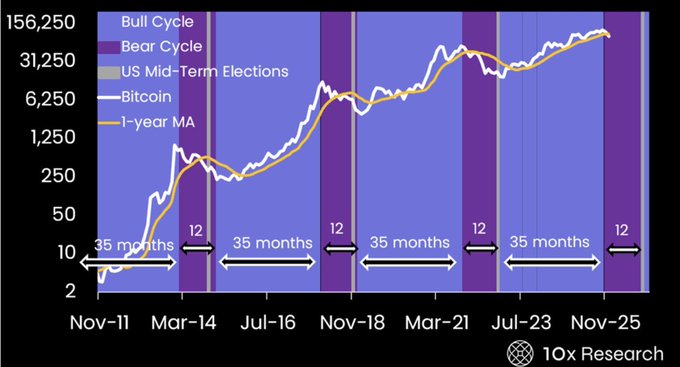
Many are still clinging to outdated practices, failing to recognize the structural shifts in the Bitcoin market. 1️⃣ Is the four-year Bitcoin cycle still intact? Gold, silver, and even the A-share market have surged, but Bitcoin hasn't risen this year. In fact, the four-year cycle has been clearly broken. This bull market not only started early, but its price fluctuations haven't replicated previous cycles. According to past patterns, 2025 should have been a major bull year, but this year's performance has been relatively poor. 2️⃣ Why has the four-year cycle been broken? A key reason is that Bitcoin's price has shifted from being determined by supply to being determined by demand. Previously, Bitcoin's supply halved every four years; with demand remaining constant, the price naturally rose. Now, most Bitcoins have been mined, making the annual supply changes less impactful on price. Furthermore, the pricing power of Bitcoin has shifted to Wall Street, with traditional financial institutions continuously entering the market and traditional funds flowing in. Changes in market demand have a greater impact than changes in supply. 3️⃣ Where is Bitcoin's next stage? Bitcoin's current narrative is "digital gold," but for Bitcoin to truly replace gold, it needs attributes at least 10 times superior to gold. Bitcoin already possesses the scarcity of gold, but its greatest untapped potential lies in its digitality. Or, programmability. Simply hoarding coins makes it no different from gold. What gold cannot do is become an interest-bearing asset, while Bitcoin can. A financial system can be built around Bitcoin. Imagine Bitcoin becoming digital oil, usable in various practical scenarios; Bitcoin could also become digital bonds, spawning various financial derivatives. Several projects are already continuously building in this direction, a prime example being GOAT Network, positioned as a Bitcoin yield layer. @GOATRollup Bitcoin's next narrative should be "interest-bearing digital gold." This narrative point has not yet been fully realized by the market. It is recommended to invest in related projects in advance. twitter.com/yuexiaoyu111/statu...
GOAT
2.01%
avatar
岳小鱼
12-10
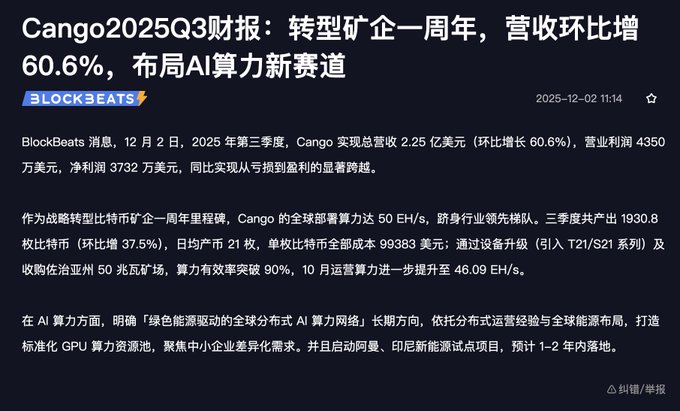
A Chinese company that has not only successfully expanded overseas but also transformed into a Bitcoin mining company, and is now heavily investing in AI computing power, is definitely worth studying in depth. Recently, I came across a Chinese company called Cango, which has successfully completed a three-stage leap: The first leap was overseas expansion, shifting from domestic Chinese business to global operations and listing directly on the US stock market; The second leap was transformation into a Bitcoin mining company, fully entering mining in November 2024 and quickly becoming one of the top three globally; The third leap was investing in AI computing power, leveraging its mining foundation to build a globally distributed AI computing infrastructure. Why was this company able to achieve this three-stage leap? @Cango_Group After studying the company's development history, the core can be summarized in one sentence: It is a Chinese team that is extremely cash-driven, extremely sensitive to regulatory red lines, and willing to start over. Break down this sentence, there are actually five truly decisive factors: 1️⃣ Sufficient cash on hand: In May 2025, the sale of its Chinese automotive business to Ursalpha for $352 million in cash is the origin of Cango's three-stage leap. 2️⃣ Determined to start from scratch: Zhang Xiaojun, the original founder of the automotive business, voluntarily stepped down at the end of 2024, handing over the CEO role to Paul Yu, a true expert in crypto and energy. 3️⃣ Highly sensitive to regulation: From day one, they have maintained 100% overseas deployment, 100% overseas electricity supply, and 100% overseas hosting, leaving not a single mining machine in China. 4️⃣ They treat Bitcoin as a long-term asset: They don't sell the mined Bitcoin; instead, they use it as collateral to borrow US dollars to pay for electricity, with interest rates as low as 3-5%, while Bitcoin's value increases by over 100% annually, resulting in very impressive financial statements. 5️⃣ They seized the historic window of opportunity in 2024-2025: the Bitcoin halving, Trump's election, and the explosion of AI big data models. They first quickly transformed into a Bitcoin mining company, then began deploying AI computing power, perfectly timing each step. Therefore, we can see that opportunities are not always in the hands of the companies with the most resources, but rather in the hands of the companies that react most quickly to the market and dare to seize opportunities. We are now at the crossroads of cryptography and AI, and we can continue to pay close attention to companies that combine Bitcoin mining with AI computing power. twitter.com/yuexiaoyu111/statu...
avatar
岳小鱼
12-05
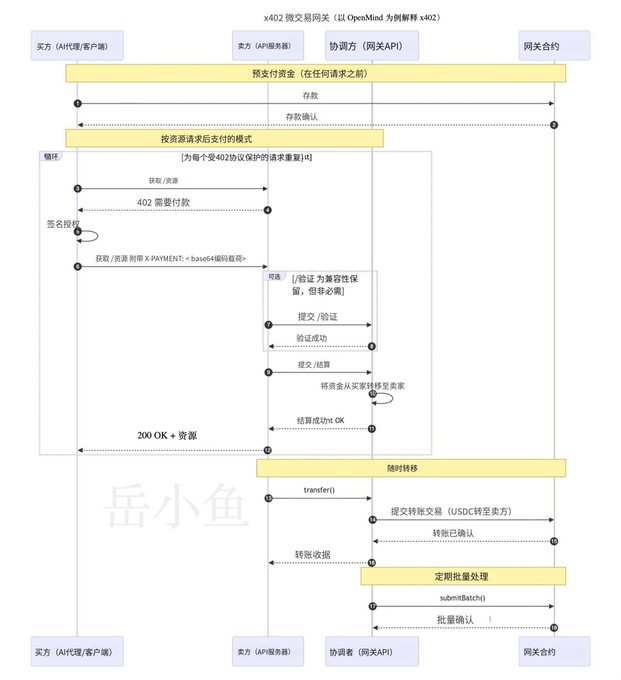
x402 has made new progress: expanding from AI payments to robot payments! If you believe the future belongs to AI and robots, then you must pay attention to this latest development! Stablecoin issuer Circle and robot network OpenMind are collaborating to develop payment standards between robots. When x402 first appeared, everyone thought AI was the future, so x402, which could be used for payments between AIs, was very important. After a period of calm, people have suddenly discovered that x402 can now be used for payments between robots! Here's a systematic analysis of this latest development of x402 and some related observations: 1️⃣ To understand the significance of this, we must first understand the relationship between AI, robots, and blockchain. We can observe that two technology trees are constantly being illuminated recently: One is AI, and the other is robotics. Many people are amazed that AI is becoming increasingly intelligent; while robots, especially humanoid robots, are becoming more and more like humans. So, what exactly is the relationship between AI, robots, and blockchain? In simple terms, AI is the brain, robots are the body, and blockchain is the wallet and ID. If we want AI and robots to create new economic models, blockchain is essential. This is because the flow of funds and identity verification in our real world are based on "natural persons"—for example, only natural persons can open a bank account. So, what about AI agents or robots? This is where blockchain-based identity and currency come in. When AI agents and robots form a network, value exchange is needed between individuals in this economy, making payments particularly important. The x402 payment protocol emerged to fill the gap in AI and robot payments. 2️⃣ Why are Circle and OpenMind doing this? The x402 payment protocol was initially driven by Coinbase, aiming to seize the cutting-edge field of AI payments. However, when entering the lucrative robot economy, Circle and OpenMind are indispensable. Circle is the issuer of the largest compliant stablecoin, USDC, while OpenMind is a leader in decentralized robot projects. Circle controls the settlement layer of stablecoin payment networks, while OpenMind provides the intelligent execution layer for bots. Circle has minted over 77.2 billion USDC, making it the second-largest stablecoin, but its use is primarily limited to DeFi and human transactions. OpenMind, on the other hand, focuses on decentralized bot coordination but lacks a reliable payment layer. By combining the two, Circle provides USDC + x402, while OpenMind contributes real-world applications, creating a closed loop. 3️⃣ What exactly is the x402 proposal from Circle and OpenMind? This proposal is an improvement on the x402 protocol. x402 originally aimed to enable small-amount, real-time payments between AIs, which places high demands on blockchain performance. Currently, blockchain throughput is still insufficient for large-scale applications. Circle aims to solve this problem using its own Gateway system, an off-chain payment gateway. Therefore, the core of this proposal is how to integrate x402 with the Circle Gateway to achieve efficient, secure, and cross-chain payments. The specific payment process can be seen in this flowchart: (1) The buyer deposits money into the Gateway contract, generating an EIP-3009 signature (authorized transfer). (2) After the buyer pays the seller via x402, the seller submits the signature to the Gateway (/settle call). (3) Gateway Off-Chain Verification: Checks the buyer's balance, locks funds, and immediately notifies the seller of receipt. (4) Gateway Batch Accumulation of Signatures, Periodic On-Chain Submission (Batch on-chain settlement can save costs). The whole process is actually very similar to Alipay's balance payment + batch reconciliation: You scan the code to pay and the payment is deducted instantly (off-chain), but the bank's backend records transactions in batches every hour (on-chain). Gateway is the user's unified multi-chain balance account. Users can deposit balances into the Gateway contract as needed and pay as needed. More importantly, Gateway can be embedded into the x402 v1 protocol (standard process) very transparently and easily, without changing the original structure, achieving plug-and-play functionality. OpenMind ecosystem robots can use USDC to achieve micro-payments between machines through x402 + Gateway. 4️⃣ Summary This proposal is a key step for Circle in promoting x402 from a theoretical standard to a practical tool. Circle's cooperation with OpenMind is actually prioritizing its application in the robot economy, realizing high-frequency, small-amount payments by robots. OpenMind is x402, a very early adopter, conducted its first humanoid robot payment in May 2025. OpenMind is building an open and scalable ecosystem for machine collaboration, meaning OpenMind is providing x402 with a completely new payment scenario. In the payment business, the scenario is paramount. AI payments and robot payments are undoubtedly two crucial payment scenarios for the future. The x402 payment ecosystem has great potential, and we should continue to monitor it closely. @circle @openmind_agi twitter.com/yuexiaoyu111/statu...
loading indicator
Loading..