Do ghosts really exist?
Hegel believed that the world is the unfolding of spirit. From a scientific perspective, a ghost should not be understood as "a floating, humanoid entity," but rather as "an informational state that cannot be fully verified externally, but can be truly experienced by the subject."
Our consciousness constitutes our experiential world; everything experienced has existence within consciousness. Thus, we shift the question of ghosts from "Does a ghost objectively exist?" to "Why do some states, though not publicly verifiable, still have a real impact on human consciousness, judgment, emotions, and behavior?"
The definition of ghosts in idealism:
Idealism is not concerned with material objects themselves, but with their presentation in consciousness. Therefore, from this perspective, a ghost can be defined as a state of existence that is felt, identified, and named within the system of consciousness, but cannot be completely reduced to public physical evidence.
This definition has three characteristics:
It is primarily empirical, not a laboratory subject. One feels it first, and then interprets it.
It depends on the subject's structure. Not everyone can feel the same "ghost" at the same time and place. This indicates that its manifestation is related to the subject's perceptual structure.
It has causal effects; although it cannot be openly displayed, it influences heartbeat, sleep, judgment, narrative, spatial awareness, and sense of relationship. This means it is not purely nothingness, but something that can enter the system and alter its state. From an idealist perspective, as long as an object continuously enters consciousness and disturbs the structure of consciousness, it already possesses some qualification for existence.
From another perspective, if we use information theory to express this, we can view "ghosts" as a state of information that is "lowly observable but highly influential."
Taking AI computation as an example, many states in the system are not directly visible. We can only infer how AI thinks by observing changes in its output.
For example:
• You can't see the full content of someone else's consciousness.
• You can't see a traumatic memory in the brain.
• You can't see the ghost itself.
But you can see the output:
• Sudden emotional shifts
• Abnormal spatial awareness
• Recurring dreams
• Shared fears within a group
• Intense discomfort with a particular place
• Persistent perceptual biases without a clear cause.
Therefore, a ghost can be described as:
• A pattern of information hidden within the system, inaccessible directly, but constantly leaking its existence through abnormal output.
In this case, the ghost is like a phantom variable in the system: unreadable but continuously influencing the outcome.
Why is the ghost unverifiable, yet experiential? A person may be certain of the existence of a certain state, but may not be able to fully convey that state to others. The experience of ghosts is similar. The experiencer is like the prover, and the observer is like the verifier. The experiencer says, "Ghosts exist," but they cannot provide complete evidence in the traditional sense. This is because the state cannot be fully downloaded, copied, or publicly broadcast. Therefore, ghosts can be interpreted as: a state of existence where only a local subject possesses witnesses, but cannot output complete proof to the public world. The witnesses here can be:
• the subjective experience of the individual
• bodily reactions
• repetitive structures in dreams
• persistent feelings of abnormality in certain scenes. These witnesses are strong, but often non-transferable. Therefore, if we abstract further, we can understand a person as a perceptual system. A complete system includes:
• Input layer: vision, hearing, touch, memory, cultural cues
• Processing layer: cognitive modeling, emotional amplification, meaning interpretation
• Output layer: language, behavior, fear, avoidance, dreams, rituals. Ghosts are like a special state transition: when certain inputs and internal structures couple, the system enters an abnormal interpretation mode. In this mode, the human body organizes information that cannot be easily categorized into the form of "ghosts." Therefore, a ghost is not simply an object, but rather a high-density, meaning-laden state generated by a system in the face of inexplicable disturbances. So how do ghosts influence the real world?
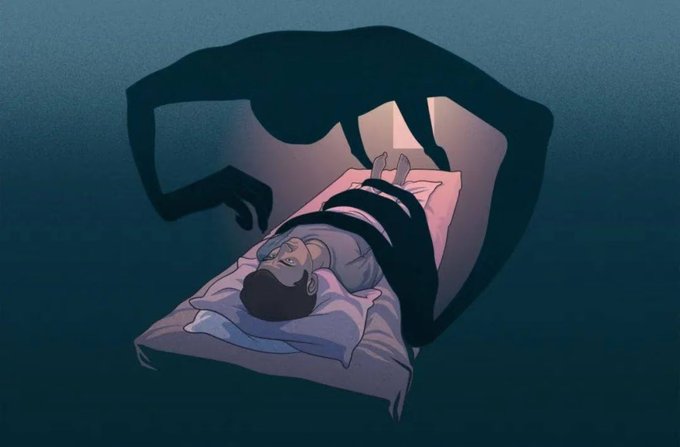
Sleep paralysis is a fairly typical example. In numerous individual descriptions:
The individual wakes up at night, conscious, and able to confirm they are in a familiar environment;
The body is unable to move, and language function is limited;
Spatial perception is significantly amplified, with room boundaries and spatial relationships becoming unusually clear;
Simultaneously, the individual experiences an enhanced sense of presence, perceiving an unvisually confirmed presence outside the original spatial structure. Highly similar descriptions can be found in ancient Chinese tales of the strange and supernatural:
"Suddenly, while lying down at night, I felt a heavy weight pressing down on me, unable to open my eyes or speak, as if someone were beside me." (Zi Bu Yu)
"When a person lies down, they feel something pressing against them, wanting to get up but unable to, knowing it's strange, yet unable to move." (Yue Wei Cao Tang Bi Ji)
The descriptions of "as if someone were beside them" and "something pressing against them" are noteworthy. The ancients did not emphasize "seeing," but rather a judgment of presence based on location. In other words, an invisible but definitively existing node has appeared in space.
This is structurally identical to the modern individual's report of "an extra thing in the room."
From an information theory perspective, this phenomenon can be uniformly understood as: a node that is not directly observed has been introduced into the original spatial model of the system.
In this process, the "ghost" indirectly participates in the generation of reality by altering the person's choice structure, thereby influencing the physical environment in the mental world.
Therefore, ghosts not only truly exist, but the more people fear them, the more likely they are to appear.
Once a ghost can enter a person through experience and retain its influence even without complete analysis, its reappearance will no longer entirely depend on external conditions.
Specifically, when a person forms a memory of a particular ghost's behavior, that ghost gains a stable entry point. In subsequent processes, the ghost no longer needs to be sensed or contacted through any medium; only certain conditions need to be met to reactivate the state.
These conditions typically include low-light environments and enclosed spaces. And the expectation of potential anomalies, with the last point being the most crucial.
Because once a person begins to reserve interpretations for a certain kind of ghost, that ghost becomes more likely to invade again.
And if you want to reduce the probability of being invaded by a ghost, the best way is to erase it from your memory.