avatar
BruceBlue 🌲
4,742 Twitter followers
Follow
Posts
avatar
BruceBlue 🌲
02-07
Thread
I recently listened to the podcast episode of "Silicon Valley 101" that deeply analyzed Clawdbot, titled "Why Will It Become the First Phenomenal Product of 2026?", and was deeply inspired. This episode not only dissected the underlying technology but also outlined the blueprint for the evolution of AI agents from tools to digital life forms. Based on the podcast's discussion of Clawdbot's (now @openclaw) heartbeat mechanism, long-term memory, and high-privilege operations, I've come up with some fundamental insights into the future explosion of AI agents: 1️⃣ Business Paradigm: From "Buying Tickets" to "Buying Results" In the past, the core of SaaS was renting the right to use software (subscription per person), but in the agent era, this logic has changed. Since agents can click, browse, and make decisions like humans, "pay per action" will become the mainstream. We no longer pay for the "process," but only for the "result/effect." 2️⃣ Development Paradigm: Cognition is Execution When structured Markdown becomes the "source code" of the agent, natural language achieves a dimensionality reduction attack on code. This means that the moat of industry know-how is being infinitely raised, while pure code execution is depreciating. "One-man companies" commanding an entire army of agents are beginning to emerge. 3️⃣ Service Target: The Internet is "Dehumanizing" This is the most profound change: the internet's service target is shifting from "people" to "agents." Future UIs may no longer be designed for human comfort, but for efficient agent reading. In this context, the "physical isolation" mentioned in the podcast will become the last line of defense for privacy, and the Mac mini is highly likely to become a "digital safe" in the agent era. I believe the explosive popularity of Openclaw foreshadows a completely new power structure: humans are responsible for providing the scarcest creative ideas and decisions, while agents, protected by physical hardware, automatically complete the production loop behind the scenes. I highly recommend listening to this episode of "Silicon Valley 101," as it's very helpful for understanding the future direction of AI. 👇Click the link to listen: sv101.fireside.fm/237
avatar
BruceBlue 🌲
01-09
Thread
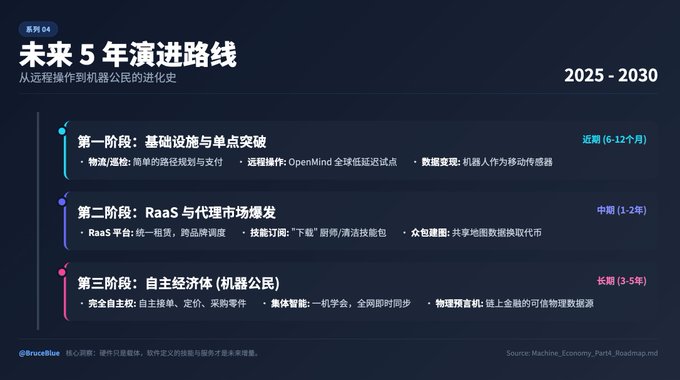
"Machine Economy Series 4️⃣: From Remote Operation to Autonomous Entities, a 5-Year Evolution Roadmap" The machine economy won't happen overnight. Based on the technological maturity of @openmind_agi and @virtuals_io, I've projected three stages in which the physical world will be reshaped over the next 3-5 years. This collaboration will be implemented in phases over the next few years, each corresponding to a different business model. 1️⃣ Infrastructure and Single-Point Breakthroughs (6-12 months) This is the "road-building" stage. 🔹Logistics and Inspection: Robot fleets utilize ACP (Agent Computer Protocol) for simple route planning and can autonomously pay for charging stations. 🔹Remote Operation Pilot: Utilizing OpenMind's low-latency network, global remote operation of humanoid robots will be implemented. OpenMind launched a selective pilot in December 2025. 🔹Data Monetization: Robots are not just workers, but also mobile data collectors. They validate and sell sensor data (such as street congestion and air quality) through FABRIC. 2️⃣ RaaS and Agent Market Explosion (1-2 years) This is the stage where "app stores" emerge. 🔹RaaS (Robot as a Service) Market: A unified robot rental platform will appear (similar to Didi Chuxing). Users don't need to own robots; they can simply dispatch and rent them on demand across brands. 🔹Skill Subscription: You purchase a general-purpose "whiteboard" robot and then subscribe to "Michelin Chef Agent" or "Professional Cleaning Agent" modules through the Virtuals marketplace. Software defines hardware functionality. 🔹Crowdsourced Mapping: Decentralized robots collaboratively build high-precision maps and are incentivized through tokens. 3️⃣ Autonomous Economy (3-5 years) This is the stage of "machine citizens." 🔹Complete Autonomy: Robots become independent economic entities (Autonomous Economic Agents). They autonomously decide when to accept orders, when to rest, and even autonomously procure parts for maintenance. 🔹Collective Intelligence: Based on Fabric's knowledge dissemination, a machine in New York learns how to handle a new type of doorknob, and bots across the network can learn within seconds. 🔹Physical Oracles: Bots, as the most trusted data sources in the real world, provide location proofs and environmental monitoring data for DeFi and DePIN, becoming beacons connecting the physical world and on-chain finance. 🔮Next Episode Preview: Faced with such a grand vision, how can ordinary investors and developers participate? In the fifth installment, I will analyze investment opportunities and potential risks. twitter.com/BruceBlue/status/2...

FABRIC
0%
-- END --