avatar
캘빈의 감금원
Follow
Posts
avatar
캘빈의 감금원
02-07
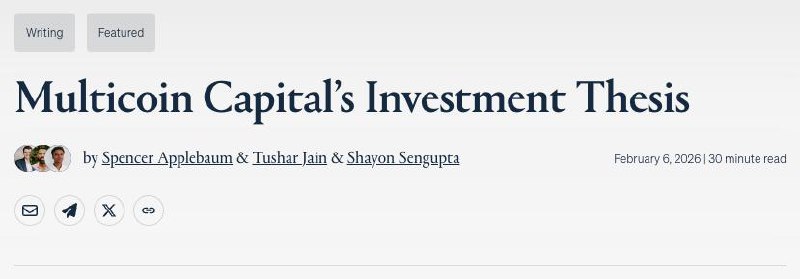
Multicoin's Investment Thesis Update. This is their thesis for their investment portfolio, so you can take a quick look and see what they're thinking. Full Text: assets.ctfassets.net/qtbqvna1l... 1. Fintech 4.0 • Specialized stablecoin fintech with better unit economics at lower costs • Covering most of the fintech stack (e.g., Altitude) • Companies providing stablecoin accessibility to global users/enterprises (e.g., p2p.me, El Dorade) 2. DeFi • Consumer-facing front-end (e.g., Phantom, Fuse Wallet, Robinhood) • DeFi-based company equity (e.g., Coinbase, Morpho) • DeFi middleware (e.g., Li.Fi, Fun.xyz, Yield.xyz) • DeFi protocols (e.g., Kamino, Drift, Aave, Ethena) 3. Financial globalization • Liquid market tokenization (e.g., Paxos) • Global accessibility of synthetic derivatives (e.g., Drift, Hyperliquid, Lighter) • Black market decentralization and efficiency (e.g., BAXUS, Triumph) • New markets (e.g., Kalshi, Sway) • On-chain microstructures (e.g., DFlow, Jito, FastLane) 4. More efficient borrowing/lending • Kamino, Aave 5. Entertainment economy • Cheddr, Novig 6. Programmable ownership • DePIN (e.g., Hivemapper, Render, io.net, Geodnet, Pipe, Gradient) • Internet labor markets (e.g., CrunchDAO, Fuse) • Virtual markets controlled by DAOs (e.g., Jito, Drift, Kamino) • Exploring the Equity 2.0 market 7. Trusted, neutral blockchains • Blockchains with corporate interests will struggle to attract third-party builders and liquidity • Currently, Aptos, Solana invested in Say. 8. Cryptographic Primitives • Zama, Fheniz, zkMe
FUSE
4.74%
avatar
캘빈의 감금원
02-05
In modern society, privacy is a fundamental right. However, in centralized structures, individuals lose control of their data and become the unprotected victims of numerous personal information leaks. While blockchain might offer a solution, existing protocols like Zcash and Monero are limited by their dependence on specific chains or their ability to provide privacy at the level of simple asset transfers. In particular, the technical limitations of requiring multiple parties to participate in computation make these chains particularly vulnerable to applications in DeFi models or AI. As an extension of this discussion, I've been researching new privacy chains, and I recently read Siwon's post about Arcium. Arcium is a project that adopts multi-party computation (MPC) as its core technology and attempts to overcome the limitations of existing privacy chains through distributed processing. Furthermore, I learned that Arcium is designed as a computation layer, rather than an independent L1, to provide privacy features as plugins across various chains, enabling use cases similar to Umbra. Ultimately, I believe Archium's goal is to make privacy a fundamental foundation, not a special feature. If it can serve as a universal computing layer between fragmented chains, it could accelerate institutional-grade on-chain finance and private AI learning. It will be interesting to see how general-purpose solutions like Archium address this structural flaw. In particular, it will be fascinating to see whether Archium can move beyond being a standalone solution and work in complementary ways with various emerging privacy chains, ultimately raising privacy standards across the entire ecosystem. The original article can be found here. The ecosystem section is worth a look! Full issue article (post) | Full issue article (website)
MPC
5.86%
avatar
캘빈의 감금원
02-04
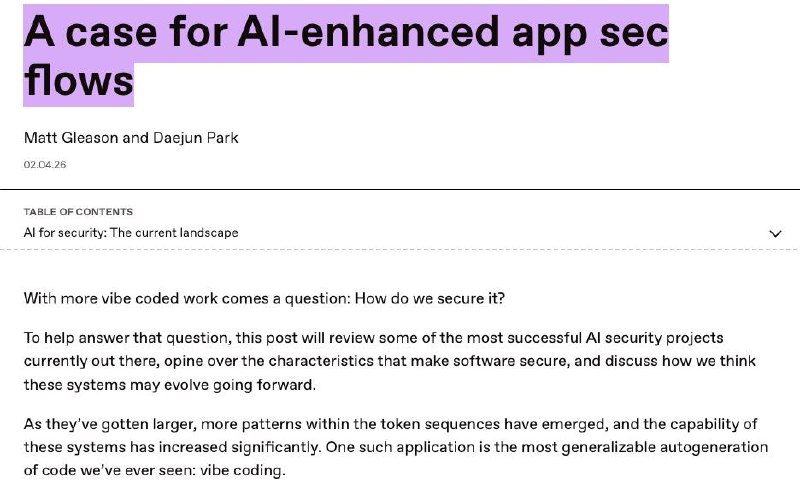
a16z crypto posted an article about leading AI security solutions and AI security in the era of Vibe Coding. @peachmint shared it with me, so I read it. The AI security solutions introduced in the article are broadly categorized into three categories: 1. Solutions from the AIxCC (AI Security Solutions Competition hosted by the US Department of Defense) • These solutions focus on automating fuzzing, and most of them integrate existing tools with AI rather than introducing completely new approaches. Fine-tuned models are used for patching vulnerabilities after vulnerability detection. 2. Google's Big Sleep • An agent that mimics the behavior of human security researchers. It primarily discovers memory vulnerabilities in C code and proves them using address sanitizers. • These solutions can only detect vulnerabilities, not patch them. The CodeMender project currently under development at Google is expected to improve this. 3. OpenAI's Aardbark • Rather than focusing on bug detection, it is expected to be more of a reasoning-based assistant that can assist human researchers. The article concludes that in the current era of "vibcoding," programs have inconsistent code and diverse security practices, making it difficult to consistently apply existing security systems. AI security systems, in particular, frequently suffer from hallucinations when identifying and patching vulnerabilities. Nevertheless, the article concludes that AI will be the tool to solve this problem, and that special-purpose models and agent systems are expected to evolve over time. This discussion was a bit more theoretical than expected, which was a bit disappointing. Since we're talking about AIxCC, I'd like to discuss the approaches and recent developments of the finalists at AIxCC. Watch this if you're bored. 1st Place: Team Atlanta's Atlantis • A joint team of Georgia Tech, Samsung Research, KAIST, and POSTECH • Fuzzing + symbolic execution + a fine-tuned proprietary model • Uses agents with different strategies for each language and stage • github.com/Team-Atlanta/aixcc-... 2nd Place: Trail of Bits' Buttercup • Traditional fuzzing tools (e.g., libfuzzer) + non-inference LLM => High cost-effectiveness • github.com/trailofbits/butterc... 3rd Place: Theory's Roboduck • Relies on modern LLM code analysis rather than traditional binary analysis techniques. Traditional techniques serve as a backup • Reproducing the workflow of a human security researcher • Developing a commercial security solution using Xint Code • github.com/theori-io/aixcc-afc... 4th Place: Fuzzing Brain by All You Need Is A Fuzzing Brain • Like Roboduck, it relies on LLM and has a fuzzing fallback. • It runs 23 different LLM strategies in parallel. • github.com/o2lab/afc-crs-all-y... 5th Place: Shellphish's Artiphishell • Joint team from UC Santa Barbara, Arizona State University, and Purdue • Development of GrammarGuy, specialized for fuzzing complex input formats and evolving grammar generation based on LLM coverage feedback • A pipeline that connects static analysis, dynamic analysis, triage, and patching 6th Place: 42-b3yong-bug's BugBuster • Joint team from Northwestern University, etc. • Fuzzing-focused vulnerability detection • Ranked second in number of vulnerabilities detected, but low patch success rate resulted in a low final ranking 7th Place: Lacrosse from US defense company SIFT • Modernizing a 10-year-old legacy system • Fuzzing + symbolic reasoning • github.com/siftech/afc-crs-lac... Original text: a16zcrypto.com/posts/article/a...
LLM
0%
loading indicator
Loading..