


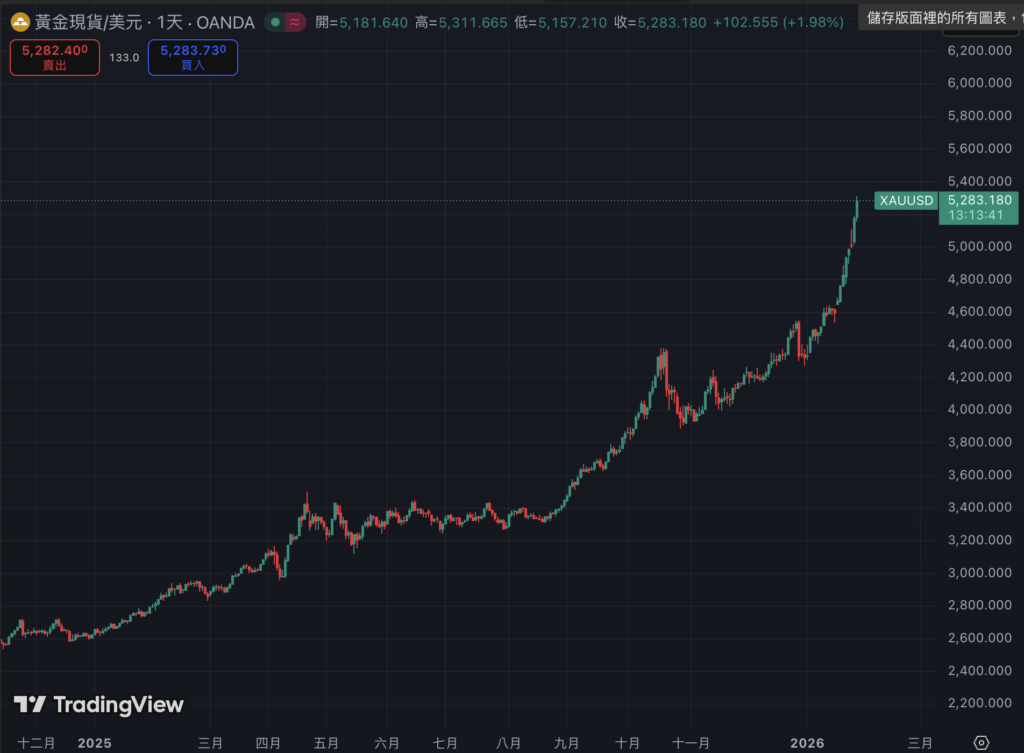
Geopolitical safe-haven demand, declining confidence in the US dollar, and strong investor buying have made gold quite strong recently, even breaking through $5,300 earlier today (28th) to set a new historical high. Against this backdrop, Yasuyuki Fukushima, a researcher at IHI Heavy Industries in Japan, has put forward an innovative research project: the challenge of extracting gold from seawater!
Valuation Reconstruction from Earth's Bottom to the Seabed?
We know that gold is difficult to mine and its reserves in the earth's crust are scarce. Scientists agree that the recoverable reserves are only about 50,000 tons, while humans have only mined about 230,000 tons over thousands of years. This is one of the physical reasons behind the continued surge in gold prices.
But IHI is challenging this logic. Yasuyuki Fukushima's team has developed a technology called "bio-sorption." Simply put, it uses the chemical properties of specific algae to capture gold chloride ions in seawater and then reduce them back to their metallic state. This is much cleaner than traditional chemical displacement, avoiding the use of highly toxic cyanides.
But there's a huge "but": the physical reality is harsh. Data analysis shows that the concentration of gold in seawater is extremely low, only about 0.03 ppt (parts per trillion). What does that mean?
Imagine you're trying to precisely filter a single grain of salt from an entire standard Olympic swimming pool. Even if the price of gold soars to $5,300, you'd have to process tens of millions of tons of seawater to get just a few grams of gold; the energy and equipment costs alone could bankrupt you.
Retreating from the Ocean to Hot Springs: A Clever Business Compromise
The good news is, IHI isn't crazy. They understand this perfectly well, so they don't plan to drain the Pacific Ocean tomorrow. Their strategy has shifted to "concentration," targeting hot spring water and deep mine wastewater within Japan.
These areas have gold concentrations several orders of magnitude higher than seawater, and are already an environmental burden that needs to be addressed. The real commercial appeal of this technology lies in turning "mining" into "waste resource recovery."
This is somewhat like the eve of the shale oil revolution. As long as the technology proves viable in low-cost scenarios, future marginal costs will plummet like a slide.
Should investors care?
As for whether you need to worry about a potential plunge in gold prices?
In fact, gold refining from seawater is not a new idea. About 100 years ago, Haber, the German chemist and Nobel laureate in chemistry, attempted to raise funds for postwar Germany's reparations, but ultimately abandoned the project due to excessive costs. Currently, there is no readily available technology that can make this "seawater gold refining" outperform traditional mining in terms of return on investment.
However, this experiment reminds us that in this era of exponential technological explosion, no asset's moat is absolutely insurmountable, not even gold or Bitcoin.





