Original title: USDT Q4 2025 Market Report
Original source: Philip Gradwell, Vice President of Economics at Tether
Original translation by: Saoirse, Foresight News
USDT hit several new highs in the fourth quarter of 2025, as follows:
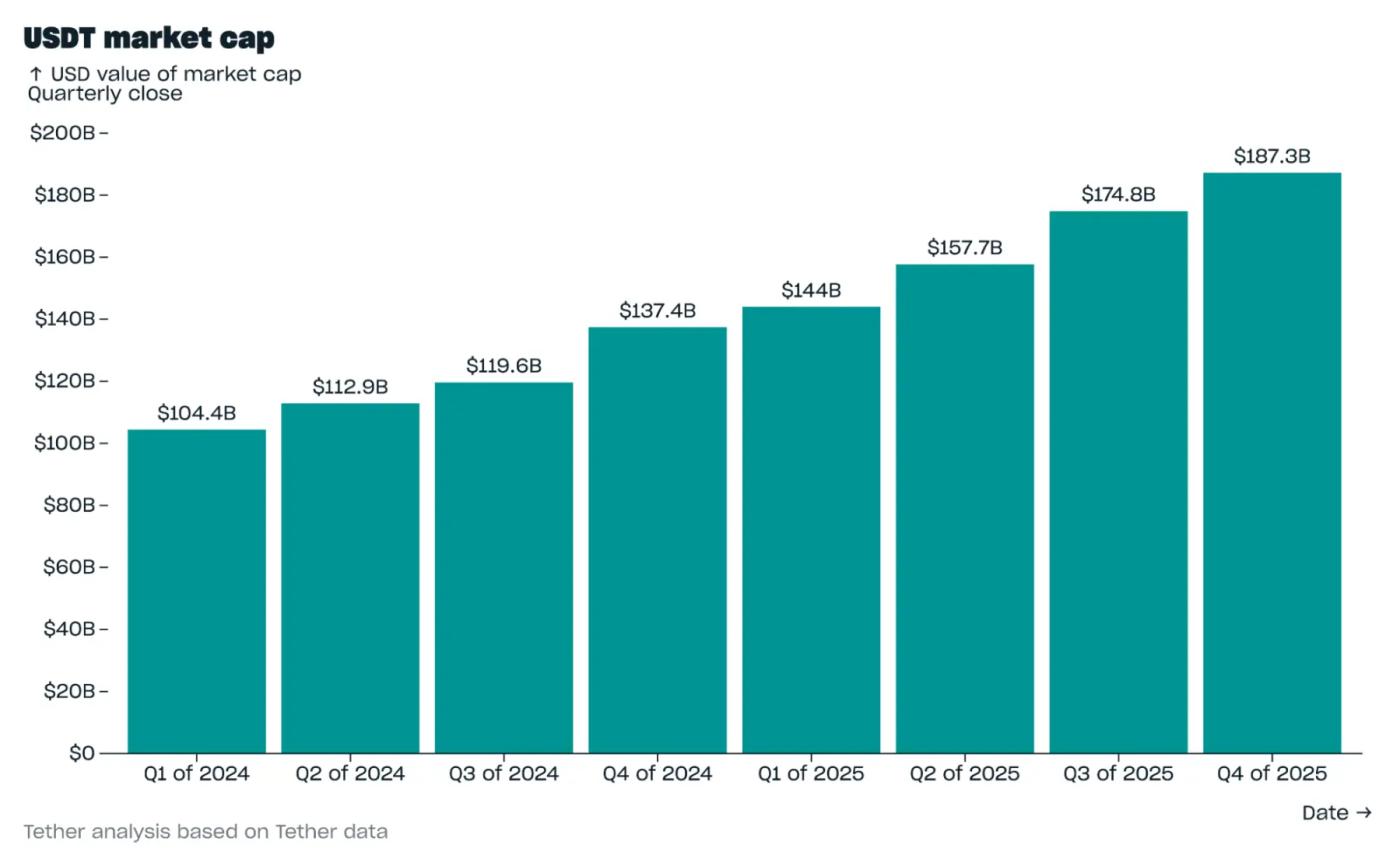
Its market capitalization reached $187.3 billion;
• Achieved over 30 million new users for the eighth consecutive quarter;
• The number of on-chain wallets holding USDT saw its largest quarterly increase;
• The number of monthly active on-chain users has reached an all-time high;
• Both the number and value of on-chain transactions reached record highs.
Meanwhile, the cascading liquidations of cryptocurrencies that occurred on October 10, 2025, caused the stablecoin ecosystem to grow at a slower pace than before. Between October 10, 2025 and February 1, 2026, the total market capitalization of cryptocurrencies fell by more than one-third, while USDT's market capitalization grew by 3.5% during the same period; in contrast, the market capitalization of the second and third largest stablecoins fell by 2.6% and 57%, respectively.
USDT's continued growth relies not only on the cryptocurrency market but also on various applications outside of it. Data clearly shows that users tend to use USDT as a stablecoin that can both store wealth and facilitate transactions.
These conclusions are primarily based on Tether's analysis of blockchain data (also known as on-chain data). The on-chain data for 75 stablecoins across 15 blockchains all originated from Chainalysis and Artemis.
Market capitalization
In the fourth quarter of 2025, USDT's market capitalization increased by $12.4 billion, reaching $187.3 billion. The month-over-month growth rate in October was 4.9%, but the growth rate slowed after the cryptocurrency liquidation wave on October 10th.
Reserves
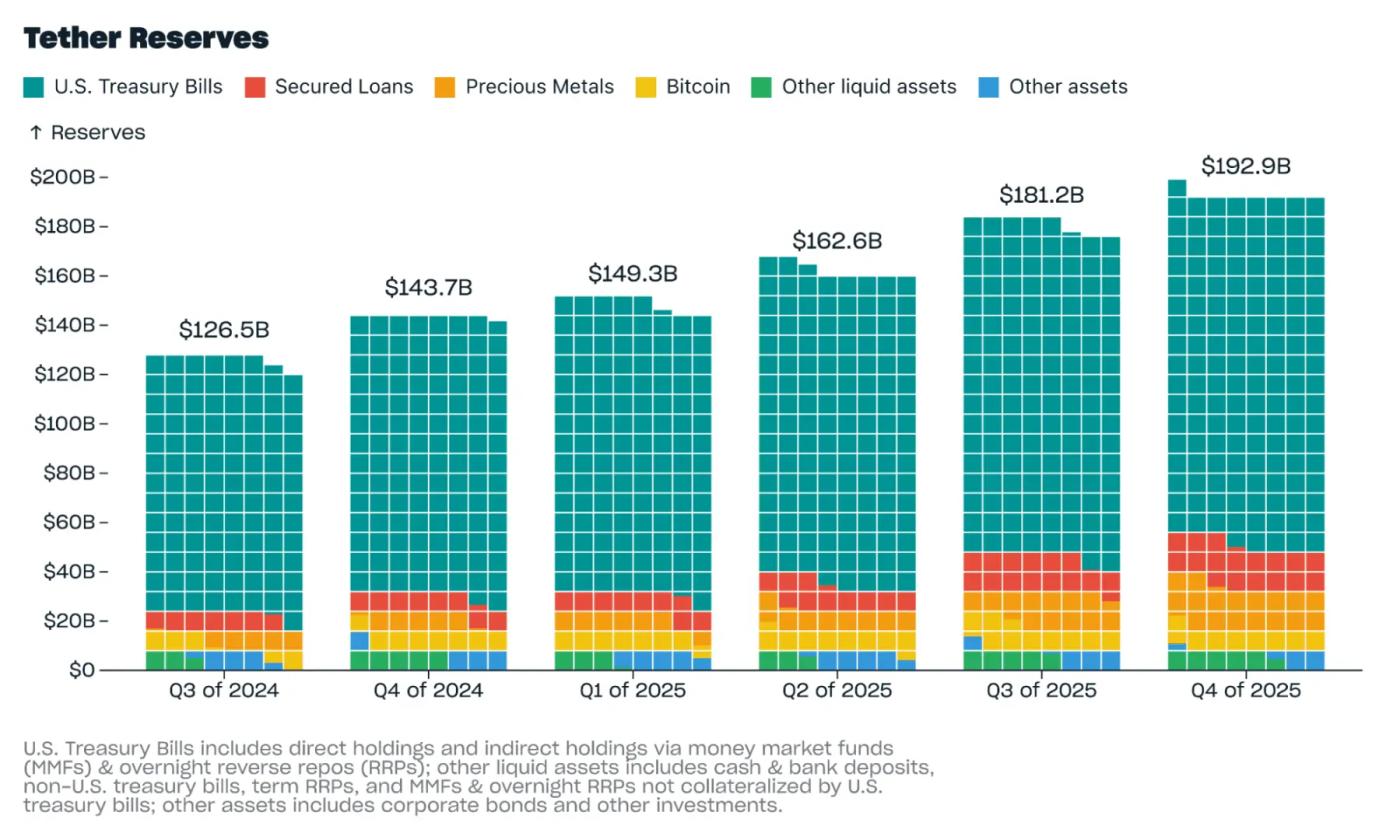
In the fourth quarter of 2025, Tether's total reserves increased by $11.7 billion to $192.9 billion, and its net assets (assets exceeding liabilities) were $6.3 billion. The total reserves included 96,184 bitcoins (an increase of 9,850 in the fourth quarter) and 127.5 metric tons of gold (an increase of 21.9 metric tons in the fourth quarter).
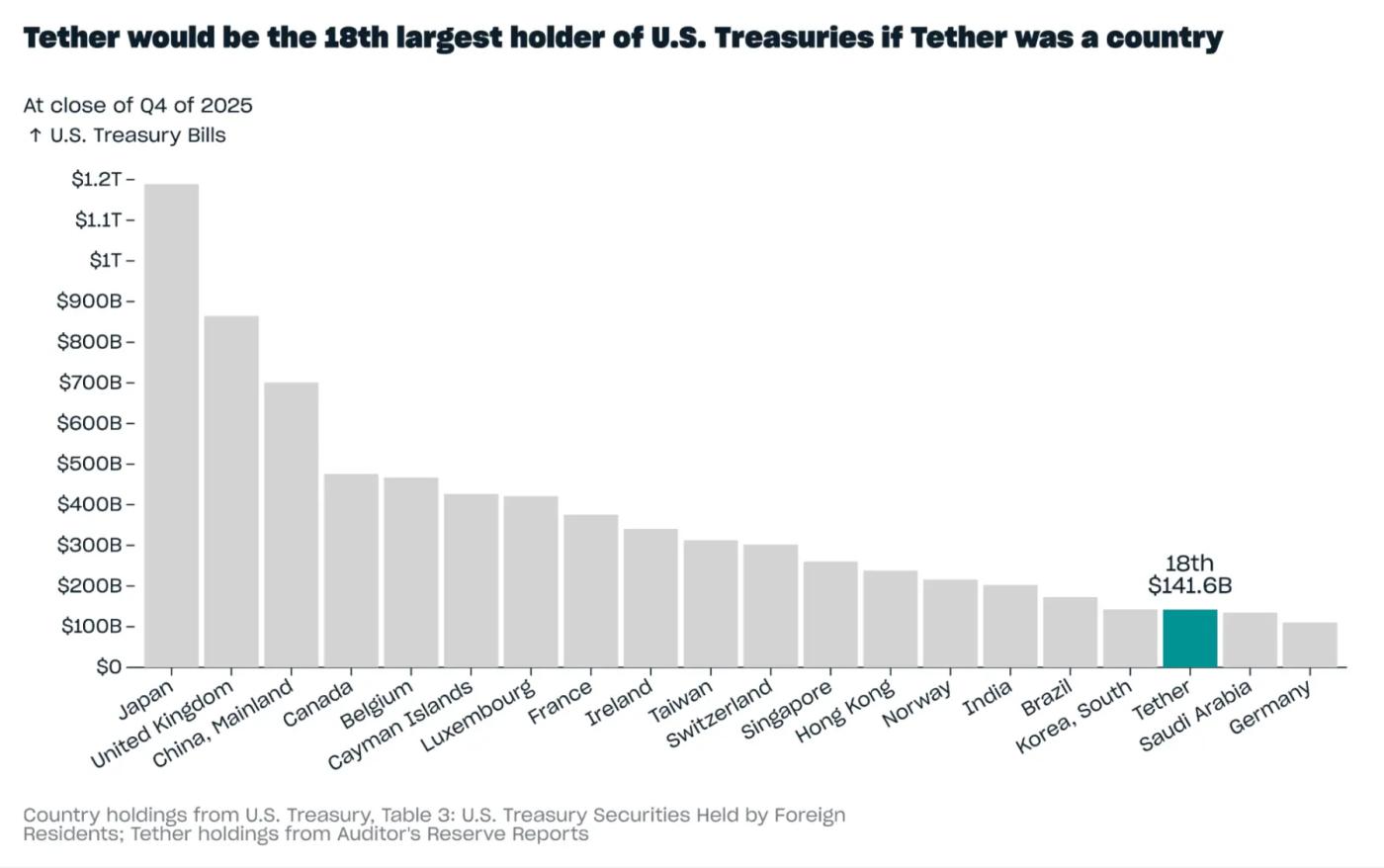
In the fourth quarter, Tether's total holdings of U.S. Treasury bonds increased by $6.5 billion, reaching $141.6 billion. If Tether were considered a "country," its holdings of U.S. Treasury bonds would rank 18th globally, surpassing Saudi Arabia and Germany.
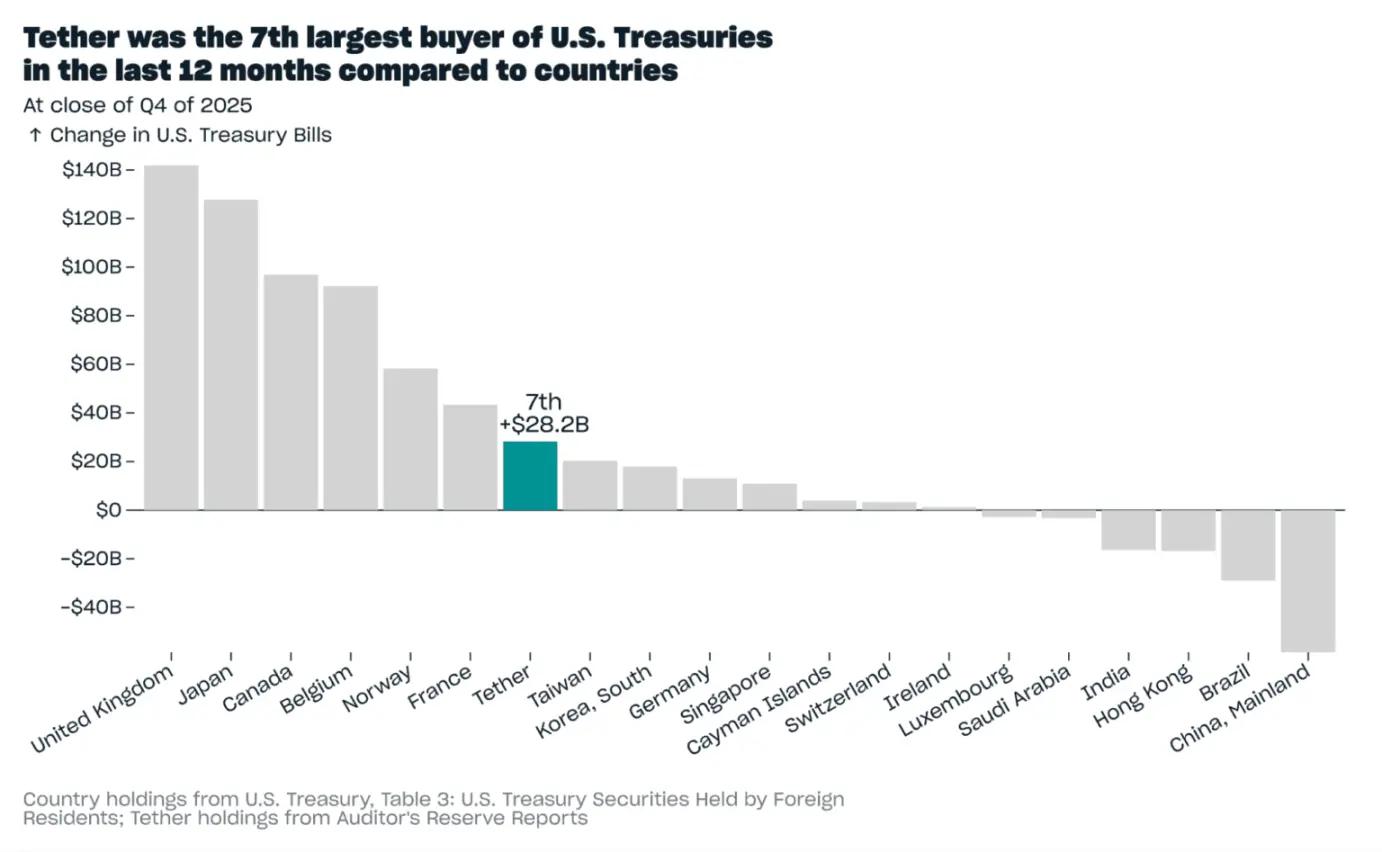
In 2025, Tether increased its holdings of U.S. Treasury bonds by $28.2 billion. Over the past 12 months, compared to other countries, Tether has become the seventh largest buyer of U.S. Treasury bonds, exceeding the purchases by Taiwan and South Korea.
Total number of users
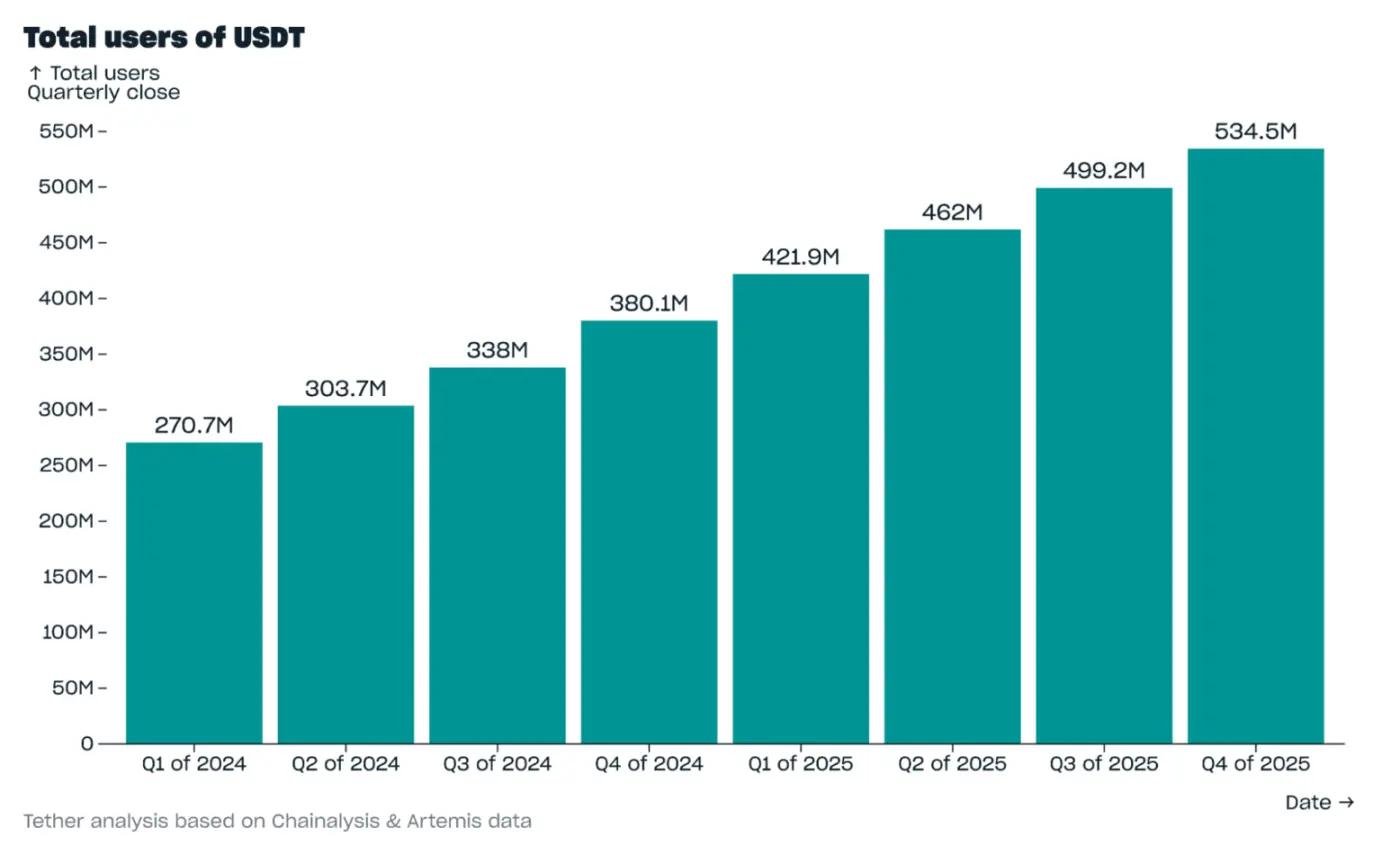
In the fourth quarter of 2025, the estimated total number of USDT users increased by 35.2 million, reaching 534.5 million. This marks the eighth consecutive quarter that the stablecoin has achieved user growth exceeding 30 million. The user statistics here include two parts: first, on-chain wallet users (i.e., users who have received USDT and held it for at least 24 hours); and second, the estimated number of users receiving USDT on centralized service platforms (such as cryptocurrency exchanges).
On-chain holders
In the fourth quarter of 2025, the number of on-chain wallet users holding USDT increased by 14.7 million, reaching a total of 139.1 million, setting a new record for single-quarter growth. Wallets holding USDT accounted for 70.7% of all wallets holding stablecoins. In addition to on-chain wallet users, it is estimated that over 100 million users also hold USDT on centralized service platforms such as exchanges.
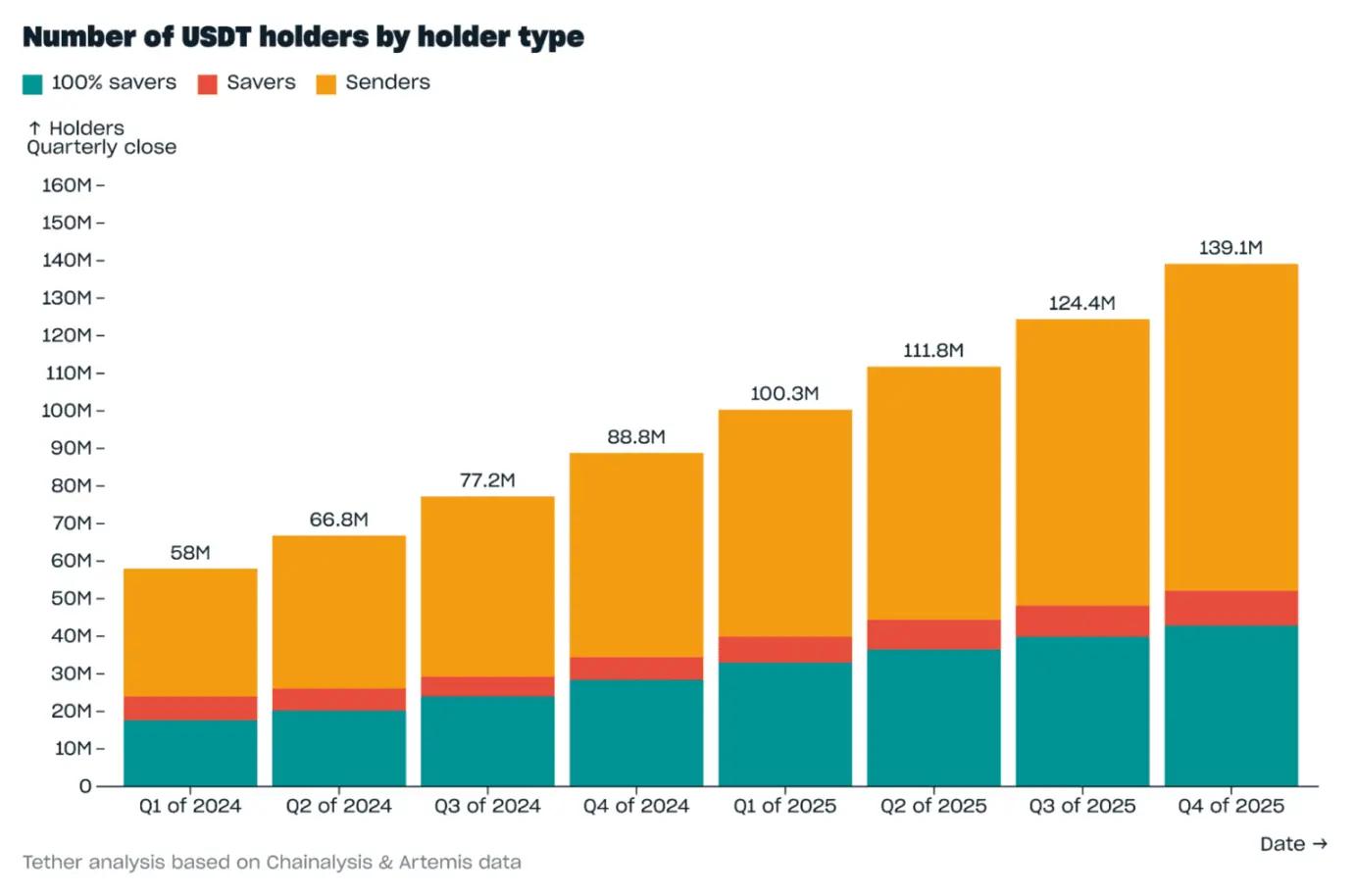
The structure of USDT on-chain holders remains relatively stable, with the following specific distribution:
• "Fully savings" holders (wallet users who retain all USDT after receiving it) account for 30.8%;
• "Savings-type" holders (wallet users whose average retention rate after receiving USDT is less than 100% but more than 2/3) account for 6.7%;
• "Transfer-type" holders (wallet users whose average retention rate after receiving USDT is less than 2/3) account for 62.6%.
Compared to all other stablecoins, USDT has a higher percentage of "savings-oriented" and "fully savings-oriented" holders (USDT at 37.5%, compared to 30% for all other stablecoins). Among all stablecoin savings wallets, 75.1% choose to hold USDT, indicating that USDT remains the preferred wealth storage stablecoin for users.
On-chain active users
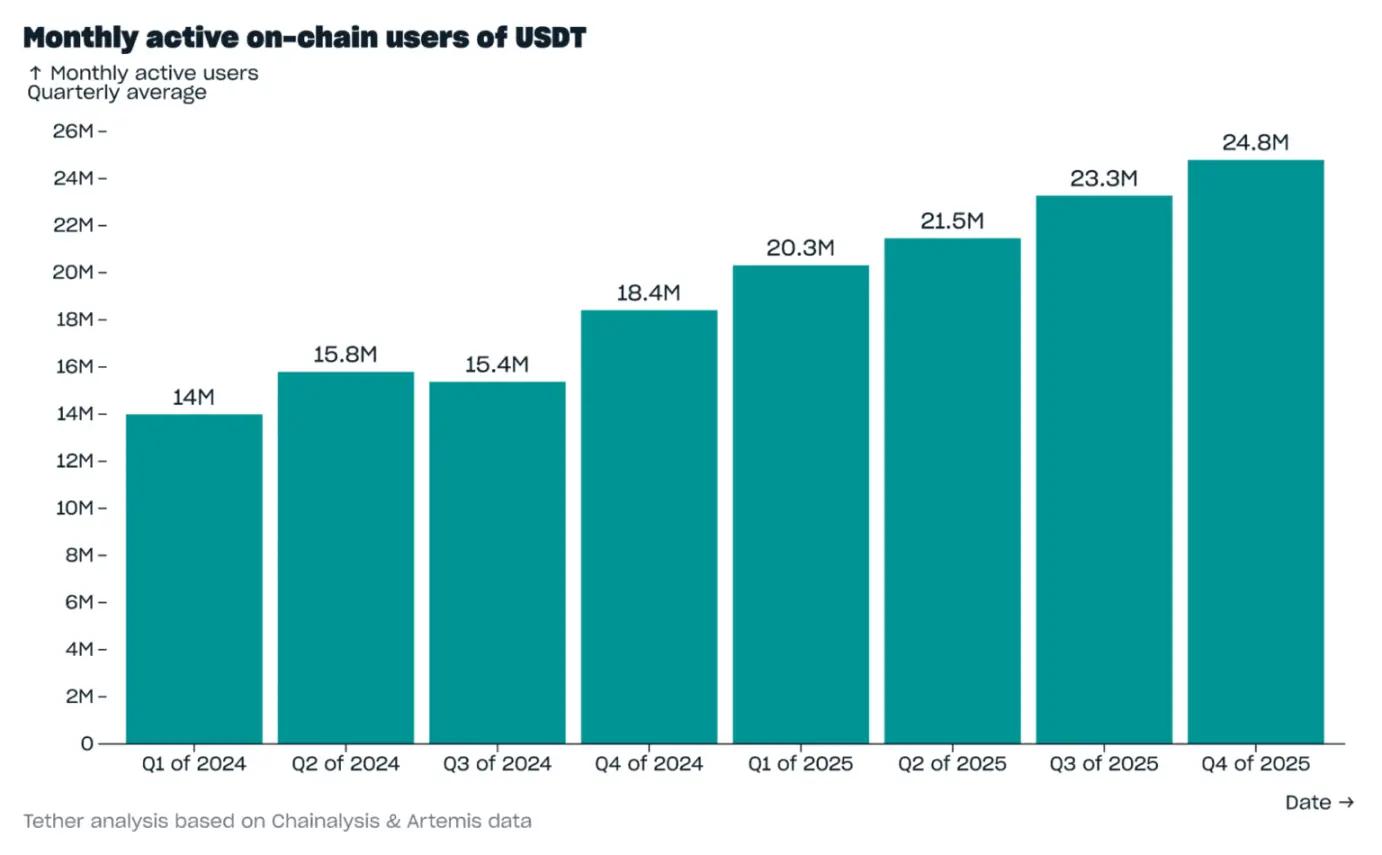
In the fourth quarter of 2025, USDT's monthly active on-chain users (wallet users who received USDT at least once within a 30-day rolling period) reached an average of 24.8 million, a record high, indicating that USDT's user activity continued to increase. This number accounted for 68.4% of the total monthly active users of all stablecoins.
Distribution of holdings by different types of users
As of the end of Q4 2025, 36% of USDT holdings were concentrated on centralized exchanges (CEXs), an increase of 2.8 percentage points from the end of Q3. This change was partly due to a decrease in USDT holdings on decentralized exchanges (DEXs) and decentralized finance (DeFi) platforms following the cryptocurrency liquidation wave on October 10: In Q4, USDT holdings on DEXs and DeFi platforms decreased by $3 billion (a 2 percentage point drop) to $7.1 billion, representing 3.8% of total USDT holdings.
The second largest group of holders was savings-oriented users, accounting for 33%, with "pure savings" users accounting for 17.4% and other "savings" users accounting for 15.6%. In the fourth quarter, savings-oriented users increased their USDT holdings by $2.9 billion, reaching a total of $62.1 billion by the end of the quarter. As mentioned earlier, USDT not only attracted the most savings-oriented users, but also held the highest value of US dollars: USDT accounted for 59.9% of the total value stored in all stablecoins; if wallets with holdings exceeding $10 million (most of which are cold wallets on trading platforms) are excluded, USDT's share rises to a staggering 77.3%.
"Transfer-type" users held the third largest share of USDT, at 26.5% by the end of the fourth quarter. This share remained relatively stable between the third and fourth quarters, and "transfer-type" users' holdings increased by $2.2 billion, reflecting the continued improvement in USDT liquidity in trading applications.
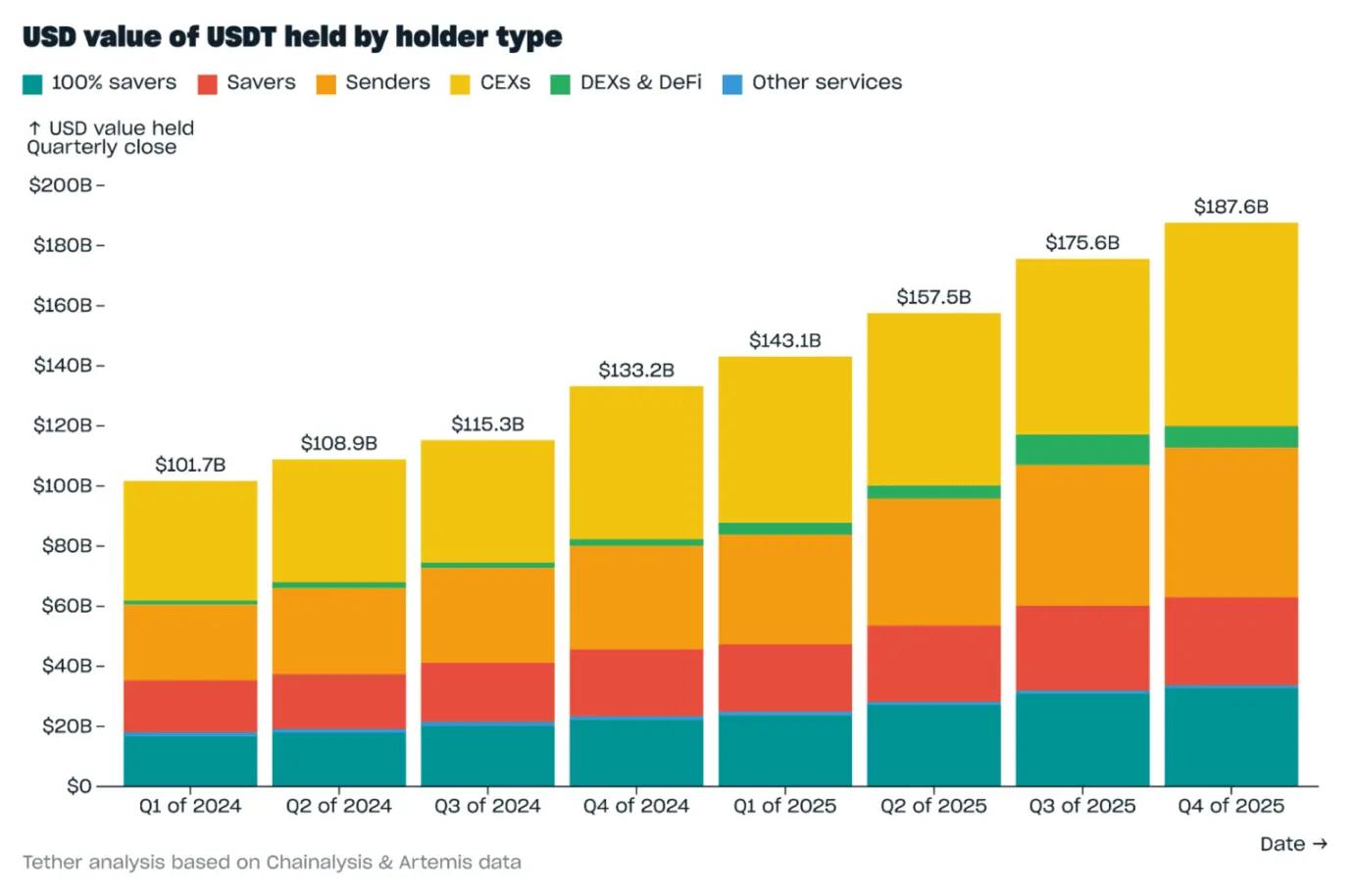
It should be noted that the total holdings counted here are slightly higher than the market capitalization of USDT. This is because the total holdings include USDT that has not yet been issued in Tether's vault, while the market capitalization only counts USDT that is in net circulation.
On-chain transfer of USD value
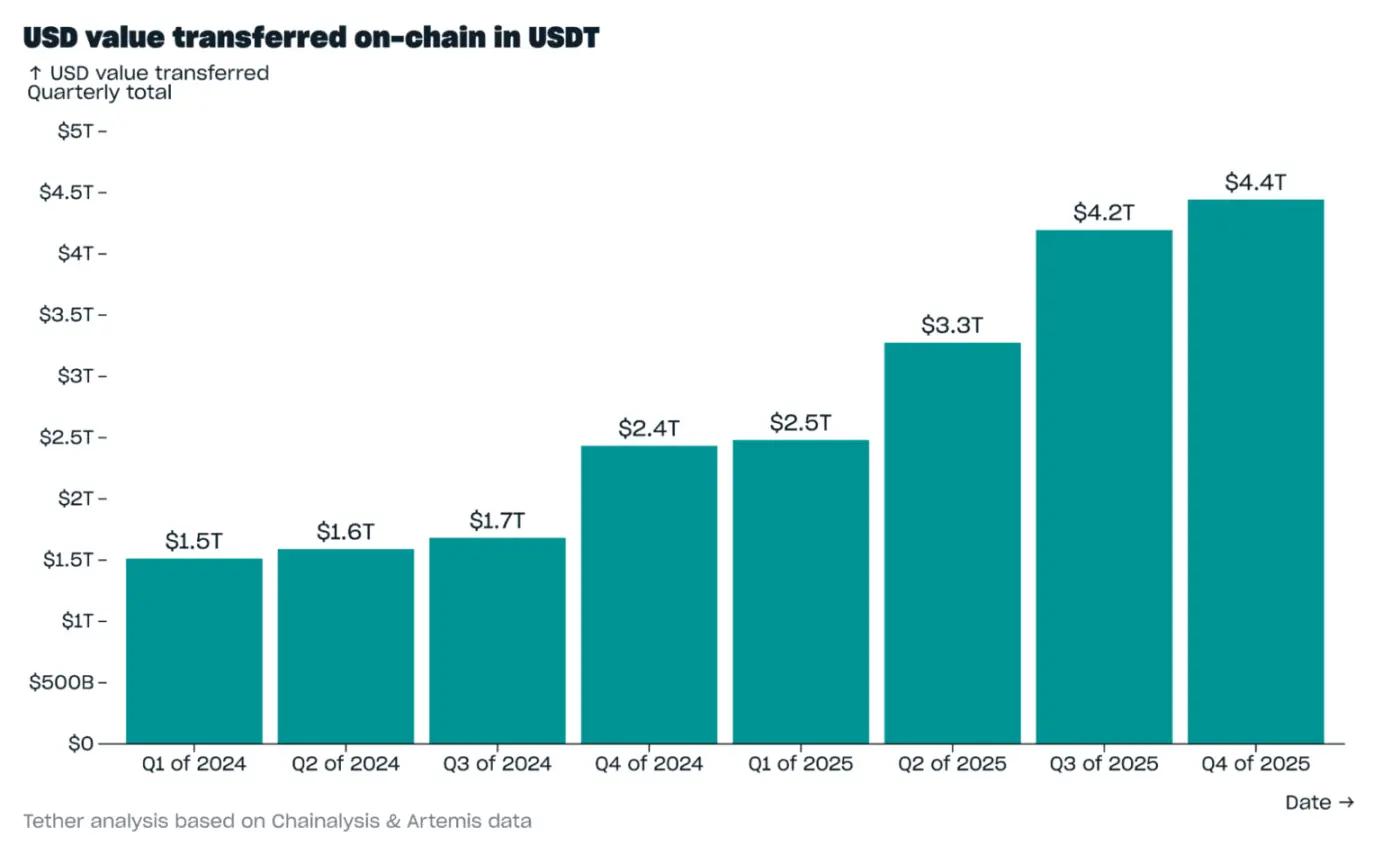
In the fourth quarter of 2025, the quarterly on-chain USD value of USDT increased by $248.6 billion, reaching $4.4 trillion, a record high. Of this total quarterly transaction volume of $4.4 trillion, $2.8 trillion (63.6%) consisted of transactions involving only USDT, while $1.6 trillion (36.4%) consisted of transactions involving multiple assets (the latter typically occur in DeFi exchange scenarios).
In single-asset transfers involving stablecoins, USDT accounts for 65.9% of the value; in multi-asset transfers involving stablecoins, USDT accounts for 34.6% of the value. This data indicates that USDT remains the preferred stablecoin for value transfer among users, while other stablecoins are more often used for value exchange scenarios, and the exchange object is often USDT.
Number of on-chain transactions
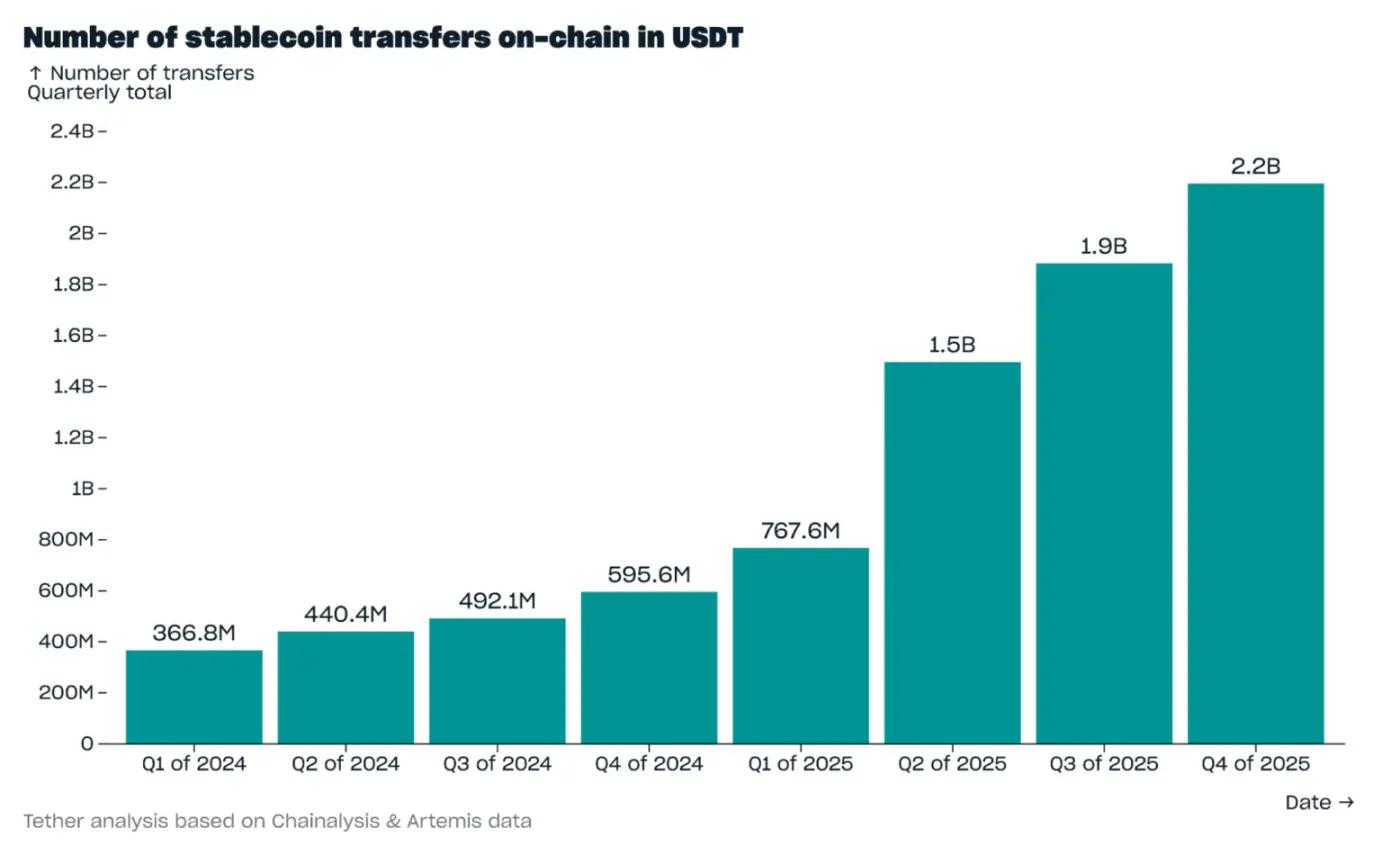
In the fourth quarter of 2025, the number of USDT on-chain transactions increased by 313.1 million to reach a record high of 2.2 billion. Of these 2.2 billion total quarterly transactions:
• There were 1.94 billion transactions with a single transaction amount of less than $1,000, accounting for 88.2%;
• There were 256 million transactions with individual amounts between $1,000 and $100,000, accounting for 11.6%;
• There were 4.6 million transactions with a single amount exceeding $100,000, accounting for 0.2%.
Circulation speed
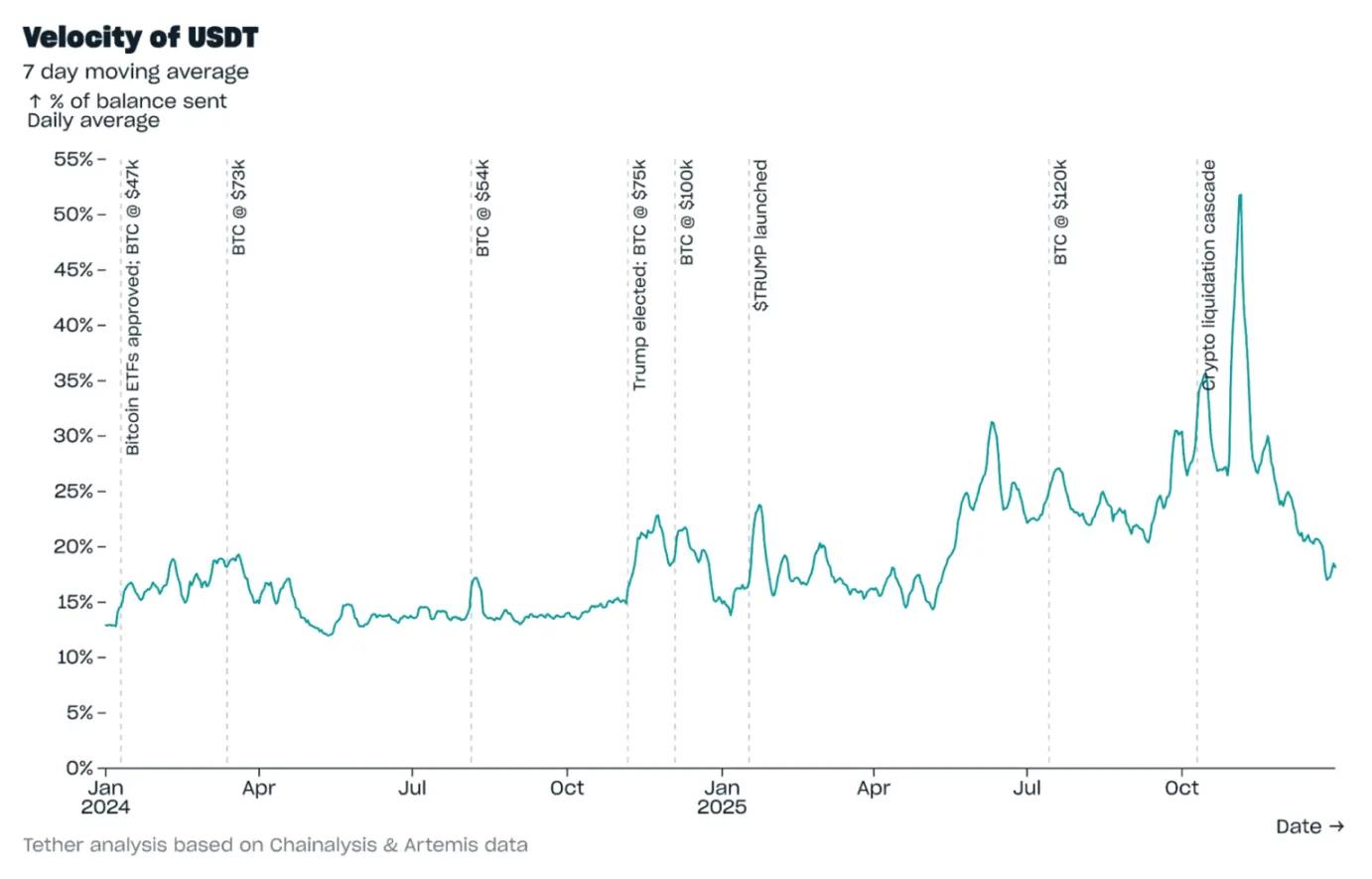
As of the end of Q4 2025, USDT's velocity of flow (the percentage of daily transfers to total holdings) was 18.2% based on a 7-day moving average. This figure is lower than the peak of 51.8% on November 5 (driven by a surge in DeFi activity) and is similar to levels seen before Q2 2025 (when Bitcoin prices were similar to those in the current quarter).
In the fourth quarter, USDT's average velocity of circulation was 28%, significantly lower than the 151% velocity of the second-largest stablecoin by market capitalization. USDT's relatively low velocity of circulation indicates stronger user loyalty, greater stability, and, as discussed later, more diverse application scenarios.
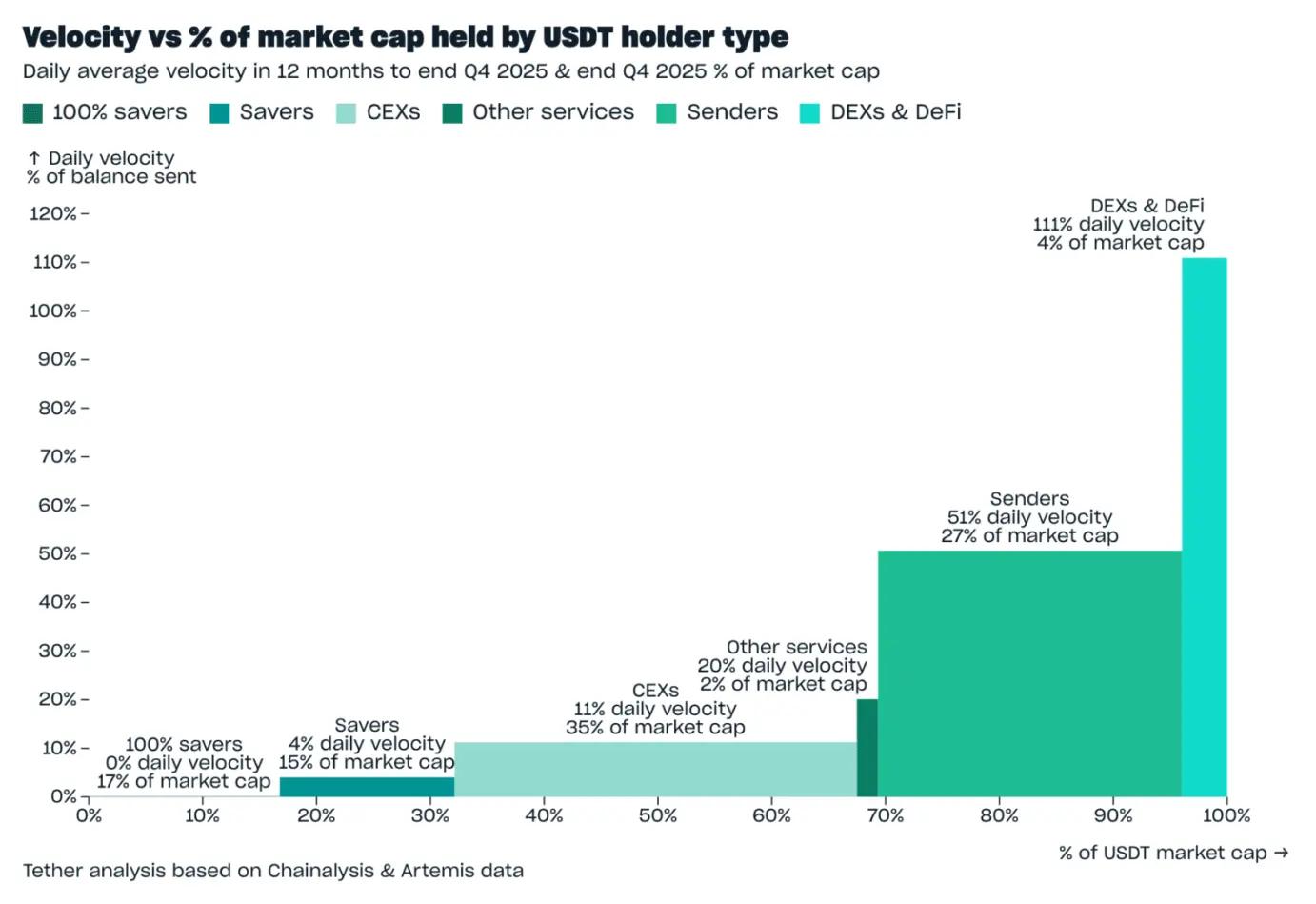
The velocity of USDT will naturally vary depending on the application scenario: users who hold USDT for savings purposes will have a lower velocity of circulation (because users usually choose to hold rather than transfer). The velocity of circulation for "purely savings" users will naturally be 0, while the average daily velocity of circulation for "savings" users in 2025 will be 4%.
Centralized exchanges also have lower on-chain velocity, with an average daily velocity of 11% in 2025. This is because users hold USDT on exchanges for both savings and trading purposes—but as will be discussed in the next section, the trading volume on exchanges is recorded in a centralized order book, not on the blockchain. Therefore, the amount of USDT transferred out of centralized exchanges via the blockchain is relatively small compared to the amount of USDT held on the exchanges.
Applications where USDT has a high velocity of circulation include:
• "Transfer-type" wallets: The average daily circulation velocity in 2025 was 51%. These wallets transfer USDT for various purposes, including payments, remittances, and transferring funds between different trading platforms.
• DEX and DeFi platforms: The average daily velocity of circulation in 2025 was 111%. The velocity of circulation in these scenarios is usually extremely high because DEX transactions are recorded on the blockchain and users may make multiple transactions a day, which eventually leads to a velocity of circulation of more than 100%.
Of USDT's market capitalization, 67% is distributed in low-velocity scenarios and 33% in high-velocity scenarios. This distribution ensures stability through low-velocity scenarios and liquidity through high-velocity scenarios.
spot market
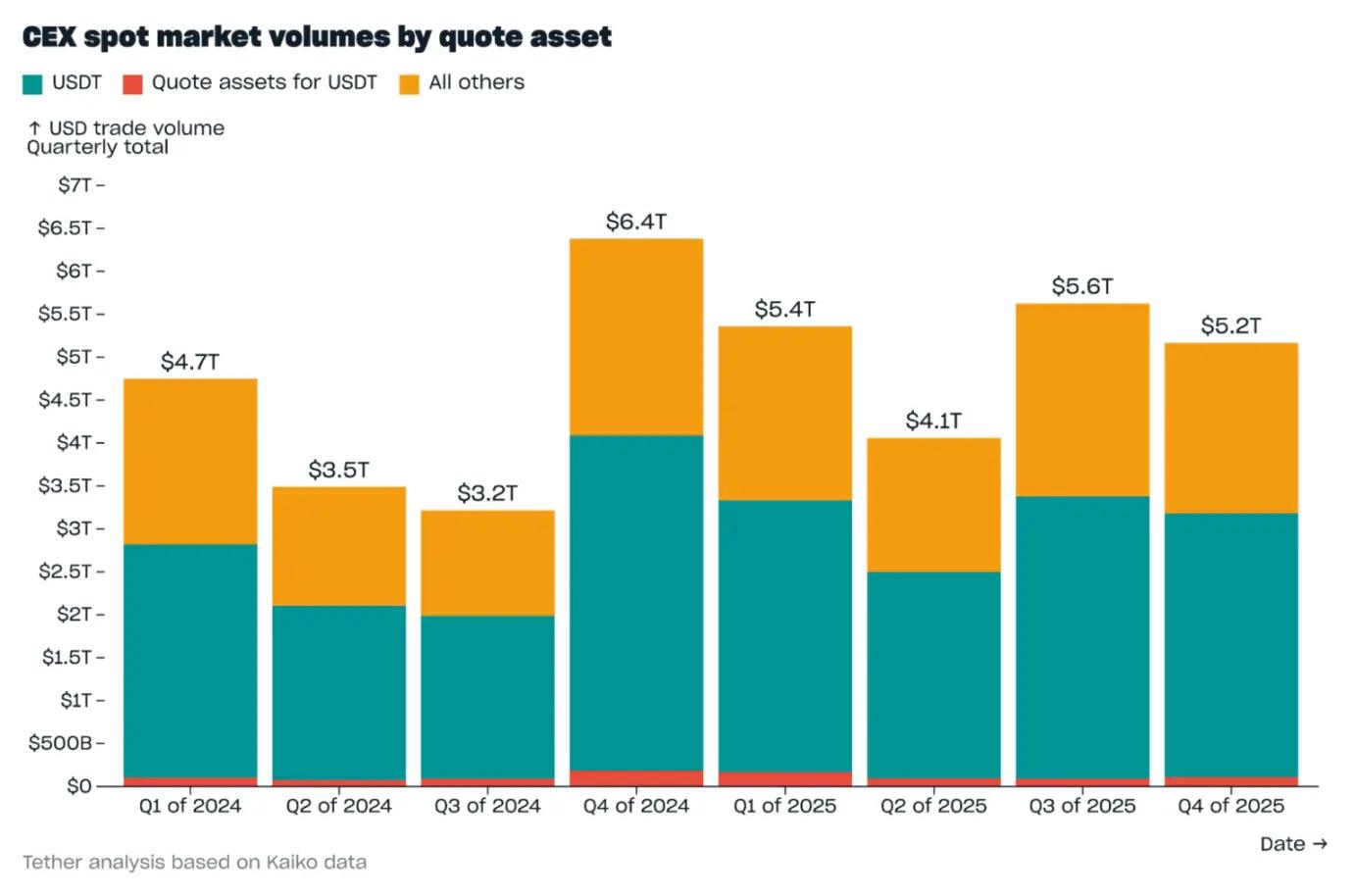
In the fourth quarter of 2025, the spot trading volume of USDT on centralized exchanges reached $3.2 trillion, with 96.5% of the trading volume using USDT as the quoted asset and the remainder using other assets as the quoted asset for USDT. Affected by the cryptocurrency liquidation wave on October 10th, the trading volume decreased by 5.9% compared to the third quarter. However, because the trading volume of all other assets decreased by 11.5% compared to the third quarter, USDT's share of the total spot market trading volume actually increased by 1.5 percentage points, reaching 61.5%.
In the fourth quarter, USDT spot transactions totaled 14.1 billion, accounting for 80% of all spot transactions in the quarter.
in conclusion
In the fourth quarter of 2025, USDT set several new all-time highs, although growth slowed after the cryptocurrency liquidation wave on October 10th. However, data suggests that the cryptocurrency market was not the sole driver of USDT's growth.
Compared to other stablecoins, users have a significantly higher preference for saving USDT (USDT accounts for 75% of all stablecoin savings wallets; USDT accounts for 77% of the savings value of wallets with holdings of less than $10 million), which provides USDT with a stable source of demand with low velocity of circulation.
In high-velocity transaction medium applications, USDT also holds a leading position: in single-asset transfers involving stablecoins, USDT accounts for 65.9% of the value; while in multi-asset transfers involving stablecoins, USDT accounts for 34.6%. This phenomenon indicates that USDT remains the preferred stablecoin for value transfer, while other stablecoins are more often used for value exchange (and the exchange object is often USDT). These high-velocity application scenarios provide USDT with ample liquidity, ensuring its widespread availability and acceptance.