#BTC Falls Below $40,000 as Grayscale Unwind Continues#
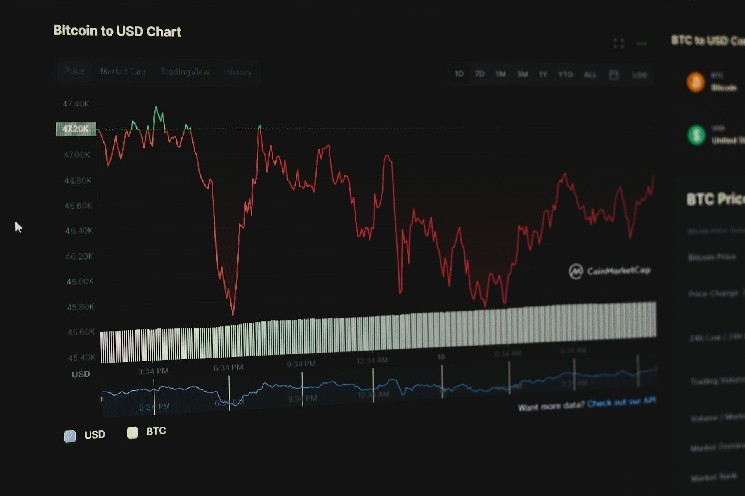
On January 23, the crypto market continued its downward trend. BTC fell again in the early morning, falling below $40,000. It has fallen by more than $10,000 from the high of $49,000 when the ETF was listed for trading.
Latest
FeaturedTimeline
avatar
Crypto Market Aggregator|币圈新闻汇总
[2/3] 3. Bloomberg ETF Analyst: Spot ETFs have not "significantly reduced volatility," and the selling pressure from OG's high-level profit-taking is underestimated. Eric Balchunas stated that the market underestimated the amplifying effect of early holders' concentrated selling at high levels; Bitcoin's approximately 450% increase over two years also signifies a high volatility risk. (PANews | TechFlow | Odaily) 4. Liquidity pressure: Crypto funds saw net outflows of approximately $1.5 billion this week, the largest since November. According to data from the Kobeissi Letter, funds have been withdrawn for the second consecutive week, marking the fifth net outflow in the past seven weeks. (Kobeissi Letter) 5. On-chain/Sentiment Indicators: BTC social sentiment hit a near 4-year low; price near the 200-week moving average of approximately $58,000. Santiment data shows a significant weakening of sentiment; from a technical perspective, the area around the 200-week moving average has historically served as a reference point for bear market bottoms/accumulation zones. (BlockBeats | PANews) ━━ Project Updates ━━ 1. Bitfarms plans to relocate to the United States and change its name to Keel Infrastructure. The company plans to become a dual-listed company under the name "KEEL" and will move its registered office from Canada to the United States and change its name. A special shareholders' meeting is scheduled to be held on March 20, 2026, pending approval from shareholders, the stock exchange and the court. After completion, it plans to trade on Nasdaq and the Toronto Stock Exchange under the name "KEEL". (TechFlow | PANews) 2. ENS: ENS v2 will only be deployed on Ethereum L1, and Namechain L2 development will be discontinued. The ENS COO stated that discontinuing Namechain L2 will not affect v2 functionality and roadmap; more chains will still be supported in the future, and it may be possible to allow .eth registration on any EVM chain. (PANews) 3. ERC-8004 Progress: Avalanche C-Chain supports the standard; Virtuals claims that ACP "graduation agents" will automatically register and be scored on the blockchain. Avalanche announced that C-Chain supports ERC-8004 for AI agents with on-chain identity and transferable reputation; Virtuals Protocol stated that its AI agents that have graduated on ACP will automatically register in ERC-8004, and new evaluations and scores will be automatically added to the chain and bound to the identity. (BlockBeats | Foresight News | BlockBeats | Foresight News) 4. EY: Wallets will become a key entry point for next-generation financial services; banks "must have wallets." EY believes that wallets are evolving from crypto tools into gateways to financial services, and the core position of traditional bank accounts may be weakened by "smart wallets". (CoinDesk | BlockBeats | PANews) ━━ Other ━━ 1. Fund flows related to the “BTC OG/1011 whale” have attracted attention: On-chain monitoring shows signs of large deposits to Binance and withdrawals of stablecoins. It is reported that this cluster address deposited about 5,000 BTC to Binance within a few hours, then withdrew about 55 million USDC, and then deposited about 4,200 BTC. Other monitoring shows that it transferred about 20,000 ETH and 69.08 million USDT in about 12 hours, and there was on-chain behavior of “withdrawing 55,000 ETH from Aave and then partially depositing it to the exchange”. The market interprets this as suspected reduction of holdings/exchange for stablecoins. (Foresight News | BlockBeats | PANews | TechFlow | BlockBeats) 2. Aave Funding: The ETH borrowing APR surged from 2.13% to 7.35% at one point, before falling back to approximately 5.33%. Data shows that the ETH supply on Aave is approximately 3.09 million (accounting for about 81% of the hard cap), of which about 2.92 million have been lent out, with a borrowing utilization rate of about 81%. Interest rate fluctuations reflect the tightening of short-term liquidity. (Foresight News | PANews | Odaily) 3. Increased volatility in derivatives: Approximately $605 million in positions were liquidated across the network in 24 hours, with short positions dominating. Statistics show that long positions totaled approximately $228 million and short positions totaled approximately $377 million. The largest single liquidation occurred on Hyperliquid's BTC-USD pair, amounting to approximately $21.3 million. (TechFlow) 4. Prediction Markets and Sports Compliance Controversy: Kalshi claims Giannis Antetokounmpo's stake is less than 1%, NBA rules remain unclear. Kalshi confirmed that Giannis Antetokounmpo's shareholding is less than 1% (the specific amount was not disclosed); media reports indicate that the NBA has not yet provided clear guidelines for on-chain prediction/betting platforms, with related betting volume estimated at approximately $23.31 million.
ENS
1.7%
avatar
Crypto Market Aggregator|币圈新闻汇总
[1/3] [Crypto/TradFi Merge Update] 2026-02-08 00:00 (Beijing Time) ━━ Important News ━━ 1. China issues regulatory guidelines for “Responsible Vacancies (RWAs) issued overseas by domestic assets”: The guidelines clarify the division of regulatory responsibilities based on the principle of “same business, same risk, same rules.” This means that RWAs issued overseas by domestic assets will be subject to the following regulatory framework: Foreign debt RWAs will be regulated by the National Development and Reform Commission (NDRC); equity RWAs and asset securitization RWAs will be regulated by the China Securities Regulatory Commission (CSRC); RWAs involving the repatriation of funds raised overseas will be regulated by the State Administration of Foreign Exchange (SAFE); and other forms will be regulated by the CSRC in conjunction with relevant departments according to their respective responsibilities. (BlockBeats | PANews(Caixin) | Odaily) 2. Vietnam plans to tax the transfer/trading of crypto assets: 0.1% of the transaction amount for individuals, and 20% for institutions or corporations; crypto transactions are exempt from VAT. Vietnam's Ministry of Finance has proposed a draft tax law that would subject individuals (regardless of whether they are residents or non-residents) to a 0.1% personal income tax on the transfer of crypto assets through licensed platforms (similar to the securities tax system); related income of institutional investors might be subject to a 20% corporate income tax; and the transfer/trading of crypto assets would be exempt from value-added tax (VAT). The draft law also proposes setting high thresholds for digital asset exchanges, such as a legal capital of 10 trillion Vietnamese dong (approximately US$408 million) and a foreign ownership limit of 49%. (Hanoi Times | BlockBeats | Foresight News | TechFlow) 3. Tether assisted Türkiye in freezing approximately $544 million in crypto assets involved in illicit gambling/money laundering. Tether CEO Paolo Ardoino stated that the freeze was executed at the request of the Istanbul Prosecutor's Office. Disclosed information shows that Tether has assisted law enforcement in over 1,800 cases in 62 countries, freezing approximately $3.4 billion in USDT. Elliptic data indicates that by the end of 2025, Tether and Circle have blacklisted approximately 5,700 wallets, freezing a total of approximately $2.5 billion (about two-thirds of which is USDT). (PANews | BlockBeats | Foresight News | Cointelegraph) 4. Strategy (formerly MicroStrategy) reported a huge loss in its Q4 earnings report: unrealized losses of approximately $17.4 billion and a net loss of $12.4 billion. The company stated that it holds approximately $2.25 billion in cash reserves to cover interest and dividends and that there is currently no pressure to sell liquidity. However, Michael Saylor stated in a conference call that "selling Bitcoin is also an option," prompting the market to reassess potential selling pressure. (PANews | Odaily) 5. Bithumb "accidental Bitcoin sending" incident: Customers are expected to lose approximately 1 billion Korean won. The company has launched a compensation and rectification program and established a 100 billion Korean won guarantee fund. Bithumb apologized and stated that it would compensate users who panic-sold at low prices during a specific period with "the transaction price plus an additional 10%", and would also provide compensation to users who visited the site during the incident and offer 7 days of zero transaction fees across the entire site. At the same time, it would cooperate with regulatory investigations, upgrade asset verification/multiple payment/anomaly detection and external auditing, and establish a 100 billion won "customer protection fund". (PANews | BlockBeats | Foresight News | TechFlow) 6. Hong Kong Securities and Futures Commission (SFC) Digital Asset Advisory Group Meeting: Discussion on Enhancing Liquidity and Expanding Product and Service Offerings for Licensed Platforms. The SFC and licensed virtual asset trading platforms discussed the “Strengthening the Digital Asset Ecosystem Plan,” focusing on enhancing liquidity, promoting the expansion of product and service offerings, and emphasizing the balance between innovation and investor protection. (BlockBeats | Foresight News | TechFlow) 7. Market rumors of "institutional collapse" are gaining traction: Winternute CEO expressed strong skepticism, stating that the current market is more orderly and the risks are controllable. Historically, risk signals from 3AC, FTX, and other institutions have often been exposed quickly through industry channels, but no similar signs have been observed so far. Most of the related rumors come from anonymous accounts with insufficient credibility. (PANews | Odaily) Market Analysis 1. Next week's macroeconomic "high-density risk window": a concentration of data and official speeches may amplify cross-asset volatility and transmit it to cryptocurrencies. The US non-farm payrolls, CPI, and retail sales will be released in quick succession, and several Federal Reserve officials will speak out; coupled with geopolitical and policy variables (such as US-Iran negotiations, the Japanese general election, etc.), the risk of volatility spillover increases. (BlockBeats | TechFlow | PANews) 2. 10X Research: Selling pressure may mainly come from the selling and forced liquidation of spot ETFs; a short-term rebound/consolidation is possible, but new lows may still be reached in the summer. CNBC, citing 10X Research, believes that selling pressure this week may come from Bitcoin spot ETF sell-offs, sharp drops triggering forced liquidations, and being dragged down by weaker risk assets; however, further declines this summer cannot be ruled out, with the low point potentially pointing to the $40,000–$50,000 range. (BlockBeats | PANews | Odaily)
ETH
2.78%
avatar
PEPE Playground
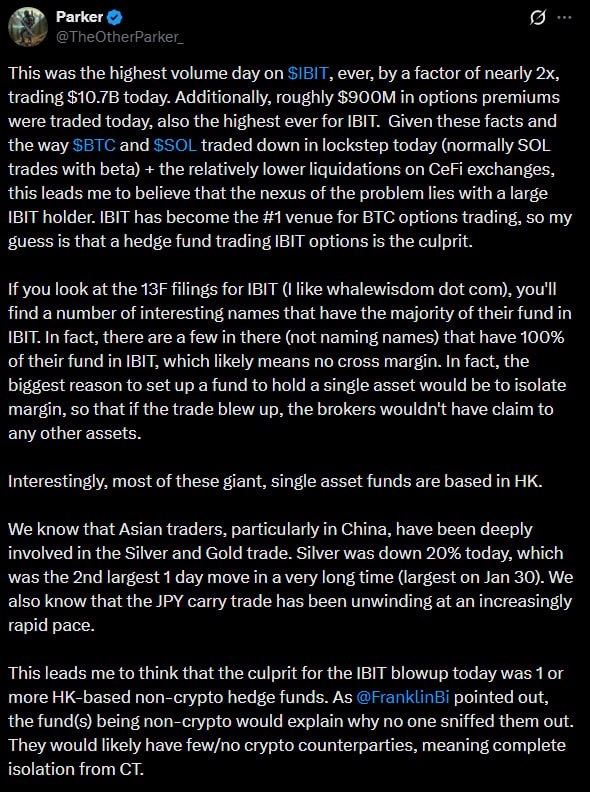
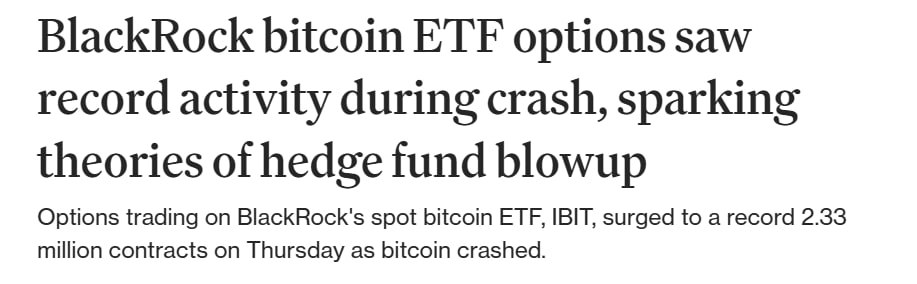
IBIT's Record Trading Volume and Hong Kong-based Fund Liquidations? 1. The typically conservative Nasdaq requested the SEC to lift the contract limit on BTC/ETH ETF options, skipping the usual 30-day grace period and leading to immediate implementation on January 21st. 2. With the 25,000 contract limit removed, IBIT has become a "financial nuclear weapon" capable of generating the most powerful leverage in the global cryptocurrency market. 3. Nasdaq's rapid movement suggests that a certain large fund has already reached its limit, and brokers likely rushed to ease regulations to legally liquidate it. 4. On January 29th, a week after the limit was lifted, Bitcoin plummeted. This suggests the first major position adjustment in the new unlimited leverage environment. 5. During this decline, IBIT reached a record high, recording $10.7 billion in trading volume, double its normal level, and $900 million in options premiums. 6. The fact that Solana, which should normally exhibit higher volatility, plummeted in line with Bitcoin, and that the liquidation on the exchange (CeFi) was small, confirms that the primary culprit in this crisis was a traditional financial fund. 7. The funds with 100% IBIT exposure, as revealed in their 13F filings, are based in Hong Kong, a typical risk isolation structure designed to prevent brokers from accessing other assets in the event of an incident. 8. The fund suspected to be the primary culprit bet on IBIT ultra-high gamma options, but its balance sheet is likely completely destroyed by a combination of negative factors, including a 20% plunge in the silver market. 9. Because this hypothesis was not a crypto-focused fund, it was not detected by information networks such as Crypto Twitter (CT), and was able to secretly increase its leverage within the existing financial system. 10. The conclusion of this hypothesis' liquidation will be revealed in the 13F filing, which will be filed approximately 45 days later, regarding the IBIT exposure of a specific Hong Kong-based fund. The moment your holdings hit "0," it will be officially confirmed. This is a hypothesis for this recent decline. It's interesting and well-written. x.com/TheOtherParker_/status/2...
IBIT
315.1%
avatar
加密大漂亮| C Labs | 招人
This is the most widely accepted analysis post regarding the price drop to 60,000 on November 11, 2024 (20230). The main points are: Hong Kong hedge funds, not traditional financial players specializing in cryptocurrencies, borrowed extremely cheap Japanese yen and used high leverage to buy call options on the BlackRock Bitcoin ETF (IBIT)—a cheap, long-term "lottery" bet on a Bitcoin price surge, with very high leverage. They bet on a rebound after the crash last October, but the rebound didn't materialize; Bitcoin continued to fall. Simultaneously, the cost of borrowing yen increased (arbitrage trading began to collapse), and they may have also heavily invested in silver/gold (silver plummeted by over 20% in a single day), resulting in massive losses across multiple sectors. Brokerages chased margin calls, which they couldn't withstand, forcing them to frantically sell IBIT shares and options to liquidate their positions. As a result, IBIT's trading volume that day exploded to $10.7 billion (a historical record, almost doubling), and options also reached a new high of $90 million. These sell orders directly hit the Bitcoin spot market, triggering a chain reaction of panic and causing BTC to plummet from over 70k to around 60k.
Parker
@TheOtherParker_
This was the highest volume day on $IBIT, ever, by a factor of nearly 2x, trading $10.7B today. Additionally, roughly $900M in options premiums were traded today, also the highest ever for IBIT. Given these facts and the way $BTC and $SOL traded down in lockstep today (normally
BTC
2.33%
loading indicator
Loading..