
Does ChatGPT pass the Turing test?
AI (artificial intelligence) has gone from science fiction to everyday life, bringing unprecedented changes to the world. From self-driving cars driving down the streets to smart assistants answering questions at home, AI applications are becoming ubiquitous. The chatbot ChatGPT has improved work efficiency, created new job opportunities, and promoted innovation in many fields such as medical care, finance, and education.
In a recent study conducted by the University of California, San Diego, OpenAI's latest artificial intelligence model GPT-4 successfully made it difficult for participants to distinguish machines from humans in a blind test. The study showed that 54% of the time, participants mistook GPT-4 for a human, which means that GPT-4 likely passed the Turing test.
Researchers at the University of California, San Diego, recently published a paper titled "People Can't Distinguish GPT-4 from Humans in the Turing Test," and asked about 500 humans to compete with humans and AI without knowing it. The models interacted to determine whether they could blindly detect differences between humans and AI.
The experimental results are unexpected. The probability of humans mistakenly identifying GPT-4 as "human" is about 54%, which means that in more than half of the cases, humans cannot successfully identify whether they are talking to AI or humans. .
The Turing test was proposed by British mathematician Alan Turing in 1950. It is mainly used to evaluate whether AI can imitate humans to the extent that real people can't distinguish it. Although the Turing test has been questioned by some, it is still one of the objective methods currently used to test AI capabilities.
GPT-4 passed the Turing test, OpenAI announced the upcoming launch of GPT-4o, and reached an agreement with Apple and artificial intelligence companies, causing AI-themed tokens such as Worldcoin (WLD) to surge.
Although most AI tokens on the market are not directly related to OpenAI or Google AI model Gemini, the market’s optimism about the prospects of GPT-4 and AI have caused Fetch (FET), The Graph ( The global market capitalization of digital currencies such as GRT), Bittensor (TAO), Akash Network (AKT) and SingularityNET (AGIX) have all seen double-digit growth.
What does Vitalik think about the development of AI?
Vitalik Buterin, co-founder of Ethereum, is also very excited about this achievement, because the data shows that AI has reached a level that is difficult to distinguish, "This means that to distinguish whether it is a human or a robot, basically It’s almost like flipping a coin!”
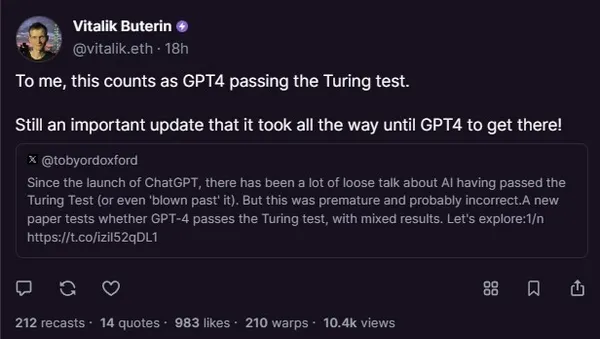
Vitalik added that in that experiment, humans were recognized as humans 66% of the time, while robots were recognized as humans 54% of the time. He further explained that in the real world, a 12% difference is quite big. Small, so in a sense, GPT-4 has passed.
The comments below are also very excited about this achievement. Some netizens pointed out that in the post-AI era, what is really worrying is not whether robots can pass the test like humans, but whether humans can be recognized as real during the test. Humanity.
However, artificial general intelligence (AGI) and the Turing test are not necessarily related, because the Turing test does not have a benchmark or technical basis, and there is currently no scientific consensus on how to measure whether a machine can "think" like a living organism.
Simply put, the ability of general artificial intelligence to "think" cannot currently be measured or defined by the scientific or engineering communities. But it is undeniable that the performance of GPT-4 is indeed quite amazing, and the future development of AI is also worth looking forward to.
References: cointelegraph , fxstreet , cryptonews