Since my Twitter Subscription and Pornhub paid account applications were not approved, I will write a separate article to talk about the practice of one of the three airdrop models I mentioned earlier - Tabi Captain Node
The current airdrop dilemma and selling nodes
Tabi is a typical large-scale public chain project, and it must follow this path. As we all know, Shanghai Stock Exchange now needs data to prove "PMF (Product Market Fit)", which is nothing more than:
• TVL
• Trading volume
• Number of real addresses
What exchanges want when listing coins is that you bring in new users/buyers. The data is just to give everyone an explanation, which leads to three problems:
1. Widespread Sybil Problem: There is no data that cannot be faked. Project owners want data, and studios want airdrops. VCs know this, and exchanges know this. 95% of the volume comes from this, which leads to too many people and too little airdrops. Subsequent exchanges also know that studios come for POW, not buying, and data alone is increasingly insufficient to impress them.
2. Chip cost: No one really thinks that they can get a TVL by organizing an event, right? To reach a TVL that can be listed on a major exchange, you need to negotiate a deal with the relevant big investors. Basically, I will give you the corresponding coins according to the annualized % of your TVL. This cost is quite huge. For example, if the annualized rate is 10% based on the last round of VC valuation of $500M, then the cost of $2 billion TVL is simply unaffordable. Even if the contract is breached after the launch, it will cause huge pressure.
3. Retention cost: Airdrop hunters will not participate in the ecological plate, but will chase the next airdrop. In essence, they are extractors of liquidity rather than providers. In the end of a round of airdrops, there is no buying order, and users do not stay. There is an effective way to solve the above problems, that is, selling nodes.
Yes, it is better to sell nodes directly than to borrow TVL:
- There are sunk costs, which can gain the trust of exchanges. The cost of mining machine orders is expensive, and pure airdrop hunters can be screened out. - You borrow TVL from large investors, and you have to protect their capital and give them chips to find selling pressure for yourself. Although selling mining machines also requires users to return their capital, the chips are given to users, and the cost of chips is high, and a community can be formed to cx the secondary fomo
- Retail investors have sunk costs when they buy mining machines, and it takes time to get their money back. You can use this time difference to build an ecosystem, and retail investors will also have to pay attention to and participate in ecological activities because of the sunk costs.
Paid airdrops + selling nodes will take over PointFi and become mainstream after Layer0 breaks the market trust balance.
Captain Tabi Node
The Tabi Captain Node represents the role of the governor within the Tabi ecosystem. Due to Tabi's unique token economic design, the main function of $Tabi is not only to reward block-producing nodes to maintain network security like other L1 public chains, but also to be used to motivate the ecosystem to continuously generate new game projects (or split the disk) in the long term. Whoever controls the Captain Node determines which game can be successfully launched on Tabi and receive the most revenue distribution.
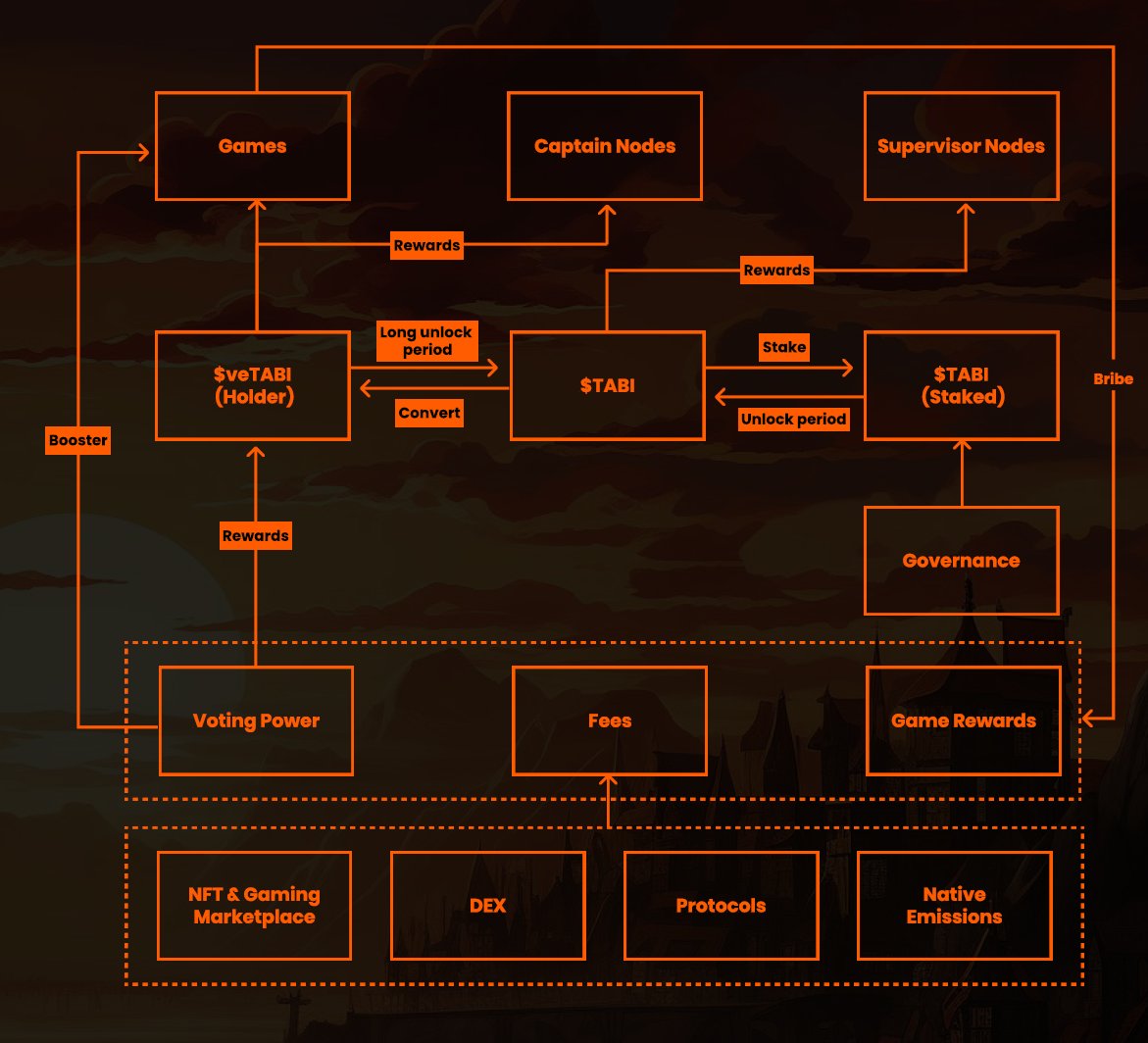 The Tabi economic model is mainly driven by the Captain Node and its veTabi staking output.
The functions of holding Tabi nodes are as follows: • Based on the computing power of the node, the output can be converted into the non-transferable governance right of $Tabi veTabi • Participate in the governance vote of veCRV to determine the allocation of continuous $Tabi output to the ecological projects in Tabi • Obtain continuous airdrop rewards provided by ecological projects for the purpose of bribery Node output 1. There are 200,000 Tabi nodes in total, divided into five levels (LV1 - LV5) 40% of the total $Tabi is produced by Tabi nodes 2. veTabi node output calculation formula: daily output * computing power share 3. The calculation method of node computing power is: basic computing power X Tabi pledge rate X operation rate. The output level of the node is determined by the level. The higher the level, the higher the basic computing power. Nodes in the same level are divided into 20 tiers. Each tier has the same computing power but different start time of output. The larger the Tier number, the later the output. Low-level nodes will start output before high-level nodes.
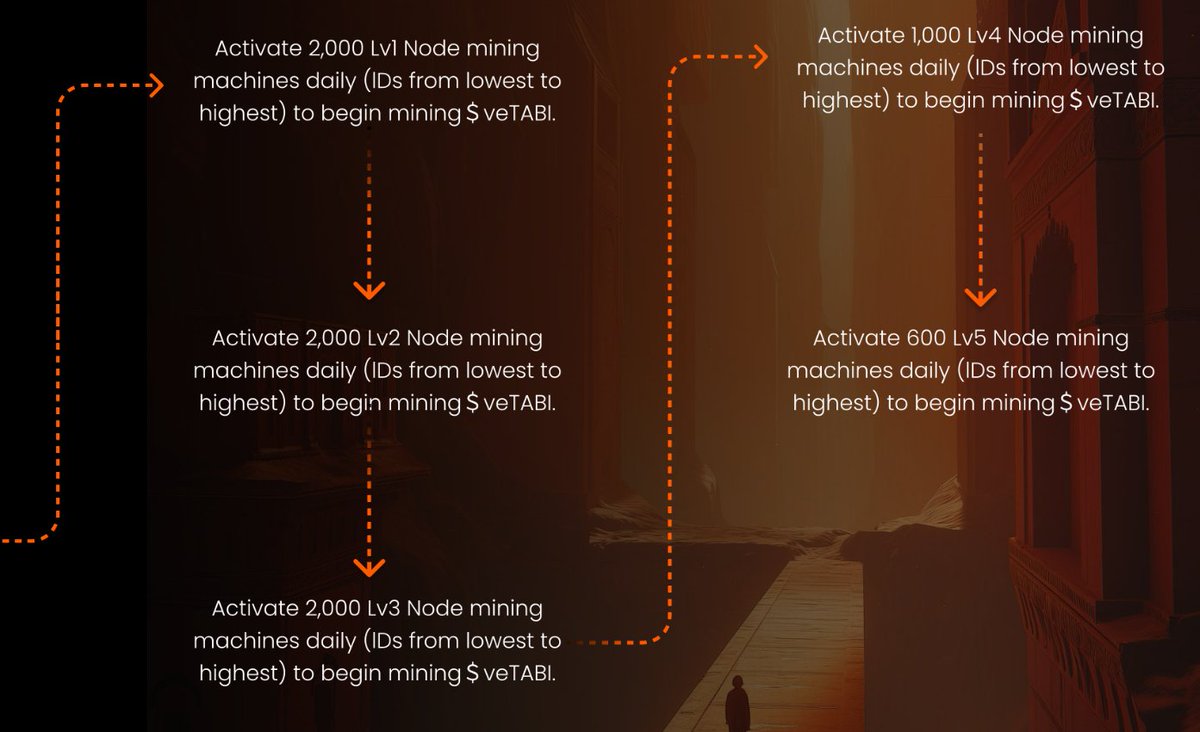 Different levels of nodes start to produce at different times to prevent high-level nodes from crushing the computing power of low-level nodes . This production rule means that the produced veTabi is not converted into Tabi and the tasks corresponding to the Tabi node are continuously completed, which can obtain higher computing power and reward sharing. On the contrary, if you mine, sell or do not participate in ecological activities, your computing power will decrease and you will be punished. This is equivalent to a disguised (3,3) and ongoing Odyssey task. Users will be more inclined to continue to participate in Tabi activities because of the accumulated sunk costs they have paid, which will bring more activity to the ecosystem and bring continuous users to the game projects in the ecosystem in disguise, forming a positive trend.
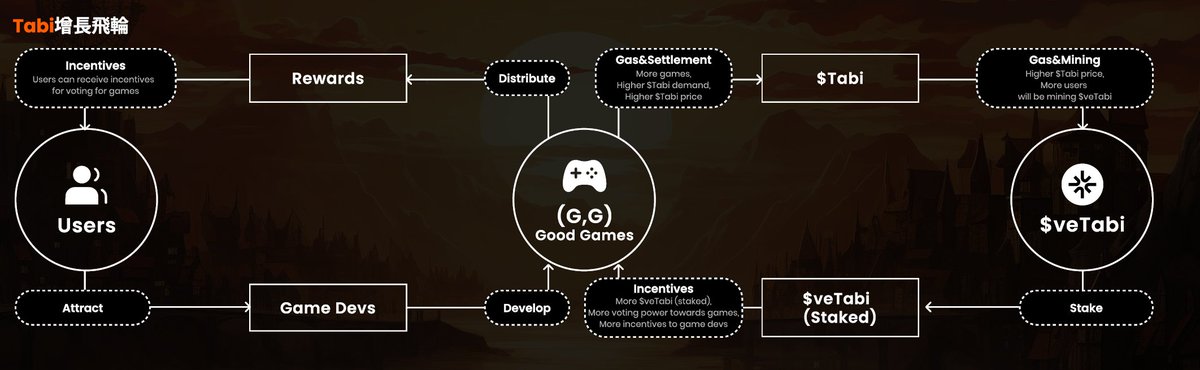 Tabi Growth Flywheel Tabi Node Sales Model 1. Pricing Model: Tabi nodes adopt a very interesting pricing model: the higher the level from LV1 to LV5, the higher the price. The smaller the Tier number within the same level, the earlier the output, the higher the selling price; conversely, the later the output, the lower the selling price. It is equivalent to the same level node using the LBP method to reduce the price.
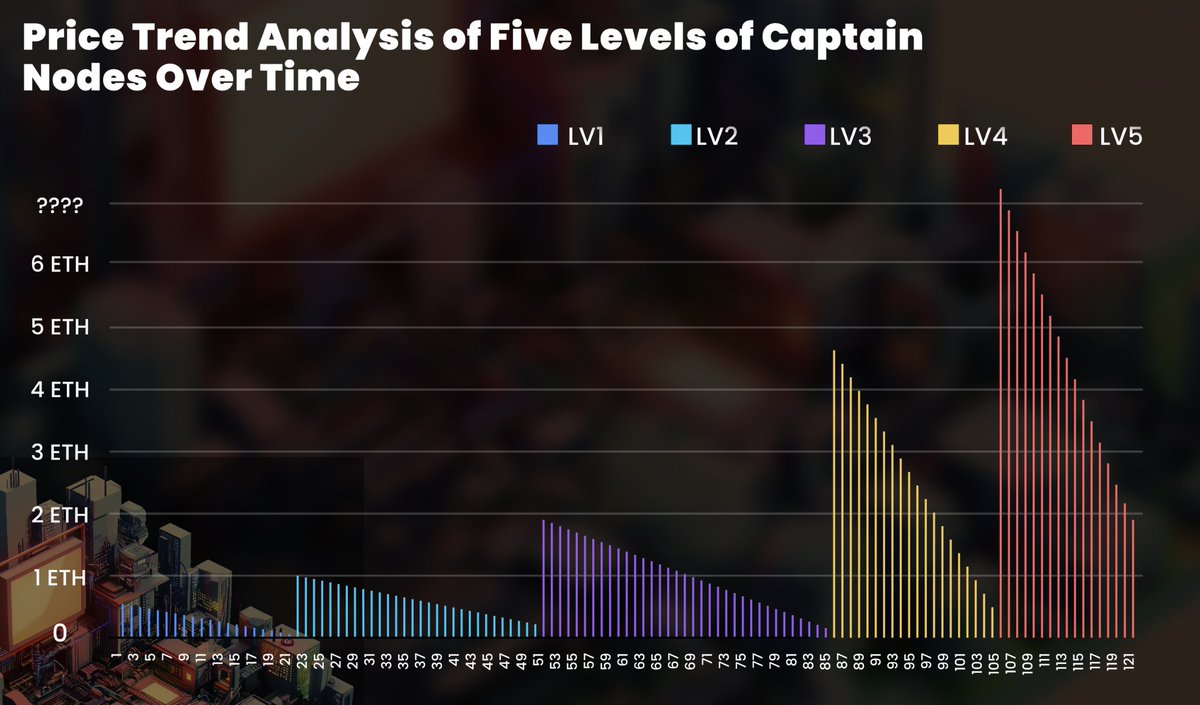 Node pricing: You can see that the higher the level, the higher the price, but within the same level, the higher the ordinal number, the lower the price
2. Sales model Tabi node sales are divided into two stages. To participate in the sales, you only need to pay the whitelist deposit through the exclusive link of any channel to reserve a node of a specific level. After booking, you will be randomly assigned to a tier node, and you will have 13 days to pay the balance of this node after the "press conference" on the whitelist deadline. For example, the total price of the LV1 Tier1 node is 0.55E, the deposit is 0.14E, the balance is 0.41E, and the channel can get the corresponding commission according to the node level. In this way, the need for a separate KOL round of fundraising is eliminated in disguise, and the binding between KOL and the community is closer.
Same mining disk, why Tabi? Tabi VS XAI VS Aethir Cloud
To put it bluntly, nodes are mining machines, and selling nodes is selling mining machines. It doesn’t matter what the nodes are used for. This approach was first started by @GoGalaGames in the last round, and this round is @XAI_GAMES . Their approach is basically to divide the same mining machine into different rounds and sell them at a higher price (similar to the picture below):
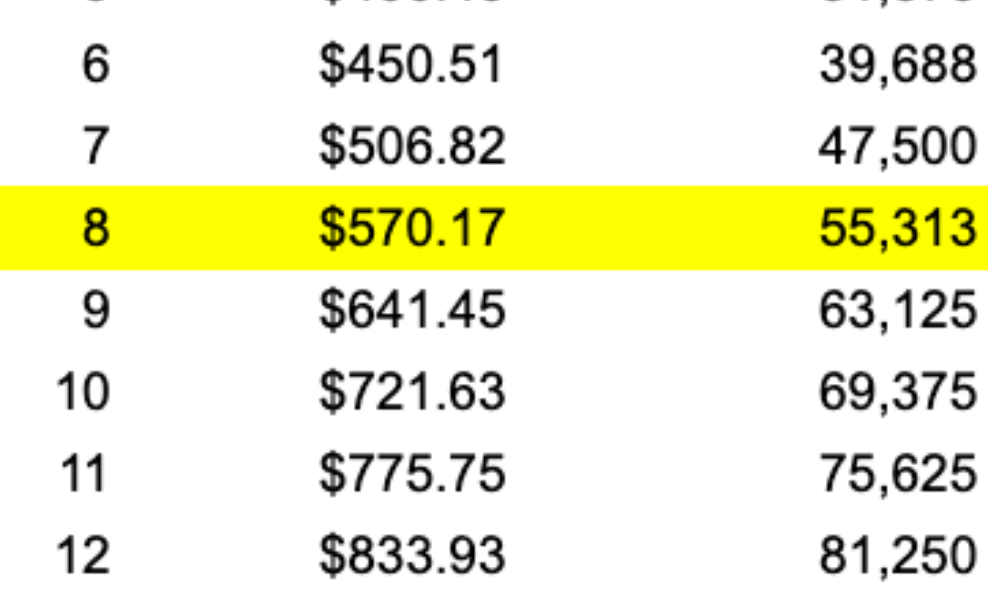 If you have been in the trading circle early, you should know that this method is the VDS resonance disk method. In each round, the number of mining machines increases from a small amount to a large amount, but the price increases from a low amount to a high amount. This can cause FOMO and make retail investors rush in desperately.
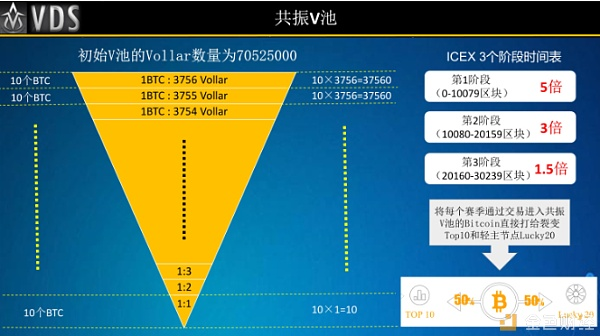 Ancient Resonance VDS, Ghost Man finally understood Shenzhen Technology after so many years. However, such shortcomings are very obvious. The mining machine considers the payback period. The payback period is determined by: mining reward/purchase price. Gala and XAI mining machines have the same computing power, and the mining reward is determined by "daily output/total computing power of participating mining machines* computing power of a single mining machine." This means that the later you buy a mining machine, the higher the cost, the greater the total number of mining machines involved in mining, the lower the unit output, and the longer the payback period.
Therefore, for those who participate in node sales above a certain level, the payback period will be very long, and compared with the token FDV, wow! It is better to buy the token directly in the secondary market. From the perspective of retail investors, why should I pay several times the price for the same thing? The project party has to fill in a lot of funds to sweep the last round of sales. At the same time, this also overdraws the secondary market. A large number of high-level mining machines take over and don’t know how many secondary multiples are needed to get out of the trap. The essence of this game is not gambling, but gambling on fools.
Tabi adopts a different output and pricing logic
Tabi nodes do not start producing at the same time, but are activated 2,000 nodes every day in order from low to high levels and tiers from low to high. This effectively prevents computing power from being crushed. Nodes at each level have at least a long period of high output, so the overall payback period is shorter than other projects, but the overall market selling pressure remains unchanged.
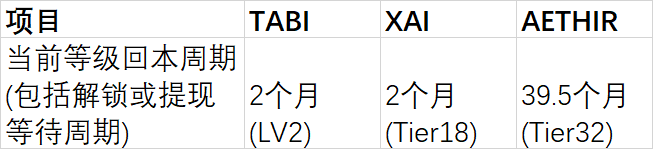 Based on this output logic, Tabi's pricing logic is also based on the same level, with pricing from high to low according to the tier order. The first output is paid at a high price, and the later output is paid at a low price. There is a game relationship here:
Although the price of the first mining machine is high, it produces output early and there is no other computing power competition to crush it. Therefore, if you believe that the multiple will be high and the profit will be large when the coin is listed, then spend a little more money; correspondingly, although the tailings mining starts late and the computing power is crushed and the output is small, it is cheap and the return on investment is fast, so it is reasonable to choose the tailings; if you don’t know what strategy is reasonable, then buy a middle tier and adopt a neutral strategy. The return on investment is not slow, and you can also get some first mining bonuses.
Each level of nodes will crush the computing power of previous nodes after mining, so each level of different tiers is essentially a redistribution of output. It's just that the output of the distribution is getting higher and higher, and the funds are getting larger and larger. For retail investors, it is equivalent to providing them with the right to choose whether to be generous or frugal.
This fundamentally solves the greater fool problem. No matter what price you enter the market, the strategy is reasonable. In the words of the trading circle, it is actually a static 3-4 times exit. If you want to get higher returns on top of this, you have to vote for nodes and improve the node operation rate, that is, do tasks and play games in ecological applications, that is, dynamic income, and get airdrops from projects. Just like the Gala node, one airdrop may earn back the static annualized return for one year.
Putting aside the airdrop, this method has effectively solved the problem of selling pressure caused by the public chain dividend digging and selling, and the problem of exploiting the applications on the chain. In many cases, it is the application that brings volume to the chain instead of the other way around, such as Blast relying on Fantasy Top, Base relying on FT for a while, and Harmony relying on DeFiKingdom. If the ecosystem does not support it with real money, it can migrate at any time. Under the logic of the Tabi node, if you want more income, you have to be dynamic and use it interactively in the application, which will bring more sticky users on the one hand and more deposits on the other. The public chain can finally feed back to the application, and more plates will come, and the logic of a large split plate will start to run.
Summarize
The essence of airdrops is to serve the purpose of listing coins and controlling the market. Nothing is free. The phrase "free is the most expensive" has indeed brainwashed many people. Unfortunately, the people who finally realized that "expensive" are precisely the zero-cost party. They have become the toilet paper that the project party and the exchange throw away after use. The new generation of node sales will tear off the "fair and free disguise" of PointFi/airdrops, and replace "stacking TVL" as the new standard for pre-listing activities - because the exchange requires that opportunities are only provided to people with purchasing power. T
The case of abi node tells us how to balance sunk costs, expand market expectations, and adjust the chip structure. Sunk costs + activity, help the project party get on the horse and send it on its way, this is the "own people" of the banker.
I have finished speaking. Who is in favor? Who is against?