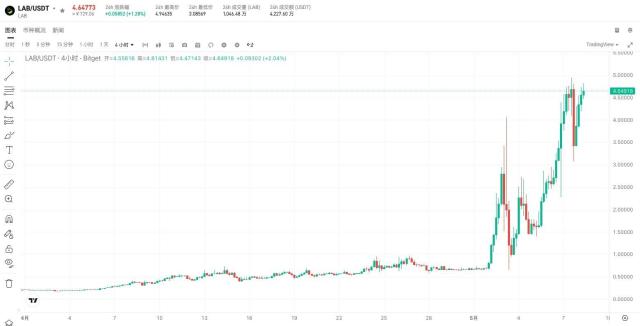
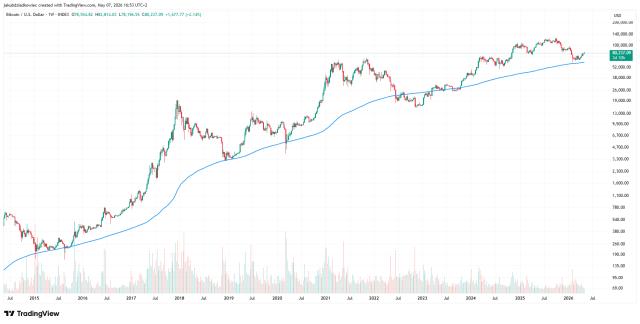
If no one in your group is discussing $SATO, $uPEG, and Slonks, you might want to switch to another group.
When Slonks launched, Mint was priced at less than 0.004 ETH, equivalent to less than 70 RMB. Six days later, the price surged to 0.123 ETH, a 60-fold increase. uPEG, priced at $982, went from a market capitalization of 0 to $34.44 million in just two weeks. When SATO's market capitalization fell below $3 million, someone used the on-chain bonding curve to buy the dips at the bottom, opening a position of 260,000 SATO. The market capitalization later surged to $40 million, resulting in a rapid profit of $360,000.
These aren't your average memecoin get-rich-quick narratives. They all point to one sector: Uniswap V4 Hooks. In just two and a half weeks, these three projects have dragged the entire V4 hook sector from "DeFi geeks' internal toy" into the mainstream. Related reading: " Bull Market Speculation: Will the 'Hook' Concept Become the Sector to Kick Off the Bull Market? "
For retail investors who missed out on early opportunities with $SATO, $uPEG, and Slonks, how can we seize the next potential opportunity to get rich quick? Before discussing this, we need to briefly review how the V4 Hook narrative became popular.
How did V4 Hook narratives become so popular?
Before V3, Uniswap was essentially a money exchange counter. You exchanged ETH for USDC, the price moved according to x*y=k, and that was it. After V4, hooks were incorporated into the swap lifecycle, allowing anyone to insert their own code before, after, or at the moment liquidity was added to a swap.
In fact, Uniswap v4 was launched as early as January 30th of last year. However, it was only with the recent emergence of projects such as $SATO, $uPEG, and Slonks that hooks have sparked widespread discussion among retail investors.
SATO was the first of the three to launch, going live around mid-April, about a week earlier than uPEG. However, it lacked a KOL to generate buzz and didn't have a heavyweight like Adam Hollander endorsing it. Its dissemination path was closer to the degen community. Keywords like "pure on-chain," "fair launch," "no team allocation," and "contracts running themselves" directly attracted V4 geeks and bonding curve veterans.
The real highlight of the V4 Hook narrative lies in Unipeg (UPEG), and the name "Unipeg" carries a strong commemorative significance for Uniswap, so it was born with its own narrative and attention.
In 2019, Hayden Adams published a blog post titled " Uniswap Birthday Blog—V0 ," in which he recalled that when he was naming the Uniswap protocol, he originally wanted to call it "Unipeg," meaning a combination of a unicorn and a Pegasus. But Vitalik glanced at it and said, "Unipeg? That sounds more like Uniswap." So Hayden settled on the name Uniswap.
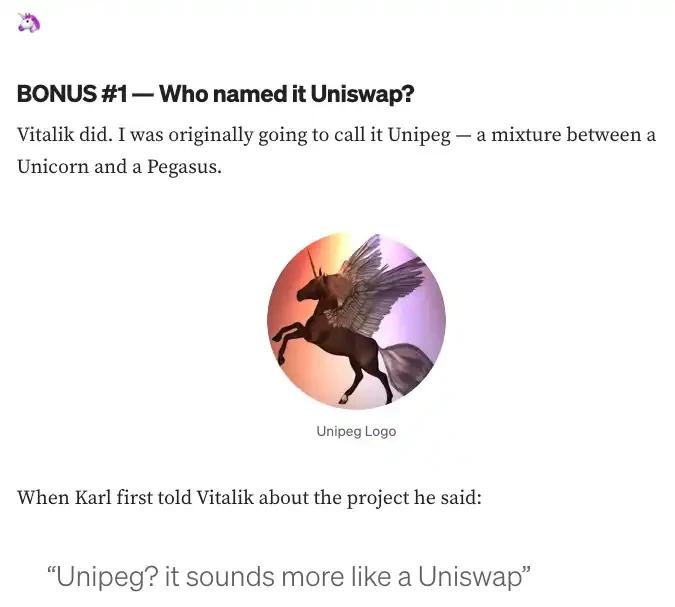
"Uniswap" has replaced "Unipeg" and become the name of the $70 billion DeFi blue chip.
Eight years later, in April 2026, an anonymous developer (Twitter account @unipegv4, rumored to be related to the 0xHadrian blog) picked up this discarded name and gave it a new meaning: Uni + JPEG = uPEG. The NFT community has always jokingly referred to images as "JPEG," and since this thing was born in the Uniswap pool, it is Uniswap's JPEG.
This story itself is viral material. It combines four narratives—Hayden's personal anecdotes, Vitalik's quip, NFT slang, and V4's new mechanisms—all within a single name.
The story of "uPEG" is very easy to tell and very easy to spread. This attracted Adam Hollander, CMO of OpenSea, who retweeted the tweet on April 25, saying, "I'm interested in this concept and will buy some to try."
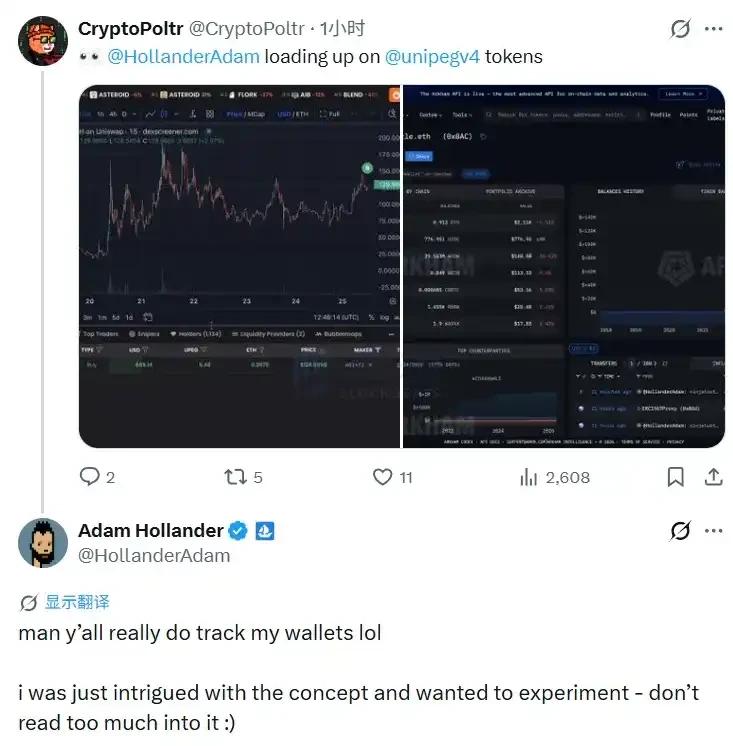
That evening, "uPEG" surged threefold. Following suit, Niko from the Uniswap team, Nafay (co-founder of Ouroboros), and Pow (a meme coin KOL) also shared their uPEG holdings on the X platform. In just two weeks, uPEG's market capitalization soared from zero to $34.44 million, with a price of $982 per coin. Related reading: " Market Capitalization Surpasses $23 Million, Setting a New Record: What's the Magic Behind the New Image of the large MC memecoin Uniswap? "
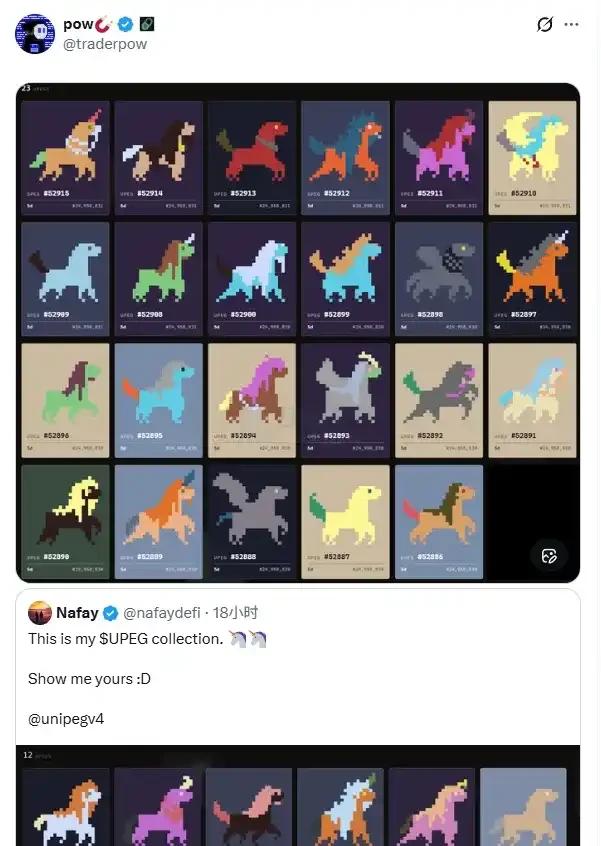
meme coin KOL pow promotion uPEG
Following uPEG, "Slonks" was launched on May 1st.
Developer Hirsch did something that sounds quite unusual: he directly crammed an AI image generation model (only 214KB, roughly the size of a low-resolution mobile wallpaper) into an Ethereum smart contract. The model's task was to reproduce 10,000 CryptoPunks.
However, a 214KB model cannot remember 10,000 faces. With each image having 576 pixels, the model will make an average of about 24 mistakes, resulting in a distortion rate of approximately 4%. Out of 10,000 images, only 32 are perfectly replicated, while the rest are all "distorted punks".
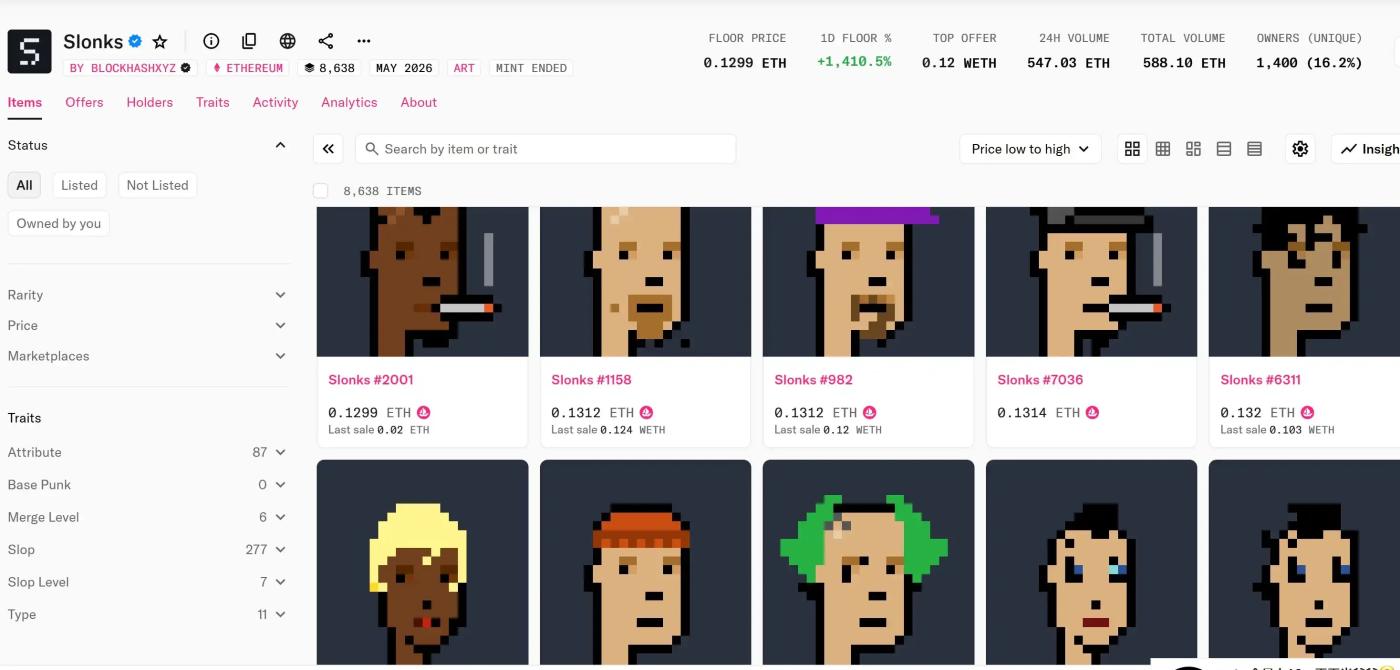
slop legend
Hirsch called these misdrawn pixels "slop." He then tweeted his attitude towards the project: "The slop is not a bug. It is the medium."
The entire economic model is built on the principle that "the more mistakes you make, the more valuable you become." Two Slonks of the same level can be merged; burning one upgrades the other, and the Slop of the new Slonk only increases, never decreases. Any Slonk can be sent to void, minting future tokens (not yet officially issued) at a 1:1 ratio with the Slop amount. Every action is completed via V4 hooks and is verifiable on-chain.
Slonks didn't become an instant hit upon launch. In the first few days after its release, it was almost overlooked amidst uPEG's impressive $30 million market capitalization. Its price hovered around 0.005 ETH, and there was little discussion on OpenSea. It wasn't until a group of NFT veterans, including 798, took turns tweeting on X, turning the phrase "mistakes are art" into a shareable meme. Simultaneously, smart money on the blockchain further captured its potential, KOLs and media outlets promoted it, and OpenSea's homepage trending helped distribute traffic. As a result, Slonks increased 60 times in 5 days.
However, SATO's significance lies in its underlying proof that "V4 hooks can create new economic models." This is a prerequisite for the later emergence of uPEG and Slonks.
The significance of uPEG lies in translating the DeFi concept of V4 hooks into practice within the NFT community. Retail investors suddenly realized that hooks aren't just toys for DeFi geeks; they can be used to create things they themselves want to buy.
Slonks leveraged the attention bonus generated by uPEG to create stronger story hooks and an engaging economic model, further driving the V4 Hook narrative.
What should we focus on to seize the next opportunity?
For foreign V4 Hook core users, the following are the users that BlockBeats Editor mainly recommends:
1. Hayden Adams (@haydenzadams), founder of Uniswap, his importance needs no introduction.
2. saucepoint (@saucepoint), the godfather of hooks at the Uniswap Foundation, author of v4-template, whose templates are used as the starting code for almost all hook projects.
3. The Builder Updates released every Wednesday or Thursday by the official Uniswap website (@Uniswap) and the Uniswap Foundation (@UniswapFND) are the most important official signals in the field.
4. niko (@niko_eth), a member of the Uniswap Labs team, can be said to have been a key figure in the first wave of KOL relay in uPEG.
5. Horsefacts (@horsefacts_eth), one of the earliest builders of V4 hooks, a trendsetter for technical enthusiasts.
6. Adam Hollander (@AdamHollander), CMO of OpenSea, is also an early ecosystem promoter of Hashmasks and Pudgy Penguins, and a key messenger in this wave of communication from the DeFi circle to the NFT circle.
7. Project official accounts: uPEG official (@unipegv4), Unimon official (@unimonapp), Slonks official account, SATO official (@Satothedog). Observing who they follow and interact with often reveals the next hook project that hasn't been mentioned yet.
In addition, we can also pay attention to some websites related to V4 hooks and Uniswap:
1. HookRank.io is currently the cleanest V4 hook explorer, with over 1300 hooks listed, sorted by TVL/Volume/Fees, and tagged with "New" and "Trending". It's the first stop for hooks that haven't yet been mentioned on Twitter but whose data is already rising.
2. HookAtlas.com is a directory for hook projects, with project descriptions, suitable for mapping.
3. The Uniswap Foundation Builder Update is posted on the blog , and the foundation releases it every Wednesday or Thursday. Core users who follow the Uniswap ecosystem will not miss the hottest stories.
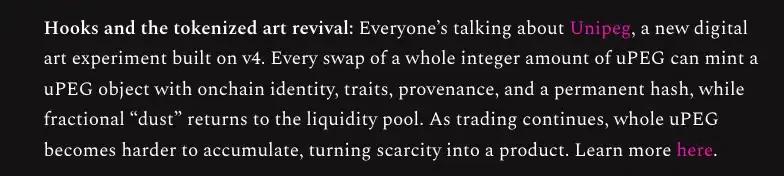
The latest blog post also mentioned community news such as "Hooks" and "Unipeg".
4. In the Unichain Infinite Hackathon competition, almost all the winning projects are seeded projects, so we can focus on the core projects on Unichain.
5. Use Dune Uniswap V4 Tracker to view the total number of hooks, TVL distribution, and chain volume distribution.
6. Dexscreener needs little introduction; it's a commonly used cryptocurrency charting website for monitoring new V4 pairs. It's an early signal source for projects without KOLs (Key Opinion Leaders) to drive their growth. For example, uPEG saw its holding addresses jump from 200 to over 4000 within 24 hours; this slope itself was a signal.
7. Slonks appeared on the OpenSea Trending list on the second day after its launch, while ordinary NFT projects need several weeks of marketing to reach that level. Meanwhile, Slonks' single-day trading volume of 575 ETH on May 8th surpassed CryptoPunks' 129 ETH. Any new project exceeding CryptoPunks' daily trading volume during the same period is a significant signal for the entire sector.
8. awesome-uniswap-hooks: This GitHub project registers all hook experiment projects, making it suitable for discovering early-stage projects with "interesting designs" that don't yet have tokens.
The next stage of V4 Hook narrative
This is just a wild guess from the editor of this BlockBeats, and if the V4 Hook narrative doesn't collapse immediately, the next wave of narrative will likely follow three lines in chronological order: in the short term, it's about fixing bugs in SATO; in the medium term, it's about the composability of hooks; and in the long term, it's about Unichain becoming the center of the entire industry.
First, there's the short-term SATO bug fix disk, which has been the subject of much discussion in various group chats today.
The reason SATO has "fix disks" like sat1 lies in its hook contract. Any V4 hook that wants to replace Uniswap's standard pricing has to maintain its own ledger of "how much money is in the pool" and use this number to calculate its own curve formula. But Uniswap PoolManager also maintains a real ledger. The two ledgers exist simultaneously and must be synchronized every time there is a swap. If the synchronization logic is not written rigorously, the two numbers will deviate further and further. This phenomenon has a name in hook engineers' circles: dual-state drift.
Shifting balances create arbitrage opportunities. At a certain moment, the hook might internally believe 1 SATO is worth X ETH, but the pool's actual reserves show Y ETH. Whoever discovers this difference first profits first. Those two addresses with floating profits of $360,000 weren't profiting from market sentiment, but from accounting loopholes in the contract.
SAT1 packages itself as "one curve, single state," using only one set of accounts and having no drift. The engineering fixes are reasonable, but the narrative is deliberate—it tells retail investors, "SATO has bugs, and I am the correct version," aiming to seize legitimacy.
This approach isn't unique to V4. The Bitcoin ecosystem has ORDI, SATS, and 1000SATS; the ERC-404 era had Pandora, DN404, and ERC-404 V2; and the pump.fun era had BankrFun and ClankerFun. Each newcomer claims to have "fixed the problems of the previous one."
The essence of a bugfix disk is not technical fixing, but narrative exploitation. It doesn't actually need to fix anything; it just needs to make the consensus on Twitter that "the original disk has a bug," and liquidity will move from the original disk to the new disk.
V4 hooks have reduced the cost of this approach to an unprecedented low. Hooks are open source; you can fork one and deploy it by modifying just three lines of code. Every successful hook project comes with its own copy generator. SATO/sat1 is the first template; uPEG2 and Slinks will inevitably follow.
In the mid-term, we can look forward to the composability of hooks.
Currently, in V4, only one hook can be attached to a pool. However, some people are already working on "meta-hooks," where a single hook internally calls multiple sub-hooks to achieve combined behavior.
Once this works, it means that uPEG's image generation, Slonks' NFT-token redemption, and SATO's bonding curve can coexist in the same pool. A single swap triggers graph generation, rewrites the pricing curve, and mints NFTs.
There are many directions that can be explored further: swap triggering music or audio generation (replacing SVG with MIDI, as audio is easier to distribute than images); swap as an identity or reputation system (updating soul-bound points with each swap); prediction market hook (treating swap as a betting action, with the Polymarket model running in the LP); time-based hook (lower sell tax the longer the holding period); and cross-collection fusion gameplay (using hooks to merge Pudgy Penguin and Azuki into a new form, most feasible among CC0 projects).
The BlockBeats at BlockBeats believe that composability is the true ceiling of this field, while single-point mechanisms are just a demo.
Looking further ahead, Unichain may become the next hot blockchain.
It's not because of its superior technology, but because it benefits from the Uniswap Foundation's funding, traffic, and whitelisting. Hook projects on Unichain have an order of magnitude higher chance of receiving official Builder Update exposure than those on the Ethereum mainnet.
If you want to catch the earliest signals, the BlockBeats also suggests setting up a separate monitoring system for Unichain: check the number of hook deployments on the Unichain dashboard in Dune, check TVL and active addresses on L2Beat, and check for new tool updates on the official builder toolkit, etc.