Author: Evie Source: X, @0xEvieYang
The market has been terrible these past two days, let’s see how AI can divert attention
As the saying goes, "speculate on the new, not the old", the crypto has been looking for new narratives. Since last year, many Web3+AI projects have emerged, and this year, more than 50 AI projects have completed financing.
This year, I have also bought some popular AI concept tokens such as $WLD and $LPT. However, I have always been curious about the development of mainstream AI. What is the difference between Web3+AI and pure AI? What opportunities are there for Web3+AI?
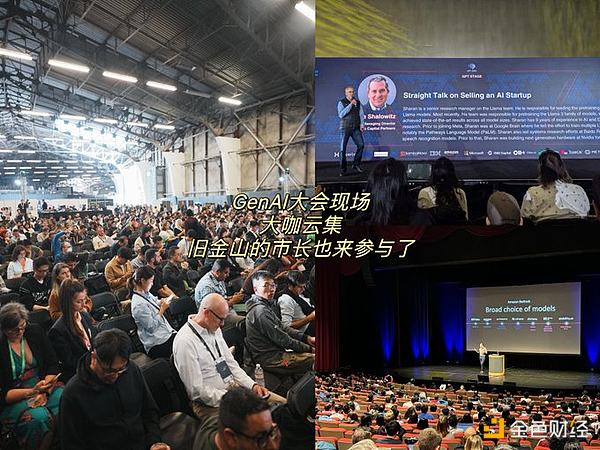
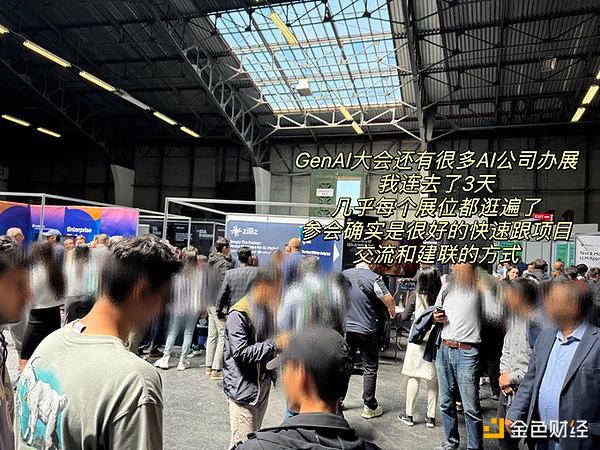
It is said that "it is difficult for people to make money beyond their cognition". In May, San Francisco held a GenAI conference @genaisummitsf with 10,000 participants. I took the opportunity to stay in the United States for a month and visited local AI, investors, entrepreneurs, researchers @FinanceYF5, etc. Next, I will share with you my experiences and thoughts.
Due to limited space, this post will focus on the development of the mainstream AI circle, including:
AI investment and financing
AI Entrepreneurship Environment
AI segmentation track situation
AI development in China and the United States
AI investment and financing
I looked at the projects that have raised more than 50 million US dollars this year and found that the vast majority of projects are 2B, including vertical categories such as health/medical care, transportation/driving, finance, and tools to improve organizational efficiency; the second largest group are cloud platforms or computing service providers; there are very few 2C applications.
Regarding this issue, my opinion is that the current death rate of the C segment is very high. The existing number of AI users is far from enough to support the cost of C-end applications, and the large amount of high-quality data required for C-end applications is in the hands of large companies, not start-ups. Based on this, some investors even believe that 90% of C-end opportunities are in large companies.
AI Entrepreneurship Environment
My feeling in the Bay Area is that even the air you breathe smells of AI. During the roadshow at the GenAI conference, some projects even started pitching with only a simple idea, which shows that the startup market is still relatively tolerant of this field, a bit like the "mass entrepreneurship and innovation" of the past.
However, if you really want to stand out from the many AI projects, it is much more competitive than you might think, and you still have to compete in technology, background, and resources. The current star AI projects all have teams with backgrounds from top North American universities and large companies, or are serially successful entrepreneurs.
As far as the organizational structure of the project is concerned, one feature I have observed is the "inverted pyramid" - that is, there are more high-level, high-quality members at the senior level, but fewer junior engineers.
Development of AI sub-sectors
Computing power: There is a huge demand for Nvidia in the market, but the supply is very limited, and large companies are also competing for GPUs. The competition among large companies is a brutal money race. More capital is needed to buy more cards and snatch more talents. In addition to the supply and demand of GPUs, reducing energy consumption is also a problem that needs to be solved.
Data: The development of large models requires powerful GPUs, but at the same time, data as another key resource is also receiving more and more attention. Therefore, some top AI laboratories are now competing to obtain more valuable data. They will spend a lot of money to purchase data, find experts to generate data, or cooperate with companies like Scale AI to label data.
Some researchers predict that high-quality data will run out by 2026. Therefore, synthetic data is becoming increasingly important. By 2024, it is expected that 60% of the data used to train AI will be synthetic data.
Model: Regarding the question of which model is better, open source or closed source, I have heard different opinions. Some investors are very optimistic about open source, believing that open source can attract contributors to participate, whether it is a large company or a startup, and a lower-cost model may appear under the open source model. At present, some models have reached the level of ChatGPT 4. Another view is that most open source models have not been verified by computing power, and the market will not buy them. It is certain that closed source models will have greater support in terms of talent and resources.
Based on the logic of open source, if we embed the business model of Web3, then everyone can contribute to a model and share the model benefits based on the degree of contribution. There are projects doing similar things now, but whether it is feasible or not is not discussed here.
In addition, most relatively mature models are supported by cloud service companies. For example, in the latest round of US$1 billion financing of Dark Side of the Moon, Alibaba was the lead investor, and part of the investment was in computing power.
Enterprise software service companies like Salsaforece also have their own AI teams of several hundred people, and their AI directly serves their own products.
Application: Chatbot is a battleground for big companies. There are relatively few big companies in the search field, mainly Microsoft, and NewBing is currently in a basically monopolistic position.
Although Apple's stock price fell after it announced its AI plans at this year's Developer Conference, I personally look forward to the combination of Apple and AI. After all, Apple is the most commonly used electronic device in daily life, and it has its own models, chips, cloud, and massive amounts of data. These form an ecosystem. If each link is optimized a little bit, the combined effect will be very strong.

AI development in China and the United States
As for the development of AI in the United States, innovation is still in the Bay Area. The amount of venture capital received by AI startups in Silicon Valley is much higher than that in other regions. AI in New York is mainly focused on practical applications, and some companies are using AI to replace or assist the work of paralegals.
I met a friend who does AI consulting services in New York. They are helping some traditional enterprises to develop AI system solutions. The integration of AI and enterprise workflow is irreversible. I feel that in a few years, juniors in consulting, auditing, and legal industries will face considerable pressure for layoffs.
The main large-scale models are concentrated in the United States, followed by China and Europe; the number of large-scale models released in the United States last year was 3-4 times that of China. The domestic large-scale model, Dark Side of the Moon, announced this year that it had raised 1 billion US dollars. Tencent, Alibaba and other large companies have also joined the market, which can be regarded as "the whole country's strength" to support the release of its own large-scale models.