In the past two days, Sentient, an open source artificial intelligence development platform, announced the completion of a US$85 million seed round of financing, aiming to break the dominance of centralized AI model development in the industry. This huge financing attracted a lot of market attention.
According to disclosures, this round of financing was co-led by Peter Thiel’s Founders Fund, Pantera Capital and Framework Ventures. Other investors include Ethereal Ventures, Robot Ventures, Symbolic Capital, Delphi Ventures, etc.
The seed round raised US$85 million. What is the background of Sentient?
1. Top-notch team support: One of Sentient’s core contributors is Polygon co-founder Sandeep Nailwal. Sentient's advisor is EigenLayer founder and CEO Sreeram Kannan.
2. Backed by Ethereum: The Sentient platform will be built on Polygon, which means that Ethereum is expanding its suite into the AI field.
3. Disruptive technology concept: compete directly with OpenAI, build a decentralized artificial general intelligence (AGI) platform, use blockchain technology to encourage contributors to collaborate, build, replicate and expand suite AI models, and reward contributors Make rewards.
These three irresistible advantages make Sentient's value manifest layer by layer.
Highlight 1: Created by technology giant Sandeep Nailwal
One of Sentient's core contributors is Polygon co-founder, Sandeep Nailwal.
Anyone who has experienced the last bull market must be familiar with this "multimillionaire" from the Web3 version of the slums. He left the slums of Madrid to lead the multi-billion dollar Web3 company Polygon, and led "Horseshoe" to upgrade to the Ethereum Layer 2 aggregator became the biggest dark horse in the crypto asset market at that time, creating a market value of tens of billions of dollars.
This is a very passionate story. Polygon’s current ranking among the top ten public chains actually has a lot to do with Sandeep Nailwal’s values.
Born in a slum in India, it was quite common for Sandeep's classmates to drop out of school, and some of them drank and gambled. Growing up, he was often very motivated to escape this life. He wants to be a big shot, doesn't want to play small games, and hates losing.
Such values stayed with Sandeep until he established MATIC Network. It was 2017, and people were crazy about initial coin offerings (ICOs).
As long as there is a white paper, you can raise funds even if you don't have a product. Many projects fail after financing.
After jointly launching MATIC Network in India with JD Kanani and Anurag Arjun, the team could actually easily raise $20 million in funding, but they did not do so because taking shortcuts and making quick money went against Sandeep's big shot philosophy.

Sandeep responded: "Matic is solving a long-term problem and therefore has to choose a slower growth method. If we obtain large funds early, it may limit our development and vision." In the end, they chose to raise very limited funds-500 from Binance Ten thousand dollars and spent more time polishing the product.
All in all, in addition to the team's keen entrepreneurial sense and strong technical capabilities, Sandeep's spiritual courage must be an indispensable stabilizer in the process of achieving Polygon, and will definitely bring more core souls beyond technology to Sentient.
Highlight 2: Leading Ethereum to the hottest AI narrative
Polygon is open and powerful, and its mission is to expand the Ethereum suite and make Crypto accessible to more users.
Functionally, Polygon aims to build a multi-chain ecosystem that is compatible with Ethereum, using a proof-of-stake consensus mechanism to process on-chain transactions, gaining security from Ethereum.
This enables the blockchain network to connect and expand suites, hence the name "the Internet of Blockchains." Simply put, Polygon makes Ethereum faster, more convenient, and cheaper.
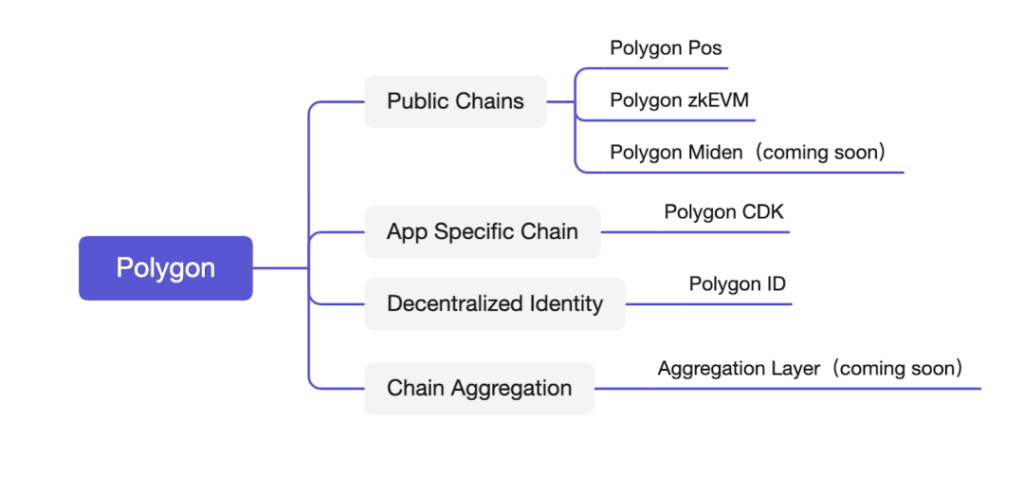
Polygon was formerly known as Matic Network. It started as a PoS chain and then evolved into a complete set of expansion suite solutions and was renamed Polygon. Later, Polygon acquired a bunch of zk technologies and now focuses on realizing Ethereum's unified liquidity and unlimited scalability through AggLayer and CDK.
As this round of bull market approaches, AI has become one of the most talked-about topics, and it has also become an entry point for established public chains to add new narratives.
Sentient announced that it will be built on Polygon, which also means that Ethereum will shine again in the field of AI. In fact, Polygon has shown significant sensitivity in the field of AI very early. It launched Polygon Copilot in June 2023, and later launched another AI tool, Brain.
In comparison, Brain has more comprehensive functions and can also deploy contracts through AI. On April 19, 2024, Ora Protocol, a widely watched AI project, announced that its on-chain AI oracle is being integrated with Polygon PoS, allowing developers to use Ora Protocol oracles to build AI-driven dApps, leveraging AI and richer data sources Break the limitations of smart contracts.
Can Polygon carry huge AI narratives? The answer is yes. Based on the Polygon aggregation architecture, it is possible to have hundreds of thousands of chains, all wired to a single layer and with the security of Ethereum, with the goal of achieving infinite growth of the blockchain network.
These chains will focus on different areas, such as DeFi, game NFT and AI projects. For example, Sentient is a project built on the Polygon CDK chain. Specific chains and ecosystems focus on building applications for specific industries, which is Polygon’s blueprint for a decentralized world.
If you want to open up AI, a big limitation is cost, which requires training costs and data collection costs.
Sandeep has publicly expressed his opinion on this: through cryptographic incentives, these cost issues can be solved through open source, such as the need for tokenized models, and Polygon will have a variety of attempts.
In addition, there have been many attempts at decentralized computing, such as the DePIN infrastructure for AI computing.
AI demand is high but supply is limited. Although decentralized solutions may solve the supply problem, they may not necessarily replace centralized providers because the latter may be better in coordination and performance.
Highlight 3: Open source AI, using disruptive concepts to compete with technology giants such as Google
Finding long-term decentralized alternatives to entities that currently provide AI services like OpenAI is a demand pain point in the AI era.
First of all, why does AI need to be open source? We all know that artificial intelligence is developing rapidly and has the potential to change many aspects of human life, but if these technologies are controlled by a few companies, there will be great risks.
Secondly, why are decentralized alternatives needed? Today, the development of artificial general intelligence (AGI) is mainly carried out in secret by large companies because they have vast resources.
This closed approach means that all model parameters and variables cannot be inspected, verified or distributed by outsiders and are completely controlled by these companies.
This is also Sandeep's concern, so he came up with the idea of developing artificial general intelligence (AGI) by establishing a decentralized open platform to ensure that the benefits of AI can be distributed fairly and that the development process is in the interest of everyone.

To solve these problems, Sentient came into being.
Imagine an AI platform that is open and open source, allowing everyone to collaborate, and using blockchain technology to incentivize people to build and expand suites of AI models, for which participants receive rewards. This is what Sentient is trying to do. It is committed to building open source AI models through community contributions to deal with the current centralization and security ethics issues in the AI field.
Additionally, it aims to compete directly with OpenAI and differentiate from it through its community-building approach. Unlike OpenAI, which restricts users from directly accessing its models, Sentient will allow users to access and contribute to the models, and reward contributors.
Sentient's reward mechanism is implemented by initiating "activities". Each activity has specific indicators to evaluate contributions and reward them. If it can be implemented, Sentient will solve the core problem hindering the development of open source AI: incentives. Because currently, on the AI open source platform, anyone can copy the model at will without paying a fee.
Sentient plans to enter the testnet stage this quarter and plans to use this round of financing to expand its team, hire experts, and more.
risk warning
Sentient’s token incentive model, which is one of the core structures of the project, has yet to take shape. If the incentive mechanism is not good enough, the core problems that hinder the development of open source AI will still be difficult to solve.
The project is in its early stages, and there is currently no finished product. The test network has not yet been launched. The number of people in the community is very small, and there is great uncertainty. Users are advised to wait for further information to be disclosed or for project progress to be made before interacting.
Before there is little information and the project has not progressed, be careful to click on the website and Discord links under Twitter to protect the safety of your funds.
Summarize
The rapid development of AI has brought mankind to the crossroads of two future worlds. One path is to enter a closed world dominated by a few large companies and a closed-source model. Another way is to enter an open world, where the model presets are open source and the reasoning is transparent and verifiable. This open world is our ideal future, and only through blockchain technology can this vision be realized, making artificial intelligence more fair and transparent.
In every bull market, a group of public chains will be in the limelight, and when the bull market ends, another group of public chains will quietly exit the stage. We look forward to Sentient leading Polygon and Ethereum to a deeper future.