If I were to imagine how finance would be performed in the future, I would undoubtedly introduce the many advantages that digital currency and blockchain technology can bring: 24/7 availability, instant settlement, permissionless fair access, global liquidity, asset accountability Composability, and transparency.
Since this imagined future financial world was proposed by Satoshi Nakamoto in the Bitcoin white paper in 2008, it is now being gradually constructed through tokenization, and in the future it is expected to realize Mass Adoption through PayFi.
Since the advent of Bitcoin in 2009, the rise of digital currencies has swept the world. But over the past decade, a focus on price speculation and boom-and-bust volatility has distracted attention from the groundbreaking innovations that digital currency and blockchain technology can bring.
As a16z partner Chris Dixon said in his book "Read Write Own": "Cryptocurrency is just one of the many applications that blockchain technology can bring. Digital currency (Token) built on the blockchain network is the Able to maximize the effectiveness of the Web3 value Internet.
Digital currency allows value to no longer be precipitated. Instead, through the Web3 value Internet, it can be transferred anytime, anywhere, almost instantly and at a low cost without permission. Anyone with an Internet connection can access it. The essence of payment is the transfer of value.
Nowadays, with the year-by-year development of the underlying blockchain infrastructure and the arrival of the tokenization wave, it is shown that the biggest opportunity for digital currency may not be regarded as digital currency, but a new set of payments combined with the blockchain. Way.
This revolutionary paradigm shift heralds that people will break away from the constraints of the traditional financial system, bypass today's complex and outdated settlement systems, and embrace the possibilities brought by digital currency and blockchain technology. This is like Starlink directly lighting up the most essential communication needs of people deep in the Serengeti grasslands from space, instead of waiting for a communication company that will never come to lay down the network.
Therefore, this article will combine my limited knowledge of Web3 payment, RWA tokenization and financial currency system, and through 13 latest Web3 payment cases, sort out the journey from the great vision of Bitcoin to today's tokenization The development trend of the wave has arrived, further looking forward to how PayFi will be implemented and open the next chapter for Web3 payment.
If I had any doubts about this last year when I was writing the Web3 Payment 10,000-Word Research Report: The all-out attack by industry giants is expected to change the existing encryption market structure, now I am convinced that the killer application of Web3 has arrived, and it is payment!
Web3 payments overview
1.1 Payment and payment system
Let’s first look at the definition of traditional payment: payment is the act of a payer transferring money or claims to a payee. It is a process in which information flow and capital flow are paired with each other to complete the delivery of money. The essence of payment is the transfer of value (Exchange of Value).
According to the 2020 Annual Report of the Bank for International Settlements (BIS), a payment system (Payment System) refers to a set of tools, processes and systems developed for the clearing and settlement of transaction payments among multiple transaction participants (including payment service providers). rule. This kind of payment financial infrastructure is usually divided into "front-end" and "back-end": "front-end" interacts with end consumers and merchants, and payment service providers are the main participants, processing the information flow of payment transactions, involving:
1) Source of funds;
2) Service channel for initiating payment;
3) Payment tools;
The "back-end" handles the capital flow of payment transactions, with financial infrastructure such as payment and settlement networks as major participants, involving:
1) Clearing refers to the payment instruction transmission and reconciliation process, sometimes including transaction confirmation before settlement;
2) Settlement refers to the transfer of funds to relieve the payment obligations between two or more parties.

We can see from the picture above how complex traditional payments are, not to mention cross-border payments in the context of globalization, which require the domestic settlement systems of various countries (such as Fedwire, the large-value payment system led by the U.S. central bank, and the large-value payment system led by China’s central bank). payment settlement system (CNAPS), cross-border payment and settlement systems for settlement currencies (such as the New York Clearing House interbank payment system CHIPS in the United States, China's cross-border RMB clearing system CIPS), and international payment and settlement systems (such as the Society for Worldwide Interbank Financial Telecommunications SWIFT), not to mention the various banks participating in the system.
With the rise of cryptocurrencies, represented by Bitcoin, known as "super-sovereign digital currencies" (although currently they are digital assets denominated in US dollars), stablecoins (Stablecoins) issued by the private sector and central banks of various countries have With the continuous exploration of tokenized money such as central bank digital currency (CBDC), new currency forms and new currency circulation methods are emerging.
Web3 payment built on the blockchain is the carrier of this new currency form and the new currency circulation operating mechanism. Blockchain directly embeds digital currency into the Web3 value Internet as an underlying structure for currency settlement, so that it can transmit value in the same form of data transmitted online in the early Internet era.
More importantly, digital currency and blockchain technology can also represent real-world assets in a unique (or irreplaceable) digital form on the Web3 value Internet through tokenization. Digital currencies and Tokens representing real-world assets can quickly open up a free market for asset purchase, sale, financing and trading that anyone anywhere can participate in at any time based on the properties of blockchain atomic exchange.
The endowment of the blockchain is the financial infrastructure, which was originally constructed to solve the final consistency problem of payment and settlement. Digital currency built on the blockchain can take advantage of the huge advantages brought to us by digital currency and blockchain technology. These advantages are reflected in the near-instant settlement, 24/7 availability, and transactions brought about by the characteristics of the blockchain. Low cost, as well as the infinite possibilities brought by the programmability, interoperability, and DeFi composability of digital currency itself.
This is what the traditional financial payment system longs for and is difficult to achieve.

1.2 Old infrastructure and complex payment system
In order to further understand the fundamental driving force of Web3 payments, let's first understand some historical background of payments.
Our payment channels and information transfer protocols (such as ACH, SEPA and SWIFT) today constitute the global payment network - the international payment and settlement system. They enable us to conduct large-scale transactions across geographies and time zones and ensure relatively smooth payments.
However, these global payment infrastructures, built more than 50 years ago, are largely outdated and fragmented today. It is an expensive and inefficient system that operates within limited banking hours and relies on many intermediaries.
A significant problem with the current financial infrastructure is the lack of global standards, and the fragmented financial payment systems of various countries hinder seamless international transactions and bring complexity to the establishment of a consistent payment system. This complexity is best illustrated by the structure of cross-border payment transactions (such as the following example of a U.S. dollar transfer from the United States to Europe in euros), which contains many practical pain points:

- Multiple intermediaries: Cross-border payments often involve multiple intermediaries, such as local and correspondent banks, clearing agencies, foreign exchange brokers and payment networks. Each intermediary adds complexity to the transaction process, resulting in delays and increased costs.
- Lack of standardized processes and formats: Different countries and financial institutions may have different regulatory requirements, payment systems and messaging standards, making streamlining the payment process inefficient and challenging.
- Manual Closed Processing: Traditional systems lack automation, just-in-time processing capabilities, and interoperability with other systems, resulting in delays and manual intervention.
- Lack of transparency: Opacity in cross-border payment processes can lead to inefficiencies. Limited visibility into transaction status, processing times and associated fees can make it difficult for businesses to track and reconcile payments, resulting in delays and administrative overhead.
- High costs: Cross-border payments often incur high transaction fees, exchange rate markups and intermediary fees. Cross-border payments typically take up to 5 business days to settle, with an average fee of 6.25%.
Despite these challenges, B2B cross-border payments are a necessity in the context of globalization, and the market size is still huge and continues to grow. According to FXC Intelligence, the total market size of B2B cross-border payments in 2023 is US$39 trillion, and is expected to grow by 43% to US$53 trillion by 2030.
1.3 Urgent need for Web3 payment adoption
As Paypal said after launching its PYUSD stablecoin: "People want to pay as they want, and the current payment network cannot meet the demand. The payment network built by digital currency and blockchain technology can meet the demand and is practical, then As a company committed to promoting payment innovation, we are launching stablecoin payment solutions to meet people’s current payment needs.”
Today, digital currency and blockchain technology provide us with a new Web3 payment channel that can simplify the payment settlement process, making payments fast, cheap and easy to access, to meet the needs of today's increasingly globalized people.
Stablecoins built on the blockchain, as a major form of tokenized currency, have now become an ideal solution to current challenges in cross-border payments and other fields. Let’s review the previous complex cross-border payment example and see the elegant solution for Web3 payment (shown in the red box):

- Instant Settlement: Compared to most traditional payment methods that take days to settle, blockchain-pathed payments can settle transactions instantly and globally.
- Reduced costs: Due to the elimination of various intermediaries and superior technical infrastructure, blockchain-based payments can provide lower costs compared to existing products.
- Openness and transparency: Blockchain provides a higher level of visibility in tracking the movement of funds and easing the administrative costs of reconciliation.
- Global accessibility: Blockchain provides a "high-speed railway" that can be easily accessed by anyone with an Internet connection.
By using the payment track built by the blockchain, the payment process can be greatly simplified and the number of intermediaries can be reduced. Compared with traditional payment methods, fund flows are instantly visible, settlement times are faster, and costs are lower.
We urgently need Web3 payment solutions to help people transmit value around the world instantly and cheaply, and to solve the legacy problems of traditional payments: 1) slow settlement time; 2) high transaction costs; and 3) the current global The financial system cannot cover the incompatibilities of regions (Under-banked and Unbanked).
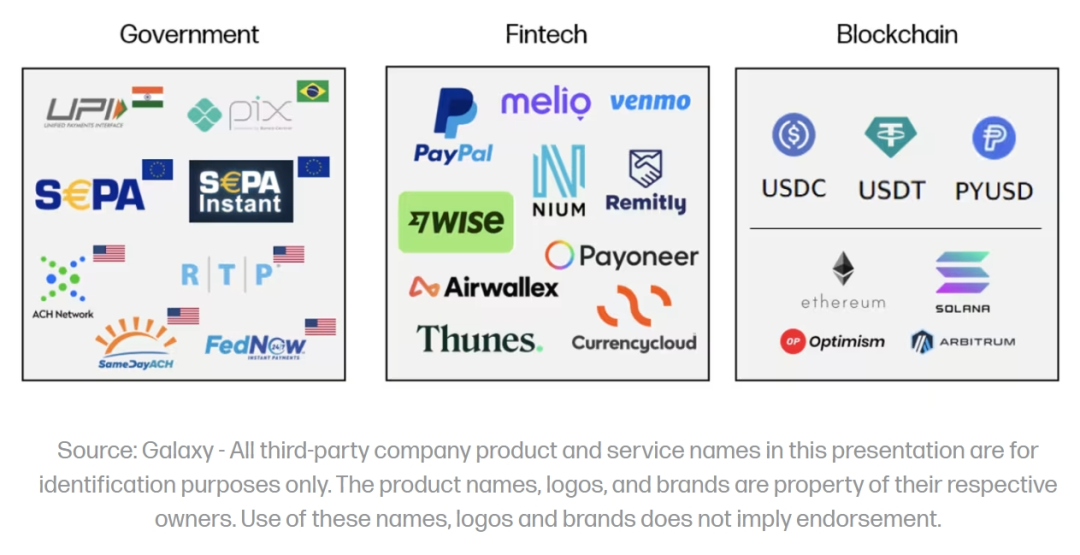 1.4 Web3 payment stack
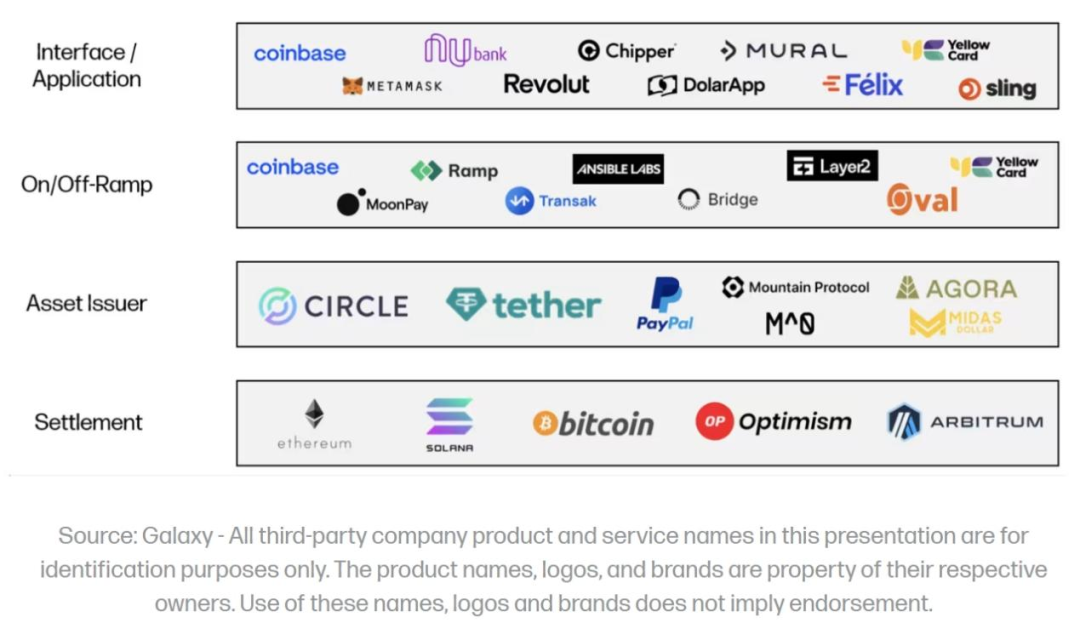
When we look closely at Web3 payment, we will find that there are mainly four layers of technology stack:
1.4.1 Blockchain settlement layer
The endowment of blockchain is financial infrastructure, and its initial structure is used to solve the final consistency problem of payment and settlement. Blockchain will serve as the underlying infrastructure for payment transactions. Layer 1 blockchains such as Bitcoin, Ethereum, and Solana, as well as general Layer 2 environments such as Optimism and Arbitrum, are all selling block space to the market. They compete on speed, cost, scalability, security, distribution channels, and more. Over time, payment use cases will become significant consumers of block space.
1.4.2 Asset issuer
An asset issuer is the entity responsible for establishing, maintaining and redeeming financial transactions and payment media. Stablecoins, for example, aim to maintain a stable value relative to an underlying reference asset or basket of assets, most typically the U.S. dollar. Stablecoin issuers such as Tehter-USDT, Circle-USDC, Paypal-PYUSD often adopt a balance sheet-driven business model similar to banks. They take customer deposits and invest them in higher-yielding assets such as U.S. Treasury bonds, and then issue stablecoins. The currency is used as a liability and profits are made from the interest rate difference or net interest spread.
1.4.3 Currency acceptance (deposits and withdrawals)
Currency acceptance providers play a key role in increasing the availability and adoption of stablecoins and other major tools as financial transactions and payment media, promoting the large-scale application of Web3 payments. Basically, they act as a technology layer that connects digital currencies on the blockchain with fiat currencies inside traditional bank accounts. Their business models tend to be traffic-driven and take a small commission from the number of dollars flowing through their platform.
For example, GatePay can provide users with smooth Web3 payment solutions based on the liquidity of the exchange, while promoting the opening up of on-chain and off-chain payment paths. At the same time, Switzerland's Web3 bank Fiat24 directly structures the bank's business logic on the blockchain, providing users with a seamless connection from wallet (digital currency) to bank account (legal currency).
1.4.4 Front-end applications
The front-end application is ultimately the customer-facing software in the Web3 payments stack that provides the user interface for supporting Web3 payments and leverages other parts of the stack to implement such transactions. Their business models vary, but tend to be some combination of platform fees plus traffic-driven fees generated through front-end transaction volume.
1.5 Multiple attributes of Web3 payment

So for Web3 payment, simply speaking, it refers to a payment method based on digital currency and blockchain technology. However, due to the Token attribute of digital currency itself and the characteristics of the blockchain infrastructure it relies on, Web3 payment It cannot be simply understood as a single attribute of a new payment method.
For example, Bitcoin, which is built based on the Bitcoin blockchain network, has multi-dimensional attributes. It is not only a form of payment and medium of exchange, but also a means of value storage. A store of value) and a financial infrastructure (a distributed ledger) that can also serve as a currency unit of account to mark value in transactions.
Therefore, Web3 payment cannot only focus on the properties of the payment transaction medium, the payment token itself (cryptocurrency, tokenized currency and other digital currencies), but also needs to be combined with the properties of the blockchain network (as financial infrastructure) that carries the payment transaction. Taken together, how do they make full use of blockchain technology to reduce costs and increase efficiency, and to build new business models.

Just like when talking about U.S. dollar payments, we should not only look at the U.S. dollar, but also look at the overall huge U.S. dollar payment and settlement network. It is very important to understand this. Let's look at the case of Paypal launching PYUSD.
Case Study A: Paypal’s Web3 payment logic
On August 7, 2023, the American payment giant Paypal announced the launch of its stablecoin PayPal USD (PYUSD) on the Ethereum blockchain. The PYUSD stablecoin is 100% fully collateralized by U.S. dollar deposits, short-term U.S. Treasury bonds and similar cash equivalents, and qualified U.S. users can conduct 1:1 U.S. dollar exchanges through Paypal. As a result, Paypal became the first technology giant to issue a stable currency.
The reason Paypal turned its attention to Web3 payments is simple: it fills a need and is practical.
In the past, online payment settlement times were still very long (in the United States, the average was 2 to 3 days). Markets, banks, and service providers needed to be open on working days, further extending the settlement time; it was difficult for employers to pay an increasingly distributed workforce; A globalized population makes it difficult to send money across borders cheaply and efficiently. Simply put, people today are not able to pay the way they want.
Today's Web3 payment based on digital currency and blockchain technology can bring people closer to realizing their payment aspirations: fast, cheap, and global payments. This new next-generation financial/payment infrastructure can help PayPal better serve its 40 million users, allowing everyone to pay according to their own wishes.
Therefore, more than a decade after the emergence of digital currency and blockchain technology, PayPal has once again reached a critical moment in payment history. This moment is just like the Internet in the early 2000s, full of potential and opportunities. Just as Paypal brought payments online before, Paypal is now bringing payments on-chain.
PYUSD has been tepid since its launch on Ethereum. It is like an experimental product and is more operated in Paypal's SupperApp. At this stage, PYUSD reaches early adopters, that is, cryptocurrency holders - this group accounts for approximately 15% of the global population, ensuring the awareness of early adopters.

Until May 31, 2024, PayPal announced the launch of PYUSD on the Solana high-performance blockchain, which can cover the most active and active people in the crypto ecosystem and let the world know, "PYUSD is really coming." At this stage, Paypal It is to truly realize the payment utility, that is, to transform the initial ideological and cognitive awakening into the payment utility in real life.
Solana brings PYUSD far faster settlement speeds, lower transaction costs, stronger scalability, interoperability, programmability, and global network support than other blockchains. After combining the advantages of Solana, users can truly realize payment functions when using PYUSD, such as in various scenarios of cross-border point-to-point transfers and remittances (C2C), inter-business transfers (B2B), and global receipts and payments (B2C). .

In this Paypal Web3 payment case, we can see that Paypal and Paxos, as stablecoin asset issuers, issued PYUSD, the only stablecoin supported in the PayPal ecosystem. PYUSD combines the efficiency, low cost, and programmability features of the Solana blockchain (as the settlement layer) and will be used to connect the 431 million users of all front-end applications in the Paypal ecosystem for Web2 consumers, merchants, and developers It provides a seamless connection between legal currency and digital currency.
Traditional payment and Web3 payment are not separated, but are running in both directions. Legal currency and digital currency continue to interact, and are gradually integrated into various practical use cases such as stable coins, tokenized deposits, and central bank digital currencies. Web3 payments are redefining the way we pay and our financial systems.
From the Beginning of Bitcoin Electronic Cash
Before continuing to delve into the specific content of Web3 payment, we must first review the "Bible" of digital currency and blockchain technology - the Bitcoin white paper, to explore the origin of Web3 payment and the significance of the blockchain network. , and understand that Paypal's Web3 payment form is not the ideal payment form in the Bitcoin white paper (centralized trust, unlimited inflation of payment currencies, etc.).
We must understand that Bitcoin and its blockchain network built by Satoshi Nakamoto represent a new solution to currency problems born in the digital age. It is not only designed to solve the eternal problems of human society: how to make economic value cross Time and space, flowing across space, also aim to solve the problem of trust in third parties in payment transactions.
2.1 Origin of Bitcoin
The traditional financial system in the real world relies heavily on the endorsement of intermediaries as trusted third parties. Although this intermediary transaction model endorsed by trusted third parties can provide some conveniences, it often has many flaws, such as Problems such as unnecessary transaction costs, reversible transactions, and centralized evil. The most realistic and tragic lesson is the 2008 global financial crisis.
So is there a completely new way that allows any two parties to transact directly without the need for a trusted third party, just like cash transactions?
This is exactly what Satoshi Nakamoto wants to achieve. In 2008, Satoshi Nakamoto released the Bitcoin white paper Bitcoin: A Peer-to-Peer Electronic Cash System, proposing the idea of a peer-to-peer electronic cash payment system, that is, electronic cash can Based on blockchain technology, it uses decentralized ledgers, uses asymmetric encryption technology, and combines consensus mechanisms to achieve decentralized point-to-point transactions without the endorsement of any neutral or trusted third party.
The Bitcoin white paper, by combining a variety of innovative technologies and the revolutionary design of social production relations, hopes to change the centralized financial system with traditional banks as the core, solve the centralized trust problems existing in the current financial system, and provide users with more security , convenient, low-cost payment method (a peer-to-peer version of electronic cash (system) would allow online payments to be sent directly from one party to another without going through a financial institution).
2.2 Collapse of intermediary trust system
Cash payment is the oldest transaction method for people. There is no delay and no third party can effectively intervene and hinder it. However, with the development of communication technology, cash transactions are difficult to meet people's payment requirements in different places, different time zones, and different scenarios, thus intermediary payment was born.
Intermediary payment requires a trusted third party, such as a bank, Paypal and other payment service providers, to provide people with innovative payment methods such as credit cards, debit cards, bank wire transfers, and cross-border transfers. But the biggest problem is that people need to fully trust the intermediary as the third party in the transaction. This kind of trust often has many flaws, such as unnecessary transaction costs, reversible transactions, and centralized evil.
Bitcoin was proposed in 2008, when the U.S. real estate market bubble burst. Many financial institutions invested heavily in mortgage-backed securities, causing huge losses. Those financial institutions and banks that were once out of reach were in bankruptcy. edge. This directly caused people to lose confidence in the traditional trust system and triggered a global financial crisis.
The most essential reason for such a financial tsunami and the evaporation of huge wealth is that people are forced to unconditionally trust the current financial system, trusting centralized banks and other financial institutions to control, custody, and dispose of our assets.
If banks only provide customers with a means to save cash, then using bank services will only involve the bank's own counterparty risk (Counterparty Risk), which is relatively controllable, but this is not the case. Money never sleeps, and banks are greedy and make money by lending people's hard-earned savings to buy government bonds or other investments. Sometimes a bank may lend so much that it cannot maintain enough liquidity to honor redemptions, causing it to fail.
This is the reason why Silicon Valley Bank, the 16th largest bank in the United States, collapsed in 2023. Subsequently, Signature Bank and Silvergate Bank were forced to close their doors, which are also the most vivid and bloody examples before our eyes.
Not only that, the traditional financial system is subject to the strictest supervision. Although information technology can subvert geographical time constraints, payments are still under the strict control of the government and state-owned banking monopolies. National and local regulations can limit how individuals can use their hard-earned wealth through the traditional financial system, which is particularly severe in countries with strict capital controls. This restriction of intermediary payment greatly reduces the effectiveness of currency. Currency is not strong when accumulated. Currency can only exert its maximum value in a free circulation environment.
Due to the development of the modern communications industry, physical cash transactions are actually no longer feasible. The shift in payment methods to digital payments is weakening people’s control over monetary sovereignty, leaving people subject to third-party intermediaries with no choice but to trust.
Financial intermediaries such as banks have failed before, and there is no doubt that they will fail again in the future.
2.3 Blockchain reconstructs trust
In order to avoid the uncertainty of this black box of trust/fund custody, as well as the risk of single-point collapse of the intermediary third party, Satoshi Nakamoto gave guidance through the Bitcoin white paper, which is to reconstruct a digital currency and blockchain technology There is no need for any neutral, trusted third party payment network.
Satoshi Nakamoto very thoroughly built Bitcoin on the basis of proof and verification, using a decentralized ledger, asymmetric encryption technology, and a consensus mechanism to achieve decentralized peer-to-peer transactions, eliminating the need for a trusted third party It allows every member on the network to verify the authenticity of every transaction without trusting each other.
Only through adequate verification can the reliance on trust be completely eliminated. Don't Trust, Verify it.
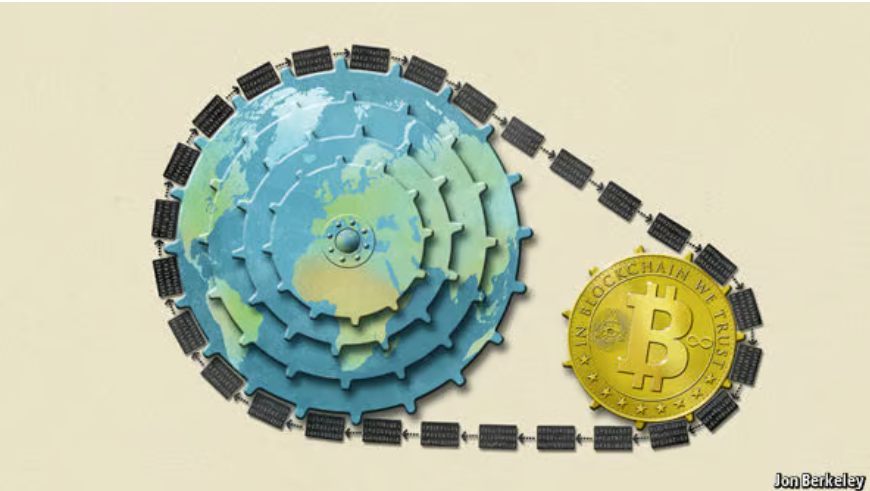
The Economist published an article about Bitcoin in 2015 - The Trust Machine, telling us that the technology behind Bitcoin will change the way the economy performs. Blockchain allows people without trust to cooperate without having to go through a neutral central trust endorsement.
In short, it is a trust-creating machine. In Trustless We Trust.
Blockchain is a powerful technology that is, at its core, a shared, trusted, public ledger that can be inspected by anyone, but that no single user can control. Participants in a blockchain system jointly maintain updates to the ledger: it can only be modified according to strict rules. Bitcoin’s blockchain network prevents double-spending of transactions and keeps track of the ledger. This is the key to achieving a currency without central bank control.
It is true that early Bitcoin has been notorious for its illegal uses, but we cannot ignore the extraordinary potential of the blockchain technology behind Bitcoin. The significance of this technological innovation goes far beyond the cryptocurrency itself.
2.4 Bitcoin and Payment
Let us imagine a world where people no longer need to rely on the traditional financial intermediary system to hold, dispose, and manage our assets. People can truly control their own wealth and achieve financial sovereignty by using digital wallets and blockchain technology.
This is what the Bitcoin white paper is about.
Although the 9-page Bitcoin white paper as early as 2008 was not able to implement a complete solution for a peer-to-peer electronic cash payment system, it was undoubtedly a beacon of hope in the dark storm at that time, serving as a beacon of hope for people who had lost faith in the financial tsunami. Guiding the direction and lighting the way forward.
Today, 16 years later, in this era characterized by innovation and disruption, the financial landscape is undergoing a significant change. Billions of dollars have been invested over the past decade to develop the underlying blockchain infrastructure. It is not until the development of the past few years that we have a blockchain network that can carry "payment-level scale", making blockchain-based payments increasingly feasible and popular.
With the popularity of digital currency represented by Bitcoin (according to a recent report released by Tripple-A, approximately 562 million people in the world will own cryptocurrency in 2024, accounting for 6.8% of the global population) and digital currency and blockchain technology Gradually being accepted by traditional finance on Wall Street, such as the passage of the BTC/ETH ETF, BlackRock's launch of the tokenized fund BUIDL, etc., everything has changed.
The concept of Bitcoin Electronic Cash (Electrical Cash) is becoming a reality through the efforts of early idealists. Just like the seeds originally sown, it is now growing vigorously.
We can see that the huge vision in the original Bitcoin white paper has been met by today's underlying blockchain technology facilities. Blockchain-based Web3 payment can achieve instant settlement and global access functions while being stable. The large-scale real-world use cases of digital currency can illustrate that the biggest opportunity for digital currency may not be regarded as a digital currency, but a new set of payment methods combined with the blockchain.
The wave of tokenization has arrived
Although Bitcoin was originally positioned as electronic cash, at one stage, people expected it to become a new global currency and assume the three major functions of currency - a medium of exchange (such as using Bitcoin to purchase goods and services), and a store of value ( Invest in Bitcoin for long-term gains), unit of account (price the value of goods and services).
In the past ten years of development, due to its scarcity design, Bitcoin’s value storage function has highlighted its advantages in combating global currency inflation. The purpose of establishing cryptocurrencies represented by Bitcoin is to reward people who confirm blockchain transactions. Due to its large price fluctuations, unstable value and other reasons, it is not suitable as a payment accounting unit for goods and services.
Therefore, a new digital representation of currency, especially represented by stablecoins, was born. They are usually anchored 1:1 with legal currencies (especially the U.S. dollar) and serve as a new currency on the blockchain network. medium of exchange. Tokenized currency aims to solve the payment accounting problem of goods and services by maintaining a stable value, and has been widely used in the Web3 payment market.
We have been able to see the explosive rise of the stablecoin market in this wave of tokenization, but before we delve into the current Web3 payment market dominated by stablecoins, we must understand what tokenization is and the role of currency in tokens. The huge advantages that can be brought to us after transformation.
3.1 What is tokenization?
"Tokenization" refers to the process of recording the ownership of financial or real assets (Claims on Financial or Real assets) that exist on traditional ledgers on the blockchain programmable platform to create a digital representation of the assets. . These assets can be traditional tangible assets (such as real estate, agricultural or mining commodities, simulated art), financial assets (stocks, bonds), or intangible assets (such as digital art and other intellectual property rights).
The resulting "Tokens" refer to ownership certificates (Claims) recorded on the blockchain programmable platform that can be traded, helping to ensure authenticity and traceability. More than just a single digital certificate, a token often brings together the rules and logic that govern the transfer of underlying assets in a traditional ledger. Therefore, tokens are programmable and customizable to meet personalized scenarios and regulatory compliance requirements.

Currently the world's second largest stablecoin, USDC, is issued by the American private institution Circle, which uses the U.S. dollar as collateral and anchor currency to issue a tokenized currency product, the U.S. dollar stablecoin USDC.
Due to the global versatility of the U.S. dollar, USDC can not only function as a currency trading medium and an accounting unit for goods and services, but can also highlight the huge advantages of tokenization on the blockchain. These advantages are often difficult to achieve in the traditional financial system.
3.2 Advantages of Tokenization
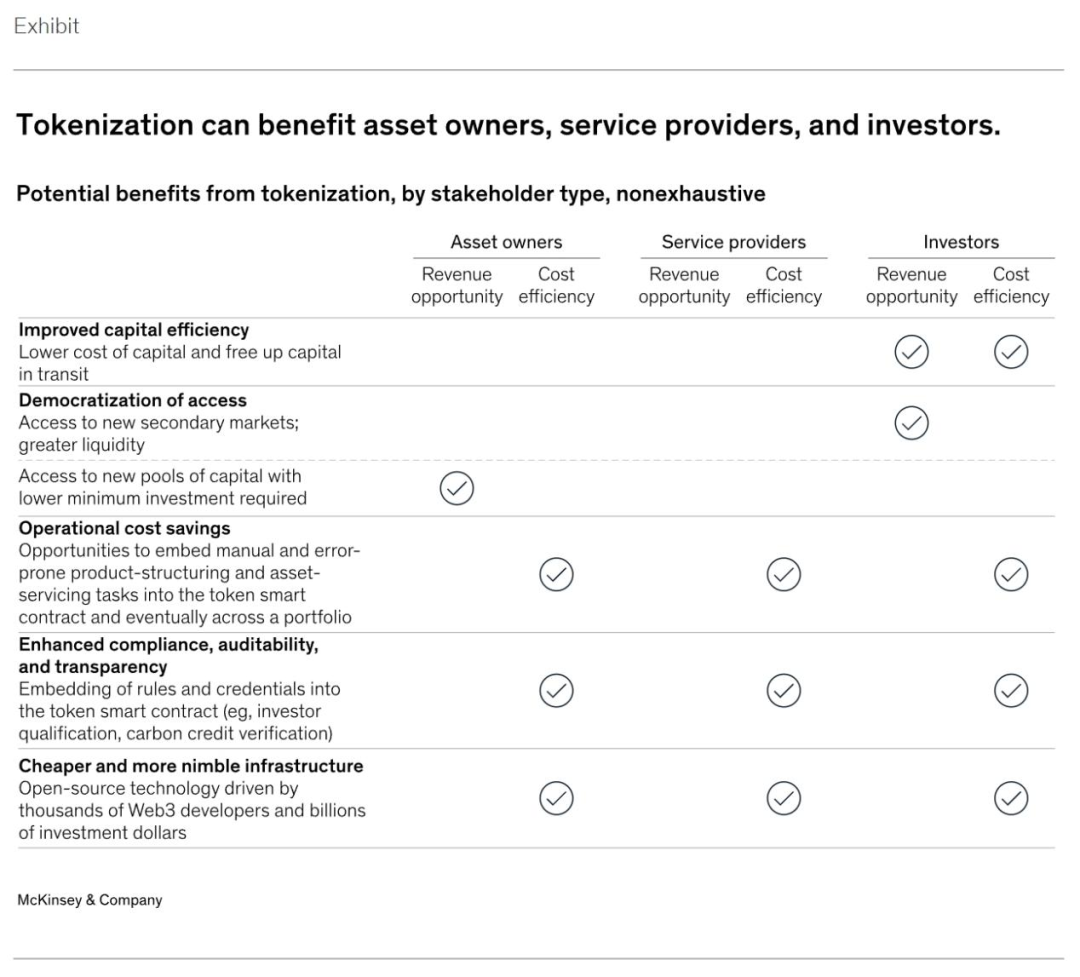
Tokenization allows assets to access the huge potential brought by digital currency and blockchain technology. Broadly speaking, these advantages include: 1) The advantages of blockchain: 24/7 availability, data availability, and so-called instant atomic settlement (Atomic Settlement);
2) The advantages of the token itself: Programmability - that is, the ability to embed programming code in the token, and the ability of the token to interact with smart contracts (composability), thereby achieving a higher degree of automation and interface The ability to enter decentralized finance (DeFi).
Especially when asset tokenization is promoted on a large scale, in addition to proof of concept, the following advantages will become increasingly prominent:
3.2.1 Improving capital efficiency
Tokenization can significantly improve the capital efficiency of assets in the market. For example, the redemption of tokenized repurchase transactions (Repurchase Agreements, Repo) or money market funds (Money Market Fund) can be completed instantly on T+0 within a few minutes, while the current traditional settlement time is T+2. In today's high interest rate market environment, shorter settlement times can save a lot of money. For investors, these funding rate savings may be why recent projects to tokenize U.S. debt can have a huge impact in the near term.
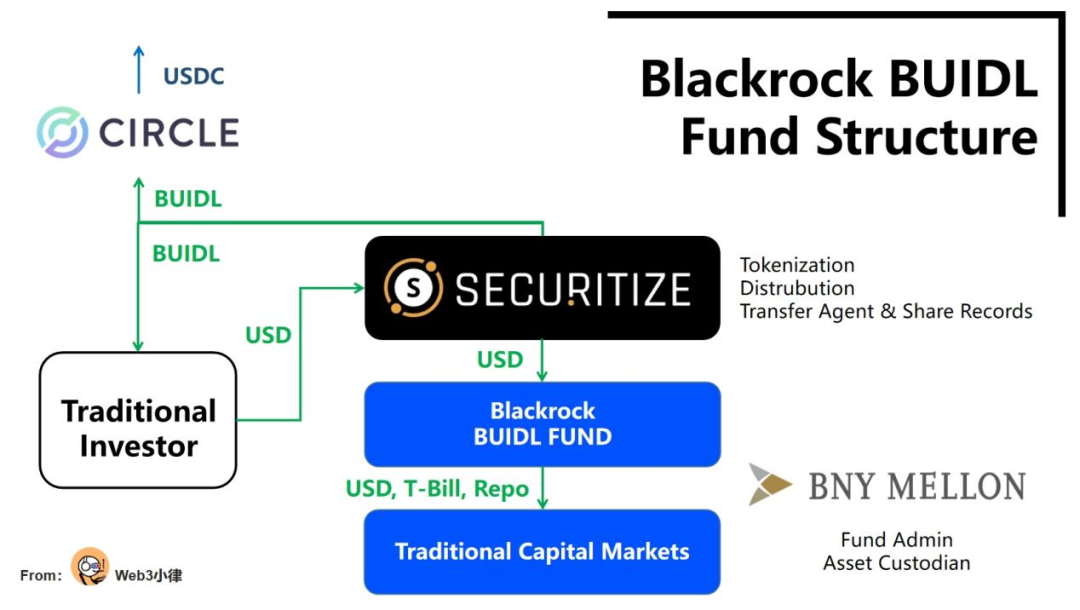
Case Study B: Blackrock’s Tokenized Fund BUIDL
On March 21, 2024, Blackrock and Securitize joined hands to launch the first tokenized fund BUIDL on the public blockchain - Ethereum. After the fund is tokenized, it can realize instant settlement of a unified account on the chain, which greatly reduces transaction costs and improves capital efficiency. It can realize (1) 24/7 all-weather fund subscription/redemption of legal currency USD. This kind of instant settlement , the function of instant redemption is something that many traditional financial institutions are very eager to achieve; at the same time, it cooperates with Circle to achieve 24/7 instant exchange of (2) stable currency USDC and fund token BUIDL at 1:1.
This kind of tokenized fund that can connect traditional finance and digital finance is a landmark innovation for the financial industry.
3.2.2 Save operating costs
Asset programmability can be another source of cost savings, particularly for asset classes where servicing or issuance is often highly manual, error-prone and involves numerous intermediaries, such as corporate bonds and other fixed income products. These products often involve bespoke structures, imprecise interest calculations and coupon payment expenses. Embedding operations such as interest calculation and coupon payment into smart contracts of tokens will automate these functions and significantly reduce costs; system automation achieved through smart contracts can also reduce the cost of services such as securities lending and repurchase transactions.
Case Study C: Tokenized bond project Evergreen
The Bank for International Settlements (BIS) and the Hong Kong Monetary Authority launched the Evergreen project in 2022 to issue green bonds using tokenization and a unified ledger. The project makes full use of the decentralized unified ledger to integrate the participants involved in bond issuance on the same data platform, supports multi-party workflow and provides specific participant authorization, real-time verification and signature functions, improving transaction processing efficiency. Bond settlement realizes DvP settlement, reducing settlement delays and settlement risks. The platform's real-time data update of participants also improves the transparency of transactions.
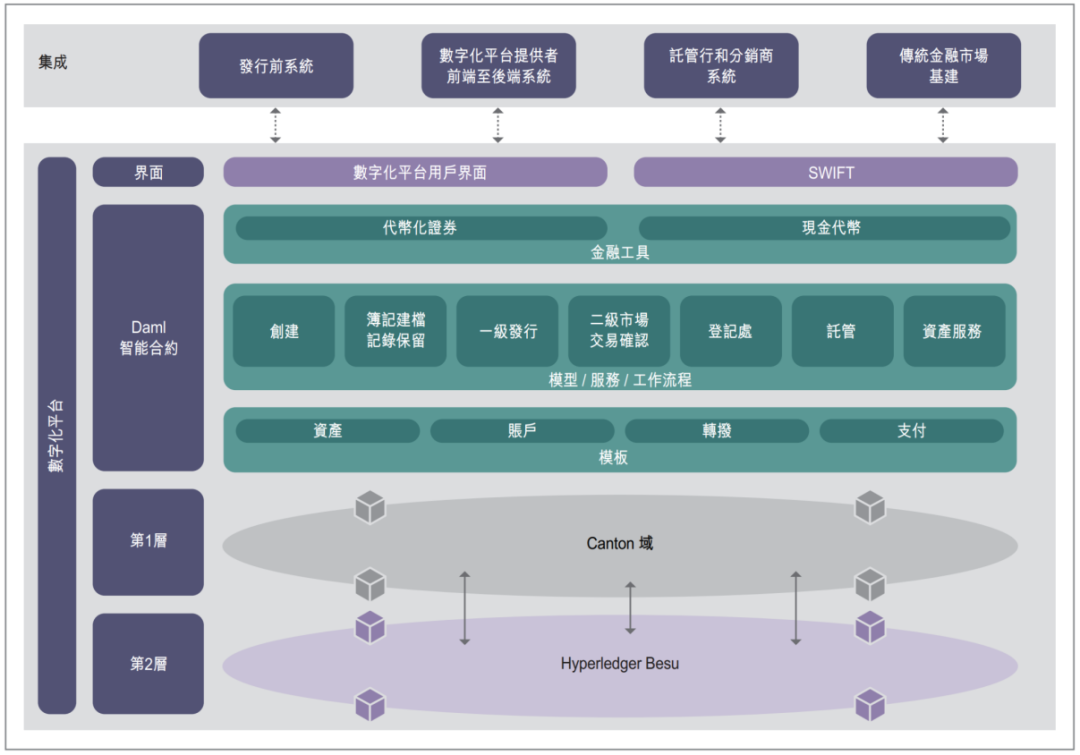
Tokenized asset programmability can also create benefits at the portfolio level over time, allowing asset managers to automatically rebalance portfolios on the fly.
3.2.3 Permissionless democratic access
One of the most touted benefits of tokenization, or blockchain, is the democratization of access. This permissionless entry barrier is compounded by the nature of token fragmentation (i.e., dividing ownership into smaller shares, lowering investment barriers). Afterwards, it may be possible to increase asset liquidity, but only if tokenized markets gain popularity.
In some asset classes, streamlining intensive manual processes through smart contracts can significantly improve unit economics, allowing smaller investors to be served. However, access to these investments may be subject to regulatory restrictions, meaning many tokenized assets may only be available to accredited investors.
Case Study D: Tokenized Private Equity Fund
We can see that the famous private equity giants Hamilton Lane and KKR have cooperated with Securitize respectively to tokenize the Feeder Fund that manages private equity funds, providing investors with an "affordable" way to participate in top private equity funds with a minimum investment. The threshold has been significantly reduced from an average of US$5 million to only US$20,000, but individual investors still have to pass the Securitize platform's accredited investor verification, and there are still certain thresholds.

3.2.4 Enhance compliance, auditability and transparency
Current compliance systems often rely on manual inspections and retrospective analysis. Asset issuers can automate these compliance checks by embedding specific compliance-related operations (e.g., KYC/AML/CTF, and rules such as transfer restrictions) into tokenized assets. Additionally, the 24/7 data availability of blockchain-based systems creates opportunities for streamlined consolidated reporting, immutable record storage, and instant auditability.
3.2.5 Cheaper and more flexible infrastructure
Blockchain is inherently open source and continues to evolve, driven by thousands of Web3 developers and billions of dollars in venture capital. Business entities engaged in Web3 payments can directly choose to operate on public permissionless blockchains or public/private hybrid blockchains. Innovations in these blockchain technologies (such as smart contracts and token standards) can easily and quickly are adopted to further reduce operating costs.
3.3 The tipping point for mass adoption
The previous stage of asset digitization can be fully rolled out with the maturity of technology and measurable economic benefits, but the large-scale and widespread adoption of asset tokenization will not happen overnight. One of the most challenging points is that in financial services, a strictly regulated industry, transforming the infrastructure of traditional finance requires the participation of all players along the entire value chain.
Nonetheless, we can already see the first wave of tokenization arriving, driven primarily by returns on investment in the current high-interest rate environment and practical use cases at existing scale (e.g. stablecoins, tokenized U.S. Treasuries) ).
Blackrock CEO Larry Fink emphasized the importance of tokenization for the future of finance in early 2024: "We believe that the next step in financial services will be the tokenization of financial assets, which means every stock, every bond, every All financial assets will be executed in the same general ledger."
Similarly, the Bank for International Settlements (BIS) also showed great concern for tokenization in previous research reports, saying: "The global monetary system is on the cusp of a historic major leap. After digitization, tokenization Tokenization is the key to a leap forward. Tokenization will greatly enhance the capabilities of the monetary and financial system by changing the way intermediaries serve users; opening up the barriers of information transmission, reconciliation and settlement. economic activities, which are difficult to achieve in the current inherent monetary system.”
Today’s tokenized asset flows are just the beginning of this new frontier of tokenization. The past history of the Internet has been marked not only by the radical reshaping of existing industries, but also by the creation of entirely new business models that were not possible or even imaginable before advances in technology and connectivity.
One of the biggest breakthroughs of blockchain is that it enables "real-world assets" (such as houses, cars, office buildings, factories, concert tickets, customer loyalty points, stock certificates, etc.) to be exchanged in the form of digital tokens with unique identities. Presented online. These tokens allow you to easily track, transfer and store proof of ownership of the corresponding assets online in a digital wallet.
Embedding ownership of these assets in the form of digital currency into the Web3 Internet of Value (directly along with accompanying funding flows) could open up a potential future where virtually anything can be tokenized, Financing and trading without traditional financial intermediaries.
It is Web3 payment that promotes the flow of these values.
Tokenized currency - a new way of currency circulation
After understanding tokenization, we can understand that digital currencies such as stable coins, tokenized deposits, and central bank digital currencies that Web3 payment relies on are all forms of currency that have been tokenized. This kind of digital currency represents a new way of currency circulation based on the blockchain, rather than a new way of currency creation.
With the continuous development of human society, the concept and expression of currency have been constantly changing. From the earliest simple barter of stone coins and shells on the island of Yap, to the invention of coins and banknotes, thus revolutionizing trade. Since then, the advent of globalization and the increasing complexity of economic activities, the demand for more efficient and secure payment methods have promoted the rise of Internet digital payments and the emergence of digital currencies, improving the efficiency, entry barriers and global integration of financial services. laid the foundation for integration.

Although the current form of currency is still dominated by fiat trust currencies guaranteed by national credit, innovative currency expressions such as stable coins, tokenized deposits (Tokenized Deposits), and central bank digital currencies (CBDC) are all based on digital currency and blockchain. Under the guidance of chain technology, innovative currency flow methods under the background of changing times.
4.1 Central Bank Digital Currency (CBDC)
The International Monetary Fund (IMF) defines it as “a digital representation of a sovereign currency issued by the monetary authority of a jurisdiction that appears on the liability side of the monetary authority’s balance sheet.” CBDC designs vary, especially when it comes to Between wholesale CBDC (Wholesale CBDC) designed for large-scale inter-bank transactions by financial institutions and retail CBDC (Retail CBDC) for public use, the latter aims to replace traditional cash payments and conduct modern payments in the form of digital cash.
Among the BIS's pilot projects with national regulators and the top private sector, 15 of the 26 are focused on exploring CBDC and digital currencies. This reflects global recognition of this development trend. These pilots demonstrate the potential for stability, programmability, liquidity and efficient asset transfer of tokenized digital currencies.
Each country has its own motivations and interests to explore CBDC pilots. The Monetary Authority of Singapore (MAS) has proposed an open, interoperable digital asset network framework and is conducting pilot projects in the fields of asset management, fixed income and foreign exchange. The European Central Bank (ECB) emphasizes the need for central banks to remain technologically advanced in order to make cash or central bank currency attractive for transactions and stable in financial innovation. The European Commission has proposed establishing a legal framework for a digital euro, signaling the EU's progress towards a potential CBDC. Hong Kong demonstrates similar motivations, with a focus on the acquisition of practical cases and the exploration of potential functions of CBDC, such as programmability to unlock new transaction types and the development of tokenized markets. At the same time, other markets such as Brazil, India and Kazakhstan are committed to using CBDC to promote financial inclusion. For example, Visa’s pilot project in partnership with Brazil’s Agrotoken uses CBDC to provide farmers with access to digital finance by tokenizing crops as Collateral, and automated payments through smart contracts, reducing costs and risks.
4.2 Tokenized Deposit
Tokenized deposits are digital certificates of commercial bank deposits issued on the blockchain, combining the familiarity and reliability of bank deposits with the advantages of blockchain technology, such as programmability, instant settlement and enhanced transparency.
Tokenized deposits can be designed according to the operation method of regular bank deposits. Like regular deposits, they serve as liabilities of the issuer. Tokenized deposits cannot be directly transferred. The clearing liquidity provided by the central bank will still ensure the normal execution of the payment function.
Tokenized deposits are likely to become the cornerstone of innovation at the application level in the traditional banking financial system, providing innovative momentum for the business of the traditional banking and financial industry.
Case Study E: J.P. Morgan Onyx Network
JPMorgan Chase began experimenting with blockchain earlier, and the essence of its tokenization business relies on tokenized deposits. Onyx, the institutional-level blockchain payment network it built, is currently capable of processing US$2 billion in transactions every day. Onyx's trading volume can be attributed to JPMorgan Chase's "Coin System", which focuses on solving customers' cross-border payment and liquidity financing needs, using JPM Coin as the digital currency for cross-border transaction settlement.
At the same time, JPMorgan Chase launched an asset tokenization platform (Digital Asset), cooperated with Goldman Sachs to launch an intraday repurchase solution, cooperated with BlackRock and Barclays to launch a tokenized collateral network, and cooperated with local municipalities to issue bonds. Not only that, JPMorgan Chase’s application innovations through tokenization also include: After participating in BIS’s Project Guardian project last year, Onyx plans to launch a tokenized fund. Onyx is enabling its JPM Coin tokenized deposit solution for On-chain settlement on the Broadridge platform (DLR).
Case Study F: Visa’s tokenized deposit case
In addition, in a research report on tokenized deposits piloted by Visa, HSBC and Hang Seng Bank, led by the Hong Kong Monetary Authority, some use cases were also given to achieve end-to-end atomic settlement of the payment process, demonstrating It has the potential to improve the efficiency of existing settlement processes and support application innovation.
First of all, tokenized deposits can make full use of the advantages of the unified ledger of the blockchain, reduce settlement risks, achieve instant settlement, and improve the efficiency of fund transfer. For example, in one interbank use case (acquirer – merchant settlement), the acquirer wanted to streamline the settlement process by using tokenized deposits, making it more transparent and seamless for merchants.
In the existing interbank workflow, the acquiring bank processes credit and debit card transactions on behalf of the merchant. When the customer completes the transaction, the acquiring bank initiates the settlement process and ultimately transfers the funds to the merchant's account. This process can take anywhere from a few hours to a day to settle, and merchants lack immediate visibility into settlement status, making it difficult to manage cash flow and reconciliation.

And through tokenized e-HKD and Visa solutions, settlement between acquiring banks and merchants is almost instantaneous. Merchants receive settlement notifications immediately, enabling better transaction reconciliation and reducing the risk of disputes. The immutability of blockchain also provides a tamper-proof audit record, enhancing the overall transparency and trust of the settlement process.
Secondly, tokenized deposits structured on the blockchain can be used as a transaction medium to realize the atomic settlement function of the blockchain with other types of tokenized assets on the chain (such as real estate, securities, commodities, etc.), enabling instant transactions and instant settlement. . This logic also applies to other banking financial system businesses, such as mortgages, pledges, etc.
Finally, in addition to the advantages brought by blockchain, tokenized deposits can realize the programmability of tokens through smart contracts, further enhancing payment functions. These capabilities allow automating complex business logic. Settlement between transaction parties can be more efficient, potentially reducing the number of intermediaries, as ownership transfers and payments can be handled simultaneously through smart contracts.
For example, in a real estate transaction, a buyer can use a tokenized deposit to secure the property and initiate the payment process. Smart contracts can automate the remaining transaction steps and can be triggered as soon as predefined conditions are met, such as completion of due diligence or transfer of property ownership. In this way, the use of tokenized deposits and smart contracts can minimize the need for custody services and reduce manual intervention, thereby reducing transaction costs and settlement time.
4.3 Stablecoin
The explosive rise of stablecoins over the past decade has been particularly notable. A stablecoin is a tokenized currency (digital currency) anchored to a fiat currency (usually the U.S. dollar) that is designed to maintain price stability and avoid the volatility of cryptocurrencies such as Bitcoin. This characteristic makes stablecoins an important financial tool and transaction medium, playing an increasingly important role in encrypted asset transaction settlement, cross-border payments, international trade, etc. Legal currency stablecoins account for more than 90% of the stablecoin market, and the following discussion will focus on legal currency stablecoins.
4.3.1 Explosive growth in stablecoin data
According to SoSoValue, as of July 2024, approximately $165 billion in tokenized currencies are in circulation in the form of stablecoins. According to Coinmetrics, the total stablecoin trading volume will reach nearly US$7 trillion in 2023, of which USDT accounts for approximately two-thirds.
Stablecoins are experiencing an explosive rise globally, and this is clearly a long-term trend. Visa recently launched its public-facing on-chain stablecoin analytics platform (Visa Onchain Analytics), providing a glimpse into the growth of stablecoins and demonstrating how stablecoins and the underlying blockchain infrastructure can be used to facilitate global payments.
The stablecoin trading volume of the entire market has increased by approximately 3.5 times year over year (Year over Year). When the analysis focuses on transaction volume initiated directly by consumers and businesses (excluding automated high-frequency trading, large institutional fund flows, smart contract operations, etc.), in the 12 months ending in May 2024, stablecoins trading volume reached $2.5 trillion. From this perspective, it is 1.5 times PayPal's full-year transaction volume in 2023 (the 2024 annual report shows that Paypal's full-year transaction volume is US$1.53 trillion and Mastercard's full-year transaction volume is US$9 trillion), which is equivalent to the GDP of India or the United Kingdom. .