Summary
Kamino Lend is the largest DeFi protocol on Solana (excluding LST), with a market cap of approximately $2 billion. The protocol has an extreme focus on security and robustness, earning the trust of Solana's core DeFi audience. Now it's time for the next evolution.
Today, we introduced our vision for Kamino Lend V2. Building on the battle-tested V1 codebase, Kamino Lend V2 enables the protocol to scale dramatically while enhancing security, capital efficiency, and flexibility.
V2 will introduce a greatly improved lending user experience, as well as a more sophisticated risk management infrastructure.
Kamino Lend V2 Overview:
- Market Layer
- Vault Layer
- Next generation clearing engine
- Risk Management Framework
- User Experience Automation
3. New products
- Lending Order Book
- Spot Leverage
introduce
Why build on V1?
The V1 codebase has been battle-tested, has undergone 10 external audits, and has been rigorously tested with internal smart contract testing. Our core users have come to trust the security and robustness of the Kamino smart contracts. Additionally, Kamino Lend V1 has evolved into a highly versatile and powerful lending platform - we believe this infrastructure is mature enough to support the next evolution of lending on Solana. This codebase will remain the core primitives, providing the foundational layer for building v2.
Our Vision for Solana DeFi
Solana has expanded rapidly over the past year, with a surge in new projects, assets, and users. However, as detailed in our “ Path to $10B ” proposal, we believe Solana’s breakout growth phase is far from over. We expect a continued influx of institutional traffic and retail users, with a new wave of builders taking advantage of Solana’s scalability and growing liquidity and user base.
The vision for V2 is to establish Kamino as the financial layer that supports the next phase of Solana DeFi development . The foundation has been laid; the next wave of capital is coming, and Kamino will serve it.
Kamino Lend V2
1. Core Primitives
1.1 Market Layer
Kamino Lend V2 will be modular, opening up the V1 infrastructure to enable permissionless market creation and enabling a wide variety of markets on the platform to serve different users, use cases, and risk profiles. Any market can be created using any combination of assets and unique risk profiles.
 kamino-lend-v2 - Market layer
The creation and management of these markets will be done through the open source, permissionless Kamino Manager SDK. Features include:
- Unlimited asset combinations and vault configurations
- Risk Oracle
- Collateral re-hypothecation (collateral yield)
- Customizable interest rate curves and fee parameters
- Automated functionality (revolving, leverage, collateral repayment, collateral swaps, etc.)
- Margin call, deleveraging
- Limit orders (target leverage, take profit, stop loss, deleverage, re-leverage)
1.2 Vault Layer
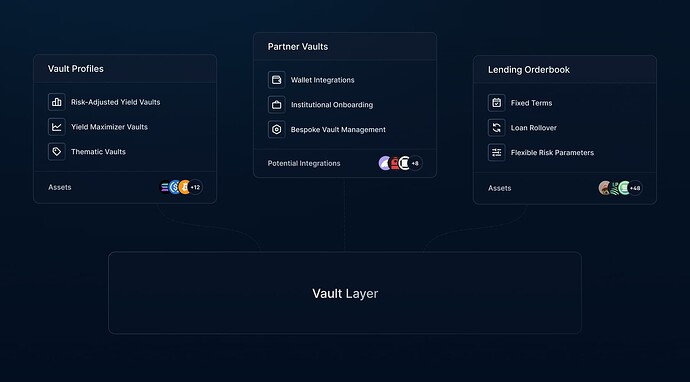
As the market layer grows, yield opportunities will become more diverse and it will become more difficult for users to manually optimize yields. V2 introduces the Vault Layer: single-asset lending vaults that automatically aggregate liquidity across markets to provide optimized, risk-adjusted returns for every major token in Solana.
Vault Profile
The vault layer will support nearly unlimited customization. Each vault can be deployed to a specified set of markets and have a number of triggers and risk parameters, enabling automatic or manual rebalancing.
A simple way to define these vaults is to call them yield accounts or DeFi savings accounts. However, unlike a one-size-fits-all approach, users can choose a vault that is optimized for their yield expectations and risk profile and use the token of their choice.
Some examples of vault configuration files include:
- Risk adjustment: Maximize USDC returns and deploy only to asset markets with high liquidity and low volatility. Trigger conditions: Usage limit for each asset, allocation limit for each market
- Maximizing returns : Maximizing USDC returns indiscriminately across all markets
- Topic : Barbell portfolio, deploying 90% of funds to low-risk markets and 10% to high-risk markets, or maximizing SOL returns by deploying funds only to markets with only LST collateral
Thanks to its flexible Vault infrastructure, V2 will also enable a brand new product on Kamino: order book lending.
 Partner Vault

With the V2 vault infrastructure, Kamino can serve a previously untapped market in Solana DeFi: lending vaults tailored for projects, institutions, and fund managers.
These vaults can be seamlessly integrated into any external platform, providing users with direct access to Kamino yield opportunities while adhering to specific risk and liquidity standards and offering customized fee structures.
There are currently multiple partner vaults in the conception stage, being developed in collaboration with the Kamino Risk Council. These vaults can be customized to meet almost any requirement and will come with dedicated integration and product support. If you are interested in creating and integrating a vault, please contact us here2 .
Curator Vault
With the introduction of the Vault Layer in V2, Kamino will also bring in external risk experts who will work with Kamino’s Risk Committee to manage these lending vaults and ensure their risk/return is optimized.
These Curator Vaults can significantly expand the Vault Layer, allowing a wider range of Vault Profiles to serve a wider variety of users and risk profiles. In turn, these experts will share in the benefits generated from their Vaults. A variety of experienced risk experts are already involved in the onboarding process, working closely with the Risk Committee. The official introduction will be released in the coming weeks.
2. Infrastructure upgrade
In Kamino’s product and development framework, no area has received more resources than protocol risk monitoring and smart contract risk assessment. We believe this is the main reason why Kamino has earned so much trust in the ecosystem and become the preferred lending protocol for Solana users.
Building on the existing V1 infrastructure, Kamino Lend V2 will introduce a wide range of improvements:
2.1 Next Generation Clearing Engine
- Fraud Wick Protection
- Limit Orders
- Liquidation Auction
- Isolation mode and crossover mode
- Interest rate premium
- Dynamic Lifetime Value
- Automatically cancel pledge
- Target Leverage
- Stop Loss/Take Profit
2.1 Next Generation Clearing Engine
Kamino’s approach to clearing infrastructure is based on two key principles:
- Lender solvency is critical : Kamino’s liquidation engine should be extremely reliable, designed to ensure lenders’ (and the protocol’s) solvency under the most adverse conditions
- Liquidations create a bad user experience : Our goal is to build products and mechanisms that protect users from liquidations, and only perform liquidations when they threaten the solvency of the lender.
Both of these principles are reflected in Kamino Lend V1, where flagship products such as Multiply and JLP Market have experienced zero liquidations since launch, and no bad debts have been incurred on the protocol since launch, largely due to its liquidation rules and risk parameters.
Kamino Lend V2 will add three main features:
scam wick protection
We have put a lot of effort into developing a robust oracle and pricing architecture on Kamino. However, sudden market fluctuations can still cause user positions to be liquidated. Even if it is only for a moment, such positions may be liquidated. However, fraudsters can be identified and removed from liquidation, significantly improving the user experience for borrowers.
V2 will introduce scamcore protection, a mechanism designed to prevent liquidations in these situations while ensuring the security of the protocol.

Limit orders are a key financial primitive for Solana’s low-cost, large-scale support. They are extremely versatile and can implement functions such as stop loss, take profit, target leverage, collateral swaps, and zero-slippage liquidation, allowing users to better control their positions, better capture upside, limit downside, avoid liquidation, etc.
Liquidation Auction
In addition to the new limit order infrastructure, V2 introduces a new auction-based liquidation architecture for Kamino, creating a more competitive liquidation environment that benefits both borrowers and the protocol.
In Kamino Lend V1, liquidation penalties are fixed between a minimum and maximum value (e.g. 5-10%). Liquidating users will be subject to a minimum 5% penalty, and the penalty can go up to 10% as the risk of the position increases.
In contrast, V2 only specifies a starting penalty. This is the point in time when the liquidation auction begins. Liquidators then bid to accept a decreasing liquidation fee. With each higher bid, liquidators agree to accept a lower liquidation fee, resulting in users being less penalized.

For Kamino, limit orders and liquidation auctions will greatly improve the liquidation experience, allowing protocols and liquidators to reduce price impact losses during liquidation without being limited by integration complexity. Ultimately, this will allow more liquidators to join and better access to liquidity.
2.2 Risk Management Framework
Due to the inherent volatility of crypto assets, as well as liquidity constraints in Solana DeFi, Kamino Lend V1’s risk parameters have remained relatively conservative since launch. This ensures the security of the protocol and users, but also limits the growth of Kamino Lend V1’s borrowing.
Kamino Lend V2 will introduce three features that will further reduce solvency risk while enabling borrowing to scale more aggressively than V1:
Isolation mode and crossover mode
Segregated mode will allow for more granular in-market risk allocation for specific collateral/debt combinations, allowing borrowing scale to be significantly more secure and efficient compared to V1.
While V1 has a robust debt ceiling and LTV system, the surge in lending activity on Kamino has exposed the inefficiencies of the current system. In V1, debt ceilings are collateral agnostic, meaning that if an asset’s debt ceiling is raised, additional capacity can be borrowed with any collateral in the market - operating on a first-come, first-served basis. In more targeted markets, such as the JLP market, this is less cumbersome. However, in markets with large amounts of collateral and debt assets, such as the Main Market, borrowing can only be done within the highest risk collateral allowed by the market.

In contrast, segregated mode allows LTV and borrowing of specific assets to be adjusted drastically for specific collateral types, while global settings can remain unchanged. Segregated mode can be as granular as needed - for example, a market can set specific caps and LTVs for each collateral/debt combination.
The orphan debt cap has been audited and is in testing in the main market (labeled as orphan cap) and has been proven to be effective in scaling PYUSD borrowing for SOL and wBTC collateral only.
Interest rate premium
The interest premium is an elegant dynamic interest rate system where the borrowing rate is not only determined by asset utilization, but also reacts to the risk of the borrowing position based on its LTV and collateral composition. This is an additional feature of the isolation mode, where a specific risk profile can be set for each collateral/debt pairing.
Under the current usage-based interest rate system, high-risk and low-risk debt positions are subject to exactly the same borrowing rate, while in V2, position risk is factored into the user's borrowing rate through two mechanisms: risk premium and liquidity premium.
- Risk Premium : A premium on borrowing rates based on the risk of a position (LTV). As a position approaches liquidation, borrowing rates rise, resulting in higher interest for lenders while encouraging borrowers to repay their debts and reduce liquidation risk. Risk premiums may be specific to a particular market or collateral/debt combination.
- Liquidity Premium : A premium on the borrowing rate based on the collateral composition. Each collateral asset on Kamino is assigned a risk rating based on Kamino’s risk assessment framework. Pledging riskier assets will increase the interest rate premium, thereby pricing risk into the borrowing cost of the position and rewarding lenders for deploying liquidity against these assets.
Dynamic Lifetime Value
In Kamino Lend V2, LTV can react to collateral price changes. Instead of the LTV of a position changing with collateral price changes (e.g. a 10% price increase would cause the LTV to drop 10%), in V2 the LTV can be anchored to a certain collateral price point.

For example, if a user has SOL as collateral, their liquidation LTV might be 80% and the SOL price is $200. However, if the SOL price increases by 50% to $300, the user's liquidation LTV might also decrease linearly by 50% to end up at 30%. In effect, the user's borrowing power increases at a value lower than the SOL price increase, ensuring that unnecessary risk does not enter the system. In contrast, the current LTV system simply increases borrowing power as the collateral price increases, which can be fatal during a euphoric bull market as debt flows into the system at unsustainable levels.
Different collateral assets may also have different dilution factors, e.g. some assets’ borrowing power may not increase at all when prices rise. These parameters are very flexible and can even vary between different collateral/debt combinations (e.g. more USDC borrowing power is safer than more WIF borrowing power).
2.3 User Experience Automation
Kamino’s Multiply product has proven the value of UX automation to its users. With over $350 million invested in Multiply, the product’s automated revenue cycle, one-click leverage adjustment, and seamless collateral and debt management have enabled people to see the potential of Kamino’s infrastructure.
Kamino Lend V2 will raise the bar, with major improvements to Multiply and a whole new suite of spot leverage products.
Automatically cancel pledge
Since launch, we have put a lot of effort into making Multiply as smooth and secure as possible, with features like collateralization pricing completely redefining the risk landscape for Kamino leveraged staking. V2 will introduce another major improvement to SOL Multiply: automatic unstaking.
One of the biggest UX limitations we’ve observed in Multiply is the risk of price impact when closing a position. Especially for large positions, closing a position can have a significant impact on price, potentially eroding the returns earned through the product itself. Auto-unstaking solves this problem by allowing users to close their Multiply positions by unstaking their LST directly from the staking pool.

When closing a position, users can choose to unstake instead of closing the market. Users do not need to incur slippage to close the market position immediately, they can just wait until the end of the cycle to unstake. They will receive SOL, and there will be no impact on the price when the position is closed.
Target Leverage
Some users may want to always target a 2x long position in SOL or BTC. However, with the current tool, as price increases, the debt remains the same and leverage decreases. Target leverage can help increase exposure as price increases. Likewise, in the current lending model, as price decreases, leverage will increase, bringing users closer to liquidation. Target leverage will automatically reduce the leverage of the position, ensuring it remains at the target LTV and does not reach liquidation levels.
Stop Loss/Take Profit
The new spot leverage products will also feature stop-loss and take-profit automation. These leverage trading tools will allow users to determine the price at which they want to fully close their positions - automating the workflow from start to finish.

3New Products
Kamino Lend V2 will enable a ton of new products on Solana, and to showcase what’s possible, Kamino itself will be launching two new products within the app:
3.1 Spot Leverage
DeFi lending platforms play an important role in helping users leverage their assets. Kamino Lend V2 will launch a new recurring product - spot leverage, which has the following features:
- Optimize the user interface
- Fees are much lower than criminals
- Collateral yield
- Soft Liquidation
- Liquidation protection function
Solana DeFi lacks a UX-optimized solution for long-term leverage at more conservative leverage multiples (2-4x). This product is especially necessary for large holders of SOL, BTC, or Memes who just want to increase medium- to long-term exposure. For example, Perps platforms are generally not able to withstand long-term transactions and often have extremely harsh liquidation conditions.
Kamino Lend has all the necessary smart contract infrastructure, risk management expertise, and deep liquidity reserves to bring a new, cost-effective leverage product to Solana. Spot leverage will be powered by Kamino flash loan and will use the target leverage and stop loss/take profit mechanisms described above.
It is worth noting that leveraged products will utilize Kamino Lend’s funding pool, which means that users will have access to a large existing liquidity pool from day one. In addition, large investors will not be subject to artificial position size restrictions. As long as there is enough liquidity in the market, whales can open large positions at will.
We expect Spot Leverage to serve a core group of SOL, BTC, and Memecoin traders and grow into a widely used exchange with a wide variety of trading pairs.
3.2 Loan Order Book
Lending orders are the final part of the Kamino Lend V2 product suite and will allow borrowers and lenders to fully express their intentions rather than relying on a fixed pool formula. More implementation details will be announced soon.
in conclusion
Ultimately, we envision a future where Kamino’s core becomes increasingly powerful, with continued improvements to risk management, smart contract security, and clearing engines. With an extremely secure foundation, the platform can then develop new infrastructure, products, and use cases.
Kamino Lend V2 is designed to meet both of these needs. With new primitives to support more products, improved security infrastructure, and novel UX improvements, Kamino Lend V2 is designed to serve the next wave of on-chain activity on Solana.
Kamino Lend V2 is expected to start rolling out in Q4 2024, with a core group of vault administrators already beginning the onboarding process, while a range of flagship products are also being developed with various teams in the ecosystem.