TL;DR
- Unlike the previous bull market, which was driven by macroeconomic prosperity, this current round of crypto markets is mainly affected by macroeconomic uncertainty;
- ETF is just an "ibuprofen sustained-release capsule", and the trend of crypto-U.S. stockization has become a "curse" on the industry's growth potential;
- The current bull market is almost limited to Bitcoin. The main reasons for the sluggish performance of Altcoin are the lack of innovation in the overall industry, insufficient liquidity and overvaluation of the primary market. The overall capital driving force is limited, and the market is difficult to increase in volume;
- When industry innovation is stagnant, although the entry of traditional institutions such as BlackRock can provide a certain amount of incremental funds, it cannot change the trend of market involution, and it is difficult to play old songs and support sustained growth;
1. Can the cyclical rise of halving in four years be carried out in a desperate manner?
1.1 The starting point of the bull market is completely different
Perhaps out of resistance to the excessive issuance of national sovereign currencies and monetary policy intervention, Bitcoin was coincidentally born in the context of the global economic crisis. From the perspective of development history, before Bitcoin was widely banned in the country in 2021, China was the main promoter of the encryption industry, and domestic single mining mining volume once accounted for two-thirds of the global total.
At the same time, China's overall economy is developing rapidly, driven by the real estate and Internet boom. The macroeconomic environment before 2021 is favorable, and the central bank's monetary easing policy has stimulated the market's investment enthusiasm. However, as real estate cooled down after 2020 and the overall economy declined, some market liquidity was gradually drained away.
Looking at industry innovation from a rearview mirror perspective, DeFi Summer promoted Ethereum’s inner loop economy and became the main driving force for its explosion. Subsequently, NFT, MEME, and GameFi continued to break through the circle, attracting massive traffic resources and triggering digital collections craze. The rise in market value of the industry has led to an upsurge in the development of the entire industry. However, this round of innovation has mostly been a "reprise of old songs" and has not brought about substantial breakthroughs. Or maybe the bull market hasn’t really arrived yet, and the new narrative hasn’t made enough waves yet.
If the beginning of 2019 to the beginning of 2021 is regarded as the starting point of the last bull market, Bitcoin is in the price range of 4K-1W US dollars, and Ethereum is in the 130U-330 US dollars range. The entire encryption market is small in size and has huge room for growth. But currently, according to CompaniesMarketCap data, Bitcoin's market capitalization is currently ranked 10th in the world, second only to Facebook, with about three times the growth potential of Apple and about 15 times the growth potential of gold. However, compared with the previous bull market, the overall expected growth space has been significantly reduced.
The rise driven by the halving was the core narrative of the last bull market, and the cyclical growth of the crypto market has always been closely related to the macro economy. Since the Genesis Block of Bitcoin in 2009, its market value has exceeded US$1 trillion, which is inseparable from the stimulus of periodic monetary easing. However, the only constant in the financial market is "change." Even if you gain a position, you cannot know the depth of your dive.
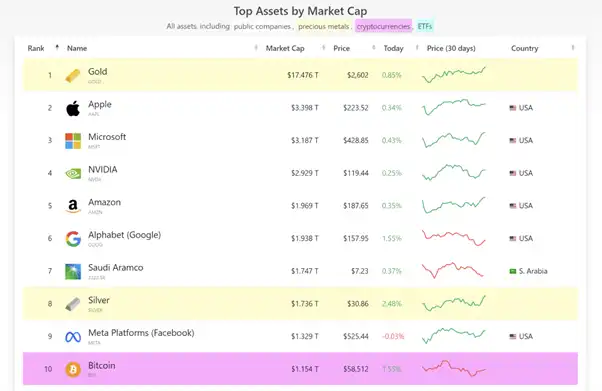
1.2 Where is Bitcoin’s positioning and room for future growth?
Is Bitcoin’s hedging property just a consensus within the circle?
To this day, the US dollar still controls the global economy through pricing power, while gold serves as a "safe haven" for risk avoidance and value preservation. Its historical price highs are accompanied by major crises. The first euphoria began with the collapse of the Bretton Woods system after World War II. The dollar was decoupled from gold, driven by geopolitics and inflation. The second binge began in 2005, when a large amount of money poured into gold havens after the subprime mortgage crisis. After the Libyan war ended in 2011, geopolitics remained a key factor.
After the Third Carnival in 2018, the COVID-19 pandemic and regional geopolitics drove gold prices higher. Overall, gold has always been the first choice for hedging risks, and the US Federal Reserve's quantitative easing to expand money supply and geopolitics are the main driving forces for its price rise.
Moving zone supplement: The price of gold hit a record high of US$2,586.16 per ounce on the 14th, rising by more than US$80 (or 2.8%) last week, marking the strongest weekly performance since 2020.
The positioning of Bitcoin and gold as safe-haven assets seems to have been broken. Gold has skyrocketed, but Bitcoin has failed to keep up. Instead, its price trend has become closer to that of U.S. stocks.
Bitcoin’s greatest value: a tool to resist economic sanctions and lack of trust in fiat currencies
In the context of economic globalization, all countries hope to achieve international circulation, reserves and settlement of their own legal currencies. However, the trilemma between monetary sovereignty, free capital circulation and fixed exchange rates still exists. From what I felt after reading "Currency War", paper money itself has no value. It only relies on the national credit endorsement. Those who control the currency issuance power can actually be above the law.
Even if it is as strong as the hegemony of the US dollar, it will be difficult to support such a large-scale credit endorsement for a long time. Behind global economic globalization, the essence is the unsolvable contradiction between monetary globalization and national interests. For example, El Salvador adopted "fiat currency dualization" to promote the use of Bitcoin across the country to weaken the hegemony of the US dollar. Russia has allowed residents to trade cryptocurrency and use it for trade settlement since September 2024 to circumvent sanctions.
The embarrassment of Bitcoin is that its value comes from hedging the risk of trust in legal currency, but its upward momentum depends on the policies of powerful countries, the adoption of monopoly capital, and the influence of the macroeconomic environment. This dual dependence allows Bitcoin to challenge the traditional financial system while still being constrained by its rules.
2. ETFs only provide short-term pain relief, but they are not a cure-all.
2.1 The post-encrypted ETF era: failed great power confrontation

Bitcoin coincidentally was born in the context of the global economic crisis. The unique attributes of blockchain have the potential to resist the over-issuance of national sovereign currencies and monetary policy intervention. Anti-power, advocating freedom, and decentralization were once the beliefs and slogans of the industry. However, most of the "players" in the industry are speculative. Getting rich overnight seems to be the primary productivity driving the development of the industry. Although the launch of Bitcoin ETF is a good thing, it is ultimately just an unavoidable one-time event and cannot support the market in the long term.
Once upon a time, most of us embraced the belief of resisting power, but now we place our hope in the power of power. In Utopia, we seem to only care about profits and not direction. The market is filled with cheers for the benefits of ETFs, and everyone is looking forward to the influx of more funds to take over for us. However, those of us who once fought hard against the powerful are now giving up our achievements to the powerful step by step. This change reflects the profound contradiction between ideals and reality.
BlackRock, Vanguard, State Street and other giants control the world, and now BlackRock is controlling Bitcoin.
The most influential company in the world is actually not Apple, Tesla, Google, Amazon or Microsoft, but the world's largest asset management company. BlackRock is one of them. From 2009 to 2023, it has been the world's largest asset management company for 14 consecutive years, managing trillions of dollars in assets. Compared with technology giants, these asset management companies have more profound economic influence through the global flow of capital.
The intuitive impact of the post-ETF era is that crypto asset prices will be closer to the trend of traditional finance. Only by mastering more chips can we have a greater say in the industry. Today, the United States is gradually controlling the development of the encryption industry through ideology. According to news from QCP Capital on September 10, economic uncertainty has become a dominant factor in the crypto market. The 30-day correlation between BTC and the MSCI World Stock Index reached 0.6, close to a two-year high. This suggests that Bitcoin’s price movements are increasingly influenced by the performance of global stock markets.
The encryption industry did sprout in China at first, but now the "big dealer" has changed, and more professional competitors are emerging. In the future, in addition to screening brand IP and track sectors, you will also need to have strong trading and transaction capabilities. The Matthew Effect will penetrate into every corner of the industry, and the crypto world is gradually ushering in "Wall Street-level" transaction difficulty.
2.2 The gold rush metaphor
Looking back at the California Gold Rush more than a hundred years ago, hundreds of thousands of gold diggers with the dream of getting rich overnight flocked to California from all over the world. However, most of them returned empty-handed in the end, and even paid the price with their lives. In contrast, Levi Strauss found another way and took advantage of the gold rush to make trousers made of canvas that he had accumulated and sold them to gold miners. They were very popular because of their practicality. Later, he improved the trousers, became the founder of jeans, and founded the now world-famous Levi's company.
Interestingly, PoW’s Bitcoin mining is similar to PoS’s Ethereum staking to some extent. The mining boom of PoW allows "gold diggers" to carry mining machines on their shoulders, while the staking wave of PoS allows them to go into battle with their own capital. However, characters like "Levis" are everywhere - behind this game is that you are betting on getting rich overnight to realize your dream, but I am betting on the capital you have. The 24/7 global and uninterrupted transactions of the blockchain have brought countless opportunities to "gold diggers", but it has also made the market particularly prone to ups and downs. High risks are accompanied by high returns, profits and risks. Constantly influencing everyone's courage and diligence.
Behind the fast pace, non-stop trading and high volatility of the market are both tempting traps and unlimited trading opportunities. This is the greatest charm of Crypto. The dual blessing of strong financial attributes and low entry barriers makes Crypto a Natural and high-quality large gold mines, we once shouted that the benefits of ETF will bring more OTC funds, but after the adoption of ETF, it also opened the door for more Levi Strauss, creating more arbitrage and Opportunities for indirect revenue.
The crypto market will involve more “Levis”
ETFs not only bring about the "acquisition" of position funds, but also risk hedging transactions. The biggest innovation of blockchain at present is to put finance on the chain and establish a "self-cultivating economic cycle" in the encryption market, successfully blocking the direct intervention of powerful and traditional capital. However, entering the post-crypto ETF era, the crypto market has given up a full range of financial derivatives to some extent. This will only attract more arbitrageurs and big funds to enter the market, further compressing the already limited market profit margins and weakening the market. Innovation drive and freedom in the market.
3. The primary market is difficult to break the ice
Primary market with low circulation and high FDV
Recently, the financing situation in the primary market has changed significantly compared with the past. Listed tokens generally show extremely high FDV (fully diluted valuation) and low liquidity. According to Binance’s "High Valuation, Low Circulation Tokens" According to the information provided in "Current Observation and Thoughts", the ratio of market capitalization (MC) to FDV of tokens launched in 2024 is the lowest in recent years. This shows that a large number of tokens will still be unlocked in the future, and the FDV of tokens issued in the early months of 2024 is already close to the total in 2023.
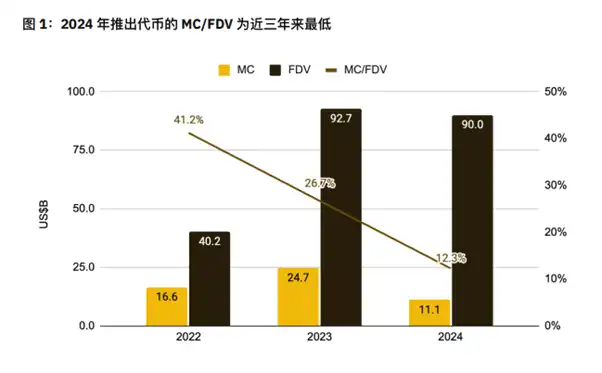
In a market that generally lacks liquidity, tokens are gradually unlocked after TGE (Token Generation Event), which brings a lot of selling pressure to the market. However, have VCs really made money in this market? Not necessarily. Typically, for compliant and regulated project financing, there is at least a one-year cliff period for token unlocking. However, when a project has high FDV and low liquidity, it is very easy to encounter a breakout after unlocking. But this does not rule out the possibility that some small VCs may make profits through secondary market dumping or early over-the-counter sales. As shown in the figure below, the circulating supply ratio of these tokens is generally lower than
20%, the lowest is only 6%, the high FDV phenomenon is very significant.
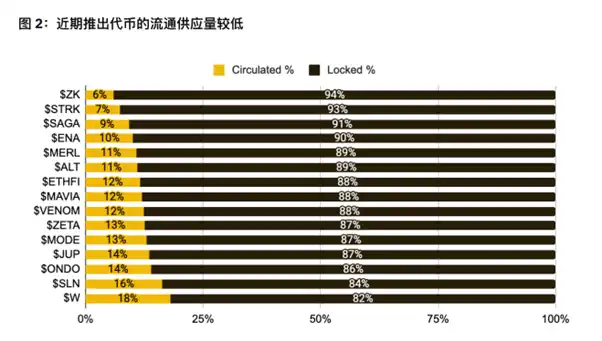
The capital-driven benefits at this stage have obviously been temporarily ineffective. In addition to the aforementioned reasons, there are also some objective factors that have led to the current low circulation and high FDV market situation:
1. The market is fragmented, with more wolves and less meat: In the last bull market, global capital was working together to hype DeFi and public chains. However, in this round of the market, funds and participants are too scattered, the narratives are diversified, and Eastern and Western capital are not mutually exclusive. In order to receive orders, it often happens that there are not enough takers for the coins being offered, and the market is fragmented;
2. Lack of copycat bull market and lack of motivation for speculation: The infrastructure of the EVM public chain has tended to be perfected, funds and projects have been rolled in in the same direction, and the Ethereum killers have not brought new breakthroughs. In the absence of a bull market for Altcoin, after the benchmark project came out, projects of the same type quickly emerged, which in turn exacerbated the value depression effect;
3. Simple things are complicated, and complex things are turned into stories: Pseudo-innovation can be seen everywhere in the market, and simple things are artificially complicated, just to tell the market about bigger dreams, which is essentially changing the soup without changing the medicine;
4. The Matthew Effect is becoming more and more obvious: the encryption industry has been developing for nearly 16 years, and top-level monopoly benefits have basically been generated. Whether it is technology, projects, or capital, the strong ones have become stronger, and the weak have become weaker. The market for top companies has The right to speak becomes more and more stable;
5. Lack of innovation and liquidity: The primary challenge facing the current market is the lack of innovation and insufficient liquidity, which makes it difficult for the market to increase in volume and the overall development to reach a bottleneck.