The Federal Reserve announced in the early morning of today (19th) Taiwan time that it would lower the benchmark interest rate by 0.5% (2 yards) to 4.75% to 5%, launching the first interest rate cut since 2020 and ending the most aggressive interest rate increase since the 1980s. cycle.
However, Fed Chairman Jerome Powell emphasized at the post-meeting press conference that this sharp interest rate cut will not become the norm. This decision is to maintain the stability of the economy and the job market, rather than to express serious concerns about the economy. The downside zone is You summarize the key points of this interest rate cut decision and Ball’s press conference remarks.
Powell explains why he cut interest rates
Ball explained at the post-meeting press conference that the Fed’s decision to cut interest rates sharply this time was based on a balance between inflation and risks and in order to maintain the stability of the job market, especially when it begins to show signs of slowing down. Next, he said:
The labor market is actually in good shape, and our policy actions today are designed to keep it that way.
Interest rate forecasts and economic outlook
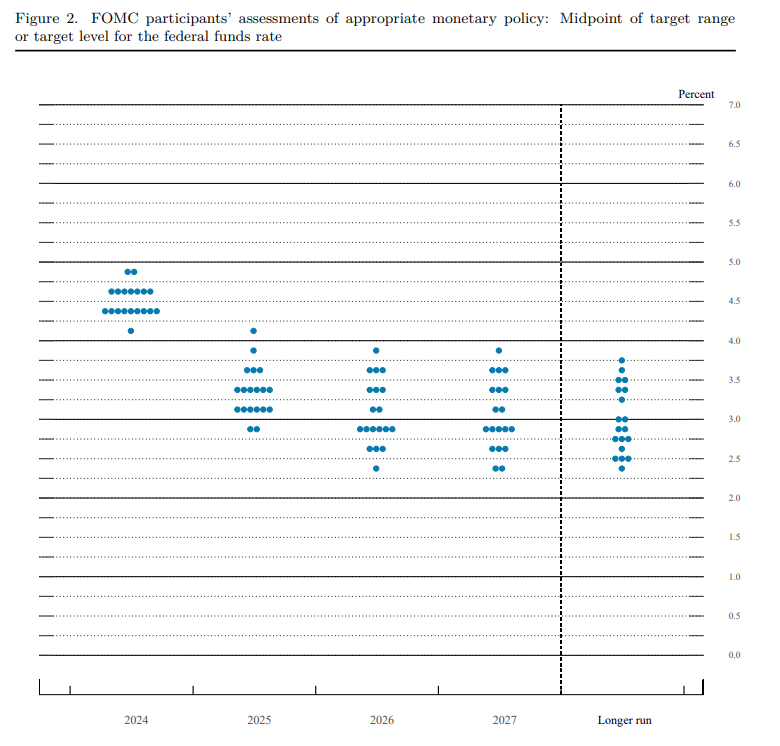
According to the Fed's latest interest rate dot plot, policymakers expect a total of another 2-yardage rate cut in the last two meetings in November and December this year. It may be a 1-yard rate cut in each of these two meetings, or It is in these 2 meetings that there may be a 2-yard rate cut in one meeting.
At the same time, Zhentu predicts that there will be four interest rate cuts in 2025 and two in 2026, which means that the end point of the interest rate cut may fall in the range of 2.75% to 3%. Ball also added that future interest rate levels are unlikely to Return to pre-pandemic ultra-low levels.
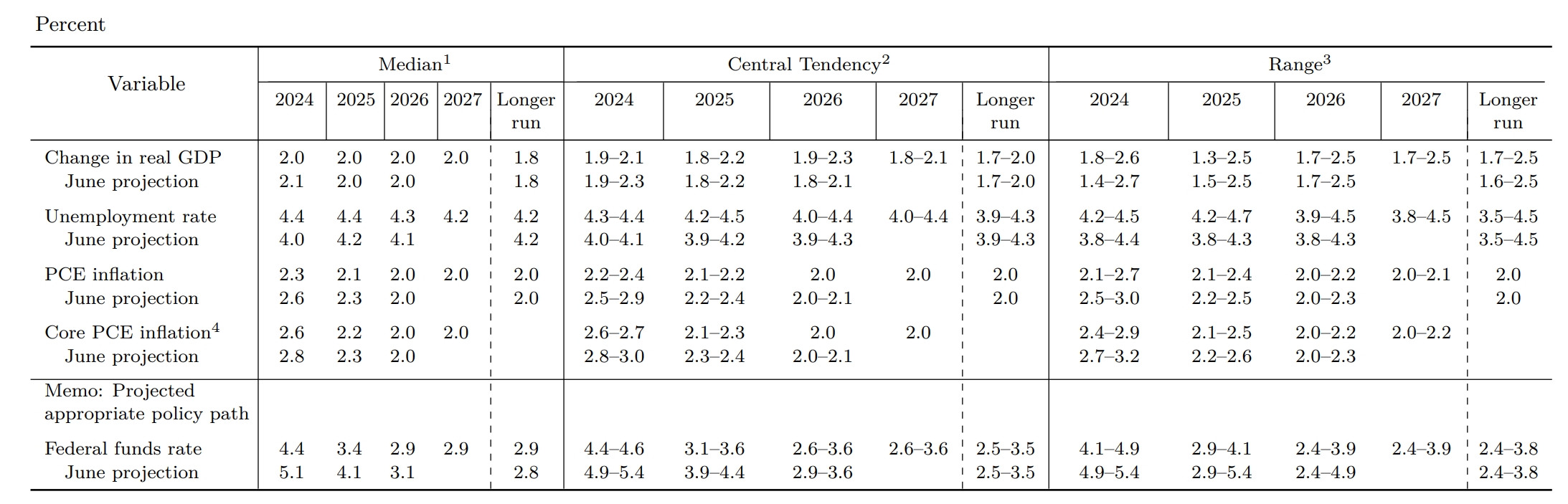
In addition, in its latest forecast, the Federal Reserve predicts that inflation will decline faster than the forecast three months ago, but the unemployment rate will also be higher. The inflation indicators it focuses on, personal consumption expenditures (PCE) prices The index will fall to 2.3% by the end of this year, down from the current 2.5%, and to 2.1% by the end of 2025.
The unemployment rate is expected to rise further this year, from the current 4.2% to 4.4%, and will remain at 4.4% at the end of 2025. This is higher than the forecast three months ago of 4% unemployment at the end of this year and 4.2% in 2025. ; US GDP is estimated to grow by 2% this year, 0.1% lower than the forecast in June.
For the first time since 2005, FOMC members voted against
However, it is worth noting that the Federal Open Market Committee (FOMC)'s decision to cut interest rates by 2% was passed with 11 votes in favor and 1 vote against. Michelle Bowman, a member of the Federal Reserve Board of Governors, opposed a 2-point rate cut and supported a 1-point rate cut, becoming the first Fed member to vote against the Fed's interest rate decision since 2005.
Bowman has always been cautious about the slowdown in inflation. On August 20, she said that price growth was still higher than the 2% target and interest rates should be cut “gradually.” Ball admitted at the press conference that among FOMC members There are objections, but it is emphasized that the decision has broad support and there are many common positions among decision-makers.
Views on inflation and recession risks
There are two main changes in this FOMC statement: first, it emphasizes that the authorities have increased confidence in combating inflation; second, the authorities' focus begins to shift towards employment, and a new part indicates that they are committed to supporting full employment.
Ball said that inflation has not yet been fully reduced to the 2% target. The Fed chose to wait longer before cutting interest rates because it gave policymakers more confidence in the downward trend of inflation. The Fed did not believe that the interest rate cut was lagging behind. The risk of economic recession has not increased significantly, and there are currently no signs in the economy that indicate an increase in the probability of economic recession.
As for whether a series of interest rate cuts of 2 yards will continue in the future? Powell emphasized that "a 2-point interest rate cut should not be regarded as a new policy direction." Substantial interest rate cuts will not be the norm. The Fed will accelerate, slow down or suspend the pace of interest rate cuts under appropriate circumstances based on economic data. Make adjustments.