What is Pre-Market Trading: The Important Trading Window Before the Market Opens
In the traditional financial market, the time during which you can buy and sell is limited . There is only a window for trading every working day from Monday to Friday. You cannot buy or sell immediately if you want to. Therefore, pre-market trading refers to a window for investors to conduct transactions in advance before the market officially opens.
The regular trading hours of the stock market are usually from 9:30 am to 4:00 pm EST, while pre-market trading starts at 4:00 am and ends when the market officially opens.
This window provides investors with more flexibility, especially when important financial reports, economic data or international events occur. Pre-market trading allows investors to react more immediately and quickly adjust their positions.
Pre-market trading is different in different markets: traditional stock market VS cryptocurrency
However, in the cryptocurrency market, the concept of pre-market trading is different. Cryptocurrency exchanges operate 24/7, so the pre-market trading function refers to providing users with pre-market access before the "spot market" is officially opened for trading. Token opportunities.
This means that investors can gain early access to specific tokens before others enter the market.
Why Pre-Market Trading in the Cryptocurrency Market?
Some people may think that since cryptocurrencies can be bought and sold at any time, if there are new coins to be listed, they can just snap up and buy them when they are launched. Why should they participate in pre-market trading?
In fact, for a market like cryptocurrency that pays great attention to news and has a popular airdrop culture, pre-market trading is a window of opportunity to increase profits!
・Enter the market early and seize the opportunity: Users who have received bonus token airdrops in advance, or who want to grasp the project chips early, can lock in a specific price to buy or sell tokens before the spot is officially listed on the project.
・Obtain important trading information in advance: Investors can evaluate the trend of a token after the official opening through the performance of pre-market trading, and decide whether to participate in the trading after the official opening.
・Reduce competition and increase liquidity: There are usually fewer investors participating in pre-market trading, so competition is relatively reduced. For users with better market acumen, pre-market trading provides a relatively favorable price and trading environment. At the same time, this can also help exchanges obtain liquidity before the market opens, making the market more stable after official trading begins.
・Using volatility to create short-term arbitrage opportunities: Cryptocurrency markets are highly volatile, and price volatility is even greater during pre-market trading hours. For some users with higher risk tolerance, the volatility of pre-market trading is actually a good short-term arbitrage or speculation opportunity. If you can correctly predict the price trend of a token, you may have the opportunity to make profits through quick entry and exit operations.
The process of cryptocurrency pre-market trading: pre-market trading, currency delivery, spot listing
Taking several exchanges that have opened pre-market trading as an example, the procedures for most pre-market trading are similar.
Pre-market trading stage
Buyers and sellers participating in pre-market trading use the ideal price and quantity to place or take orders in the pre-market trading market before the new currency is officially listed for spot trading (usually for a few days to a week or so). The platform will lock the user's order amount (usually USDT) as a margin for subsequent delivery.
On some exchanges, there is a limit to the number of tokens that can be purchased during the pre-market trading period, and there is usually no sale.
Currency delivery stage
Before the delivery time is reached, the seller who "sells tokens" in pre-market trading needs to prepare enough project currency for the order for delivery, and the buyer who "buys tokens" sometimes needs to lock in sufficient margin.
Delivery completion stage
After the delivery time is reached, the buyer and seller will complete the transaction. The seller will receive income according to the price of the pending order, and the buyer will obtain tokens according to the price of the pending order. It should be noted that on some exchanges, if the seller's order defaults (the token cannot be delivered on time), the seller will have to compensate the buyer for the deposit due to the breach of contract.
Which exchanges are open for pre-market trading: Binance, OKX, Bybit, Bitget, Gate
In response to the needs of users, almost all mainstream cryptocurrency exchanges have joined the ranks of pre-market trading, including Binance, OKX, Bybit, Bitget, Gate and other exchanges, which all provide pre-market trading services.
However, it should be noted that the pre-market trading currencies provided by each exchange are different, and the current transaction prices are also different. Because pre-market tokens are not yet liquid, the price difference between pre-market trading on different exchanges is larger than spot trading. Users can make more comparisons and choose the exchange that is most suitable for pre-market trading.
What are the pre-market trading markets for on-chain cryptocurrencies: Whales Market, Aevo, Bubbly Fianance, Hyperliquid
In addition to the pre-market trading market provided by the exchange, there are also several well-known pre-market trading DeFi on the chain. In addition to trading tokens, community points for projects can also be traded in advance. In particular, most projects also have their own tokens, which together can provide more diverse and complex gameplay. Advanced DeFi players can refer to it!
For example, $Eigen, which was recently listed on Binance, users who know how many airdrop shares they have can lock in a specific selling price in the on-chain market in advance, trade the tokens in advance, and then officially open the market when others are fighting in the market. , your profits have been safely pocketed, and you can avoid fluctuations caused by macroeconomic or global events like this time after the official opening.
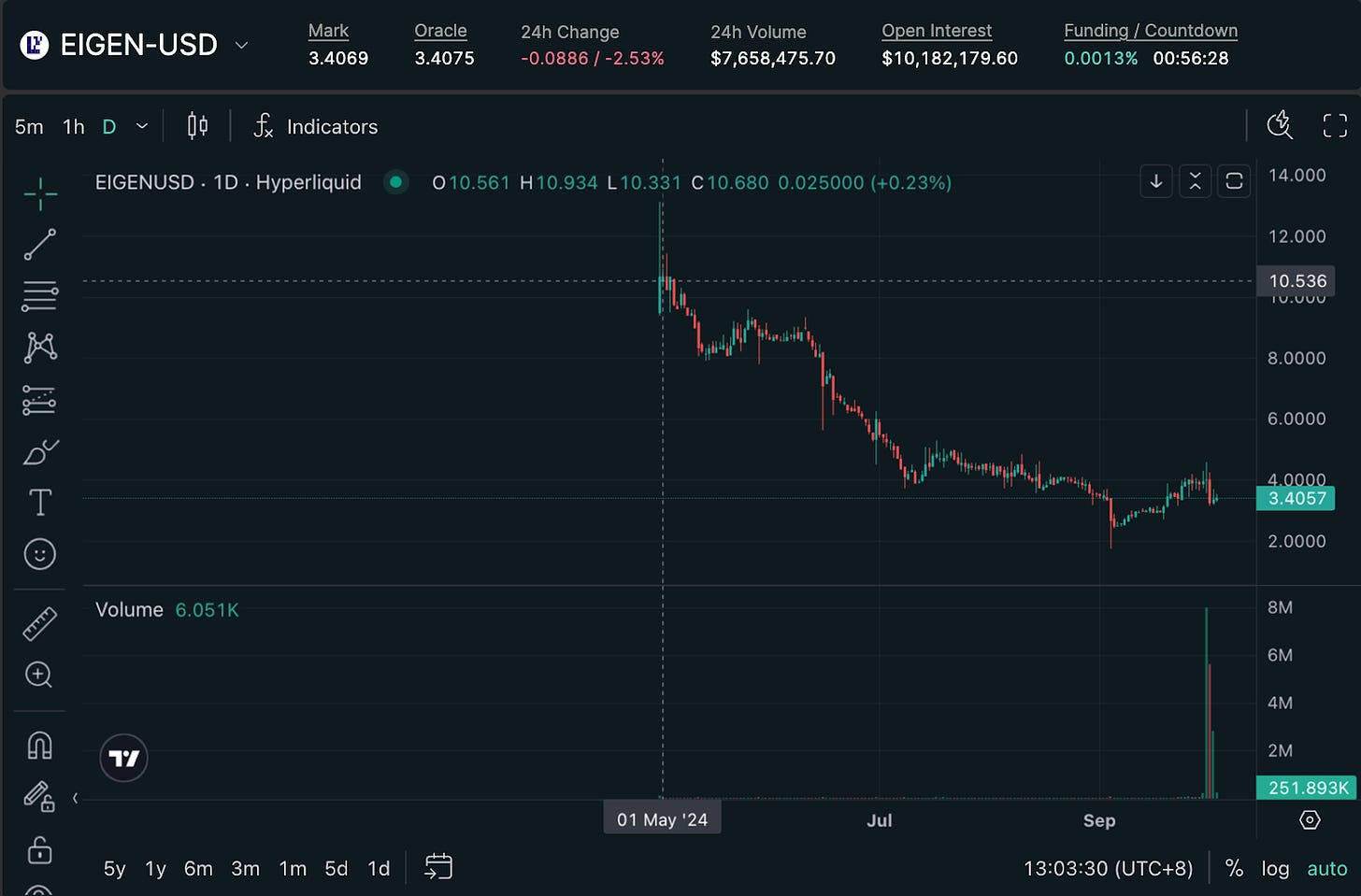
When the Eigenlayer token was initially listed on Hyperliquid, the price reached an astonishing US$10.5. Subsequently, before being listed on Binance, the price also slowly rose to around US$4.5.
https://app.hyperliquid.xyz/trade/EIGEN
Before the official opening, people who don’t have chips can also go to the on-chain market to try to find bargains, buy chips at a price you think is undervalued, and sell them when the tokens are released and the opening price is higher than the buying price. A nice arbitrage. (Most on-chain pre-market markets have a margin mechanism, which means that if the seller is ultimately unable to deliver the token, the buyer can still obtain an equivalent deposit)
▌Recommended reading: Pre-trade before the market opens! Introduction to Sol chain derivatives market Whales Market
Risks of Pre-Market Trading in Cryptocurrency Markets
While premarket trading seems positive and has many benefits, it also comes with corresponding risks:
・Poor liquidity: Compared with the spot trading market, there are usually fewer risk participants in pre-market trading, and market liquidity is low. Therefore, price fluctuations will be larger, and the price difference between buy and sell orders is usually larger than in formal spot trading. In the case of insufficient liquidity, investors may not be able to complete transactions at the desired price, and may even face losses due to the inability to operate immediately when prices fluctuate rapidly.
・Severe price fluctuations: During pre-market trading hours, the market tends to overreact to news. Especially in the cryptocurrency market, new tokens often lack a stable price basis, resulting in large price fluctuations in the short term, which is for some risk appetites For lower investors, this may be a disadvantage.
・Market information asymmetry: Since participants in pre-market trading are usually institutional investors or professional traders with more market information, ordinary investors are often at a disadvantage in obtaining relevant information. This asymmetry may cause ordinary investors to Unable to make the best trading decisions, putting you at a disadvantage in pre-market trading.
Finding the differences in information and choosing the right time to leave the market is the charm of pre-market trading.