Hosted by the decentralized oracle Chainlink, the SmartCon event was grandly held at the Kerry Hotel in Hong Kong from 10/30 to 10/31, attracting many heavyweight international traditional financial giants. It can be said to be a milestone first large-scale dialogue conference between the web3 and traditional finance industries. The BlockTempo reporter also attended the selected sessions on 10/30 and brought the readers the latest reports. This article will introduce the topic of ''Which Web3 field will thrive by 2025?''.
Opening and Guest Introduction
Kris Fok: Before looking ahead to 2025, let's start with a simple introduction.
Chris Brewer: I'm Chris, the CEO of Infinity Exchange. Our company has been operating in the social service industry for many years and is committed to building a strong community. We are leaders in this industry and have our own research and safeguards.
Kevin He: I'm Kevin, from BitlayerLabs, building native Bitcoin Layer2.
Derek Lim: Hello everyone, I'm Derek, from Ghaf Capital, focusing on research in 5G expansion and leasing.
Robbie Nakarmi: I'm currently a representative at Statinfo Ventures and a postgraduate student at the University of Northampton.
Guest List:
- Finoverse Web3 & Crypto Head Kris Fok (Moderator)
- Infinity Exchange Chief Strategy Officer Chris Brewer
- BitlayerLabs Co-founder Kevin He
- Ghaf Capital Partners Web3 Head Derek Lim
- Standard Chartered Ventures Investment Director Robbie Nakarmi
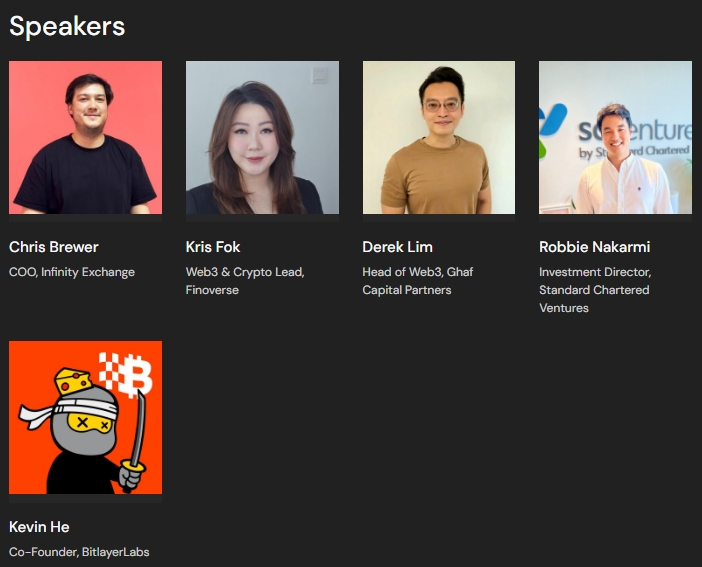
Reflection on the Current Situation and Challenges
Kris Fok: Before we look forward to the exciting opportunities in 2025, let's take some time to reflect on the current situation.
Kevin He: Although we face many obstacles and challenges, I still believe we have achieved substantial growth and investment in this field.
Kris Fok: Now, let's delve into some of the major trends and areas to see what's coming next. I'd like to start by hearing from Derek and Robbie. You are at the forefront of innovation and development, so which parts of the Web3 industry are currently attracting the most attention and funding, and what are the driving factors?
Derek Lim: From a vertical perspective, there are several very noteworthy aspects. I want to focus on one area that is rapidly expanding, which, although people may talk a lot about, has indeed become an independent vertical market.
Kris Fok: People sometimes struggle to truly apply the additional layer or base layer to certain things, and when products fail to meet expectations, their valuations are exposed to real deficiencies.
Derek Lim: Yes, that's why some meme coins are now facing challenges, as many things may not have reached their expected valuations, especially in certain specific projects.
Kris Fok: So people start to rely on "hope", which sounds quite ordinary, but it does reflect the real situation of the current market. However, there are still many interesting trends emerging, and I'm happy to explore them.
Robbie Nakarmi: I completely agree with Derek's view. In the previous discussion, we now see a bifurcated market, with institutional investors focusing on mainstream coins like BTC and ETH, while meme coins attract a lot of capital due to their culture and speculative nature.
Kris Fok: The market seems a bit divided.
Robbie Nakarmi: That's right. Firms like BlackRock and Franklin are doing business in their respective fields, while other groups focus on more niche markets. Interestingly, these markets may share the same underlying infrastructure in the future. As Solana has grown in this cycle, many institutional investors have become interested in it, especially in the DeFi and liquidity staking areas. This also explains why we're here at the Chainlink SmartCon, as Chainlink is working on this.
Institutional Investment and Major Trends
Kris Fok: So now we know the direction of the funds, but do you think this diversity will continue next year?
Kevin He: I think the meme coin craze will continue, but more importantly, the interest of institutional investors is growing stronger, with more banks like JPMorgan and Nomura researching this field. Although some banks have not yet fully entered, many are formulating strategies, and for some institutions, they are more inclined towards permissioned blockchains, while others believe that value will accumulate on public blockchains.
Kris Fok: We also believe that the two will coexist, but a lot of infrastructure solutions are needed to connect them.
Robbie Nakarmi: Over time, the public permissionless blockchains will have the advantage, as the activity there will become more and more. But we are still in the early stages.
Kris Fok: Should we continue to focus on L1 and those impressive teams next year?
Robbie Nakarmi: Absolutely. Teams like Aptos and Sui, as well as the development of the Move programming language, we've seen a lot of great developers from Solidity and Rust backgrounds, these are innovations worth watching. Although EigenLayer and ETH are currently receiving some criticism, we know that the most concentrated talent is here, and their efforts should not be overlooked.
Opportunities and Challenges in DeFi
Kris Fok: So Derek, what are your thoughts on this trend?
Derek Lim : I'm very excited about the further development of DeFi. This is a broad field covering many aspects. We are seeing DeFi integrating with traditional markets, the first wave of DeFi has stripped the principal of the yield, and through its composable loops. Now many teams are innovating on this basis, such as Perk Finance is realizing on-chain project launches, similar to how Binance operates. They are working with real invoice companies at real speed to truly solve the borrower's problems, and then when you do that, you can strip from the lender.
Kris Fok: That's really interesting, these new models provide a stable source of fuel for capital efficiency. Do you think DeFi will continue to lead the trend in 2025? They all seem to be doing so. What about you?
Derek Lim : So I absolutely agree. I think the future of DeFi is indeed in the permissioned blockchain space. We still need gatekeepers and checks around KYC and AML. These are where topics like decentralized identity come in. Along with the integration of anti-money laundering policies, the future of DeFi is actually within the rules and regulatory framework, which will become the industry standard. So I think this is also a very important issue that the ecosystem must solve. In terms of user experience, from a capital perspective, I also think another key trend is intent-based training, which is, you know, our key obviously this is a smart scam.
Kris Fok: This indeed solves the fragmented liquidity we see in DeFi today.
Derek Lim : So when it comes to these two trends, I think blockchain throughput is a core growth. Then in the UK, KYC, AML has been adapted for DID. Then in price discovery and price execution, I think intent-based trading will ultimately. Guide us down a path where the slippage we see in DeFi will actually be comparable to the global CeFi impact on price slippage based on the US dollar.
The Gap in Long-Term Yield Products: Innovative Opportunities in a Non-Arbitrage Environment
Derek Lim : Some background on Infinity. So when it comes to the broader market, Infinity is building infrastructure for the financial markets. So able to generate a cash yield curve.
Kris Fok: As a reference rate for CeFi and DeFi trading companies.
Derek Lim : There is no duration in cryptocurrencies. So in terms of exposure, everything is extremely short-lived. Key examples are the open interest data we see in professional markets with various options and term futures.
Infinity provides a repo market for lenders and borrowers. So we typically refer to price discovery as the rate at which one party matches the other. In our case, it is the rate at which lenders and borrowers match. Specific quantities and specific terms, which can be floating forward a minute or a fixed term to maturity, we can say a week or a year. The purpose of the yield curve is to price capital assets. Generating the ability to be risk-free.
Kris Fok: Equivalence is very important. If we look at the major currency pairs and derivatives, most of the interest is still traded in USDC or USDT. We raise the question.
Robbie Nakarmi: There are two issues. The first is that USDC and USDT do not transmit interest.
Derek Lim : Interest rates are used as the base rate for consumer products like loans and mortgages. So ultimately, you're faced with a split between flow and fixed income, and then the interest rate pricing held by retailers.
When it comes to DeFi adaptation, this is a very simple argument for us. We are all equal. So if you can enable Institute flow in the core products of the financial markets.
Kris Fok: Chris, I'd like to further discuss Infinity Exchange and its focus on the real-time branch market. Can you share why you chose this field?
Chris Brewer: Infinity is building the infrastructure for financial markets, and we are focused on providing a cash yield curve as a reference rate for CeFi and DeFi. Currently in the crypto market, there is a lack of longer-term products, which means our products focus on generating a non-arbitrage yield trading environment.
The Bitcoin Second Layer
Kris Fok: So today we are seeing a very solid, constantly evolving ecosystem.
Kevin He: How do you see the entire Bitcoin ecosystem evolving into a true Bitcoin? In fact, before I started building BitLayer on the Bitcoin second layer, I actually delved deep into the Bitcoin ecosystem, and in fact I was very invested in ABCD Capital. We've seen a lot of projects in the Bitcoin second layer or the Bitcoin ecosystem. Finally, we decided, I decided to enter a specific area, such as the Bitcoin second layer.
Because we believe we do have the opportunity to do something different, because they actually most Bitcoin second layer projects actually do a side chain check, which means it's actually an independent blockchain parallel blockchain. Without much connection to Bitcoin itself, no strong connection, so it's not secure enough, so they do have some hopes, like large EM, rather than the next upgrade like OPCAT and OTP, CTP to improve this.
Kris Fok: So we decided to connect it with this region, for a simple reason.
Kevin He: And after more than a year in this field, we feel that there are three interesting things.
First, the market environment is changing, including the upcoming ETF and the US Treasury Department. Other countries may also follow this strategy. There are also institutional and retail customers in the industry, and perhaps even households. Their Bitcoin strategy needs to be considered. So the market is actually changing. Secondly, we believe that there is a strong demand from users for BTCFly, as it is a very old-fashioned project.
Bitcoin business, which is liquidity leasing. But they don't want to sell Bitcoin. This has actually been a very realistic demand for many years. This can actually be done on-chain. And when so many institutional clients and retail clients hold a lot of Bitcoin and its derivative assets, they actually have a lot of financial needs, such as hedging, arbitrage, and earning income. This actually happened before CEX, like Binance and OKEx.
Kevin He: In fact, Ordinals is not a startup. It comes from the demise of the entire community, because after a series of halvings, the system liquidity of the Bitcoin ecosystem should be maintained by on-chain transaction fees, rather than through block subsidies. So that's why the next upgrade, in fact I will be hosting an event focused on the next Bitcoin upgrade next month. So I think that's what's really changing. That's why I think Bitcoin will be very promising in this part by 2025.
Blockchain Technology Stack: Innovative Applications for Offline Transactions
Kris Fok: Last question: Which blockchain field are you most optimistic about next year? You can't choose DeFi or the Bitcoin ecosystem.
Robbie Nakarmi: I believe financial services applications will continue to play an important role in the crypto market. Although many question why the crypto market needs infrastructure clearing, when institutional capital is unlocked, it will boost overall market liquidity.
Derek Lim : I believe the technical stack of infrastructure is the key to the future. We are working with the Foundation to explore technologies that can enable offline transactions in special scenarios, which have potential in applications such as disaster relief.
Kevin He: The two key points of new DApp innovations are: first, we should provide a new scenario for DApps, such as BTC liquidity, and second, we should believe that the infrastructure should support new types of DApps. Therefore, our next step will be a high-performance execution environment, such as 100k TPS and low latency. Assuming we can fully performance-execute DeFi protocols and DeFi infra.
Kris Fok: Thank you all for the wonderful sharing!
Great, thank you all for coming.
(Panel ends)