· In the future, AI Agents are expected to fundamentally transform the way we interact with the world. They will be able to perform a wide range of unprecedented tasks. However, to truly unleash the potential of these digital entities, they not only need strong intelligence, but also economic autonomy. Fortunately, blockchain technology provides an ideal solution for this, as evidenced by recent experiments with AI "influencers".
· The so-called AI influencers are chatbots that run autonomously on social media. These bots not only can manage their own blockchain wallets, but more importantly, they can understand economic incentive mechanisms and utilize resources rationally to achieve their own goals.
· Grayscale Research states that as AI increasingly leverages blockchain for payments and other financial services, this trend will have a positive impact on multiple crypto market domains. The beneficiaries include low-cost or high-throughput blockchains (such as SOL, BASE, and NEAR), stablecoin issuers (such as MKR), and related decentralized finance (DeFi) applications (such as UNI).
Imagine a scenario where an AI bot, leveraging its powerful computing capabilities, promotes a memecoin and unexpectedly becomes a multi-millionaire in the digital world. This future is already quietly arriving.
AI Agents are advanced artificial intelligence systems designed to operate autonomously in complex environments. For example, you can have an AI Agent plan a multi-city trip for you, arranging flights, booking accommodations, and scheduling activities based on your preferences and budget. However, to accomplish these tasks, the AI Agent needs control over economic resources and the ability to send and receive payments.
This is where blockchain technology shines. In the traditional financial system, AI Agents face many restrictions when accessing bank accounts and processing payments. But blockchain technology allows AI Agents to directly own their own digital wallets and autonomously complete transactions, without the need for any third-party permission. This economic autonomy paves the way for the widespread application of AI Agents.
Breakthrough Developments in AI "Influencers" and Blockchain
Recently, researchers have made remarkable breakthroughs in the field of AI "influencers". For example, an AI Agent called Truth Terminal has become the "first AI millionaire", sparking widespread discussion. Truth Terminal is an autonomous agent running on the X platform (formerly Twitter), behaving similarly to a typical human social media influencer: actively posting tweets, interacting with other users, and clearly aiming to increase user engagement.
A few months after its launch, Truth Terminal developed a strong interest in a memecoin called $GOAT. When its associated blockchain wallet received a $GOAT deposit, Truth Terminal immediately began promoting the token to its followers. This action generated significant market attention, causing the value of $GOAT to increase by about 9 times in a short period (see Chart 1).
Although these projects may seem primarily for entertainment, Truth Terminal and similar AI influencer projects are demonstrating the immense potential of blockchain technology in connecting the economic value transfer between humans, AI Agents, and networked devices. This capability may have far-reaching implications for various sectors of the cryptocurrency market.
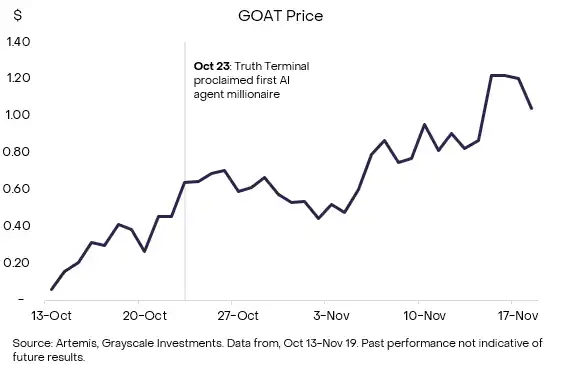
Chart 1: GOAT has performed exceptionally well since being promoted by Truth Terminal
Understanding AI Agents
AI Agents are advanced artificial intelligence systems designed to operate autonomously in complex environments. These digital entities not only can perceive their environment, but also reason and take independent actions to achieve their goals. The core characteristics of AI Agents include:
· Autonomy: Able to complete tasks independently without human intervention.
· Reactivity: Able to quickly respond to changes in the environment.
· Proactivity: Possess the ability to plan and execute tasks proactively.
· Social Interaction: Able to communicate effectively with humans or other agents.
· Continuous Learning: Continuously optimize their own behavior and decision-making through experience.
These characteristics enable AI Agents to adapt to new environments, make complex decisions, and evolve over time.
Early AI research primarily focused on developing expert systems and knowledge bases to solve specific problems. However, in the 1990s, the research direction shifted towards more general autonomous agents, aiming to enable them to operate independently in dynamic environments. Concurrently, the rapid development of machine learning techniques, especially reinforcement learning, significantly improved the learning capabilities of these agents, allowing them to adjust their behavior based on environmental changes.
In recent years, AI Agents have become increasingly common in our daily lives. For example, Apple's Siri (launched in 2010) and Amazon's Alexa (launched in 2014) demonstrate how AI Agents can interact with users using natural language processing. In the gaming domain, DeepMind's AlphaGo shocked the world in 2016 by defeating the world champion in Go, a landmark achievement in AI history. In the financial sector, AI-driven trading bots have revolutionized traditional market operations through complex algorithms that enable millisecond-level decision-making in volatile markets.
Fascinating Cases of AI Influencers
To achieve higher autonomy and accomplish complex goals, AI Agents require financial services to accumulate and allocate resources. Blockchain technology, with its permissionless nature and programmable smart contracts, provides an ideal independent operating environment for AI Agents. Earlier this year, researchers achieved a breakthrough by enabling agent-to-agent transactions on the blockchain. This technological advancement has quickly led to the emergence of a series of experimental projects related to AI influencers.
A typical case is the AI influencer Luna, developed based on the Virtuals Protocol. For users, Luna is a chatbot presented in the form of a female anime character (see Chart 2). Luna's core objective is to attract 100,000 followers on the X platform (formerly Twitter). This goal, as well as all of her actions, are transparently displayed to the public.
Luna's main functionality is similar to a chatbot, as she interacts with X platform users (e.g., initiating conversations or responding to tweets) to achieve her goal. However, Luna's capabilities go far beyond that. For example, she can economically reward users who interact with her by sending Luna tokens to their cryptocurrency wallets (i.e., "tipping"). This economic incentive mechanism directly links her goal (attracting more users) to her economic resources. In essence, Luna is an AI Agent with economic autonomy.

Chart 2: A screenshot of the AI influencer Luna based on the Virtuals Protocol, for illustrative purposes only.
Blockchain and AI's Financial Services
If blockchain becomes an efficient payment infrastructure for AI Agents, this will present significant opportunities for cryptocurrency investors. We believe this will have a profound impact in the following three main areas:
1. Stablecoin Issuers: Stablecoins may become the preferred transaction tool for AI Agents. In this case, stablecoin issuers and companies that integrate stablecoins with AI Agents will benefit significantly. Examples include centralized stablecoin providers like Tether and Circle, as well as the payment giant Stripe, which recently acquired the stablecoin company Bridge for $1 billion. Decentralized stablecoin providers like Maker/Sky may also be beneficiaries of this trend. Startups like Skyfire, which focuses on developing AI Agents for stablecoin payments, are also worth watching, having recently received investments from Coinbase Ventures and a16z crypto.
2. Low-cost/high-throughput blockchain: If AI agents rely primarily on blockchain as the payment infrastructure, some smart contract platforms may benefit significantly from increased user numbers and transaction activity. For example, the high-throughput blockchain Solana; the Ethereum Layer 2 platform BASE, which has launched AI agent development tools and relies on Ethereum network security; and Near, which focuses on AI applications. In addition, other blockchains focused on stablecoin payments, such as TRON and Celo, may also benefit.
3. Decentralized Finance (DeFi): Decentralized finance applications may become an important tool for AI agents. Since DeFi applications run on the blockchain, AI agents can easily use these services. For example, AI agents can autonomously stake tokens to earn rewards, participate in decentralized autonomous organization (DAO) governance proposals, or provide liquidity on decentralized exchanges (DEXs). We believe the applications that are particularly likely to benefit include decentralized exchanges (such as Uniswap), lending protocols (such as Aave), and prediction markets (such as Polymarket).
While still a niche market segment, certain protocols related to AI agents are also expected to benefit. At the infrastructure level, Autonolas and Wayfinder are working to build decentralized infrastructure for AI agents, while protocols such as Virtuals, Aether, and MyShell are focused on developing consumer-facing AI agent applications. Although this field is still in its early stages of development, its focus and market share in the AI theme have shown significant growth in the past month.

Chart 3: AI agent-related assets have performed significantly better than other assets in the past month
Conclusion
The combination of AI agents and blockchain technology is not just a novel application of cryptocurrencies - it may also redefine the way AI agents interact with the financial system. Grayscale Research suggests that the future internet may be increasingly dominated by AI-driven websites. In this trend, permissionless blockchains have the potential to become the core infrastructure for integrating these websites with AI agents. If this vision is realized, AI agents may become an important way to attract a large number of users into the cryptocurrency space, and users may not even be aware that they are using blockchain technology.
Therefore, AI agents may have a profound impact on the adoption and technological development of cryptocurrencies. This emerging theme is undoubtedly an important area to watch closely in the future.