Author: Liu Honglin
On October 3, 2024, the Hong Kong Securities and Futures Commission (SFC) updated the list of licensed virtual asset trading platforms on its official website, announcing the latest licensed exchange HKVAX, which is the third virtual currency exchange recognized by the Hong Kong regulatory authority after OSL Exchange and HashKey Exchange. According to a report by the well-known Hong Kong news media Ming Pao, HKVAX has already obtained licenses No. 1 (securities trading) and No. 7 (providing automated trading services) issued by the SFC, providing OTC brokerage services, virtual currency trading, and comprehensive virtual asset custody services for Hong Kong virtual currency investors.
Here, someone may ask: I also want to operate a compliant virtual currency exchange in Hong Kong. Do I need to apply for a virtual asset trading platform license, or do I have to obtain licenses No. 1 and No. 7? Are other virtual currency exchanges the same? Before answering this question, Manqun Lawyers will first introduce the licenses held by the virtual currency exchanges that have already been licensed or considered to be licensed.
Overview of Licensed Virtual Asset Trading Platforms in Hong Kong
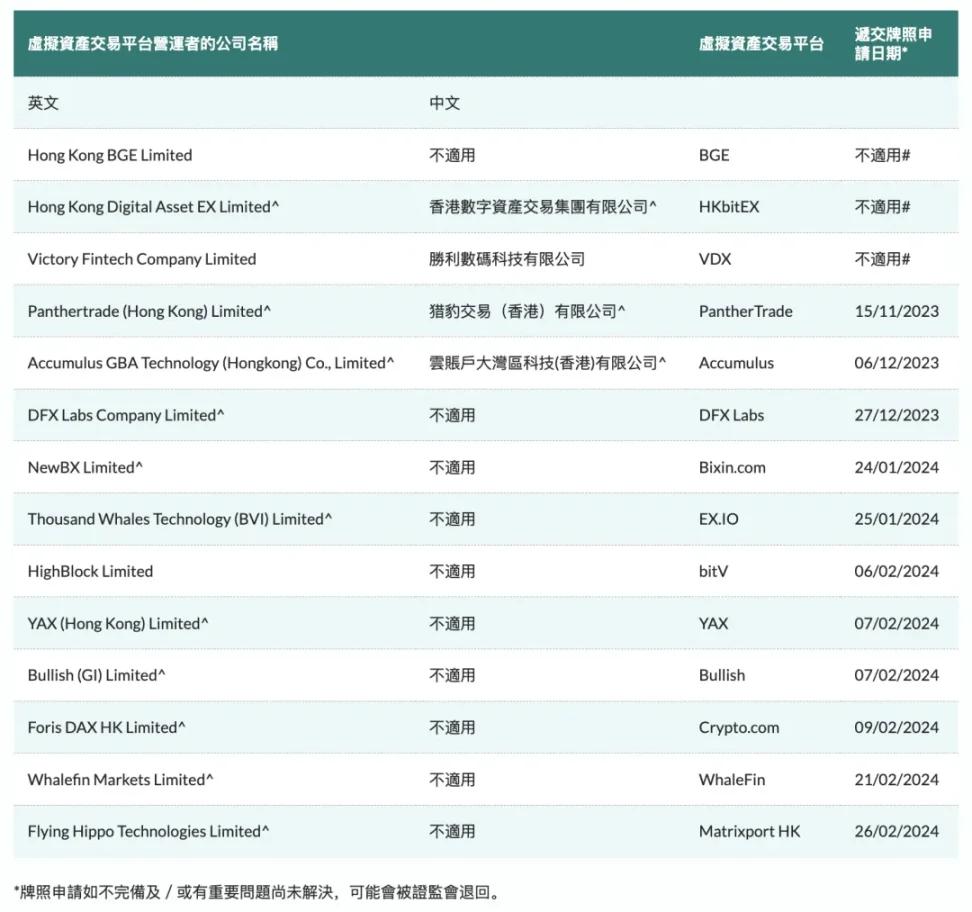
Currently, based on the list of virtual asset trading platforms that have been licensed or are in the application process on the Hong Kong Securities and Futures Commission's website, Manqun Lawyers has conducted a simple license review.
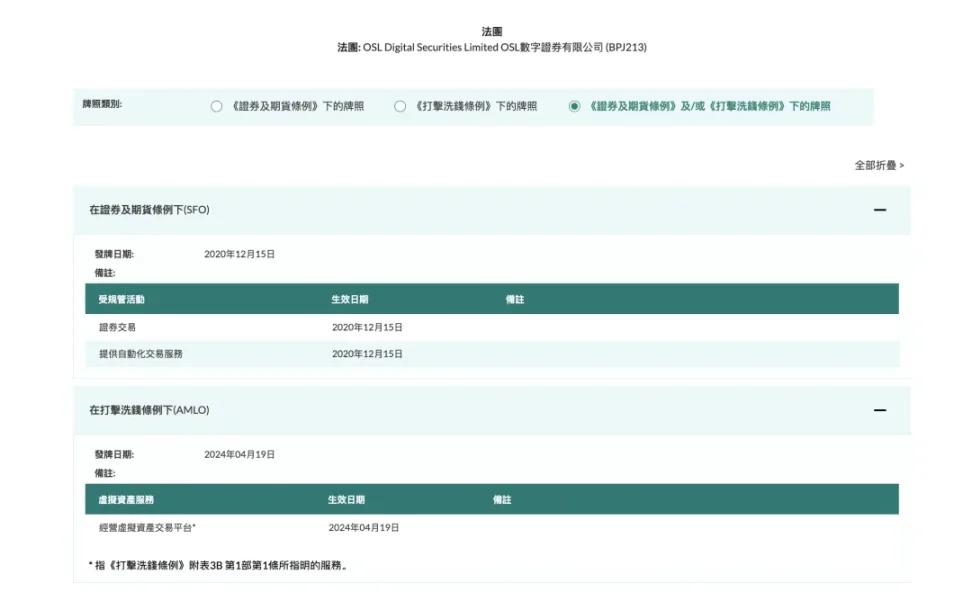
OSL Exchange has obtained licenses No. 1 and No. 7, and the license to operate a virtual asset trading platform.
HashKey Group's different platforms have obtained different licenses, including:
Hash Blockchain Limited, i.e., HashKey Exchange, has obtained licenses No. 1 and No. 7, and the license to operate a virtual asset trading platform.
HBS (Hong Kong) Limited has obtained licenses No. 1 and No. 4.
Hashkey Capital Limited has obtained licenses No. 4 and No. 9.
HKVAX has obtained licenses No. 1 and No. 7.
BGE does not hold any licenses.
HKbitEX is considered to have obtained the license to operate a virtual asset trading platform.
VDX does not hold any licenses.
PantherTrade is considered to have obtained the license to operate a virtual asset trading platform.
Accumulus is considered to have obtained the license to operate a virtual asset trading platform.
DFX Labs is considered to have obtained the license to operate a virtual asset trading platform.
Bixin.com is considered to have obtained the license to operate a virtual asset trading platform.
EX.IO is considered to have obtained the license to operate a virtual asset trading platform.
bitV does not hold any licenses.
YAX is considered to have obtained the license to operate a virtual asset trading platform.
Bullish is considered to have obtained the license to operate a virtual asset trading platform.
Crypto.com is considered to have obtained the license to operate a virtual asset trading platform.
WhaleFin is considered to have obtained the license to operate a virtual asset trading platform.
Matrixport HK is considered to have obtained the license to operate a virtual asset trading platform.
It is worth noting that although most platforms have already been shown as "considered to be licensed," this status means that the platform is still in the temporary licensing stage, and they can only provide virtual asset services under certain restrictions, mainly targeting professional investors. In this status, the platform cannot provide services to retail investors, and the scope of services it can provide is relatively limited. Specifically, these platforms cannot engage in margin trading, virtual asset derivatives (such as futures contracts) trading, asset lending, market making, and other high-risk financial activities.
It can be seen that currently, most virtual asset exchanges have not obtained licenses issued by the SFC, but have more applied for the virtual asset trading platform license. However, the three exchanges that have already obtained the virtual asset trading platform license have precisely already held licenses No. 1 and No. 7.
So, what is the relationship between the virtual asset trading platform license and the virtual asset (VA) license? To obtain a virtual asset trading platform license, is it necessary to hold licenses No. 1 and No. 7?
Virtual Asset Trading Platform License and Licenses
In Hong Kong, any centralized virtual asset trading platform, if (1) it is conducting business; or (2) actively promoting its services to Hong Kong investors, must obtain a license and be regulated by the Hong Kong Securities and Futures Commission (SFC). This requirement stems from two important Hong Kong financial regulations:
1. Securities and Futures Ordinance (SFO)
The regulatory regime under the SFO aims to regulate the following centralized platforms, involving licenses such as No. 1 and No. 7:
Providing trading services for security-type tokens using an automated trading engine to match client orders; and
Providing custody services as an ancillary service to the trading service.
2. Anti-Money Laundering and Counter-Terrorist Financing Ordinance (AMLO)
The AMLO, involving the virtual asset trading platform license, aims to regulate the following centralized platforms:
Providing trading services for non-security-type tokens using an automated trading engine to match client orders; and
Providing custody services as an ancillary service to the trading service.
However, given the often-changing nature of virtual assets, a virtual asset may change from a non-security-type token to a security-type token, and vice versa. Therefore, the Hong Kong Securities and Futures Commission recommends that companies take a prudent approach, i.e., virtual asset trading platforms should apply for licenses under both the SFO and AMLO regimes to avoid violating the licensing regime and ensure business continuity.
So, what exactly do licenses No. 1 and No. 7 correspond to? Besides these two licenses, are there any other licenses required for operating virtual asset-related businesses in Hong Kong? Why does HashKey also hold licenses No. 4 and No. 9? These questions need to be answered starting from the Hong Kong financial licenses.
Overview of Hong Kong Financial Licenses
According to the Hong Kong Securities and Futures Ordinance (SFO), the Hong Kong financial market is divided into multiple categories, and each category of market participant must apply for the corresponding license. The following are some common licenses and their applicable businesses:
License No. 1 allows the licensee to conduct securities trading, including buying and selling securities, providing securities investment services for clients, etc.
License No. 2 authorizes the licensee to engage in futures contract trading business.
License No. 3 is for leveraged foreign exchange trading platforms.
License No. 4 allows the licensee to provide securities-related investment advice for clients.
License No. 5 is for futures contract advisory services.
License No. 6 allows the licensee to provide advisory services related to corporate finance, involving capital market operations, mergers and acquisitions, listing, etc.
License No. 7 allows the platform to provide automated trading services for clients.
License No. 8 allows the licensee to engage in securities financing activities.
License No. 9 is a license that asset management companies must hold.
License No. 10 involves credit rating services.
Looking at this, a new question also arises: There are so many licenses, if I want to do virtual currency-related business in Hong Kong, do I need to apply for all of these licenses? Manqun Lawyers' answer is no!
Apply for the Licenses Corresponding to Your Business
Previously, Manqun Lawyers shared an article "Hong Kong Virtual Currency License Application, What's the Difference Between VASP and VATP? | Manqun Web3 Popularization," which detailed the virtual currency-related businesses. The article pointed out that Virtual Asset Service Providers (VASPs) cover a variety of entities, including but not limited to:
Virtual asset fund managers;
Virtual asset advisors;
Virtual asset custodians;
Virtual asset wallet providers; and
Financial service providers related to the issuance, distribution or sale of virtual assets, such as service providers in ICO projects.
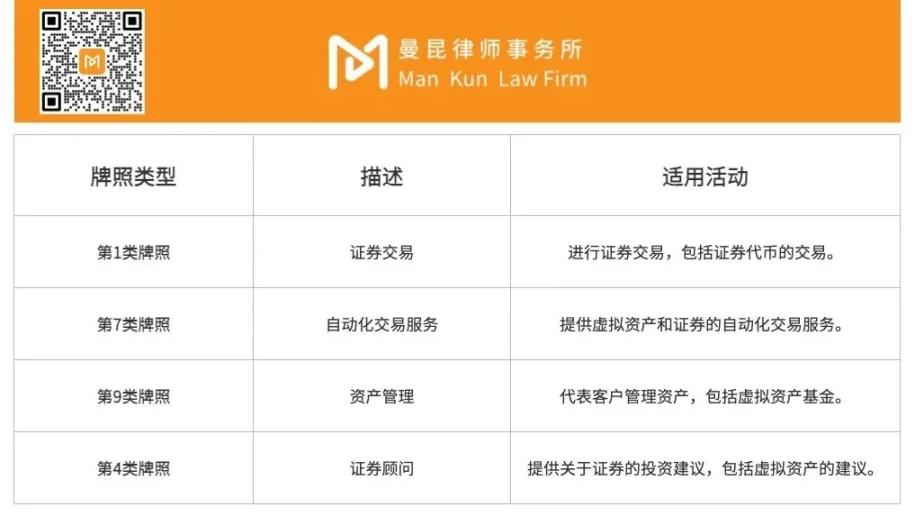 If you only plan to operate a virtual currency exchange in Hong Kong, in addition to the virtual asset trading platform license, you only need to consider licenses No. 1 and No. 7:
License No. 1 applies to trading platforms involving security-type virtual assets. In the field of virtual currencies, some virtual assets may be considered securities in structure, so operating a virtual asset exchange may require License No. 1 to legally trade these assets.
License No. 7 is a license that almost all virtual currency exchanges need, because virtual currency exchanges mainly conduct automated virtual asset trading through electronic platforms.