The world's largest exchange Binance officially launched the interest-bearing margin asset BFUSD today (27th), which can now be purchased on the Binance Futures trading platform.
According to the official announcement, users can use BFUSD as margin for contracts and trade Binance USDⓈ-M contracts, with the biggest feature being that the BFUSD in the user's wallet will be able to earn daily USDC rewards.
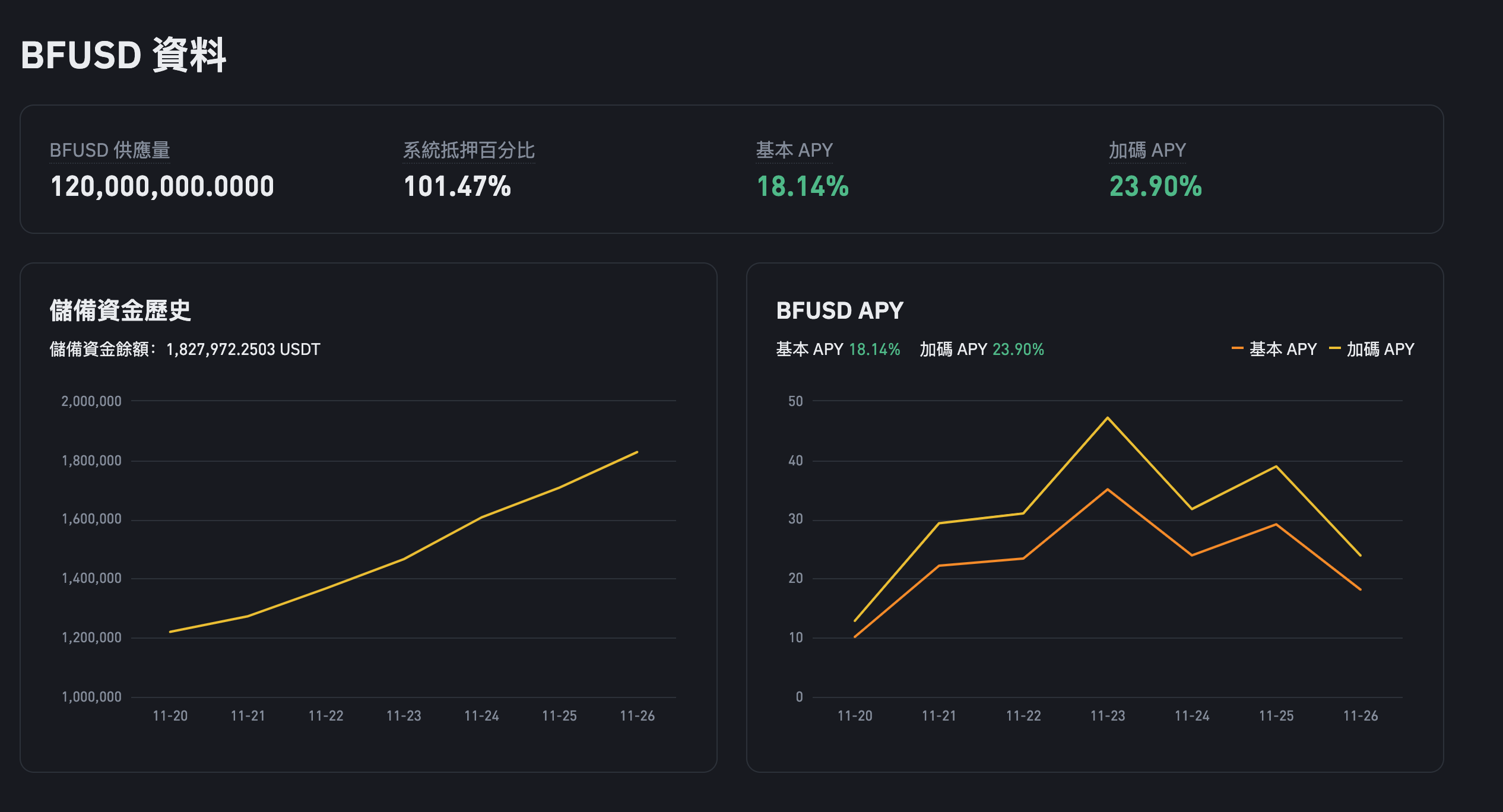
According to the website, the current basic annualized yield of BFUSD is 18.14%, and the enhanced annualized yield is 23.9%. As for why such a high return rate can be provided, it is because BFUSD will obtain the funding rate through term arbitrage.
BFUSD uses a neutral hedging strategy, collecting funding fees by hedging futures and spot positions. Funding fees are the periodic payments between the long and short parties in the perpetual futures market, used to keep the futures price consistent with the spot price. When the funding rate is positive, Binance profits from the short futures position, and does not need to worry about value loss due to holding an equal amount of spot.
However, BlockTempo would like to remind you that if the market returns to a bear market, the return rate will theoretically drop to single digits, and whether the funding rate may turn negative, according to a report by The Block, Binance has promised that the yield of BFUSD will never be negative, and it can be expected that there will be official subsidies in the initial stage.
Note: According to the understanding, BFUSD is not a normal stablecoin, and cannot be withdrawn from the Binance contract account or traded in the open market, it can only be used as margin for Binance contract trading, and can be exchanged 1:1 with USDT.
BFUSD's Potential, Will it Change the Margin Ecology of Exchanges
In simple terms, if you are an active contract operator today, you usually keep a certain amount of funds in your contract account, and in the past these funds could only be used as margin and could not be used to generate income (such as investing in USDT spot or term products).
But the advantage of BFUSD is that while meeting your need to hold margin, it also provides investors with more opportunities to generate profits, which may become a major incentive for investors to move their funds to this platform.
As for what's in it for Binance? We know that the most profitable product for an exchange is the trading fee from contract trading, and when more people move their funds to the platform to trade, it naturally benefits Binance itself.
Today is the first day of BFUSD, if the effect of attracting funds is very good in the future, it is reasonable to speculate that it will lead to a loss of stablecoin fund holdings on other exchanges; in response, other exchanges may launch similar margin products like BFUSD in order to retain user funds.
Will Interest-Bearing Stablecoins Become Tether's Biggest Competitor?
We know that USDT is currently the largest stablecoin, but they do not provide additional rewards to users, and the issuer Tether is making a fortune just by buying US Treasuries.
In order to compete with it, the market has recently launched more and more interest-bearing stablecoins, some with a model similar to BFUSD, providing stable returns through term arbitrage, and some by buying US Treasuries to earn interest.
It is reasonable to speculate that "interest-bearing stablecoins" will become the biggest competitor to USDT in the future, and may even prompt USDT, USDC and other projects that do not provide returns to also start offering stable returns, which is worth our continued attention.
What are the Risks of Holding BFUSD?
Although Binance has specifically emphasized that BFUSD is not a stablecoin, its ability to be exchanged 1:1 with USDT actually does not differ much from a stablecoin in terms of usage. However, of course, BFUSD, while having the opportunity to earn high returns, also has the following risks:
- Negative Funding Rate: When the funding rate of the short futures position is negative, it may result in the inability to pay returns to BFUSD holders.
- Credit Risk: Holding BFUSD is equivalent to taking on Binance's credit risk; if Binance is unable to pay or fails to operate, users may not be able to redeem BFUSD or receive returns.
- Redemption Restrictions: Redemption may be delayed due to high demand or market volatility, but users' BFUSD can still be used as margin for futures accounts.
- Variable Fees: Fees are required to purchase or redeem BFUSD, and Binance can adjust the fee rate at any time, with the specific fees displayed before the transaction.
Further Reading: Paxos Unveils Yield-Generating Stablecoin "USDL" with 5% Daily Rewards, Can it Shake Up the Dominance of USDT and USDC?