Author: KarenZ, Foresight News
Although the computational power of validators is increasingly powerful in L1 and L2 systems, the limitations of bandwidth and the unstable latency of communication between verification nodes remain the shackles that constrain their further performance leap.
The DoubleZero protocol is precisely aimed at breaking this dilemma, by optimizing data flow, increasing bandwidth, and reducing latency, to build a high-performance, permissionless decentralized network framework, opening up new paths for the future development of distributed systems.
What is DoubleZero?
According to the official description, DoubleZero is not an L1 or L2, but is defined as an N1 (Network 1), a decentralized framework for creating and managing high-performance, permissionless networks. The goal of DoubleZero is to provide an infrastructure layer to accelerate communication in high-performance distributed systems, increasing bandwidth and reducing latency.
The DoubleZero protocol builds a synchronous network by integrating fiber links contributed by individuals and organizations to efficiently filter spam, increase bandwidth, reduce latency, and eliminate unstable factors in communication.
DoubleZero was created by Austin Federa, Andrew McConnell, and Mateo Ward, and is supported by two core contributor teams, Firedancer and Malbec Labs. Austin Federa, the former Head of Strategy at the Solana Foundation, resigned this month to found DoubleZero and serve as its Chief Operating Officer.
Andrew McConnell is the co-founder and CTO of Malbec Labs, which is dedicated to software development, hardware acceleration, and network engineering for open-source protocols. Additionally, Nihar Shah, the former Head of Data Science at Mysten Labs, has also left to join DoubleZero as Chief Economist, after previously working at Jump Crypto and Meta (Libra/Diem).
The other core contributor team, Firedancer, is an independent Solana validator client built by Jump Crypto, designed to eliminate single points of failure and enhance the overall resilience and robustness of the network. Unlike the original Rust-based validator, Firedancer is written in C and does not contain Rust code, a choice that significantly reduces the impact of potential vulnerabilities on the entire network, providing a strong guarantee for the security of Solana.
According to the Lightspeed podcast, the Firedancer demonstration running at 1 million TPS during this year's Solana Breakpoint conference was running on top of DoubleZero.
The key to Firedancer's ability to boost Solana's network performance to 1 million TPS (the current protocol-level limit restricts performance to around 81,000 TPS) lies in its innovative architectural design and data flow optimization.
It is worth mentioning that the goals of DoubleZero are highly aligned with the overall vision of Solana. Solana's official and co-founder Toly (Anatoly Yakovenko) have repeatedly emphasized on Twitter the importance of "increasing bandwidth and reducing latency", which is exactly what DoubleZero is pursuing.
How does DoubleZero work?
According to the whitepaper, the DoubleZero network can bring two significant improvements to blockchain systems: First, by using dedicated hardware to pre-filter incoming transactions, eliminating spam and duplicate transactions, effectively reducing the burden on validators. This allows the blockchain to benefit from shared system-wide filtering resources, without each individual validator needing to provide sufficient resources. Second, it achieves clear routing, tracking, and prioritization of outgoing messages to improve communication efficiency.
In terms of network architecture, DoubleZero is cleverly divided into an external in/out loop and an internal data flow loop. The former handles external interfaces and security, using hardware (such as FPGAs) to mitigate distributed denial-of-service attacks, verify signatures, and filter out duplicate transactions. The servers on the internal data flow loop then build consensus on these filtered traffic using optimized routing over dedicated bandwidth lines.
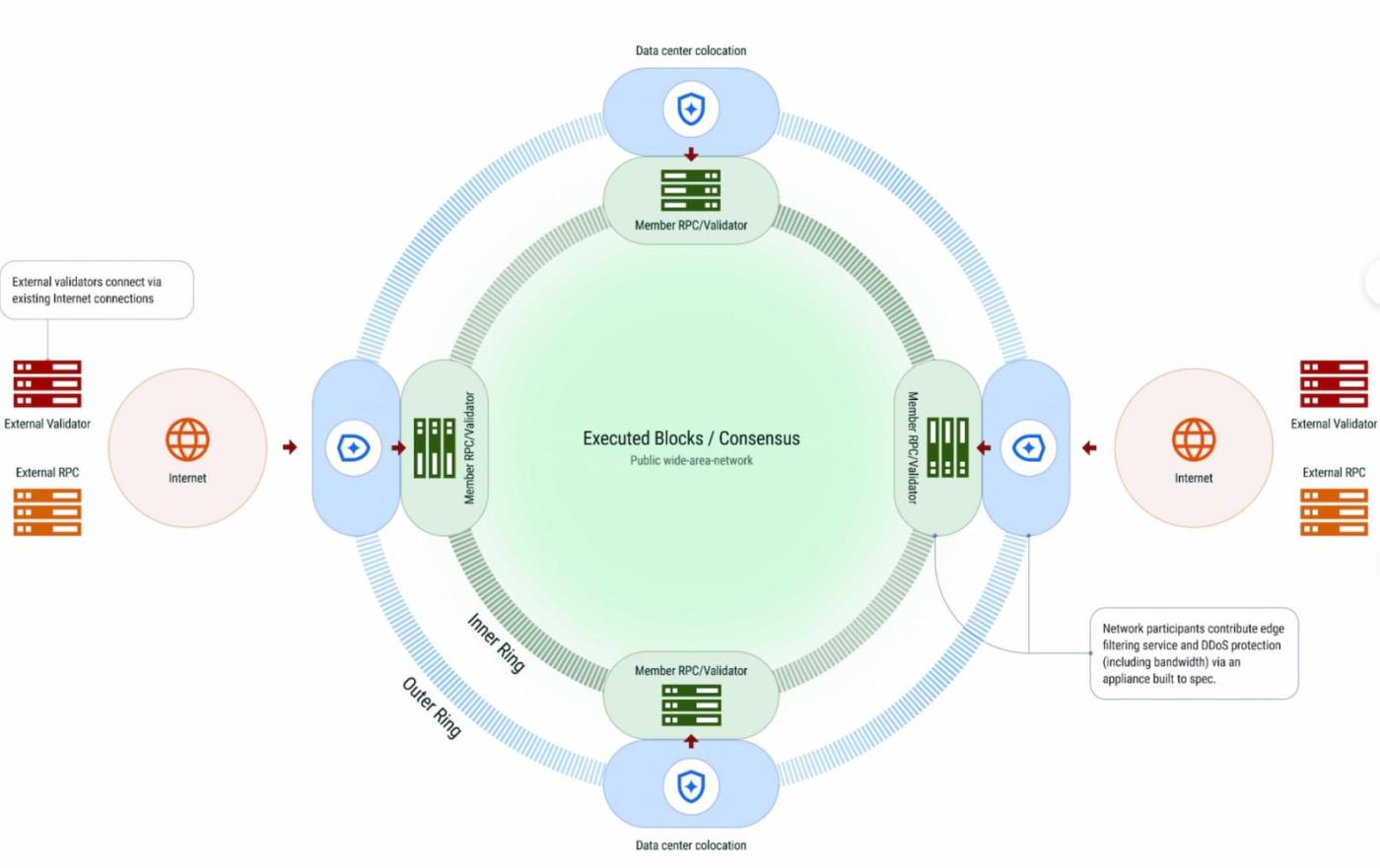
From the DoubleZero network architecture, we can see its key components, including network devices at the critical entry/exit points of the network and the bandwidth configured across the network. These network devices allow the data links contributed by individuals and organizations to operate as a prioritized network, and then implement filtering, verification, and spam protection.
The fiber links on the DoubleZero network provide low-latency, high-bandwidth connections between different locations. Network contributors will add their owned or leased idle fiber links to the network, and sign service level agreements for each link (including endpoint locations, bandwidth, latency, and compliant MTU size).
As a result, DoubleZero sees itself as an N1 - a neutral and high-performance physical infrastructure layer. On top of this N1, distributed systems and applications (such as N2 or others) can be built.
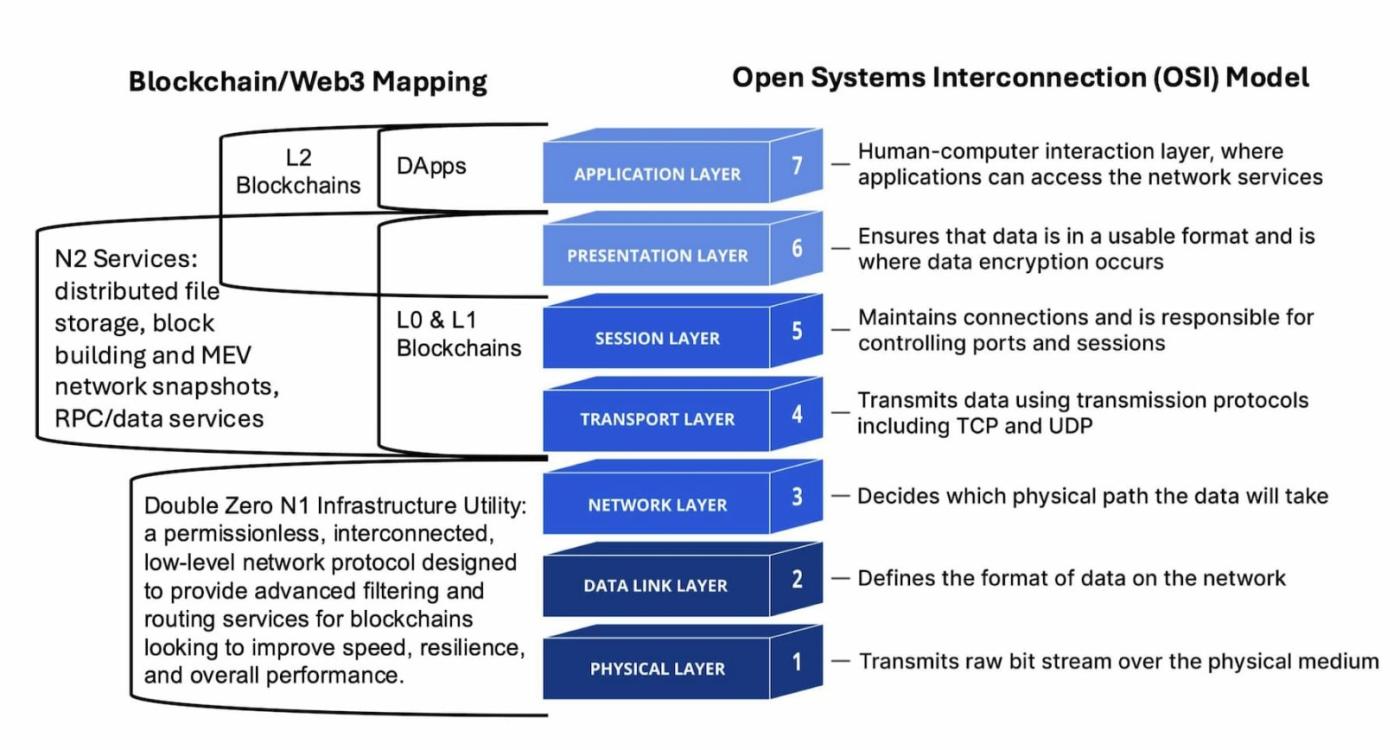
DoubleZero states in the whitepaper that the DoubleZero network can be used to optimize any distributed system. L1, L2, RPC nodes, and MEV systems can all join in to reduce validator burden, mitigate distributed denial-of-service attacks, and improve performance, while benefiting from increased bandwidth and reduced latency. Furthermore, DoubleZero's network architecture can also be applied to online gaming, large language model training that requires high-bandwidth connections, and other distributed systems that need low latency and high bandwidth.
According to DoubleZero's vision, the DoubleZero protocol is a new economic model in the field of bandwidth and communication. On the supply side, private enterprises can invest their idle fiber links purchased or leased from telecom operators or network service providers into the DoubleZero system, opening up new revenue streams. On the user and operator level, DoubleZero allows distributed systems to enjoy the advantages of private networks without relying on centralized systems or long-term contracts.
Overall, the DoubleZero protocol can match the needs of suppliers and users, helping to achieve mutual benefit by contributing and utilizing idle fiber links, and integrating the contributions of individuals and organizations into a unified, robust, and highly scalable global network.