
Author: Beosin Compliance Team
As the global cryptocurrency market has been developing rapidly, anti-money laundering (AML) and compliance regulations have gradually become a focus of attention in various countries. Recently, the Turkish government announced a series of more stringent cryptocurrency anti-money laundering regulations, which quickly drew widespread attention from the industry. These new regulations will officially take effect on February 25, 2025, demonstrating Turkey's determination in the field of cryptocurrency regulation and also providing an important reference for the compliance development of the global market.
Interpretation of the New Regulations: Strengthening Information Transparency and Transaction Security
The Turkish government issued an announcement on December 25, 2024, outlining the main provisions of the new anti-money laundering regulations, focusing on the setting of transaction thresholds, the handling of risky transactions, and the restrictions on unregistered wallets, in an effort to enhance the transparency and security of cryptocurrency transactions.
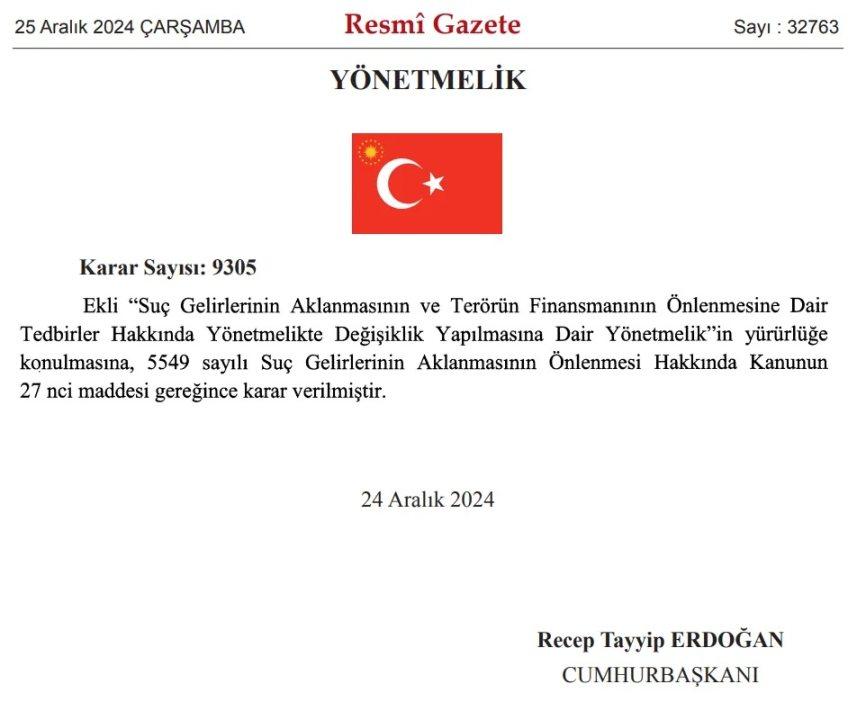
New Cryptocurrency Regulations in Turkey
Source: Official Gazette of the Republic of Turkey
1. Setting of Transaction Thresholds
According to the new regulations, when users execute cryptocurrency transactions exceeding 15,000 Turkish Lira (approximately $425), they need to provide complete identity information to the service provider. For transactions below this threshold, service providers can optionally collect relevant information. This provision aims to ensure the traceability of large transactions, thereby effectively curbing the flow of illegal funds.
2. Handling of Risky Transactions
If the cryptocurrency sender fails to provide sufficient information, the transaction will be marked as "high-risk". In this case, the service provider has the right to take various measures, including rejecting the transaction, limiting cooperation with relevant financial institutions, or even terminating the business relationship with the transaction party. This provision provides service providers with greater discretion, helping to improve the overall security of the transaction system.
3. Restrictions on Unregistered Wallets
Wallet addresses that are not registered on the platform are also subject to strict regulation. Service providers need to collect the sender's identity information, otherwise the relevant transactions will be restricted. This measure aims to crack down on illegal activities, such as money laundering and terrorist financing, carried out through anonymous wallets.
Through the above measures, the Turkish government hopes to establish a more transparent and secure transaction environment in the cryptocurrency field, laying the foundation for the future standardization of the industry.

Global Context: Aligning with the European MiCA Framework
The introduction of Turkey's new regulations coincides with important regulatory changes in the global cryptocurrency industry. The European Union's Regulation on Markets in Crypto-Assets (MiCA), which took effect on December 30, 2024, is seen as the world's first comprehensive regulatory framework for crypto-assets.
Turkey's new regulations clearly draw on the international best practices of regulations such as MiCA, marking its alignment with global standards in cryptocurrency compliance. This convergence with international norms not only helps to enhance the attractiveness of the Turkish market, but also provides a more reliable trading environment for international investors. Furthermore, strengthening regulations is crucial for addressing cross-border financial crimes such as money laundering and terrorist financing.
Industry Impact: Turkey's Compliance Journey and Market Prospects
As the world's fourth-largest cryptocurrency market, Turkey's trading volume reached $170 billion in 2023, surpassing Russia and Canada, demonstrating its important position in the cryptocurrency field. However, Turkey still faces various challenges between regulation and market development. Although the purchase, holding, and trading of cryptocurrencies are legal in Turkey, the use of cryptocurrencies as a means of payment has been prohibited since 2021. This means that while investors can freely engage in transactions, they cannot directly apply cryptocurrencies to daily consumption scenarios.
Turkey's cryptocurrency market has shown strong growth momentum, which is inseparable from its unique economic environment and the strong demand of the population for digital assets. For a long time, Turkey has faced high inflation and currency depreciation, which has prompted more and more people to view cryptocurrencies as a tool to hedge risks and protect their wealth. However, the Turkish government's attitude towards cryptocurrencies is relatively cautious. Although it allows legal transactions, the restrictions on the payment scenario indicate that the regulatory authorities are still trying to balance innovation and risk control.
1. Promoting Market Standardization
The new regulations will significantly improve market transparency and transaction security, enhancing investor confidence in crypto-assets. In a standardized market environment, participants can enjoy higher-quality services, further promoting the healthy development of the market.
2. Accelerating Enterprise Compliance
As of December 2024, 77 cryptocurrency companies have applied for operating licenses from the Turkish Capital Markets Board. This reflects the industry's positive response to the new regulations and lays the foundation for broader market participation in the future.
3. Long-term Development Potential
Although the new regulations impose restrictions on certain trading activities, the Turkish government maintains an open attitude in its tax policy. For example, it does not tax profits from crypto-assets, only levying a 0.03% transaction tax, demonstrating its support for market development. This balanced regulatory approach will help the long-term development of Turkey's cryptocurrency market.