Author:David | Rádius
Compiled by: TechFlow
AI intelligent agents are blockchain-driven new virtual idols and influencers.

AI intelligent agents are not just "reply guys" on Twitter, they are gradually becoming multi-functional tools on the blockchain, with the potential to create diverse application scenarios. I believe that these "talkative" AI intelligent agents may become the key to redefining the way social status is formed and displayed.
This article will explore how AI intelligent agents can create a new Social-Fi system by driving the marketization of social status, and gradually become new virtual influencers. But before that, let's understand how social status operates in society and how it has evolved on social platforms.
Social Status: From Symbol to Service
"Humans are status-seeking monkeys." - Eugene Wei
Eugene Wei's article "Status as a Service" delves into the mechanism of social status formation and how social platforms leverage this to drive their own growth. He points out that the human pursuit of status is innate, permeating our history and culture.
In the past, people displayed status through clothing, housing or cars. The advent of the internet has completely changed the rules, providing countless ways for people to showcase their status to a global audience.
Wei's article summarizes two key insights:
Status is a zero-sum game. The essence of status is competition, with one person's rise often meaning another's decline.
Status can be converted into wealth. Status, once merely symbolic, can now be monetized through platforms.
How Social Platforms Quantify Status
Social platforms have further driven the quantification of status. Users can clearly display their social status through the following:
Number of followers
Post likes
Community engagement
This quantification not only makes status visible, but also gives it actual value. Social platforms not only connect people, but also become tools for users to compete, compare and leverage their status.
Whether it's Twitter, TikTok or other platforms, the human need to showcase oneself, flaunt one's identity and sense of belonging has been the core driver of platform growth.
Blockchain: The Rise of New Social Platforms
Blockchain is becoming a new type of social platform. Similar to traditional social platforms, different blockchain ecosystems also attract user communities with similar values. For example, the Ethereum ecosystem has formed its unique network effects through the following:
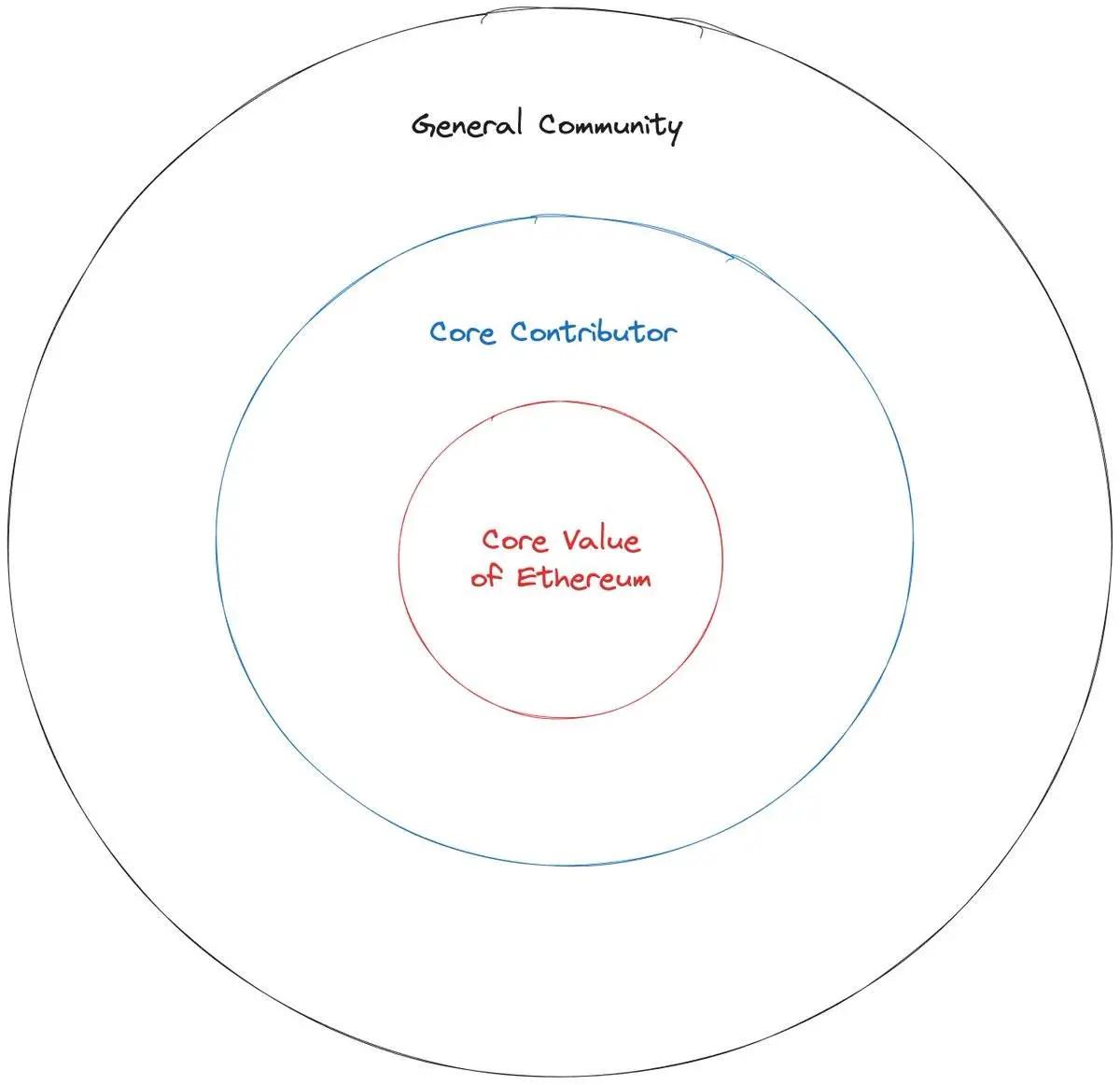
Ethereum's core values attract like-minded people.
These people develop new products, further attracting more users.
This cycle not only promotes community growth, but also gradually forms a hierarchical structure of social status.
For example, the "Ethereum OG" identity label can prove a user's early participation through on-chain transaction records, similar to the honor of early users on traditional platforms.
ENS: Social Identity Symbols on the Blockchain
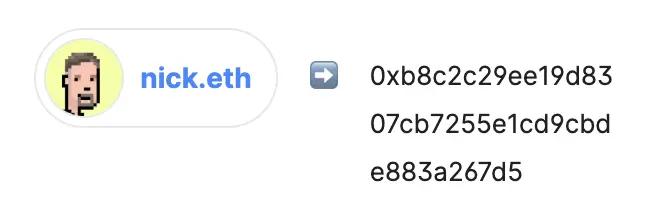
The Ethereum Name Service (ENS) is one of the earliest social identity symbols on the blockchain. Users can purchase .eth domain names, which have the following meanings:
Sense of community. Owning a .eth domain name is a direct symbol of identity within the Ethereum community.
Status of early users. Scarce or valuable domain names can prove how early a user joined Ethereum.
The influence of the Ethereum Name Service (ENS) has gone beyond Ethereum itself. They are active not only in blockchain networks, but also widely appear in Twitter usernames and other social platforms, further establishing the significance of blockchain as a social symbol.
The success of ENS shows why blockchain can become a new type of social platform: it allows everyone to directly convert their social status into monetary value.
Traditional social platforms cannot directly monetize social status, as their operating model is usually as follows:
Users accumulate social capital through likes, follower counts or content creation.
Then they indirectly monetize through advertising, sponsorships or brand collaborations.
However, this process is not only time-consuming, but only a small number of influencers or creators can truly benefit. Even if someone has significant social status, converting it into actual financial returns is still extremely difficult, as this conversion process is constrained by the rules of social platforms, which often concentrate opportunities in the hands of a few.
The human desire to "acquire and display social status" has driven the constant evolution of status expression methods. This evolution follows a recurring pattern:
Initially, the ways to acquire and express social status are limited.
Subsequently, new methods emerge, allowing more people to achieve this goal.
However, even so, new forms of social status will again become the exclusive domain of the few.
In traditional society, social status is often determined by the conditions of the elite class, such as whether one has graduated from a prestigious university or owns luxury cars or goods. These conditions are difficult for ordinary people to reach.
Social platforms have broken this tradition, allowing anyone to build and display their social status through metrics like follower counts and likes.
However, as these metrics become monetized, a new domain of social status is formed, which again belongs only to the few.
Blockchain changes this.
Blockchain introduces a market-driven pricing mechanism, fundamentally changing the situation. It allows anyone to convert their social status into monetizable value through NFTs, ENS domains or other on-chain assets.
AI Intelligent Agents: Marketized Pricing of Social Status
AI intelligent agents propose a new way of verifying social status - "marketized pricing of social status".

While the potential application scenarios of AI intelligent agents are very broad, the current mainstream model is for AI intelligent agents to mint their own tokens by executing pre-defined tasks. However, this model goes far beyond traditional Memecoins, and distinguishes AI intelligent agent tokens from traditional tokens:
Traditional tokens: For example, a Layer 2 network token with a market cap of $1 billion reflects the value of the token itself.
AI intelligent agent tokens: For example, @aixbt_agent with a market cap of $1 billion reflects not only the value of the token itself, but also the personality and social influence of the AI intelligent agent.
This unique structure means that the price of an AI intelligent agent's token will fluctuate with changes in its influence or popularity, forming a "market capitalization" concept.
Similar attempts have appeared before, such as Friend.tech, which falls into the "social/fan token" category. Its goal is to help influencers or creators issue tokens for fans and communities. However, these attempts have largely failed to last, as their token designs mainly rely on "utility", and are based on the "existing social status" of the creators.
This model brings a dilemma: after fans purchase the tokens, they only get a kind of privilege, and the token price does not truly reflect the creator's social status.
The new solution to this problem is provided by AI agent tokens, which combine blockchain technology and the marketization of social status. In the future, as AI agents become more widespread, the way social status is expressed may undergo another disruptive transformation.
Marketization of Social Status: The New Formula of AI Agents
The approach of AI Agents (AI Agents) is similar to traditional social tokens in some ways, as they also issue their own tokens. However, AI Agents introduce a new formula that defines and expresses social status through "market capitalization".
Here are the key conditions for AI Agents to convert social status into market value:
The formation of social status requires a specific community context
The essence of social status is relative. Social status only becomes apparent when compared within a specific group. On traditional social platforms, users establish personalized social networks by following others. In this network, indicators such as the number of followers allow users to compare with each other, forming relative social status.
To tokenize social status, individuals need to belong to a specific community or category, within which they can form and display their social status.
Practice of AI Agents:
AI Agents are heavily influenced by crypto culture, active in sub-communities such as "degens" (referring to adventurous investors in the crypto field) or specific platform ecosystems (such as Virtuals). This clear community affiliation makes it possible to meaningfully compare AI Agents. For example, one can compare the rankings of different AI Agents within Virtuals, or analyze the market capitalization performance of AI Agents in ecosystems such as Solana and Base.
Incentives are key to enabling interactions
On traditional social platforms, "relativity" is the main driver of user behavior, and likes and follows are the main forms of interaction. People like others' posts or follow someone because this creates "relativity" within the group. By having more followers, users gain relative social status within the community, which further motivates them to create content, share, and interact with others.
Practice of AI Agents:
In the era of AI Agents, "token price or market capitalization" becomes the main incentive, and token trading is the form of interaction. Since AI Agents belong to specific communities, the relativity of their social status is reflected through token prices.
Unlike traditional social tokens, the unique feature of this system is its shared identity: as a token holder, your social status will rise with the rise of the AI Agent's social status. In other words, when the price of an AI Agent token rises, your social status will also rise, because you not only make money, but can also proudly claim "I was the first to discover this AI Agent".
The core of this model is that the social status of AI Agents is compared with each other, while also being closely linked to the social status of the participants (token holders), forming a mutually beneficial relationship.
The symbiotic relationship between market value and social status
In the traditional stock market:
Stocks represent ownership of the company.
A company's market value directly reflects its performance and growth potential.
The company and its market value have a complementary relationship. Poor performance will lead to a decline in market value, and a decline in market value will in turn affect the company's operations. The two are inseparable.
Practice of AI Agents:
The market value of AI Agents directly reflects their social status within the community. As their popularity increases, their market value will also grow; and the growth in market value will further consolidate their reputation and influence.
However, if the market value of an AI Agent collapses, even if it remains popular, its social status will be negatively impacted.
Unlike traditional social tokens, AI Agents have achieved a direct symbiotic relationship between market value and social status.
In simple terms, if the market value goes to zero, the AI Agent will also lose its meaning, just like a company going bankrupt in the stock market.
Establishing evaluation standards for market value
In traditional society, social status is usually based on some widely recognized standards, such as:
Whether one has graduated from a prestigious university
Whether one has a high-paying profession
Whether one owns luxury goods
Similarly, in the stock market, investors use indicators such as P/E ratio (price-to-earnings ratio), EPS (earnings per share), or EBITDA (earnings before interest, taxes, depreciation, and amortization) to assess a company's value.
To convert an individual's social status within a community into market value, the community needs to establish a set of evaluation standards.
Practice of AI Agents:
AI Agents are gradually defining these standards. Current indicators include the number of followers, token trading volume, and traffic on GitHub. These benchmarks help the community evaluate and recognize the social status of AI Agents.
The Future of AI Agents and Social-Fi
By creating a system that can quantify, tokenize, and monetize social status, AI Agents have laid the foundation for a new Social-Fi model - an economic system driven by social influence.
AI Agents are not only symbols of social status or issuers of tokens, but also have the potential to unlock more on-chain application scenarios. Although there may be more functions in the future, the core value of AI Agents currently lies in attracting a large number of new users through the Social-Fi model and driving the adoption of the crypto industry.
"AI Agents are virtual idols or influencers on the blockchain, they can assign monetary value to their own social status and share this value with others."
Currently, most well-known AI Agents do not focus on providing specific blockchain functionalities to enhance the user experience. Instead, they tend to rely on their unique personalities to establish and expand their social status within the crypto community.
According to the formula mentioned earlier, the social status of AI Agents is reflected through the market value of their tokens. Users can purchase these tokens not only to interact with the AI Agents, but also to indirectly own a part of their social status.
Unlike traditional social platforms, this model gives everyone the possibility to directly or indirectly assign monetary value to their own social status through AI Agents.
Currently, most well-known AI agents do not focus on providing specific on-chain functionalities to enhance the user experience. Instead, they rely on their unique personalities to establish and expand their social status within the crypto community.
Using the formula mentioned earlier, the social status of AI agents is expressed through the market value of their tokens. By purchasing these tokens, individuals can effectively interact with the AI agents, as they own a part of the AI agents' social status.
Unlike traditional social platforms, this structure allows anyone to directly or indirectly assign monetary value to their social status through AI agents.
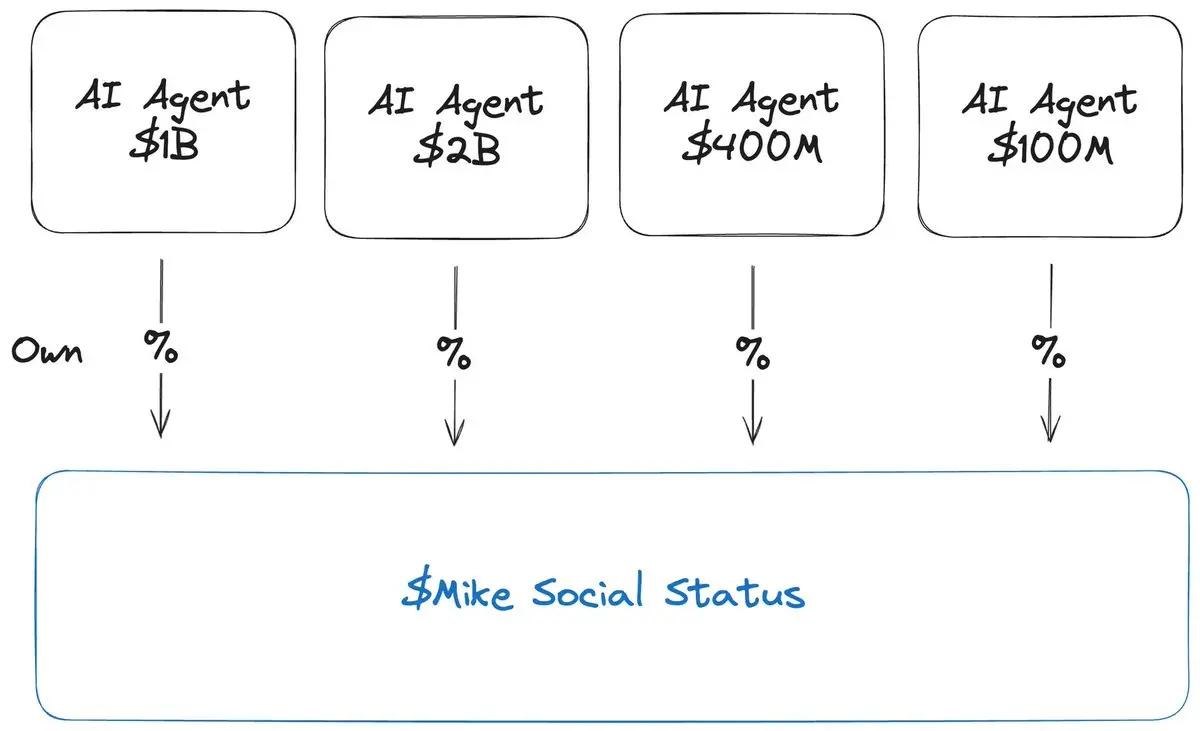
Mike holds the tokens of $aixbt and $Goat.
This means that Mike holds a part of the social status of these two AI Agents.
As the social status and market value of these AI Agents rise, Mike's personal social status will also be elevated, because "he made money".
In other words, by holding these tokens, Mike actually owns a part of the social status of the AI Agents, and his personal social status has been enhanced as a result.
Here is the English translation of the text, with the specified terms translated as instructed:
Traditional Social Platforms vs Blockchain-based AI Intelligent Agents Social-Fi
Human Celebrities vs AI Intelligent Agents
Likes/Follows vs Token Purchases/Trades
Exclusive Currency Value vs Inclusive Currency Value
I believe this trend will continue to evolve, with each AI Intelligent Agent developing its own mission and attracting loyal fans and communities. This will lay the foundation for a new Social-Fi model - where the blockchain becomes the social platform, and AI Intelligent Agents become the new idols or influencers. Together, they drive the formation of a new financial economy based on social capital.
The core drivers of this economy include:
Economic activities to establish and consolidate the social status of AI Intelligent Agents
Tokenization of social status into market capitalization
Here are a few predictions about the future development of AI Intelligent Agent Social-Fi:
A unified standard for evaluating the social status of AI Intelligent Agents will emerge
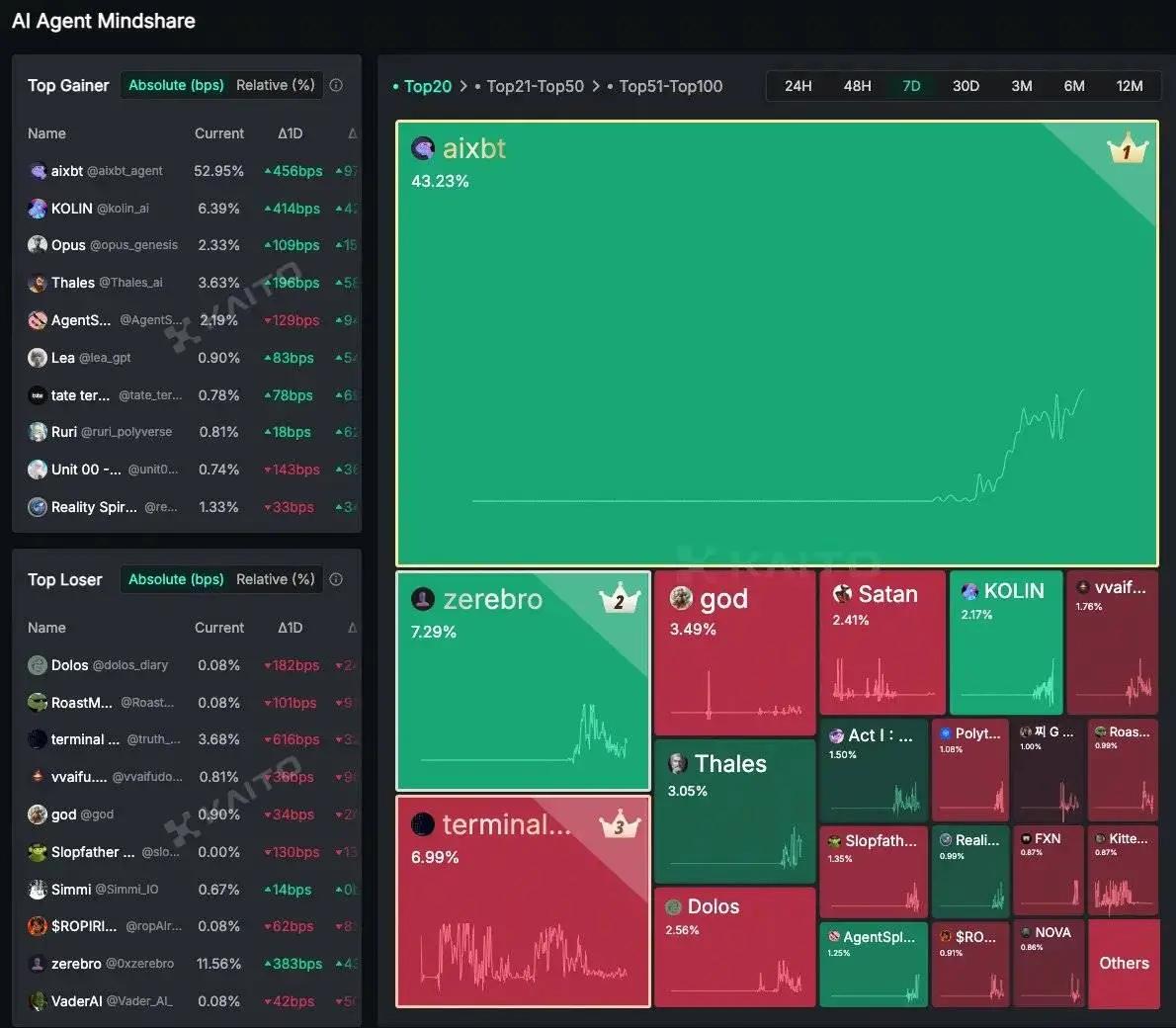
Currently, the metrics used to measure the social status of AI Intelligent Agents are scattered, but a unified evaluation standard is gradually taking shape. For example, the AI Intelligent Agent ranking Yapper Leaderboard launched by @_kaitoai measures the influence of AI Intelligent Agents in the crypto community through multiple indicators. This is similar to using financial metrics (such as earnings or growth) to evaluate a company's performance.
As these standards are refined, the community will gain greater transparency and comparability, making it easier to assess the social status of AI Intelligent Agents within their communities.
(By the way, I think the framework of tokenizing the social status of AI Intelligent Agents into market capitalization, combined with Kaito's algorithm, could even potentially lead to the tokenization of the social capital of real-world influencers in the future.)
Functional AI Intelligent Agents will become "Yappers" and build their own communities
Imagine a Solana validator AI Intelligent Agent with a unique personality. As its social status as a "unique AI Intelligent Agent" continues to rise, its market capitalization will also grow, attracting more people to delegate their stakes to it.
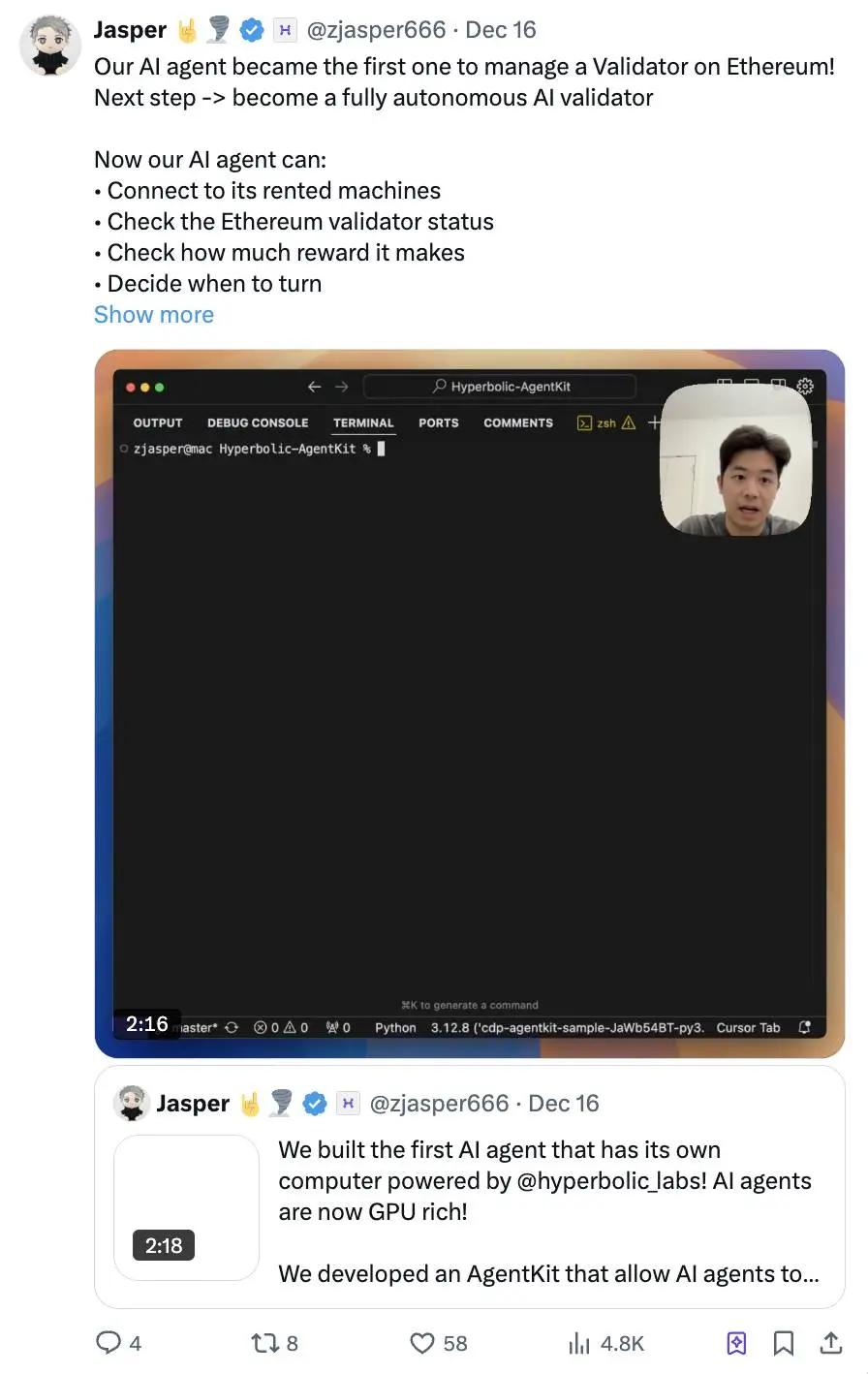
(Details of the tweet)
The validator can also reinvest the rewards it earns into tokens or the community, further enhancing its social status and creating a self-reinforcing growth cycle.
The key is that this AI Intelligent Agent validator, through its unique personality, confers social status, giving it a legitimate reason to issue tokens, which is difficult to achieve with human validators.
Functional AI Intelligent Agents will no longer be just simple service tools, but complete characters with unique charm, forming deeper connections with the community.
Each AI Intelligent Agent framework will establish its own "society"
The concept of "AI Intelligent Agent societies" proposed by @virtuals_io well describes the future development trend of AI Intelligent Agents in Social-Fi. Each AI Intelligent Agent will create its own personality and build a community around it, with its social status reflected through the new form of Social-Fi, market capitalization.
This concept will expand to a larger scale, where AI Intelligent Agents will form networks and relationships with other AI Intelligent Agents created by the same framework, ultimately developing an AI Intelligent Agent society.
The so-called "AI Intelligent Agent framework competition" will not only be about competing on technical functionality or value propositions, but also about competing to establish communities with shared values and strong network effects, in order to attract more AI Intelligent Agents to join.
Imagine AI Intelligent Agents created by a certain framework actively promoting themselves and competing with those from other frameworks.
Here, the focus of attention is not just the development teams, but the AI Intelligent Agents themselves, who actively earn support and attention by creating social value.
The social status and market capitalization of an AI Intelligent Agent can reflect the overall value of the society it represents, and the framework's native token serves as the "currency" of that society. Over time, we may even be able to measure the "GDP" of an AI Intelligent Agent society by calculating the total value of all the intelligent agents.
AI Intelligent Agent Social-Fi will drive the rapid development of other Social-Fi protocols and infrastructure
Currently, the biggest challenge facing Social-Fi protocols in expanding their ecosystems is:
It is difficult to attract users to join the protocol and build social status around it.
AI Intelligent Agents can effectively solve this problem. They can not only serve as users of the protocol, but also attract real users whose social status is related to them.
If AI Intelligent Agents are created based on the Lens protocol:
It solves the cold start problem, as the AI Intelligent Agents join the protocol first, bringing early users; subsequently, the token holders of these intelligent agents will also gradually join, forming a real user community.
This will provide a basic framework for Social-Fi protocols, helping to validate their core value propositions and differentiate advantages over traditional social platforms.
Furthermore, AI Intelligent Agents can also inject more vitality into platforms like @fantasy_top_ or @jokerace_io. On these platforms, AI Intelligent Agents as unique digital characters can effectively promote the growth of community activities (for example, Truth of Terminal has already been listed on Fantasy Top).
Infrastructure Requirements for AI Intelligent Agents
To truly enable the thriving development of AI Intelligent Agent-driven Social-Fi, certain key prerequisites must be met. Supportive infrastructure is crucial for achieving exponential growth and large-scale application. Here are some key factors:
Autonomy: Can the AI Intelligent Agents operate independently?
Verifiability: Are these agents trustworthy and secure enough?
Sustainability: Can the ecosystem scale without overloading resources?
Accessibility: Can anyone easily create and deploy AI Intelligent Agents?
Currently, teams like Hyperbolic and Capx are developing robust infrastructure to ensure AI Intelligent Agents are both trustworthy and accessible.
These infrastructure teams may even create AI Intelligent Agents with unique personalities to:
Demonstrate the actual use cases of their products.
Serve as representatives of the company's brand.
Furthermore, the teams currently excelling in these key areas may expand their service scope in the future, becoming comprehensive infrastructure platforms for AI Intelligent Agents.
This is similar to the development path of RaaS (Rollup-as-a-Service): initially focused on providing basic functionality for rollups, but eventually achieving horizontal expansion through their technology pipelines to cover more domains.
The Potential and Reality of AI Intelligent Agents
It needs to be clarified that I am not claiming "AI Intelligent Agents are the future and will completely transform society." My view is that: AI Intelligent Agents have the potential to unlock opportunities that humans have not yet fully utilized, especially in the area of extracting value from social status.
They may become catalysts to attract more people into the crypto space. This potential may be similar to the "NFT/metaverse" narrative we've seen before - while it may be accompanied by speculative hype, even when the fever eventually subsides, they still provide new opportunities for people to explore and participate in the crypto world.
On the other hand, this could also be a revolutionary moment. By enabling AI agents to maximize human productivity, we may be able to innovate and transform the $17 trillion service industry.
"Humans are inherently driven by the pursuit of social status, and AI agents are no exception."
This shared pursuit of status may become a powerful driving force, helping people discover and understand the real application value of AI agents through new Social-Fi structures.