Author: Deep Value Memetics, Translator: Jinse Finance xiaozou
In this article, we will explore the prospects of the Crypto X AI framework. We will focus on the four main frameworks (ELIZA, GAME, ARC, ZEREPY) and their respective technical differences.
1. Introduction
Over the past week, we have researched and tested the four major Crypto X AI frameworks: ELIZA, GAME, ARC, and ZEREPY. Our conclusions are as follows.
We believe that AI16Z will continue to dominate. The value of Eliza (with a market share of around 60% and a market capitalization of over $1 billion) lies in its first-mover advantage (the Lindy effect) and its increasing adoption by more developers, as evidenced by its 193 contributors, 1,800 forks, and over 6,000 stars, making it one of the most popular code repositories on Github.
So far, GAME (with a market share of around 20% and a market capitalization of around $300 million) has been developing very well, gaining rapid adoption, as VIRTUAL has just announced, with over 200 projects on the platform, 150,000 daily requests, and a 200% weekly growth rate. GAME will continue to benefit from the rise of VIRTUAL and will be one of the biggest winners in its ecosystem.
Rig (ARC, with a market share of around 15% and a market capitalization of around $160 million) is very notable because its modular design is very easy to operate and can dominate the Solana ecosystem (RUST) as a "pure-play".
Zerepy (with a market share of around 5% and a market capitalization of around $300 million) is a relatively niche application specifically targeting the passionate ZEREBRO community, and its recent collaboration with the ai16z community may create synergies.
We note that our market share calculations cover market capitalization, development records, and underlying operating system end-market.
We believe that in this market cycle, the framework segmentation market will be the fastest-growing area, and the total market value of $1.7 billion could easily grow to $20 billion, which is still relatively conservative compared to the 2021 L1 peak valuation, when many L1s were valued at over $20 billion. Although these frameworks serve different end markets (chains/ecosystems), given that we believe this field is on an upward trend, a market capitalization-weighted approach may be the most prudent.
2. The Four Frameworks
In the table below, we list the key technologies, components, and advantages of each major framework.
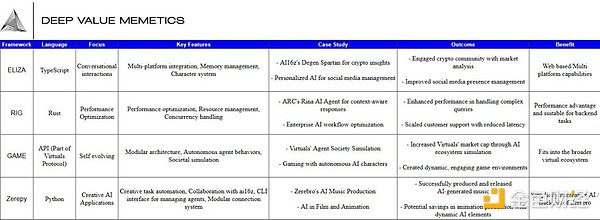
(1) Framework Overview
In the intersection of AI X Crypto, there are several frameworks that have facilitated the development of AI. They are ELIZA from AI16Z, RIG from ARC, ZEREBRO from ZEREPY, and VIRTUAL from GAME. Each framework caters to different needs and philosophies in the AI agent development process, from open-source community projects to performance-focused enterprise solutions.
This article will first introduce the frameworks, telling you what they are, what programming languages and technical architectures they use, what unique features they have, and what potential use cases the frameworks can be used for. Then, we will compare each framework in terms of usability, scalability, adaptability, and performance, exploring their respective strengths and limitations.
ELIZA (Developed by ai16z)
Eliza is an open-source multi-agent simulation framework aimed at creating, deploying, and managing autonomous AI agents. It is developed in the TypeScript programming language, providing a flexible and scalable platform for building intelligent agents that can interact with humans across multiple platforms while maintaining consistent personalities and knowledge.
The core functionalities of the framework include a multi-agent architecture that supports the simultaneous deployment and management of multiple unique AI personalities, a role system for creating different agent personas using a role file framework, and a memory management system that provides long-term memory and context-awareness through an advanced retrieval-augmented generation (RAG) system. Additionally, the Eliza framework offers seamless platform integration, enabling reliable connections with Discord, X, and other social media platforms.
From the perspective of AI agent communication and media capabilities, Eliza is an excellent choice. In terms of communication, the framework supports integrations with Discord's voice channel functionality, X features, Telegram, and direct API access for custom use cases. On the media processing side, the framework's capabilities extend to PDF document reading and analysis, link content extraction and summarization, audio transcription, video content processing, image analysis, and dialogue summarization, effectively handling a wide range of media inputs and outputs.
The Eliza framework provides flexible AI model support through local inference of open-source models, OpenAI cloud inference, and default configurations (such as Nous Hermes Llama 3.1B), and it integrates support for Claude to handle complex tasks. Eliza's modular architecture, with extensive operating system support, custom client support, and comprehensive APIs, ensures scalability and adaptability across applications.
Eliza's use cases span multiple domains, such as AI assistants for customer support, community moderation, and personal tasks, as well as content auto-creators, interactive bots, and brand representatives for social media. It can also serve as a knowledge worker, taking on roles like research assistant, content analyst, and document processor, and support role-playing bots, educational tutors, and entertainment agents.
Eliza's architecture is built around the agent runtime, which seamlessly integrates with its role system (supported by model providers), memory manager (connected to a database), and operating system (linked to platform clients). The framework's unique features include a plugin system that supports modular functionality extensions, multi-modal interaction support for voice, text, and media, and compatibility with leading AI models like Llama, GPT-4, and Claude. With its diverse functionality and robust design, Eliza stands out as a powerful tool for cross-domain development of AI applications.
G.A.M.E (Developed by Virtuals Protocol)
The Generative Autonomous Multimodal Entity (G.A.M.E) framework aims to provide developers with API and SDK access to experiment with AI agents. This framework offers a structured approach to managing the behavior, decision-making, and learning processes of AI agents.
Its core components are as follows: First, the Agent Prompting Interface is the entry point for developers to integrate GAME into their agents and access agent behaviors. The Perception Subsystem initiates sessions by specifying parameters such as session ID, agent ID, user, and other relevant details.
It synthesizes incoming information into a format suitable for the Strategic Planning Engine, serving as the sensory input mechanism for the AI agent, whether in the form of dialogue or reactions. At the core is the Dialogue Processing Module, which handles messages and responses from the agent and collaborates with the Perception Subsystem to effectively interpret and respond to inputs.
The Strategic Planning Engine works together with the Dialogue Processing Module and the On-Chain Wallet Operator to generate responses and plans. This engine has two levels of functionality: as a high-level planner, it creates broad strategies based on context or goals; as a low-level strategist, it translates these strategies into actionable plans, further divided into action planners for specific tasks and plan executors for task execution.
Another independent but important component is the World Context, which references the environment, global information, and game state, providing the necessary context for the agent's decision-making. Additionally, the Agent Repository stores long-term attributes, such as goals, reflections, experiences, and personality, which collectively shape the agent's behavior and decision-making process.
The framework utilizes short-term working memory and long-term memory processors. The short-term memory retains relevant information about past actions, results, and current plans. In contrast, the long-term memory processor extracts key information based on criteria like importance, recency, and relevance. The long-term memory stores the agent's experiences, reflections, dynamic personality, world context, and working memory, enhancing decision-making and providing a foundation for learning.
The learning module uses data from the Perception Subsystem to generate general knowledge, which is then fed back into the system to improve future interactions. Developers can provide feedback on actions, game states, and sensory data through the interface to enhance the AI agent's learning capabilities and improve its planning and decision-making abilities.
The workflow begins with developers interacting through the Agent Prompting Interface. The input is processed by the Perception Subsystem and forwarded to the Dialogue Processing Module, which manages the interaction logic. The Strategic Planning Engine then formulates and executes plans, leveraging high-level strategies and detailed action plans.
Data notifications from the world's context and agent repositories inform these processes, while working memory tracks real-time tasks. At the same time, long-term memory processors store and retrieve long-term knowledge. The learning module analyzes the results and integrates new knowledge into the system, allowing the agent's behavior and interactions to be continuously improved.
RIG (developed by ARC)
Rig is an open-source Rust framework aimed at simplifying the development of large language model applications. It provides a unified interface for interacting with multiple LLM providers, such as OpenAI and Anthropic, and supports various vector stores, including MongoDB and Neo4j. The unique aspect of the framework's modular architecture is its core components, such as the Provider Abstraction Layer, Vector Store Integration, and Agent System, which facilitate seamless LLM interactions.
Rig's primary audience includes developers building AI/ML applications using Rust, as well as organizations seeking to integrate multiple LLM providers and vector stores into their Rust applications. The repository uses a workspace architecture with multiple crates, supporting scalability and efficient project management. Its key features include the Provider Abstraction Layer, which standardizes the completion and embedding of APIs across different LLM providers, with consistent error handling. The Vector Store Integration component provides an abstract interface for multiple backends and supports vector similarity searches. The Agent System simplifies LLM interactions, supporting Retrieval Augmented Generation (RAG) and tool integrations. Additionally, the embedding framework provides batch processing capabilities and type-safe embedding operations.
Rig leverages several technical advantages to ensure reliability and performance. Asynchronous operations utilize Rust's asynchronous runtime to efficiently handle a large number of concurrent requests. The framework's inherent error handling mechanisms improve the resilience to failures in AI provider or database operations. Type safety can prevent errors during the compilation process, enhancing the maintainability of the code. Efficient serialization and deserialization processes support data processing in formats like JSON, which is crucial for AI service communication and storage. Detailed logging and monitoring further assist in debugging and application monitoring.
Rig's workflow begins when a client initiates a request, which is then routed through the Provider Abstraction Layer to the appropriate LLM model. The data is then processed by the core layer, where the agent can use tools or access the vector store for context. The response is generated and refined through complex workflows, such as RAG, involving document retrieval and context understanding, before being returned to the client. The system is integrated with multiple LLM providers and vector stores, adapting to model availability or performance updates.
Rig's use cases span a wide range, including question-answering systems that retrieve relevant documents to provide accurate responses, document search and retrieval systems for efficient content discovery, and chatbots or virtual assistants that offer context-aware interactions for customer service or education. It also supports content generation, enabling the creation of text and other materials based on learned patterns, making it a versatile tool for developers and organizations.
Zerepy (developed by ZEREPY and blorm)
ZerePy is an open-source framework written in Python, aimed at deploying agents on X using OpenAI or Anthropic LLMs. Derived from a modular version of the Zerebro backend, ZerePy allows developers to launch agents with similar core functionality to Zerebro. While the framework provides a foundation for agent deployment, fine-tuning the models is essential to generate creative output. ZerePy simplifies the development and deployment of personalized AI agents, particularly for content creation on social platforms, fostering an AI-driven creative ecosystem for art and decentralized applications.
The framework is Python-based, emphasizing agent autonomy and focusing on the generation of creative output, consistent with the ELIZA architecture and its collaboration with ELIZA. Its modular design supports memory system integration and enables agent deployment on social platforms. Key features include a command-line interface for agent management, integration with Twitter, support for OpenAI and Anthropic LLMs, and a modular connection system for enhanced functionality.
ZerePy's use cases cover the social media automation domain, where users can deploy AI agents to perform posting, replying, liking, and retweeting, thereby increasing platform engagement. Additionally, it caters to content creation in areas such as music, memes, and Non-Fungible Tokens (NFTs), making it a valuable tool for digital art and blockchain-based content platforms.
(2) Comparison of the Four Frameworks
In our view, each framework offers a unique approach to AI development, catering to specific needs and environments, and we shift the focus from the competitive relationships between these frameworks to their distinct characteristics.
ELIZA stands out with its user-friendly interface, particularly for developers familiar with the JavaScript and Node.js environment. Its comprehensive documentation aids in setting up AI agents across various platforms, although its broad feature set may introduce a learning curve. Developed using TypeScript, Eliza becomes an ideal choice for building agents embedded within the web, as most web infrastructure front-ends are developed in TypeScript. The framework is known for its multi-agent architecture, allowing the deployment of different AI personalities on platforms like Discord, X, and Telegram. Its advanced memory management RAG system makes it particularly effective for customer support or social media applications with AI assistants. While it offers flexibility, strong community support, and consistent cross-platform performance, it is still in its early stages, potentially posing a learning curve for developers.
GAME is designed specifically for game developers, providing a low-code or no-code interface through APIs, enabling even non-technical users in the gaming domain to utilize it. However, its focus on game development and blockchain integration may present a steep learning curve for those without relevant experience. It excels in in-game content generation and NPC behavior, but is constrained by the added complexity of its niche domain and blockchain integration.
Due to its use of the Rust programming language, Rig may not be as user-friendly, presenting a significant learning challenge, but it offers an intuitive interaction for those proficient in system programming. Compared to TypeScript, Rust is known for its performance and memory safety. It features strict compile-time checks and zero-cost abstractions, which are essential for running complex AI algorithms. The language is highly efficient, and its low-level control makes it an ideal choice for resource-intensive AI applications. The framework provides a high-performance solution with a modular and scalable design, making it a suitable choice for enterprise applications. However, the use of Rust inevitably introduces a steep learning curve for developers unfamiliar with the language.
ZerePy leverages Python, providing high accessibility for creative AI tasks, with a lower learning curve for Python developers, especially those with an AI/ML background, and benefits from the strong community support of the Zerebro crypto community. ZerePy excels in creative AI applications such as NFTs, positioning itself as a powerful tool for digital media and art. While it thrives in the realm of creativity, its scope is relatively narrower compared to the other frameworks.
In terms of scalability, ELIZA has made significant progress in its V2 update, introducing a unified message pipeline and a scalable core framework, supporting effective management across multiple platforms. However, the management of this multi-platform interaction may pose scalability challenges if not optimized.
GAME performs exceptionally well in the real-time processing required for games, with scalability managed through efficient algorithms and potential blockchain-based distributed systems, although it may be constrained by specific game engines or blockchain networks.
The Rig framework leverages Rust's scalable performance, designed for high-throughput applications, which is particularly effective for enterprise-level deployments, although this may mean that achieving true scalability requires complex setup.
Zerepy's scalability is oriented towards creative output, with community contributions, but its focused scope may limit its application in a broader AI environment, as its scalability may be tested by the diversity of creative tasks rather than user numbers.
In terms of adaptability, ELIZA leads with its plugin system and cross-platform compatibility, while GAME in gaming environments and Rig in handling complex AI tasks also demonstrate strong adaptability. ZerePy exhibits high adaptability in the creative domain, but may be less suitable for broader AI applications.
Regarding performance, ELIZA is optimized for fast social media interactions, with rapid response times being critical, but its performance may differ when handling more complex computational tasks.
Virtual Protocol's GAME focuses on high-performance real-time interaction in gaming scenarios, utilizing efficient decision-making processes and potential blockchain for decentralized artificial intelligence operations.
The Rig framework is based on the Rust language and provides excellent performance for high-performance computing tasks, suitable for enterprise applications where computational efficiency is critical.
Zerepy's performance is tailored for the creation of creative content, with its metrics centered on the efficiency and quality of content generation, and may not be as widely applicable outside the creative domain.
ELIZA's strength lies in its flexibility and scalability, with its plugin system and role configuration making it highly adaptable, benefiting cross-platform social AI interactions.
GAME provides unique real-time interaction capabilities in games, enhanced by blockchain integration to augment novel AI participation.
Rig's advantage is in its performance and scalability for enterprise AI tasks, focusing on providing clean, modular code for long-term project health.
Zerepy excels at nurturing creativity, leading in digital art AI applications, and is supported by a vibrant community-driven development model.
Each framework has its own limitations, with ELIZA still in the early stages, potential stability issues, and a steep learning curve for new developers, the niche of Game may limit broader applications, and the complexity added by blockchain, while Rig's steep learning curve due to Rust may deter some developers, and Zerepy's narrow focus on creative output may limit its use in other AI domains.
(3) Framework Comparison Summary
Rig (ARC):
Language: Rust, focused on safety and performance.
Use Case: Ideal choice for enterprise-level AI applications, as it emphasizes efficiency and scalability.
Community: Not heavily community-driven, more focused on technical developers.
Eliza (AI16Z):
Language: TypeScript, emphasizes web3 flexibility and community engagement.
Use Case: Designed for social interactions, DAOs, and trading, with a particular focus on multi-agent systems.
Community: Highly community-driven, with extensive GitHub participation.
ZerePy (ZEREBRO):
Language: Python, making it accessible to a wider base of AI developers.
Use Case: Suitable for social media automation and simpler AI agent tasks.
Community: Relatively new, but with the potential for growth due to Python's popularity and support from AI16Z contributors.
GAME (VIRTUAL):
Focus: Autonomous, adaptive AI agents that can evolve based on interactions in virtual environments.
Use Case: Most suitable for AI agent learning and adaptation scenarios, such as games or virtual worlds.
Community: Innovative community, but still defining its positioning in the competition.
3. GitHub Star Data Trends
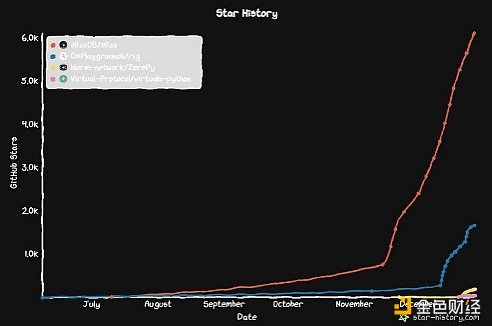
The image shows the GitHub star data for the frameworks since their release. It's worth noting that GitHub stars are an indicator of community interest, project popularity, and perceived project value.
ELIZA (red line):
Starting from a low base in July, it has seen a rapid increase in star count, reaching a significant 61,000 stars by late November. This indicates a surge in interest, attracting the attention of developers. This exponential growth suggests that ELIZA has gained tremendous traction due to its features, updates, and community engagement. Its popularity far exceeds the other competitors, indicating strong community support and broader applicability or interest in the AI community.
RIG (blue line):
Rig is the oldest of the four frameworks, with a moderate but steadily growing star count, likely to see a significant increase in the coming months. It has reached 1,700 stars and is still on the rise. Ongoing development, updates, and a growing user base are the reasons for the accumulating user interest. This may reflect a niche user base or the framework still building its reputation.
ZEREPY (yellow line):
ZerePy was just launched a few days ago and has already accumulated 181 stars. It's worth emphasizing that ZerePy needs more development to improve its visibility and adoption. Collaboration with AI16Z may attract more code contributors.
GAME (green line):
This project has the fewest stars, but it's worth noting that this framework can be directly applied to agents within virtual ecosystems through APIs, eliminating the need for GitHub visibility. However, this framework was only made publicly available to builders a little over a month ago, and there are over 200 projects currently using GAME.
4. Bullish Factors for the Frameworks
Eliza's V2 version will integrate the Coinbase agent suite. All projects using Eliza will soon support native TEE, allowing agents to run in a secure environment. An upcoming Eliza feature is the Plugin Registry, which will allow developers to seamlessly register and integrate plugins.
Additionally, Eliza V2 will support automated anonymous cross-platform messaging. The token economics whitepaper is scheduled for release on January 1, 2025, and is expected to have a positive impact on the underlying AI16Z token of the Eliza framework. AI16Z plans to continue enhancing the framework's utility and attracting high-quality talent, and the efforts of its key contributors have already proven its ability to do so.
The GAME framework provides no-code integration for agents, allowing the simultaneous use of GAME and ELIZA within a single project, each serving a specific purpose. This approach is expected to attract builders focused on business logic rather than technical complexity. Although the framework has only been publicly available for a little over a month, it has made substantial progress with the team's efforts to attract more contributors. All projects launched on VIRTUAL are expected to use GAME.
The ARC token-represented Rig has tremendous potential, although its framework is still in the early growth stage, and its plans to drive project adoption have only been launched a few days ago. However, high-quality projects adopting ARC are expected to emerge soon, similar to the Virtual flywheel, but with a focus on Solana. The team is optimistic about its collaboration with Solana, comparing the ARC-Solana relationship to Virtual's relationship with Base. Notably, the team not only encourages new projects to use Rig to launch, but also encourages developers to enhance the Rig framework itself.
Zerepy is a newly launched framework that is gaining increasing attention due to its collaboration with Eliza. The framework has attracted Eliza contributors who are actively improving it. Driven by a passionate ZEREBRO following, it has a dedicated base of enthusiasts and provides new opportunities for Python developers, who were previously underrepresented in the competition for AI infrastructure. The framework is expected to play a significant role in AI creativity.