Introduction
On January 7th, the Solana Virtual Machine (SVM) SOON announced on social media that the COMMing SOON NFT launch attracted $200 million in subscriptions in just 16 hours, with the NFT minting being oversubscribed by 8 times.
As of the time of writing, the subscription amount has reached $349 million. However, this is currently only at the pre-order stage, and there has not been any real investment yet. Nevertheless, the current marketing seems to be very successful, with SOON's popularity surging. Traditionally, token distribution often adopts direct listing on exchanges or the ICO model, but SOON's attempt is quite unique: through a layered reward NFT mechanism, the fairness and flexibility of token distribution have been raised to a new level. Whether for short-term arbitrage players or long-term community builders, the reward design of COMMing SOON NFT can find suitable options.
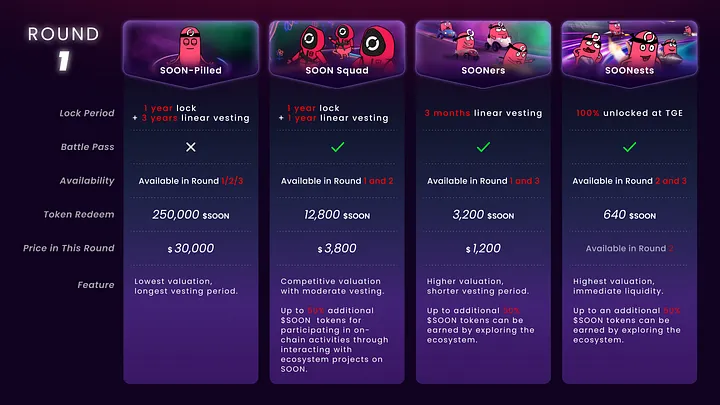
The minting rules are also quite innovative, with three different price and unlocking cycle NFTs, allocating 51% of the SOON tokens to the community, satisfying the diverse needs of users:
- $900 NFT: Airdrop 3,200 $SOON, linearly unlocked in three months;
- $2,850 NFT: Airdrop 12,800 $SOON, locked for 12 months and then linearly unlocked;
- $22,500 NFT: Airdrop 250,000 $SOON, locked for 12 months and then linearly unlocked over 36 months.
In a sense, this is not just a token distribution, but a completely new exploration of "how a decentralized community is formed". By attracting capital commitments and early community participation, SOON is gradually building an ecological foundation that is both open and with clear incentives. More noteworthy is that the token distribution model behind SOON's technical blueprint is obviously not limited to a one-time minting event, but aims to drive fundamental changes in the blockchain industry through innovative architecture.
So, what is behind this hot project? How can SOON stand out in the tide of modular blockchains? How will its three core products - SOON Mainnet, SOON Stack, and InterSOON - realize the ambition of connecting all blockchains? Let's dive into this feast of technology and innovation.
SOON's Positioning: Ethereum's Layer2, Extension of Solana Technology
SVM was originally born as the core virtual machine of Solana, with its high-performance parallel processing capability (Sealevel) and localized fee market solving the throughput bottleneck of traditional blockchains, quickly establishing a reputation among developers. However, the emergence of SOON not only redefines the boundaries of SVM, but also introduces it into the new realm of modular blockchains.
But before understanding SOON's ecosystem, we must first answer a core question: Is SOON an Ethereum Layer2 or an extension of Solana? What is the relationship between the two?
SOON is built on the SVM ecosystem, primarily positioned as an Ethereum Layer2, but it has fundamental differences from traditional Layer2s:
- Technical Foundation: SOON uses Solana's core virtual machine (SVM) as the execution layer, rather than Ethereum's EVM (Ethereum Virtual Machine). This means that SOON inherits Solana's high-performance parallel processing advantages in its technical architecture, but is not dependent on the Solana mainnet.
- Settlement Layer Choice: SOON's mainnet (SOON Mainnet) uses Ethereum as the settlement layer, with all state changes ultimately submitted to Ethereum for verification and storage.
- Scalability: Through SOON Stack, SVM is extended to other mainstream L1s (such as Bitcoin, Cosmos), enabling cross-chain deployment.
This makes SOON a unique technical bridge: it is based on Solana technology, but not limited to Solana; it injects high-performance execution capabilities into the Ethereum ecosystem, while providing modular expansion possibilities for other L1s.
SVM: The Key Engine Driving the Development of Decentralized Ecosystems
The core advantages of SVM as a virtual machine are:
- Parallel Processing Capability: Through the Sealevel architecture, SVM can process multiple transactions simultaneously, significantly improving throughput, which is several times that of traditional EVM.
- Efficient Fee Market: Solana's localized fee market model solves the impact of a single application on the entire network fee, allowing users to use blockchain services at a lower cost.
SOON's innovation lies in decoupling SVM from a single public chain and transforming it into a modular virtual machine solution, allowing it to be seamlessly embedded into Ethereum and other mainstream blockchains.
Interpretation of SOON's Three Core Products
After clarifying SOON's technical positioning and its relationship with Ethereum and Solana, we can delve deeper into its three core products: SOON Mainnet, SOON Stack, and InterSOON. These three together constitute the ecological framework of SOON, providing modular and high-performance infrastructure for the multi-chain future.
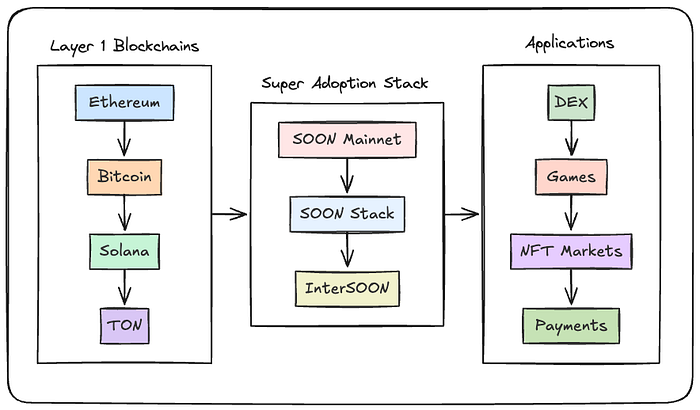
1. SOON Mainnet: The Efficient Engine of Ethereum Layer2
SOON Mainnet is an Ethereum Layer2 container built on the decoupled SVM, which significantly improves throughput and transaction efficiency through parallel processing and modular design.
Core Functions:
- High Throughput and Low Cost: By decoupling the parallel processing capability of SVM, SOON Mainnet can achieve transaction throughput tens of times higher than traditional EVM Rollups, while reducing the Gas fee per transaction.
- Optimized Resource Allocation: Supports on-demand scaling, further optimizing blockchain performance by reducing redundancy in the consensus layer.
- Planned ZK Proof Integration: Will incorporate zero-knowledge proof technology (ZK Proof) in the future to shorten the exit time from L2 to L1.
Significance: The goal of SOON Mainnet is not only to provide an economically efficient Layer2 solution, but also to promote the adoption of SVM technology in the Ethereum ecosystem by attracting high-quality developers and users.
2. SOON Stack: The Technical Engine of Modular Blockchains
SOON Stack is the core infrastructure stack of SOON, whose design allows developers to deploy SVM to any L1 public chain.
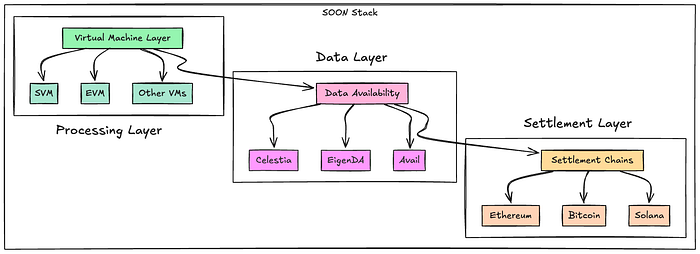
Technical Features:
- Universal Compatibility: Supports mainstream public chains such as Ethereum, Bitcoin, and Cosmos.
- Flexible Configuration: Developers can choose different settlement layers (such as Ethereum, Bitcoin) and data availability (DA) layers (such as Celestia, Avail) based on their needs.
- Decoupled SVM: By separating the execution layer of SVM from Solana's consensus mechanism, it optimizes transaction processing capabilities and reduces DA resource waste.
Core Value: SOON Stack provides tools for rapid deployment and efficient operation of modular blockchains, not only promoting the adoption of SVM, but also offering more flexible scalability options for other public chains.
3. InterSOON: The Cross-Chain Protocol Connecting Blockchains
In a modular ecosystem, cross-chain interoperability is a key issue, and InterSOON is SOON's proposed solution.
Core Functions:
- Message Passing Relayer: Combining the design of the sequencer, it enables cross-chain communication between the SOON mainnet and other SOON chains.
- Multi-Chain Interoperability: Supports asset and data flow with non-SVM public chains (such as Solana, TON), eliminating the problem of ecosystem fragmentation.
Technical Highlights:
- Native Interoperability: Each SOON chain is seamlessly connected through a centralized message passing program.
- Security and Efficiency Prioritized: Leveraging the modular architecture of SVM to ensure the security and speed of cross-chain operations.
Through InterSOON, the SOON ecosystem not only achieves efficient interaction between chains, but also takes the integration of multi-chain to a new level.
How Does SOON's Modular Architecture Work?
SOON's modular design tightly integrates its three core products, and realizes efficient collaboration through the following architecture:
- Settlement Layer: Ethereum serves as the mainnet's settlement layer, ensuring the security and finality of transactions.
- Data Availability Layer (DA Layer): Supports configurable DA layers such as Celestia and Avail, providing reliable data storage for transactions.
- Execution Layer: Efficient execution layer based on decoupled SVM, optimizing transaction throughput and improving resource utilization.
- Cross-Chain Communication Layer: Technically supported by InterSOON, enabling interconnectivity within and outside the ecosystem.
This architecture makes the SOON ecosystem both flexible and efficient, providing technical support and endless application scenarios for the development of modular blockchains.
Through the combination of SOON Mainnet, SOON Stack, and InterSOON, the SOON ecosystem not only provides solutions for high-performance applications, but also drives the blockchain industry towards a multi-chain integrated future at the technical level.
SOON's three core products not only provide flexibility and interoperability for the modular blockchain ecosystem in design, but also demonstrate significant innovation in technical implementation. Through unique architectural design and key technology optimization, SOON has solved multiple pain points of traditional systems for high-performance blockchains, paving the way for the future development of decentralized applications.
1. Decoupled SVM: The Key to Breaking Performance Bottlenecks
One of SOON's core technologies is the deep optimization of the Solana Virtual Machine (SVM), particularly the decoupling of its execution layer from the original consensus layer.
Why decouple?
In the native Solana architecture, SVM is tightly integrated with the consensus layer. While this design is suitable for monolithic chains, it can lead to performance bottlenecks and resource waste in a modular environment. After decoupling, SVM can be separated from Solana's Tower BFT consensus layer, while retaining its high-performance parallel processing capabilities, providing support for scaling in a multi-chain environment.
Advantages of decoupling:
- Higher flexibility: Supports flexible deployment in Rollup environments.
- Lower resource consumption: Optimizes the resource efficiency of the Data Availability Layer (DA Layer) by removing redundant voting transactions.
- Stronger security: The integrated fraud proof can simultaneously verify the correctness of transaction execution and state transitions.
The decoupled SVM design not only retains Solana's technical advantages, but also opens up new possibilities for the application of SVM in modular blockchains.
2. SIMD83 Optimization: A New Height in Parallel Processing
The parallel processing capability of SVM is its core highlight, and SOON has introduced the SIMD83 protocol on this basis, further improving the system's throughput and efficiency.
Core functions of SIMD83:
- Smart conflict handling: In high-concurrency transactions, it intelligently identifies and isolates the transactions of conflicting accounts, thereby optimizing the overall processing flow.
- Improved resource utilization: By reducing the time overhead of processing conflicting transactions, it achieves more efficient parallel processing.
Actual effects:
- Significantly reduces the performance bottleneck caused by transaction conflicts.
- In the test environment, the system's basic throughput reaches 30,000 TPS and can scale linearly with the increase of nodes.
The integration of SIMD83 has made SOON an ideal platform for high-frequency interaction scenarios (such as DeFi and GameFi), providing developers with more powerful technical tools.
3. Cross-Chain Communication and the Technical Implementation of InterSOON
Cross-chain interoperability is a key issue for modular blockchains, and SOON has provided an efficient solution through InterSOON:
Core mechanisms:
- Message relay: Combining the sequencer to ensure the efficient transmission and state synchronization of cross-chain messages.
- Native interoperability: Enabling the free flow of assets and data between SOON mainnet, SOON chains, and other public chains (such as Solana and TON).
Technical highlights:
- Eliminates the data island problem in the multi-chain ecosystem, providing users with a smoother cross-chain interaction experience.
- Supports the development of complex application scenarios across multiple chains through modular design.
The launch of InterSOON not only brings a unified technical standard to the SOON ecosystem, but also provides important infrastructure for the interconnection of Web3 multi-chains.
4. Synergistic Effects of the Modular Architecture
SOON's modular architecture integrates the settlement layer, data availability layer, execution layer, and cross-chain communication layer, forming a highly synergistic ecosystem:
- Settlement Layer: Ethereum as the mainnet settlement layer, providing security guarantees for state commitments.
- Data Availability Layer (DA Layer): Supports flexible configurations like Celestia and Avail, optimizing transaction storage efficiency.
- Execution Layer: Efficient execution layer based on decoupled SVM, providing computing power for the multi-chain ecosystem.
- Cross-Chain Communication Layer: Technically supported by InterSOON, enabling seamless connections between chains.
This architecture supports the rapid expansion of the modular ecosystem, while providing developers and users with a unified technical experience.
Through the decoupling of SVM, the introduction of SIMD83 optimization, and the innovation of cross-chain protocols, SOON has not only reached new heights in performance, but also set new benchmarks in multi-chain interoperability. This dual advantage has made SOON the innovation leader in the field of modular blockchains, and its ecosystem potential continues to expand due to these technical breakthroughs.
Ecosystem Applications on SOON
In the blockchain ecosystem, the diversity and user-friendliness of applications are key factors in attracting developers and users. SOON has not only achieved high performance and scalability through its technical architecture, but also provides users with a variety of rich application scenarios, from DeFi to GameFi, and to decentralized prediction markets, SOON is shaping a vibrant ecosystem.
1. DeFi Applications: Diverse Financial Solutions
The DeFi ecosystem is undoubtedly one of the core directions on the SOON platform. The DeFi applications on SOON not only have a wide variety, but also possess broad functionality, covering scenarios such as lending, trading, and staking.
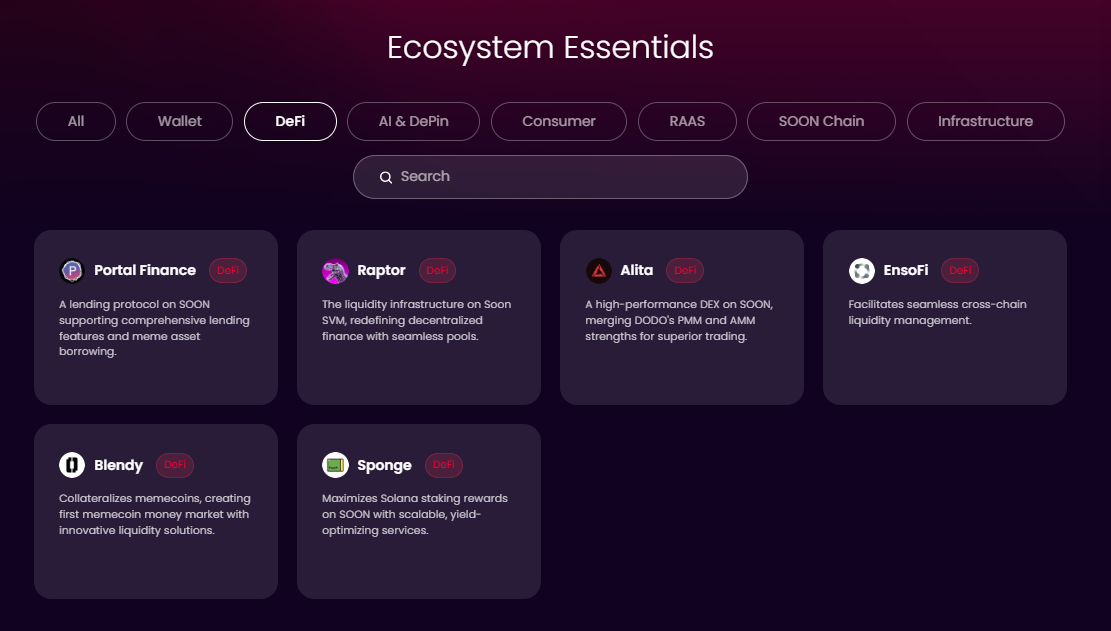
- Portal Finance: A user-facing lending protocol that allows users to access liquidity at low cost.
- Raptor: An automated market maker (AMM) that provides users with a smooth trading experience, while supporting complex liquidity pool designs.
- Alita: A native DEX (decentralized exchange) that supports multi-asset trading, providing users with efficient on-chain trading services.
- Sponge: A staking platform where users can earn passive income by staking assets, suitable for long-term holders.
Two highlight projects:
- EnzoFi: A cross-chain liquidity management hub that integrates lending, bridging, and staking functions. Its unique design lies in the point system and its widespread on-chain deployment (Solana, Sui, Eclipse, SOON, and Movement), currently with over 163,000 followers on the X platform.
- Blendy: Focuses on providing money market services for Meme coins and AI agent-related assets. The innovation of this platform is that the collateral is all Meme coins, which is very much in line with the current hot spot. Although still in the testnet stage, its trading volume has already exceeded 150,000 transactions.
2. User-Facing Innovative Applications
In addition to DeFi applications, the SOON platform also covers some innovative applications targeting end-users. These applications span payment, collaboration, prediction markets, and other fields, demonstrating the broad applicability of the SOON platform.
- Aeronyx: Based on the SOON DePIN protocol (distributed IoT network), it tokenizes the computing resources of millions of devices, opening up a new path for the popularization of distributed computing.
- Gigentic: A chain-based platform that supports AI agent collaboration, it builds a bridge between humans and AI through smart contracts and decentralized mechanisms.
- CoindPay: A multi-functional payment and DeFi application that supports cross-industry payment scenarios, providing users with an efficient and convenient payment solution.
- Polyquest: A decentralized prediction market where users can participate in event prediction and explore the prediction economic model based on blockchain.
3. Future Potential of the SOON Application Ecosystem
As more and more developers join, the SOON application ecosystem is expanding rapidly. This is reflected not only in the growth of the number of applications, but also in the improvement of functional depth and user experience.
- Multi-chain Expansion: Through the InterSOON protocol, these applications can achieve seamless operation across multiple chains, breaking through the technical limitations of traditional public chains.
- Incentive Mechanism: Through COMMing SOON NFT and token rewards, it attracts more high-quality project developers, promoting the continuous prosperity of the ecosystem.
- Capturing Hotspots: From Meme coins to AI agents, and to the DePIN protocol, SOON has always focused on industry hotspots, integrating the latest trends into the platform ecosystem.
SOON's ecosystem applications are not only diverse, but also show profound technical potential in multiple fields. Whether it is the financial infrastructure of DeFi or innovative applications for ordinary users, SOON is proving its potential as a next-generation blockchain platform through practical actions. In the future, SOON will not only be a technical platform, but also become the link of the multi-chain ecosystem and the driving force of the decentralized world.
Economic Model and Potential Market Value
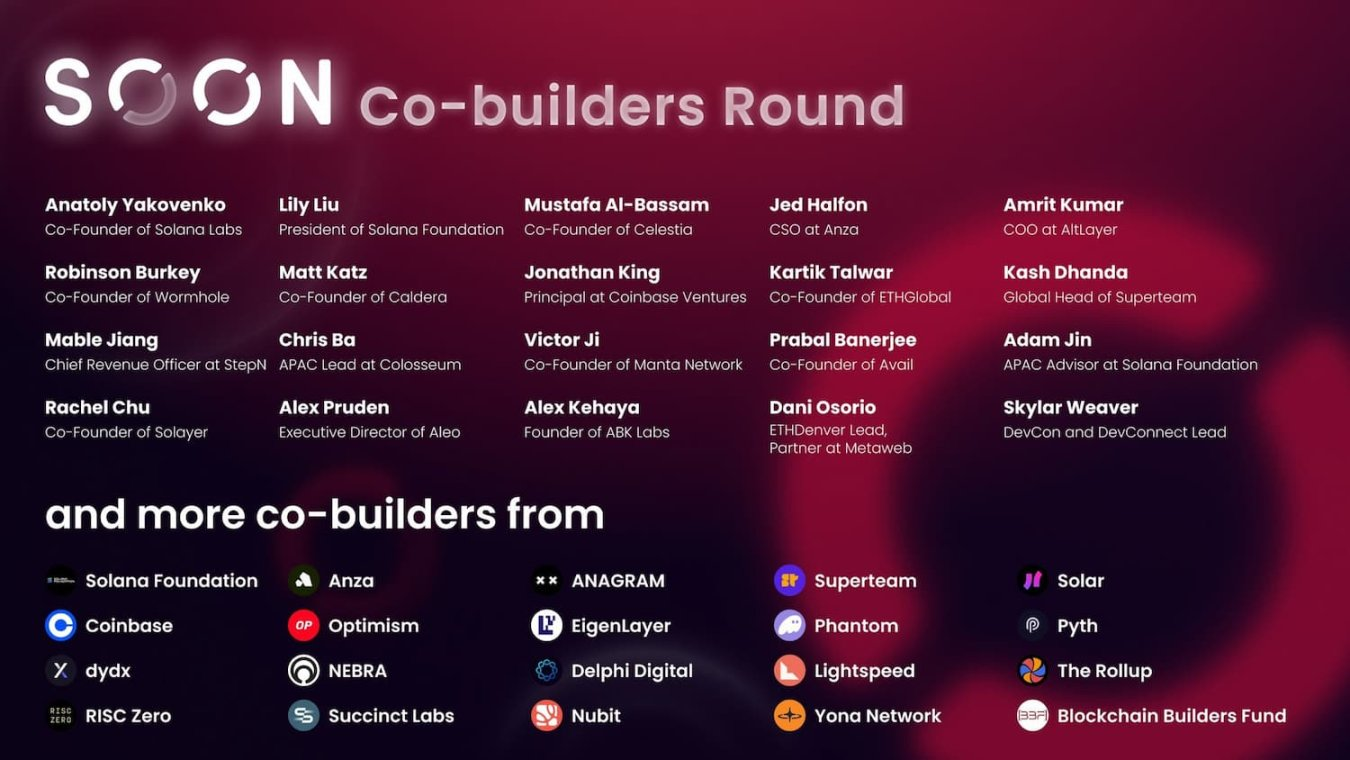
On August 27, 2024, SOON announced the completion of the Co-Builder round of financing. Without specific financing amount and VC, it is still a luxurious financing lineup: including Solana Labs co-founder Anatoly Yakovenko (toly), Solana Foundation chairman Lily Liu, Celestia co-founder Mustafa Al-Bassam, Anza (Solana client Agave developer) Chief Security Officer CSO, AltLayer COO Amrit Kumar, Wormhole Foundation co-founder Robinson Burkey, Caldera co-founder Matt Katz, Coinbase Ventures executive Jonathan King, Solayer co-founder Rachel Chu and others. For the specific list of investors, please refer to the figure below.
Token Distribution:
The total supply of SOON tokens is 1 billion, of which 51% is allocated to the community and gradually released through NFT minting and on-chain activity rewards. This token economic design avoids concentrated selling pressure, and at the same time lays the foundation for ecosystem development by incentivizing the community and developers.
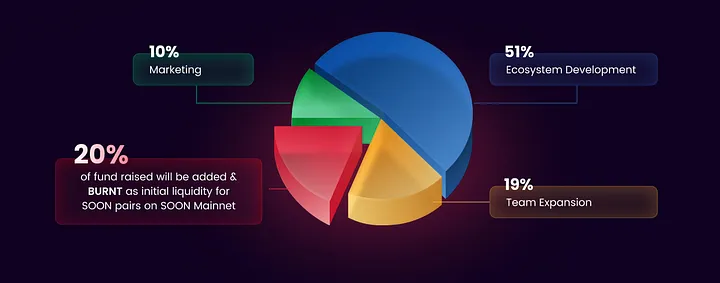
51% for ecosystem development: to promote project growth and innovation.
20% for initial liquidity destruction: the funds will be used as liquidity addition for SOON/SOON pairs on the SOON mainnet.
19% for team expansion: to expand the team and ensure excellent operations.
10% for marketing: to increase visibility and drive adoption of the SOON ecosystem.
Competitor Comparison:
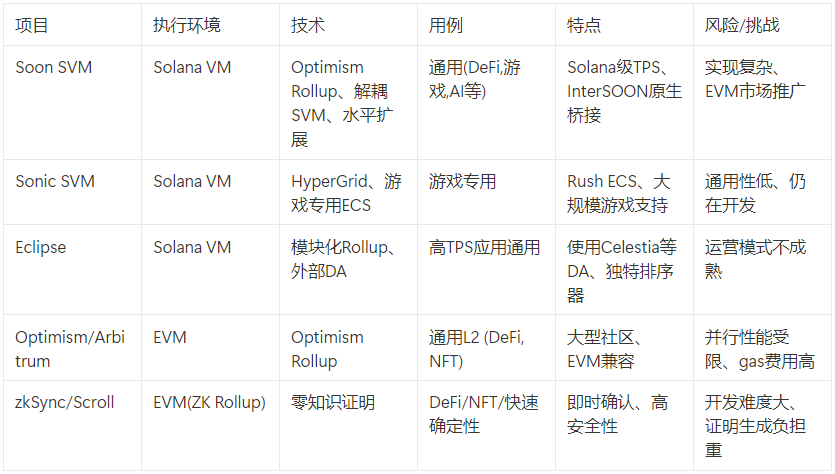
SOON's valuation potential can be divided into the following three tracks:
Modular Rollup Stack (SOON Stack): The modular design of the SOON Stack not only supports the expansion of multiple L1s, but also improves network security and performance by decoupling the SVM. Its architectural innovation has injected new vitality into the entire Rollup track. Benchmarked against Optimism (8.03B) and Arbitrum (7.59B).
SVM-based Ethereum L2 (SOON Mainnet): As the first Ethereum L2 based on decoupled SVM, SOON Mainnet's TPS is expected to reach 30,000 to 600,000, far exceeding the current mainstream EVM Rollup. The main competitor is Sonic SVM, which has just launched and currently has a market value of $320 million and an FDV of $2.2 billion.
Cross-chain Protocol (InterSOON): The cross-chain interoperability of InterSOON provides technical assurance for the coordinated development of SOON chains and other blockchains, and is expected to become the bridge of the multi-chain ecosystem. Benchmarked against Cosmos (3.8B) and Polkadot (5.5B).
Three-tier NFT Pre-sale Corresponding Market Value (Non-Oversubscription)
- $900 NFT: Airdrop 3,200 $SOON, linear unlock in 3 months; corresponding FDV: $280 million
- $2,850 NFT: Airdrop 12,800 $SOON, locked for 12 months and then linearly unlocked; corresponding FDV: $220 million
- $22,500 NFT: Airdrop 250,000 $SOON, locked for 12 months and then linearly unlocked for 36 months. Corresponding FDV: $90 million
The first round of SOON NFT subscription will officially start on January 14th. Under the premise of a bull market and non-oversubscription, the prices of the three NFTs are also relatively reasonable.
Conclusion: The Future of SOON: The Bridge Connecting Blockchains
On the path of blockchain technology towards mainstream adoption, performance and scalability have always been challenges that cannot be avoided. Relying on the technical advantages of decoupled SVM, modular architecture design, and forward-looking multi-chain interoperability solutions, SOON not only redefines the development direction of L2, but also demonstrates the infinite possibilities of modular blockchains.
From the oversubscription of COMMing SOON NFT to the rich and diverse ecosystem applications, SOON is gradually becoming the bridge connecting different blockchains, opening up new innovation space for developers and users. With the full implementation of SOON Stack and InterSOON, a decentralized world of multi-chain integration and seamless interaction is taking shape.
To a certain extent, SOON can represent our common pursuit of high-performance, low-cost, and cross-chain interconnection. This vision is gradually turning from concept to reality, step by step, coming towards us.