Author: Yohan Yun, CoinTelegraph; Translator: Tong Deng, Jinse Finance
MicroStrategy co-founder Michael Saylor has taken an aggressive Bitcoin acquisition strategy, with onlookers seeing it as either brilliant foresight or reckless gambling.
The latter warns that MicroStrategy's heavy reliance on volatile assets like Bitcoin poses risks. A significant drop in Bitcoin prices could put pressure on the company's balance sheet, exacerbating financial stress and potentially impairing its ability to repay debt or raise additional funds.
Despite the risks, Saylor remains steadfast. The American entrepreneur says he has "no reason to sell the winner."
MicroStrategy is the world's largest corporate Bitcoin holder, with 447,470 BTC as of the time of writing. These massive holdings have increased the risk for the company and the entire Bitcoin ecosystem.
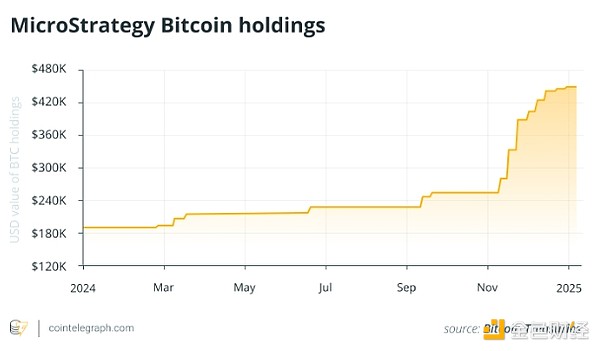
Funding MicroStrategy's BTC Purchases
Nominally a business intelligence software company, MicroStrategy's aggressive Bitcoin accumulation means it is essentially a Bitcoin finance company.
Saylor's Bitcoin buying frenzy began in August 2020 with a $250 million purchase of the company's cash. He then turned to debt issuance, starting with convertible notes - debt that can be converted into equity. These notes typically carry low interest rates and helped raise $650 million in December 2020, with subsequent issuances raising billions more.
In June 2021, MicroStrategy issued $500 million in senior secured notes, offering higher interest rates and backed by the company's assets.

Recently, on December 24, 2024, MicroStrategy proposed increasing its common stock from 330 million to 10.33 billion shares and its preferred stock from 5 million to 1.005 billion shares. The plan provides flexibility to raise funds as needed over time, rather than issuing all new shares at once.
This aligns with the company's 21/21 plan, which aims to raise $42 billion over the next three years - half through stock sales and half through fixed-income instruments - to fund further Bitcoin purchases and explore initiatives like developing a crypto bank or offering Bitcoin-based financial products.
An Irresponsible Ponzi Scheme?
David Krause, Emeritus Professor of Finance at Marquette University, says Saylor's strategy is "inappropriate."
He warns that a significant drop in Bitcoin prices could severely impact MicroStrategy (MSTR), eroding shareholder equity, jeopardizing debt repayment, and potentially leading to financial distress or bankruptcy, triggering a sell-off of its stock.
Krause stated in a written statement: "As someone who has spent most of my career researching and teaching corporate finance and investments, and serving as a [Chief Financial Officer] for over a decade, I firmly believe that treasury assets should be composed entirely of highly liquid and low-risk securities, such as money market instruments."
MSTR's trading price is generally higher than the net asset value (NAV) of its Bitcoin holdings. According to data from BitcoinTreasuries.net, on January 9th, the company's Bitcoin holdings accounted for 51% of its market capitalization.
When MSTR's trading price exceeds the net asset value of its Bitcoin assets, the company raises funds through debt or equity to purchase more Bitcoin. However, Kruger warns that this strategy may dilute shareholder equity.
Theoretically, this method could create a cycle where the company's Bitcoin holdings boost its market position and share price, enabling further bond issuance and Bitcoin purchases.
Some social media analysts have likened this cyclical strategy to a Ponzi scheme.
Financial analyst Jacob King stated: "This cycle only works if BTC keeps going up. If BTC stagnates or crashes (which it will), the cycle will collapse. It's unsustainable, it's a massive Ponzi scheme."

Source: Jacob King
In a recent media interview, Saylor compared this approach to real estate practices in Manhattan.
"Just like the developers in Manhattan, every time the real estate goes up, they issue more debt to develop more real estate," he said. "That's why the buildings in New York City are so tall, and it's been going on for 350 years. I call that economics."
Kruger has been critical of MicroStrategy's Bitcoin dependence, stating in a recent paper that it does not fit the SEC's formal definition of a Ponzi scheme.
The securities regulator describes a Ponzi scheme as "an investment fraud that involves paying purported returns to existing investors from funds contributed by new investors."
Gracy Chen, CEO of cryptocurrency exchange Bitget, agrees with Kruger's analysis.
Unlike a Ponzi scheme that relies on new investor funds to pay returns to early investors, MicroStrategy's approach depends on the market-driven appreciation of Bitcoin value.
Chen noted, "This strategy is more akin to de Gaulle challenging the Bretton Woods system by converting dollars to gold. It's leveraging known weaknesses in modern monetary theory to profit from asset appreciation."
Saylor's Bitcoin Blueprint Undeniably Successful
As of the close on January 8th, MSTR stock was trading at $331.70, up around 2,200% since the company first purchased Bitcoin on August 11, 2020 (when it closed at $14.44). During the same period, Bitcoin's price has risen approximately 735%.
Regardless of whether one agrees with Saylor's views, his plan has undoubtedly boosted MicroStrategy's cryptocurrency investment portfolio and stock performance, making the company a member of the Nasdaq-100 Index in December.
While shareholder equity may face dilution, supporters argue that Bitcoin's long-term growth potential can offset these risks. Additionally, Chen notes that MicroStrategy's convertible debt structure may provide a buffer during crises.
"A prolonged bear market could pose liquidity challenges and heightened debt management risks for the company. However, its unsecured convertible debt structure provides some protection, avoiding immediate forced liquidation," Chen explained.
The company's method of raising funds through stock issuance further reduces the risk of having to sell its Bitcoin holdings, even during bear markets.
Bitcoin Exit Strategy
In short, MicroStrategy's mission is simple: continue buying Bitcoin.
The asset is a long-term strategic holding, a hedge against economic uncertainty, and a means of enhancing shareholder value. It can also be used to obtain loans or raise funds for future business opportunities without liquidating its Bitcoin.
"It is possible to profit from the vast liquidity pool of Bitcoin," said Alexander Panasenko, Head of Product Management at VixiChain. "When you hold large amounts of this inflation-resistant asset that can actually store value, you can just hold it, lend it, and make money."
However, critics point out that Saylor lacks a clear exit strategy. Bitcoin maximalists view Bitcoin as the ultimate exit from the traditional financial system, so they see no need for one.
Stock dilution remains a pressing issue, but this strategy has greatly benefited MicroStrategy and the broader Bitcoin ecosystem, inspiring imitators around the world.
"As long as [MicroStrategy] continues to spark discussions about the role of digital assets in the future economy, you'll see more companies broadly adopt it, revealing new strategies for leveraging digital assets... This is really good," Panasenko said.
"If such proposals involving digital assets fail, it will cast a shadow over the entire industry, essentially setting us back."