Author: Jon Charbonneau Source: DBA Translator: Shan Ou Ba, Jinse Finance
Introduction
The top-tier Layer 2 (L2) networks of Bitcoin will unlock one of the largest markets in the crypto space.
This potential is evident: the market capitalization of Bitcoin (BTC) is approaching $2 trillion, gradually surpassing gold to become the world's largest asset. The network platform that can dominate the use of Bitcoin is destined to become a giant in the future.
Currently, most people try to understand Bitcoin L2 from the perspective of Ethereum L2. However, this analogical thinking often leads to erroneous conclusions, including:
1. Underestimating the market size: The lack of programmability in Bitcoin L1 means that the market opportunity for Bitcoin L2 is inherently larger than that of Ethereum L2.
2. Ignoring the factors that determine the "winner": Compared to Ethereum L2, Bitcoin L2 has higher requirements for security, and security will play a more important role in the early stage.
3. Underestimating the possibilities that can be built: Recent technological breakthroughs have made the construction of Bitcoin Zero-Knowledge Rollups (ZK-rollups) possible, with optimistic-ZK bridges (with "n-of-1" trust assumptions). Even more surprisingly, these innovations will arrive earlier than expected. Future possible Bitcoin upgrades may even be completely trustless (e.g., supporting direct ZK verification and removing the "n-of-1" mechanism).
In this article, we will use a broader definition of L2, including all types from trust-based (such as sidechains) to trust-minimized (such as ZK-rollups), but focusing mainly on fully programmable L2, rather than more specialized protocols like payment channels.
The Potential Market of Bitcoin L2 is Larger than Ethereum L2
Let's start with the first misconception: underestimating the potential market (TAM) of Bitcoin L2.
The market opportunity for Bitcoin L2 is far greater than that of Ethereum L2. This conclusion is partly self-evident, as the market capitalization of Bitcoin is about 4.7 times higher than that of Ethereum, but more importantly, due to the following fundamental reasons:
1. The purpose of Ethereum L2 is scalability
Ethereum L1 provides a complete programmable execution environment, and the value of the state stored in its L1 is much higher than that of its L2, although L1 is slow and has low throughput. The role of L2 is to provide the same functionality as L1, but faster and cheaper. L1 is still where the "real gold and silver" is, while L2 is more of a "testing ground".
2. The purpose of Bitcoin L2 is scalability and programmability
Bitcoin L1 lacks programmability features. Programmability is the key to unlocking stronger privacy, better self-custody experiences, and basic BTC DeFi. If L1 cannot provide these functions, then there is a huge space for building the dominant execution layer of Bitcoin.
Currently, most market participants use Ethereum L2 as a model to understand Bitcoin L2, but the correct comparison should be to Ethereum L1. The winning Bitcoin L2 will become the execution layer of Bitcoin - the infrastructure that provides core support for the best cryptocurrency asset.
Just ask yourself: if Bitcoin L1 was fully programmable, would you use it? I certainly would. But fortunately, Bitcoin L1 does not provide this general programmability, as this simplicity is one of the core advantages of Bitcoin's monetary properties. However, the value of overlaying this functionality onto L2 is undeniable, and L2 now has the opportunity to achieve this goal.
Considering the typically strong power-law distribution characteristics of execution layers:
• Ethereum: Ethereum L1 remains the most valuable execution layer, dominating in terms of revenue, DeFi TVL, stablecoin issuance, etc. Its L2s are all much smaller in scale than L1.
• Bitcoin: We can also expect that Bitcoin L2 will have a long-tail distribution, with the largest Bitcoin execution layer gradually pulling away. However, due to the lack of programmability in L1, the dominant Bitcoin execution layer must be L2. The only question is: which L2 will be the winner?
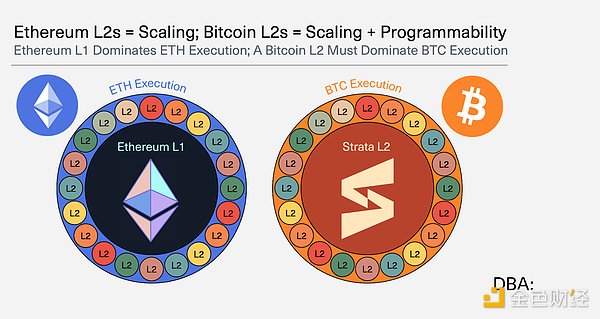
Just as Ethereum L1 plays a role for ETH, I believe the dominant Bitcoin execution layer must:
1. Significantly enhance the functionality of Bitcoin (such as better privacy, more user-friendly self-custody experiences, and basic DeFi capabilities).
2. Not significantly undermine Bitcoin's core advantages (such as secure self-custody, resistance to confiscation, and permissionless use).
Therefore, security will be the decisive factor.
L2 Security
Ethereum L2: Speed over Security
Now let's look at the second misconception: that the high security of Bitcoin L2 is irrelevant, because Ethereum L2 users are not sensitive to security.
Observing the current Ethereum L2:
• Secure L2: The three Stage 2 Rollups currently live have almost no users.
• Insecure L2: Users are pouring billions of dollars into "L2" deposit contracts controlled by anonymous 3/5 multisigs, with no verification mechanisms and no chains. Even Base is only at Stage 0. Optimism and Arbitrum have reached Stage 1, but have taken many shortcuts (e.g., Optimism has had no verification mechanism for years, and Arbitrum still has a whitelist).
From this, many conclude that the success of Bitcoin L2 requires prioritizing speed over security to quickly attract users. This is the so-called "speed > security".
Some even go further, arguing that Rollups and verified bridges are failed experiments. Users seem not to care about L2 security, and L2 also doesn't have enough incentive to achieve full decentralization.
Does Bitcoin L2 Require Higher Security?
A common rebuttal is that Bitcoin L2 security is more important because Bitcoin holders are more sovereignty-conscious and risk-averse than Ethereum holders.
I don't fully agree with either of the above views:
• The conclusions drawn from the current usage patterns of Ethereum L2 users are misleading. The security of Bitcoin L2 will be more important than Ethereum L2 and needs to be prioritized earlier.
• But this is not because there is a significant difference in the risk preferences of Bitcoin and Ethereum holders. I don't think there is a fundamental difference in this regard. Regardless of what asset they hold, large capital holders are mostly rational in assessing risks.
So I believe BTC and ETH holders have a similar sensitivity to security risks. Furthermore, by overly focusing on those early ETH L2 users, many have underestimated the sensitivity of most capital to bridge security risks.
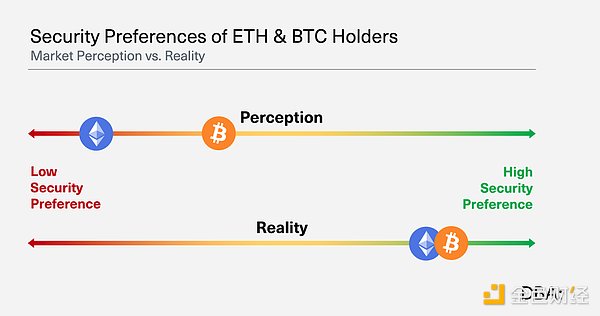
If capital is truly highly sensitive to bridge security, why is so much ETH still flowing to insecure bridges?
The answer is actually quite simple - users demonstrate their preference for high security by not bridging at all!
Currently, only about 2.5% of the ETH supply is bridged to L2, while the amount held by ETH ETFs has already exceeded this proportion. Even hardcore Ethereum supporters understand that the current security of L2 (just for holding ETH) is actually less secure than ETFs. Security issues are hindering large capital flows to L2.
The risk of bridge hacks leading to asset zeroing poses a high implicit cost to capital. Low security = high risk = high capital cost = less capital inflow.
The reality is that most capital is quite cautious and risk-averse here. You may gamble with your risk capital (degen capital) on L2, but will keep your main capital (more risk-averse capital) on L1.
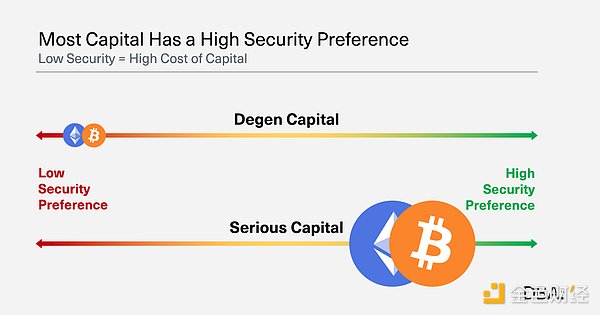
Therefore, when we observe the current usage patterns of L2 bridges, we are actually only seeing the preferences of this small portion of venture capital:
1. We cannot conclude that "L2 bridge security is unimportant" just because mainstream L2s prioritize speed over security, and these "less secure" L2s have attracted more ETH. Most capital expresses its high demand for security by avoiding bridging.
2. We can conclude that within this small portion of venture capital, the security differences between existing L2s are not a decisive factor.
Prioritizing speed over security is indeed the correct strategic decision for these early Ethereum L2s. They need to launch quickly to capture market share. In their target market (risk-takers), incremental improvements in L2 security are not important.
For example: When friend.tech first launched, if you wanted to try it, you might put a few dollars on Base. If you want to chase a new AI concept coin on Base, you'll invest some cash. Whether Base has complex ZK verification mechanisms or upgradable time-lock contracts has little impact in this case.
There is a reason why Ethereum L2s are targeting a smaller risk market, because Ethereum L1 will always attract more serious capital (at least in the early stages).
• You can perform basic ETH DeFi operations on L1.
• You don't need another high gas limit, same application EVM copy to capture ETH yields.
• Using L1 is more secure than bridging to L2, and the higher fees on L1 for large transactions (i.e., using serious capital) are acceptable.
The situation with Bitcoin is quite different:
• Bitcoin L1 is essentially unable to natively support most basic functionalities.
• This changes the value proposition and target user base of Bitcoin L2 compared to Ethereum L2.
• This also changes the most important attributes of Bitcoin L2 compared to Ethereum L2.
Absolute Security and Relative Security
In the competition of Bitcoin L2, absolute security and relative security are both crucial.
We illustrate this with two examples. To simplify the discussion, let's assume we can precisely quantify the "security level" of L2 bridging:
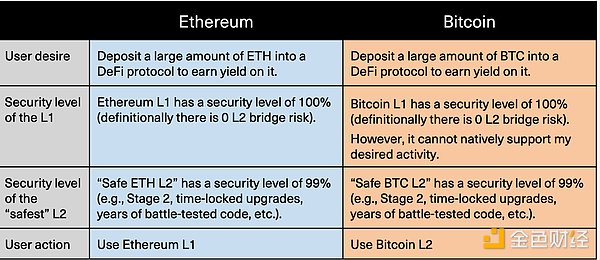
In the first example, let's assume that the security of Base has significantly improved, but you still choose Ethereum L1. The reason is that basic DeFi protocols can be used almost anywhere, and the high gas fees on L1 have almost no impact on large transactions (the incremental cost tends to 0). Therefore, most user behaviors (e.g., lending, token swaps, anonymous transfers, re-staking, etc.) will prefer to use L1 wherever possible.
In the second example, let's assume that the security of Bitcoin L2 is on par with Ethereum L2, but users must use Bitcoin L2. Although limited operations can be performed on Bitcoin L1 through DLCs, most functionalities are still unavailable. Therefore, users' dependence on Bitcoin L2 is higher.
The optimization direction of L2 depends on the target user base:
• Ethereum: Ethereum L2 has not over-optimized security increments, because for its target market (risk-takers), additional security does not bring more business growth. Therefore, speed over security is the main strategy. Only when L2 starts to directly compete with L1 to attract large capital will security become a bottleneck.

• Bitcoin: For Bitcoin L2, security will become critical earlier. Currently, the basic needs of both risk-takers and risk-averse users are not met. Occupying the position of the safest Bitcoin execution layer will be extremely valuable, and this market is still open.
The two key points to win:
• Absolute Security: Suppose the security of the safest Bitcoin L2 is only 50%. Currently, all programmable execution layers using Bitcoin require the "honest majority" assumption (sometimes even relying on more worrying security practices). If the security of L2 does not reach my minimum acceptable level, I either choose to stay on L1 and give up the expected operations (such as yield farming or enhanced privacy), or turn to centralized products (which is a concerning trend now).
• Relative Security: If there is an L2 that meets the minimum acceptable security level to complete my target operations, then I will choose the safest L2 among them, all other conditions being equal.
Compared to Ethereum, building the preferred programmable execution layer for Bitcoin itself is a huge market, and the competitors are relatively few:
• Less Competition: There are not many teams globally capable of driving the technological frontier of Bitcoin L2. Developing Bitcoin-related technologies is extremely difficult, and just in the past year, multiple breakthrough research results were needed to drive the current state-of-the-art designs, and more technical challenges remain to be solved. However, most Bitcoin L2s have taken shortcuts, sacrificing security.
• Huge Market: The leading L2 will attract the vast majority of applications, capital, and developers. Bitcoin's limited decentralized authority (DA) also determines that only a few execution layers can fully leverage its security guarantees.
While a portion of risk-takers' Bitcoin capital will still flow to L2s that compromise on security, this market is relatively small and highly competitive. In fact, the eventual "winning" secure L2 is likely to also take on a large amount of such speculative activities, as speculative behavior often follows projects that appear valuable or interesting. For example, the Bitcoin NFT craze in the past year was clearly dominated by speculation, and Bitcoin was not optimized for these, but users were still willing to pay high costs to participate because it was "fun".
Furthermore, the eventual "winning" L2 is likely to expand to attract more users willing to accept lower security compromises. For example, they may expand to selective data availability (volitions) and L3 layers to provide lower-cost non-Bitcoin DA options.
Alpen Labs
The dominant L2 for Bitcoin needs to be as close to Bitcoin itself as possible, and security is paramount here. Therefore, building this L2 must rely on the team at the forefront of Bitcoin's expansion research. Additionally, the Bitcoin culture may also play an important role, so the team must also be genuine, serious Bitcoin supporters, committed to realizing Bitcoin's vision in the long run.
DBA believes that Alpen Labs is this team. They are building Strata, which we expect to become the dominant execution layer for Bitcoin. Specifically, Strata is a Bitcoin-based zkEVM Rollup (using SP1), with a hybrid optimistic-ZK bridging technology.
Alpen Labs has been dedicated to leveraging zk-SNARKs to scale and enhance Bitcoin since 2022. They are undoubtedly one of the most impressive and principled teams we've seen. We are very excited to support them.
They have made unparalleled contributions in this field, which have culminated in the design of Strata:
• Trey Del Bonis: In early 2022, Trey published a design proposal on how Bitcoin ZK-Rollups work.
• John Light: Later in 2022, John wrote the landmark "Bitcoin Validity Rollup Report", bringing Bitcoin Rollups to public attention and igniting a lot of research work in this field.
• Simanta Gautam: In January 2023, several members of Alpen Labs, including Sims, co-authored the "ZK-Rollups on Bitcoin: Technical Whitepaper" (summarized in the BTC++ talk).
• Liam Eagen: In April 2024, Liam co-authored the groundbreaking paper "On Proving Pairings" (summarized in a presentation at the DBA Annual Research Day), which was crucial for the realization of the Strata Bridge. He also co-wrote other important research, such as "Shielded CSV: Private and Efficient Client-Side Validation".
Furthermore, they have helped popularize concepts through easy-to-understand resources, such as David Seroy's whiteboard lessons on Bitcoin Rollups and the Strata bridging technology based on BitVM2. The team is continuously growing.
This high-caliber team is a necessary condition for building the most secure Bitcoin bridging technology, both now and in the future. As future potential Bitcoin soft forks (such as the re-enablement of OP_CAT) may occur, the design will further evolve and strengthen, providing even better bridging solutions.
Strata
Let's delve into the design of Strata.
ZK-Rollup: Basic Functionality
In fact, building a ZK-Rollup on top of Bitcoin is relatively "simple". You can easily launch a sovereign ZK-Rollup, utilizing Bitcoin blocks to store Rollup data and create proofs of its validity. Rollup clients can easily verify data availability and correctness, ensuring its security.
However, if you want to establish a two-way bridge between Bitcoin and the Rollup, things become much more complex. This bridging is the key to transferring BTC into the Rollup, but to achieve this, we need a mechanism for Bitcoin nodes to verify off-chain execution.
In October 2023, Robin Linus's BitVM paper proposed a mechanism for optimistic verification on Bitcoin, which was a major breakthrough. However, the initial implementation was relatively clunky and inefficient, with some open security concerns, and the prospects for practical adoption were not clear.
Over the past year, this technology has made significant progress. As the technology matures, some of the early concerns (such as liquidity pressure issues) have been alleviated. Strata Bridge is a hybrid optimistic-ZK bridging technology, inspired by the BitVM2 paper. Alpen Labs, in collaboration with other members of the BitVM alliance, have laid the foundation for their bridging technology. Strata Bridge is based on the original BitVM design, optimized with the latest research results, making it more practical, scalable, capital-efficient, and secure.
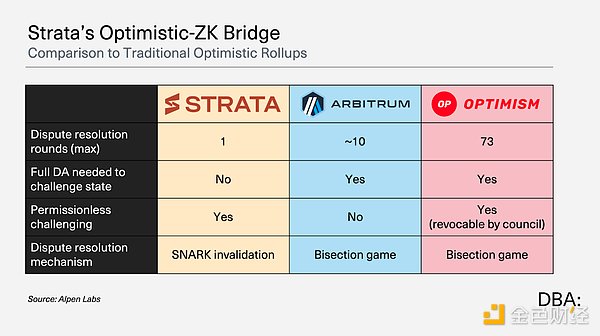
Ultimately, Strata is able to build a Bitcoin-based ZK-Rollup and achieve a 1/n trust assumption through a hybrid optimistic-ZK bridge.
If you want to delve into the technical details, I recommend referring to David Seroy's Strata Bridge whiteboard lessons and Alpen Labs' blog posts, where they have detailed the design and prototype implementation.
This is no longer the BitVM of a year ago, nor the "honest majority" sidechain of today. The 1/n security model is already very strong, and future Bitcoin upgrades (such as OP_CAT) may enable direct ZK verification on L1, achieving a completely trustless design.
The Strata Devnet has been live and open-sourced for months. The full Strata Bridge implementation will be released on the public testnet in the coming weeks, with the mainnet expected to launch later this year.
The current market is severely underestimating the latest advancements in Bitcoin L2 technology.
Making Bitcoin Stronger
As a Bitcoin supporter and an investor in Alpen Labs, my goal is not only to see Strata "win" in the existing Bitcoin L2 market, but to see the entire market thrive.
Bitcoin is already the best cryptocurrency asset. It has a compelling story (e.g., it is the first cryptocurrency, with an anonymous founder). Its fundamental economic properties are also impeccable (e.g., fixed supply).
However, compared to traditional assets (e.g., gold) and other cryptocurrencies (e.g., ETH and USDC), BTC still lacks other functional capabilities. It lacks native strong privacy, scalability, speed, ease of self-custody, interoperability with other assets, basic DeFi functionality, and so on. These functionalities are very important. This is why on-chain stablecoins continue to erode the dominance of off-chain dollars. The strength of an asset as "money" depends on many different attributes, and the strength of programmable money is even greater.
Unfortunately, to give BTC scalability and programmability today, we must completely sacrifice some of its other best features - self-custody, censorship resistance, and permissionless use. Can we have our cake and eat it too?
Better L2s are needed to bring these functionalities and scalability to BTC without any sacrifices. They will unleash BTC in the way that cryptocurrencies have unleashed the dollar. They will make BTC a better money.
Specifically, BTC is currently primarily used as a SoV ("digital gold"). It is rarely used as a UoA or MoE ("electronic cash"). Adding the functionalities described here will enhance all three monetary functions of BTC. If BTC aspires to be an MoE and UoA, then making BTC more usable is clearly necessary. However, I often hear the argument that if BTC limits its ambitions to SoV ("digital gold"), then it doesn't need this. I strongly disagree. Even digital gold needs privacy, better self-custody, and scalability. If BTC's ownership and usage primarily becomes custodial and centralized (without even a reliable decentralized fallback), then it will struggle to even outperform shiny gold. Furthermore, you should be able to put your SoV to work - BTC is the original collateral (e.g., for DeFi), which is currently underutilized.
If we cannot safely add scalability and functionality to BTC, users will be forced back into the hands of intermediary financial institutions, which we have been striving to escape since the first line of the Bitcoin whitepaper:
If we don't make self-custody and private payments in BTC easier and more scalable, we will ultimately be dominated by leading BTC custodians and payment providers.
If we don't enable basic BTC DeFi, we will ultimately get BTC CeFi.
If we don't build the most secure and decentralized L2 bridges, we will ultimately create centralized bottlenecks, even in the so-called "DeFi" ecosystem, like cbBTC.
This has long been recognized, as Hasu described years ago, "We must ensure that we can meet sufficient market demand with a trustless capacity, or the custodial banking system will forever impede the development of the base layer." Modern L2 technologies like Strata are crucial to ensuring this never happens.
Furthermore, as block rewards disappear, these L2s are the best path to provide a stable, secure budget for Bitcoin miners in the long run. It is unclear whether simple L1 BTC transfers will be sufficient to meet demand. Expanding the use of Bitcoin as a DA layer seems to be the most effective way to provide stable revenue. It will diversify the types of BTC activity and enable more activity (you can accommodate more L2 transactions in the same amount of L1 data than L1 transactions), increasing the economic density of L1 transactions. Bitcoin's uniqueness is that, given the demand for using BTC with the lowest trust, it can actually continue to command a premium for DA. I believe this is likely to happen, as money has the strongest network effects in cryptocurrencies, and BTC is the king.
Regardless of what type of Bitcoin supporter you are, introducing these functionalities is crucial:
• Bitcoin Missionaries: The primary goal is to have Bitcoin positively impact society.
• Bitcoin Mercenaries: The primary goal is to see the $BTC price rise, even if that may come with a custodial surveillance society utopia.
For the Missionaries, privacy, scalability, and usability are necessary conditions for Bitcoin to have a positive social impact.
For the Mercenaries, these functionalities make Bitcoin a better money, increasing adoption and price. Furthermore, solving Bitcoin's security budget is also crucial for its long-term impact and price growth.