Editor's Note: DeFAI is attracting market attention, especially in the abstract layer and automated trading agent categories. Although facing challenges such as limited research tools and user guidance issues, it has a strong vision and professionalism, and is expected to lead the 2025 AI agent bull market, focusing on analytical tools and practical agents, and avoiding emotional trading.
The following is the original content (edited for easier reading):
Market sentiment has become extremely bearish across all AI agent sub-sectors, with the sole exception of the DeFAI narrative.
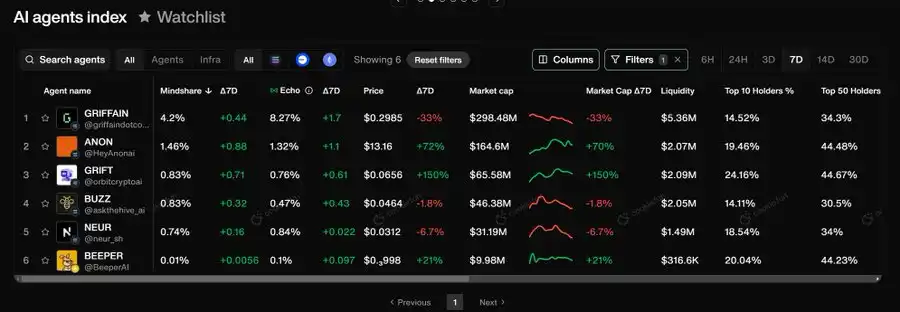
DeFAI is mainly focused on the abstract layer category, performing well during the market downturn, with two projects in particular standing out in the past week:
·GRIFT / orbitcryptoai—market cap $65 million (+150% in the past 7 days)
·ANON / HeyAnonai—market cap $161 million (+70% in the past 7 days)
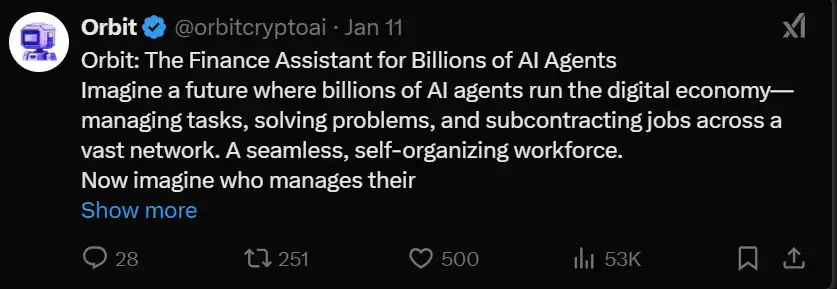
Orbit
Orbit continues to show strong momentum, with its unique features setting it apart from its peers. Its latest features include:
·USDC Transfer Agent: Aggregating USDC balances across multiple chains into a unified balance and transferring to a specified wallet for payments (will support any token in the future).
·Data Hooks: Allowing users to automate trading and on-chain tasks, e.g., "Swap [x] USDC on Solana every minute until SOL market cap reaches [x]".
With its ability to integrate 117+ chains and 200+ protocols, Orbit is positioning itself as the "financial assistant for billions of AI agents" - helping agents and humans seamlessly pay, complete tasks, and interact with protocols through the Orbit tech stack.
The market is starting to price GRIFT closer to its major competitors.
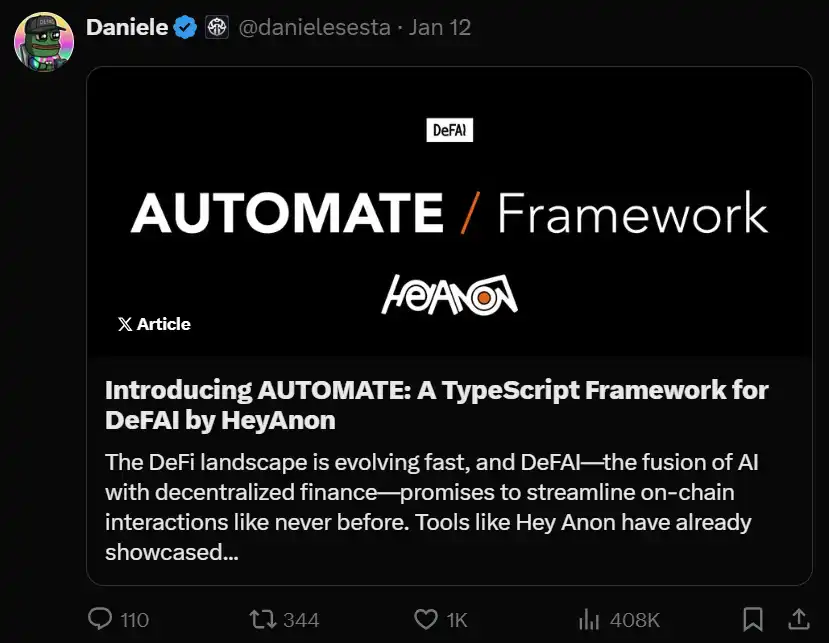
HeyAnon
Led by danielesesta, HeyAnon has recently carved out a differentiated path through some new announcements:
·Gemma: A research assistant agent aimed at converting massive on-chain and social data into actionable visual elements.
·AUTOMATE: A TypeScript framework specifically for DeFAI, accelerating the development of the HeyAnon ecosystem.
HeyAnon's vision is to become a general intelligence layer, supporting multi-step transactions, governance, and data analysis, while ensuring the security and transparency of on-chain transactions. AUTOMATE emphasizes pattern-based typed interactions to prevent developers from deploying misconfigured setups.
Partners include Arbitrum, Base, AVA, BNBChain, IOTA, Kava Chain, and SonicLabs. The team has also launched a grant program through DAO proposals, utilizing 2% of ANON and $1 million USDC in treasury reserves to drive integrations and developer activities.
Although ANON has quickly surpassed a $100 million market cap, its current slow ascent reflects a cautious pricing attitude during the market downturn.
Griffain
griffaindotcom remains the largest project in the abstract layer space by market cap ($330 million), although it has retreated 21% in the past 7 days. Why is this the case? It's unclear at the moment... it could be due to capital rotating from higher-cap DeFAI projects to lower-cap ones, or because Griffain is focused on a general abstract layer rather than specialized DeFi and trading solutions like its peers.
Functional/Focus Differences Summary
·Orbit ➔ Tailored for cross-chain transactions and DeFi operations (most integrations currently).
·Anon ➔ Focused on data (signals/insights), trading, and DeFi operations, driving developer community building through L1/L2 partnerships and grants.
·Griffain ➔ Providing a general abstract layer for Solana, positioned as the "agent of agents", with specialized agents like airdrop tools, token launchers, burn mechanisms, coffee bots, and NFT agents.
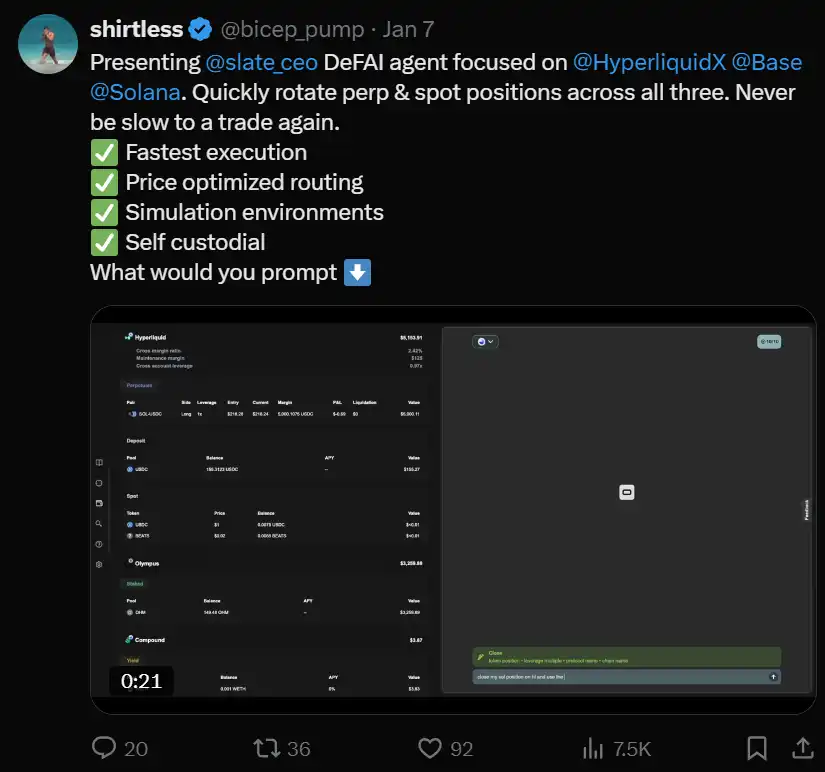
After testing these protocols, my personal favorite is still slate ceo.
The main use cases I rely on the abstract layer for include:
·Basic on-chain operations: Transfers and swaps.
·Automation: Sell [x] every hour until the next 10 days.
·Advanced conditional trades: Swap $5k of A and B when A reaches [x] market cap and B reaches [x] market cap.
Slate has no token, but I like its product, the downside is it only supports EVM chains and requires manually depositing gas tokens to use.
Challenges in the Abstract Layer
·Limited research tools: Many platforms offer "research agents", but their functionality is more limited compared to true analytical dashboards.
·Token recognition issues: Some platforms cannot recognize token symbols, forcing users to manually input token addresses.
·Limited DeFi use cases: High-quality DeFi protocols are often not integrated, or lack the underlying data (TVL, APR%, risk assessments, etc.) needed for users to make informed decisions.
·Poor user onboarding: Unclear interfaces and instructions, sometimes requiring users to manually select agents to issue commands, rather than providing a seamless centralized interface.
Conclusion on the Abstract Layer
For most use cases, traditional tools are still better. Here are my recommendations:
·Use professional analysis tools for research: Better leverage these tools.
·Use defillama to access metrics, yields, and DeFi-related insights.
·Use AcrossProtocol for L2 bridging.
·Use Wormhole for bridging between Non-EVM and EVM ecosystems.
Although the experience is a bit clunky, I remain bullish on DeFAI, especially the abstract layer, as their vision is to simplify the DeFi user experience. This vision (and its execution) is very much needed to achieve mass adoption and attract mainstream users.
Automated Trading Agents
The automated trading agent category is experiencing a significant pullback, with TONY being the best performer in the past 7 days, down only 8%.
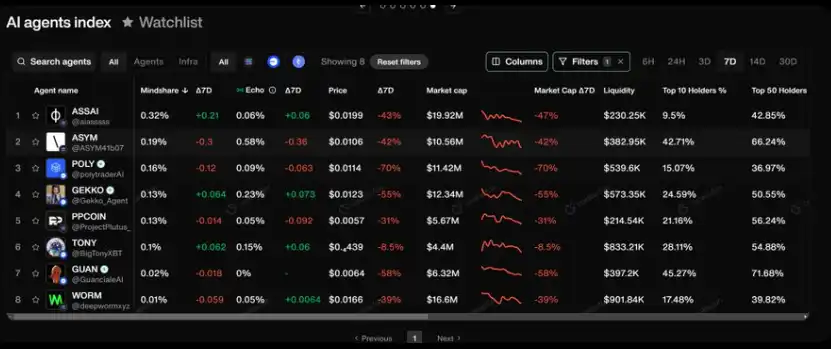
Highlights beyond the cookiedotfun dashboard:
·CATG / boltrade ai—Analysis tools and trading agents focused on smart trader signals.
·LAY / loomlayai—A no-code agent ecosystem for API/skill integrations, focused on trading strategies.
·BULLY / dolion ai—Expanding from individual agents to trading strategies.
These projects have all experienced significant pullbacks, and the most worth buying will have the following characteristics:
·Performance: Able to generate alpha returns with a robust P&L.
·Verifiability: Performance data linked to wallet addresses.
·Participation: Users can share in the profits generated by the agents.
This narrative is still in its early development stage, and currently, the only agent with verified performance is BigTonyXBT, while others are either still in the backtesting phase or operating in the background without transparency.
Conclusion
DeFAI is currently priced higher than other sub-sectors due to its novelty, strong vision, and the promotional expertise of danielesesta. However, challenges still exist in practice. To generate alpha returns, I recommend focusing on analytical tools (like the five I mentioned) and utility-focused agents, such as:
·aixbt agent
·unit00x0
·kwantxbt
·AgentScarlett
·tri sigma
Automated trading agents have not yet gained sufficient traction, and major trading agent ecosystems like Almanak have not yet launched. When the market rebounds, DeFAI (abstract layer and automated trading agents) may lead the market due to its strong narrative positioning.
Position early, stay safe, and avoid emotional trading. Focus on long-term strategies, and most importantly, be prepared to seize the opportunity when the rebound arrives. The 2025 AI agent bull market is coming, and it will be glorious!
Welcome to the official BlockBeats community:
Telegram subscription group: https://t.me/theblockbeats
Telegram discussion group: https://t.me/BlockBeats_App
Official Twitter account: https://twitter.com/BlockBeatsAsia