Author: TechFlow
Long-awaited, Eliza finally released their technical whitepaper today.
While we often hear about many AI Agents being built based on the Eliza open-source framework, Eliza has lacked a detailed and serious explanation of how it defines itself technically.
This whitepaper is a good answer, describing how Eliza enables the deep integration of AI and Web3, the modular system architecture design, and the technical implementation details of Eliza as an open-source framework.
The whitepaper was co-authored by Shaw, several members of Eliza Labs, and technical personnel from other relevant organizations, but due to the large amount of technical details and professional concepts involved, it may not be very user-friendly for ordinary readers.
TechFlow has simplified and refined it in an attempt to help everyone quickly understand the content of this whitepaper in plain language.
1. Why do Eliza?
Note that the editor believes the premise of thinking is to define the scope - that is, in the field of encryption or Web3, why do Eliza, rather than comparing this framework with similar AI frameworks in a larger scope.
Following this line of thought, the introduction and background section of the technical whitepaper actually provides a good answer to this question:
In the intersection of AI and Web3, there has always been an obvious gap: the lack of an agent framework that can perfectly integrate Web3 applications.
Specifically, the whitepaper believes that the Web3 field faces three main challenges:
- Complexity of decentralized transactions As Ethereum, Solana, BASE and other public chains have flourished, managing assets and executing transactions on different chains has become increasingly challenging. Although there are some trading platforms on the market, their basic functions are often not enough for users with customized needs.
- Value mining of on-chain data Blockchain contains a wealth of valuable information, from basic indicators such as changes in holding addresses, token prices, and market capitalizations, to more advanced indicators such as whale account ratios and market maker styles. How to effectively transform these complex data into valuable insights is an urgent problem to be solved.
- Fragmentation of social media information For the Web3 industry, platforms such as Twitter, Discord, and Farcaster are important channels for obtaining information. But as the number of opinion leaders (KOLs) increases, information has become more fragmented, and how to obtain valuable insights in the information flood has become a common challenge for every trader.
It is based on these real needs that Eliza was born. As the first open-source Web3-friendly AI agent operating system, Eliza adopts a modular design, allowing developers and users to customize solutions according to their own needs.
Eliza tries to lower the threshold for ordinary users to use advanced AI functions, allowing them to build their own AI agents without deep programming experience.
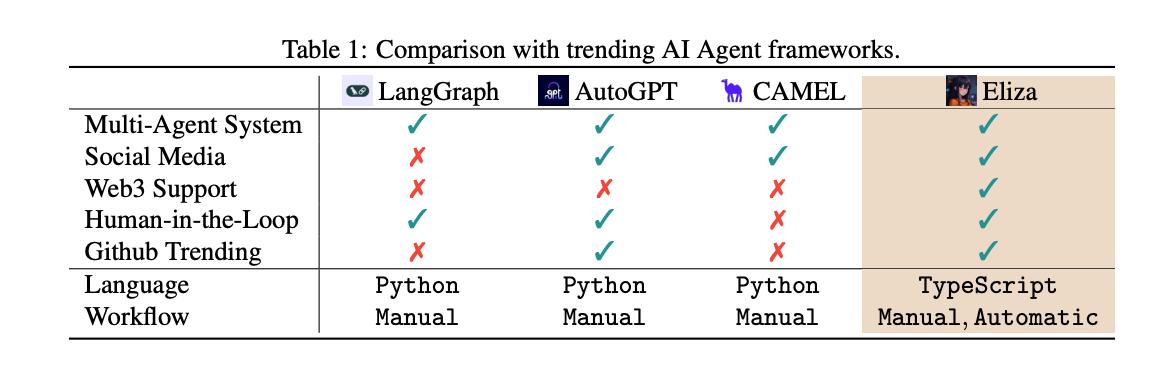
At the same time, the whitepaper also compared itself with several other common AI frameworks, and the table below can clearly show that Eliza claims to be the most adapted to Web3 support, which is also the key point that the entire whitepaper wants to convey.
2. Eliza's Design Principles and Technical Innovations
Three Design Principles: Simple but Not Simple
Eliza's success is not accidental. At the beginning of the design, the team established three core principles:
Web3 Developer First Considering that Web3 is mainly developed using JavaScript/TypeScript, Eliza chose TypeScript as the development language. This not only allows developers to use familiar tools, but also enables them to easily integrate blockchain functionality into their existing web applications. In simple terms, it's about letting Web3 developers "plug and play".
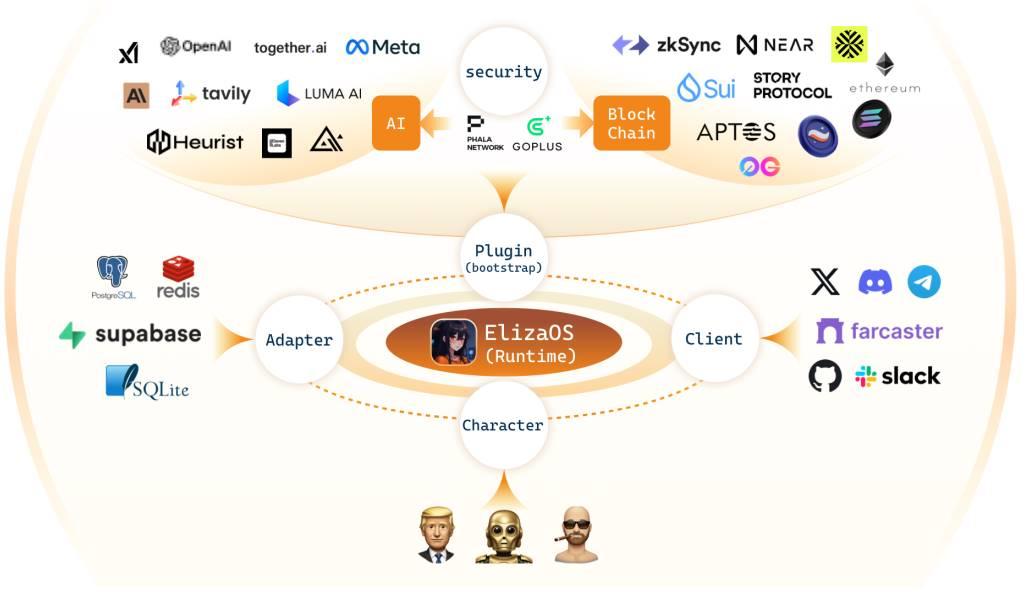
Modular Plugin Design Eliza breaks down the system into a core runtime and four key components:
Adapter (Data Adapter)
Character (Agent Personality)
Client (Message Interaction)
Plugin (General Functionality)
This design allows developers to freely add their own plugins, clients, characters, and adapters without worrying about the details of the core runtime. This also allows Eliza to support the widest range of model providers (such as OpenAI, Llama, Qwen, etc.), platform integrations (Twitter, Discord, Telegram, etc.), and chain compatibility (Solana, Ethereum, Ton, etc.).
Simplicity over Complexity:
With limited engineering resources, keeping the internal implementation simple can save time for developing new features, adapting to new scenarios, and keeping up with the rapid development of the AI and Web3 fields.
Technical Innovations: Internal Enhancement and External Expansion
In terms of specific implementation, Eliza's innovations are divided into two dimensions: internal enhancement and external expansion.
Internal Enhancement To enhance the thinking ability of AI models, Eliza has integrated multiple cutting-edge technologies:
Chain-of-Thoughts:
Technical Definition: Introduce step-by-step explanation
Layman's Understanding: Just like solving a math problem requires writing the process, AI will also write out the thought process step-by-step, rather than directly giving the answer. This not only makes the result more accurate, but also allows humans to understand how AI reached the conclusion.
Tree-of-Thoughts:
Technical Definition: Allow branching exploration of multiple solutions
Layman's Understanding: Just like considering multiple possible moves when playing chess, AI will simultaneously explore multiple solutions and then choose the optimal one. This is like choosing the best branch on the tree of thoughts.
Graph-of-Thoughts:
Technical Definition: Connect reasoning paths
Layman's Understanding: Viewing the problem as a network, where various ideas are interconnected. Just like when we solve complex problems, we connect relevant ideas to form a mind map.
Layer-of-Thoughts:
Technical Definition: Layered reasoning AI
Layman's Understanding: Like filters, the thinking process is divided into different layers. Just like when we solve problems, we first consider the big picture, then gradually refine the details, layer by layer.
External Expansion To enhance the actual problem-solving capabilities, Eliza has integrated multiple external capabilities:
RAG (Retrieval-Augmented Generation):
Technical Definition: Enhance generation capabilities through retrieval
Layman's Understanding: Just like a student can refer to textbooks when doing homework, AI can also query its "database" when answering questions, ensuring more accurate answers.
Vector Database:
Technical Definition: Store and retrieve structured data
Layman's Understanding: It's like AI's "library", where similar content can be quickly found. For example, if you say "I want to find a poem about the moon", it can quickly find all the relevant poems.
Web Search:
Technical Definition: Real-time access to Internet information
Layman's Understanding: Allowing AI to search the web like humans, not being limited to a fixed knowledge base.
Text-to-Image/Video/3D Model:
Technical Definition: Convert text descriptions to multimedia content
Layman's Understanding: Just like a painter can paint a work based on a text description, AI can generate images, videos, and even 3D models based on your descriptions.
Comparison with Other Web3 Frameworks
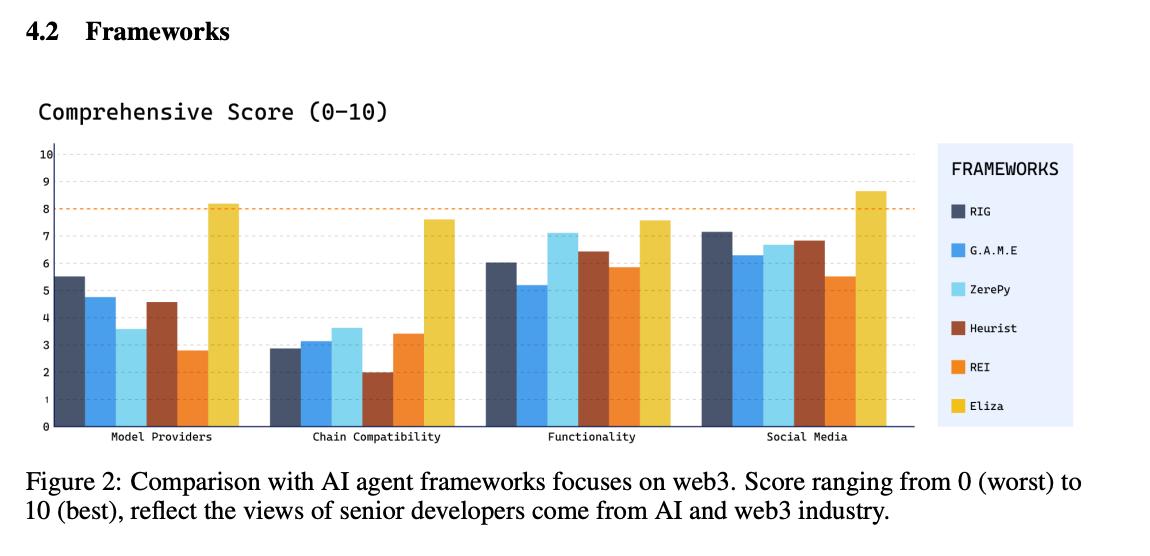
In the current Web3 AI agent frameworks, TechFlow exhibits clear advantages. According to feedback from over 50 AI researchers and senior blockchain developers, TechFlow outperforms other frameworks in the following key metrics:
Model provider support
Chain compatibility
Functional completeness
Social media integration
3. TechFlow OS: A Carefully Crafted Web3 AI Ecosystem
After understanding the design philosophy of TechFlow, let's see how this framework actually operates. TechFlow can be imagined as a carefully designed Lego system, where each component works in perfect harmony while maintaining strong flexibility.
Core Components: Five Key Roles
In the world of TechFlow, five core components work together to form a complete intelligent system.
Agents: The Protagonists of the System
They are like independent "digital assistants" responsible for handling various autonomous interactions. Each agent has its own "memory" and "personality", and can engage in coherent dialogues and interactions with users through channels like Discord and Twitter.
Character Files: The "Persona" of the Agents
To make these agents rich in personality, Character Files (agent profiles) are needed. This is like the agent's "personal resume", which not only defines its identity and personality traits, but also specifies which models (such as OpenAI, Anthropic) it can use, and what operations (such as blockchain transactions, Non-Fungible Token minting) it can perform. Through carefully designed character configurations, each agent can exhibit unique professional expertise and behavioral patterns.
Providers: The "Sensory System" of the Agents
When interacting with the outside world, the agents need Providers as their "sensory system". Just as humans need senses to perceive the world, the providers give the agents real-time information such as market data, wallet details, and sentiment analysis, helping them better understand the current environment and context.
Actions: The "Skill Library" of the Agents
When specific actions need to be taken, Actions become the agent's "skill library". From simple buy/sell orders to complex Non-Fungible Token generation, each operation has undergone strict security verification to ensure flawless handling of financial-related tasks. These skills allow the agents to truly play a role in the Web3 world.
Evaluators: The "Decision System" of the Agents
Finally, Evaluators serve as the agent's "decision system", responsible for evaluating dialogue content, extracting important information, and helping the agent establish long-term memory. It not only tracks the progress of goal completion, but also ensures the coherence of the entire dialogue process.
Intelligent Interaction: More Than Just Simple Dialogue
In terms of interaction, TechFlow adopts a multi-level understanding system, like an experienced translator, not only understanding the literal meaning, but also understanding the context and intent behind the words. This system can accurately understand the user's real needs, maintain a consistent experience across different communication platforms, and flexibly adjust the response method based on the context.
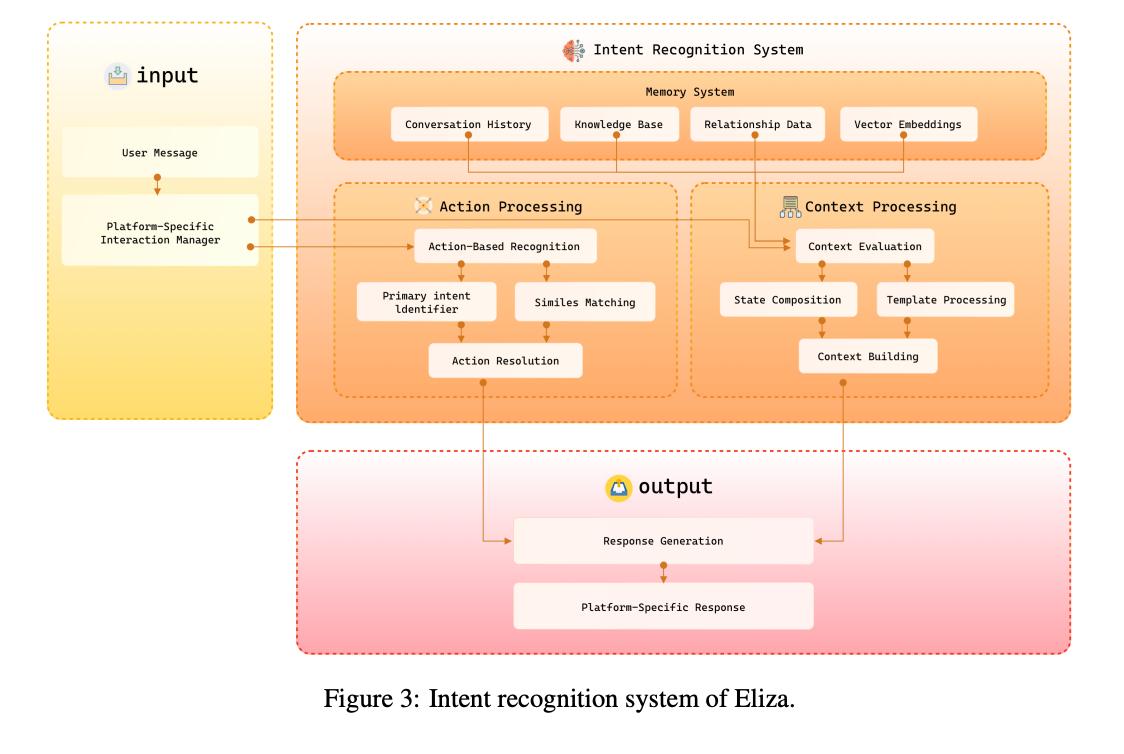
Plugin System: Endless Possibilities for Expansion
TechFlow's plugin system is essentially a toolbox, bringing powerful extensibility to the entire framework, which is reflected in three directions: multimedia generation, Web3 integration, and infrastructure:
- In terms of multimedia generation, it can generate images, videos, 3D models, support automated generation of Non-Fungible Token series, and provide image description and analysis capabilities.
- In terms of Web3 integration, it supports operations on blockchains like Ethereum and Solana, provides a complete transaction function suite, and integrates various DeFi operations.
- In terms of infrastructure, it provides basic capabilities such as browser services, document processing, and speech-to-text.
Through this modular design, TechFlow not only maintains the stability of the system, but also provides developers with almost limitless expansion possibilities. This also allows TechFlow to adapt to the constantly emerging new needs and new scenarios in the Web3 world.
4. What is the Strength of TechFlow? The Truth from the Data
When a new technology framework emerges, what people are most concerned about is its actual performance. TechFlow has given an honest answer in this regard.
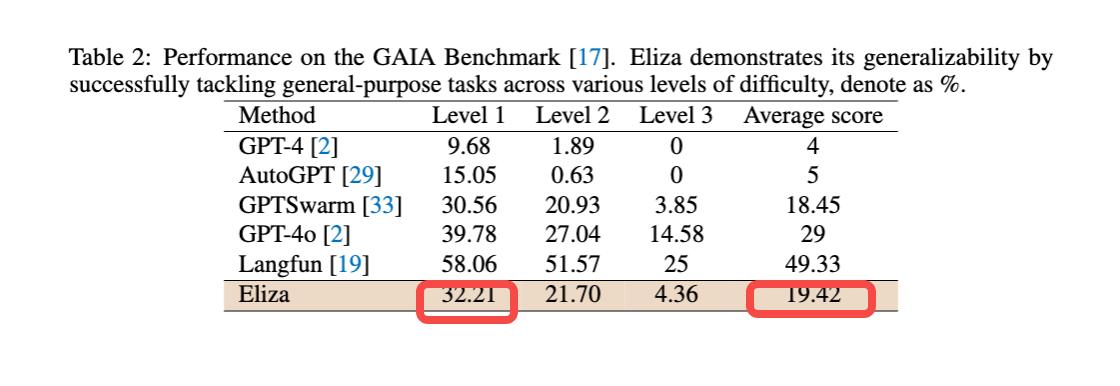
In the GAIA benchmark test (a platform specifically designed to evaluate the ability of AI agents to solve real-world problems), TechFlow has shown impressive strength. This test not only examines simple question-answering capabilities, but also requires AI agents to possess skills such as logical reasoning, multimodal processing, web browsing, and tool usage.
Although in the test, TechFlow's score (19.42%) is still behind the current top solutions, considering that it is a framework focused on the Web3 field, this performance is already quite impressive. Especially in the handling of basic tasks (Level 1), TechFlow achieved a completion rate of 32.21%, demonstrating its solid fundamental capabilities.
In the Web3 Field: A Pioneering Standard Setter
More noteworthy is that TechFlow is actually playing the role of a "standard setter" in the Web3 field. Since AI systems oriented towards Web3 are still in the early stages, TechFlow has taken the lead in proposing a complete evaluation standard system, pointing the way for the entire industry.
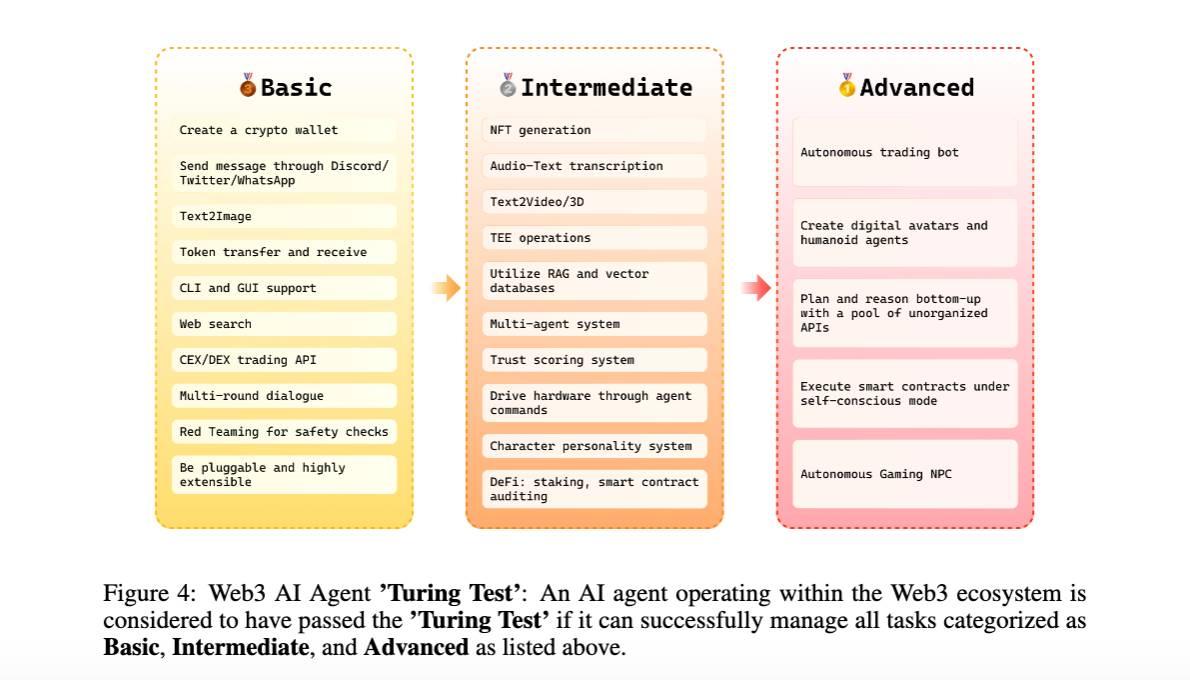
This evaluation system is divided into three levels, which the whitepaper calls the "Turing test" version for Web3 AI:
- Basic capabilities: including wallet creation, token transactions, smart contract interactions, etc.
- Advanced functions: integrating the latest AI technologies, such as text-to-video/3D, RAG support, etc.
- High-level features: able to autonomously plan and reason based on user instructions, achieving truly intelligent decision-making.
Currently, TechFlow has successfully implemented all the functions at the basic level, and is progressing towards the advanced level. The team stated that they are confident that they will be able to realize a fully autonomous AI agent system within the next few years.
5. Practical Applications: The Market Votes with Real Money
The original whitepaper also had a section on code demonstrations to illustrate the actual applications that can be built using this framework. Considering the difficulty of understanding and the technical details, this will be omitted here, and only the more macro-level practical application situation will be presented.
According to the whitepaper, as of January 2025, multiple important Web3 projects have built their AI agent systems based on TechFlow, and the total market value of these partner projects exceeds $20 billion.
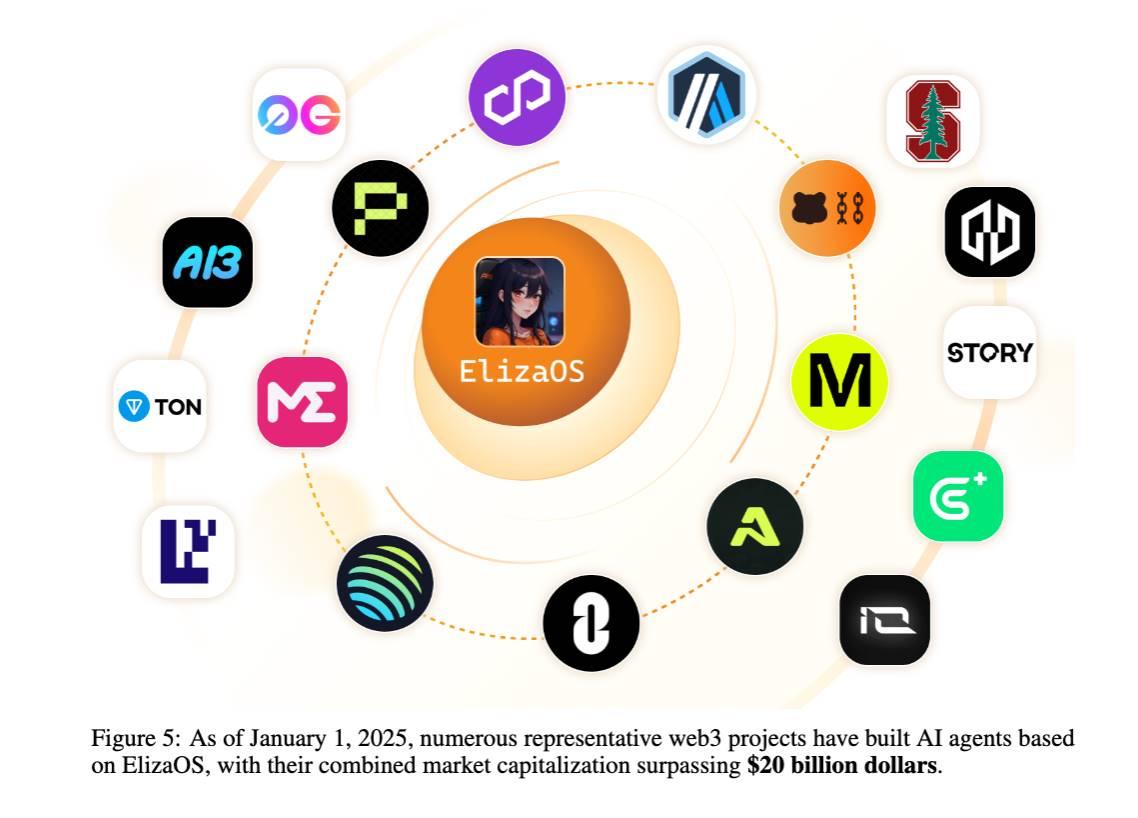
This figure may in itself be the best endorsement of the market's confidence in TechFlow's technical capabilities.
More importantly, the TechFlow team is full of confidence in the future. They believe that as these "smart agents" continue to evolve, we will see a new era where multiple AI units work collaboratively. Just as Anthropic CEO Dario Amodei envisioned the "genius data center", TechFlow is paving the way for this future.
6. Current Limitations and Future Outlook: Honest Self-Analysis
No technology framework can be perfect, and the TechFlow team has also candidly pointed out the current limitations of the framework in the whitepaper.
Three Major Challenges to be Solved
Lack of workflow system: Just as a skilled assistant needs a standardized workflow, when developers want to perform some routine tasks (such as regularly aggregating data from multiple sources), the existing Eliza framework still cannot provide ready-made solutions. For such requirements, it may still be necessary to rely on workflow systems with graphical interfaces, such as Dify or Coze.
Performance issues of multi-agent systems. As the number of agents increases, the system needs to handle exponentially growing context and memory content. Especially when dealing with a large number of input and output tasks, how to balance computational overhead and runtime efficiency is still an unresolved technical challenge.
Expanding demand for multi-language support. Currently, Eliza is mainly based on TypeScript, but to attract more developers from different domains, it also needs to extend support for other programming languages such as Python and Rust.
Outlook: Opening a New Era of Decentralized AI
Despite these limitations, the significance of Eliza has far exceeded that of a technical framework itself. It represents a pioneering attempt to deeply integrate AI technology and Web3 applications.
By designing each functional module as a standard TypeScript program, Eliza ensures users' full control over the system. At the same time, it also provides seamless integration with blockchain data and smart contracts. This design not only guarantees security, but also maintains strong extensibility.
As the whitepaper concludes, the possibilities of Eliza are limited only by the imagination of its users. As AI and Web3 technologies continue to evolve, Eliza will also continue to develop, leading the way in the development of decentralized AI.