Hong Kong courts can now send legal Tokenize notices on the blockchain to anonymous wallet owners related to illegal wallet addresses.
A court injunction obtained by TinTucBitcoin shows that two Tron wallet addresses have received legal Tokenize notices to freeze their assets.
While previous cases in jurisdictions like the US and UK have shown the courts' adaptability to new methods, Hong Kong's latest Tokenize notice stands out by preventing the use of ignorance as a justification.
"If the transaction is executed, it will constitute a criminal offense, and if centralized exchanges are involved, they will be hesitant to access these wallets due to [Anti-Money Laundering and Know Your Blockchain] obligations," Joshua Chu, a cybersecurity consultant at Macro Systems, the provider of the Tokenize legal notice technology, shared with TinTucBitcoin.
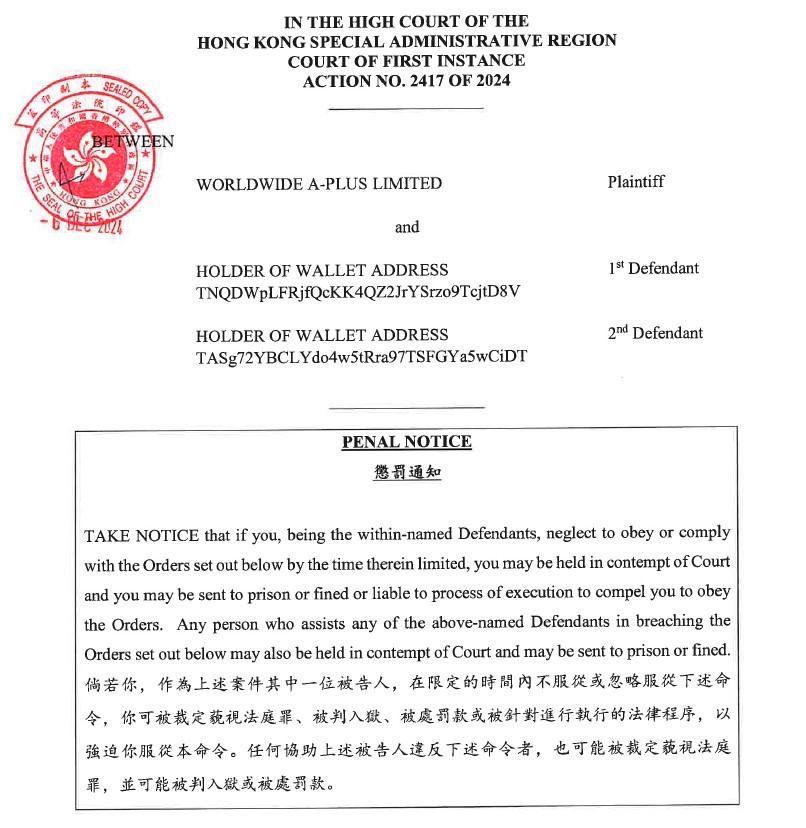
Two Tron wallets identified as defendants in Hong Kong's penalty notice. Source: Hong Kong High Court
Traditionally, the most common method of serving legal documents is direct communication, where the documents are physically handed to the recipient. Some jurisdictions also allow documents to be sent via registered mail, email, or fax under certain conditions. In cases where the recipient cannot be located, the notice is published in the media or online.
"Previously, serving court documents on wallet owners was a challenge, if not impossible under current requirements," Moses Park, the plaintiff's lawyer in the Hong Kong case, shared with TinTucBitcoin.
The court injunction has allowed the placement of a digital police cordon around 2.65 million USDT that the victim lost in an online scam. However, when the court Tokenize orders were sent to the suspected wallets, the perpetrators had already dispersed a large portion of the assets, ultimately transferring them to exchanges.
At the time of this reporting, approximately 1 million USDT remains in the wallets.
Chu said the remaining funds "are being processed separately" and declined to comment further.
Technological hesitance impedes adoption
Tron is one of the most popular chains among criminals. It accounted for nearly half of illicit transactions in 2023. Macro Systems has also tested their technology on other networks beyond Tron, including Ethereum and Polygon.
Chu said that in theory, it could also be implemented with Bitcoin and plans to continue developing the technology to expand to other networks by 2025.
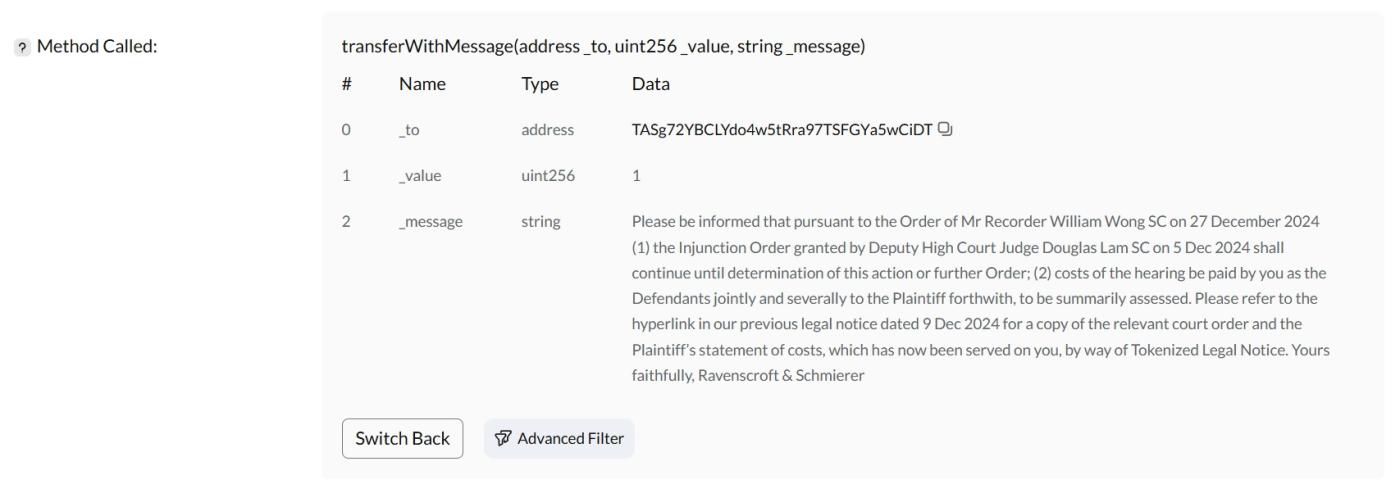
The legal notice visualized. Source: Tronscan
However, awareness among victims remains slow, as they are often unfamiliar with the opportunities that new technologies bring. Thousands of victims in Hong Kong's largest cryptocurrency fraud case, the JPEX incident, have yet to pursue legal action for their losses.
Since 2023, there have been four court orders against blockchain addresses in Hong Kong, according to records from D-Law, an online repository of legal cases.
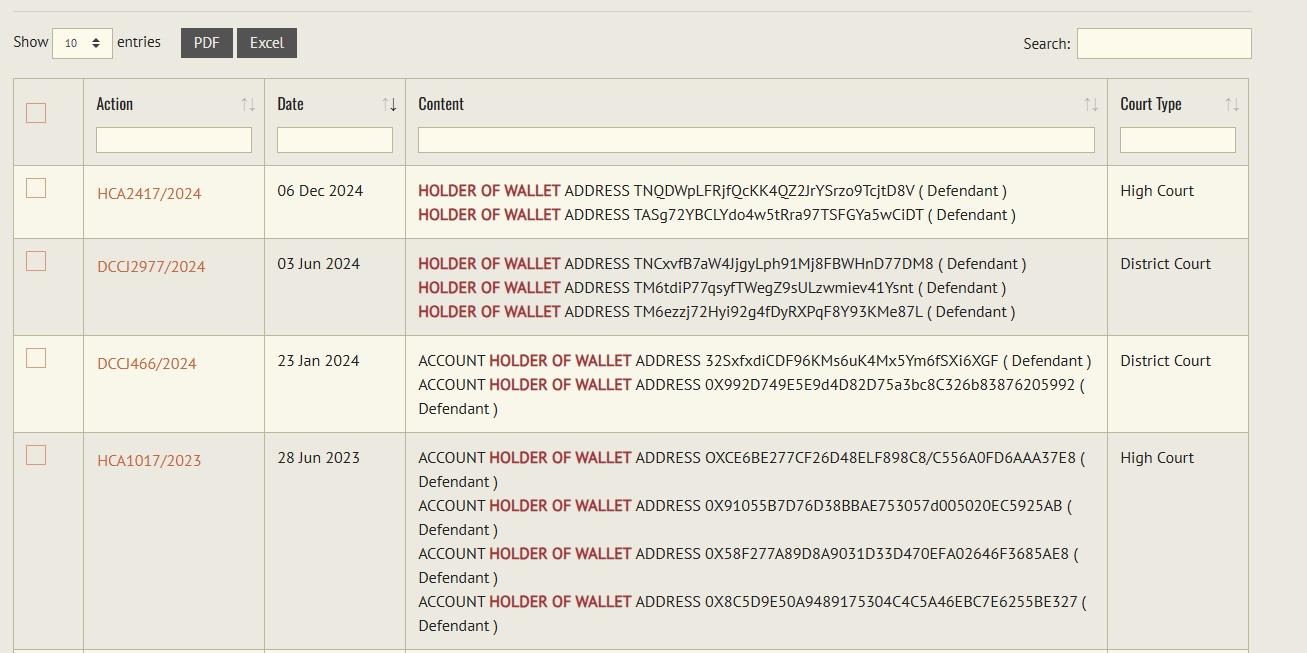
Cases against wallet addresses include the recent one related to the Tokenize legal notice. Source: D-Law
"The application of blockchain in the legal context is still limited. Many lawyers, judges, and organizations are unfamiliar with the mechanics, benefits, or practical implementation of it, slowing down the adoption process," Laurenth Alba, head of business development at Rome Protocol and a legal consultant, shared with TinTucBitcoin.
"The airdrop of [non-fungible tokens] (NFT) or Tokenize documents requires technical expertise and investment. For many cases, this complexity is not worth it unless anonymity or cross-border challenges make traditional methods impractical.
Legal precedent in the UK
Hong Kong's legal system is similar to the UK's due to over 150 years of British colonial rule ending in 1997.
The UK has also embraced innovative legal methods related to blockchain technology.
Here is the English translation, with the content inside <> retained without translation:For example, in the case of Osbourne v Persons Unknown & Ors in 2023, fintech consultant Lavinia Osbourne had her digital assets stolen when two Non-Fungible Tokens (NFTs) from her "Boss Beauties" collection were illegally transferred out of her cryptocurrency wallet.
Seeking legal recourse, Osbourne turned to the High Court of England and Wales, which recognized NFTs as property under English law. The court issued freezing orders to prevent further unauthorized transactions. It also allowed for legal documents to be served on the unidentified defendants through an NFT airdrop.
This innovative approach followed a precedent set in the case of D'Aloia v Persons Unknown & Others in 2022.
In this case, online gambling company founder Fabrizio D'Aloia was defrauded by individuals operating a fake online brokerage.
The High Court allowed for legal documents to be served through a direct NFT airdrop to the defendants' wallets and recognized the potential legal liability of cryptocurrency exchanges as custodians of the misappropriated assets.
Courts Adapting to Digital Justice
Like Hong Kong and the UK, the United States also operates under a common law system inherited from England. However, there are significant differences due to its federal structure and constitutional framework.
The world's largest economy has witnessed cases where blockchain technology has facilitated legal service.
A notable example is LCX AG v. John Doe Nos. 1-25. The New York Supreme Court allowed the plaintiff to serve legal documents on unidentified defendants by airdropping a unique NFT into their cryptocurrency wallets. This method included a link to a website containing the legal documents, ensuring the defendants were notified despite their anonymous identities.
While previous examples in major economies like the US and UK have demonstrated the courts' adaptability to modern methods, Chu noted that their use of NFTs has created unique challenges, such as the defendants' ability to simply send them elsewhere.
The records remain immutable on the blockchain, but it adds another layer of complexity to the case.
"Additionally, enforcing legal actions against impersonated parties or frozen assets requires a more harmonized legal framework," Alba shared.
She added:
"The complexity around global jurisdiction and the lack of clear standards make enforcement difficult, highlighting the need for collaboration between legal systems and blockchain technology."
Alba also noted that the lack of clear, consistent guidance on the use of blockchain for legal notification could create hesitation from US courts and legislators.
However, Chu pointed out that Macro System's technology is not constrained to Hong Kong and sees a regulatory trend in the US towards consumer protection, citing the Consumer Financial Protection Bureau's proposal that wallet developers will be liable for fraudulent on-chain transactions.
"The interesting thing about this case is that it is no longer theoretical," Chu said. "We have proven that injunctions can be issued and enforced."