With the implementation of the MiCA regulation, the enthusiasm of Web3 companies to expand to Europe has been growing. Mankun Law Firm has recently received a large number of inquiries about Web3-friendly countries in Europe, and for this reason, we are launching a series of articles to deeply analyze the crypto ecosystem in various European countries. In this issue, we will turn our attention to the highly potential Polish market.
Poland: A Web3 Market with Huge Potential
Poland's Economy Has Development Potential
The Polish economy plays an important role in Central Europe and is one of the major economies in the EU, currently ranking 6th in the EU-27 in terms of total economic size.
According to a report by the Fintech Foundation in 2023, while the Polish fintech ecosystem started relatively late, its potential is huge. As the largest financial services market in Central and Eastern Europe, Poland is attracting talent and investment from the region, and the favorable macroeconomic situation also indicates its broad development prospects.
Setting Up Entities in Poland is Favored by Web3 Companies
Poland is an important business center in Central and Eastern Europe, attracting many companies to establish entities here, with nearly 40% of the top 500 companies in Central Europe located in Poland. This trend has also extended to the Web3 field.
As of 2024, the number of active registered VASP entities in the Polish virtual currency activity register has exceeded 1,100, indicating a thriving development in this field.
Currently, Poland has 126 Web 3.0 startups, including billon, Golem Network, GamerHash, Fluency, and DoxyChain.
Poland Has a Sizable Potential Web3 User Base
Poland has a population of about 38.26 million, ranking fifth in the EU. According to a report on the adoption of cryptocurrencies in Poland released in 2023, the Polish public has a relatively high awareness of cryptocurrencies, with over 94% of respondents indicating they have heard of them. However, the proportion of those who have a deep understanding of cryptocurrencies is relatively low, at around 6.2%, indicating that the market still has a large room for popularization.
The report points out that in Poland, cryptocurrencies are mainly used for investment and speculation, with more than half of the respondents using them for this purpose. They are rarely used as tools to participate in blockchain-based projects, purchase products and services, or transfer funds.
The median amount of funds declared by Poles for investing in cryptocurrencies is 1,000 zloty, with an average of 7,642 zloty, and an average of 5,149 zloty after excluding the top 5% of values.
The frequency of cryptocurrency investment by men is three times that of women. Young people (under 34 years old) account for 41% of all those who claim to own crypto assets. In addition, the prevalence of cryptocurrency ownership also increases with the level of education.
Poland's Web3 Regulatory Authorities
The main financial regulatory authority in Poland is the Polish Financial Supervision Authority ("KNF"), with functions similar to China's National Financial Supervisory Administration.
KNF regulates the banking, capital, insurance and pension sectors, and payment institutions. The purpose of KNF's supervision of the financial market is to ensure the proper functioning of the financial market, safeguard the stability, security and transparency of the financial market, ensure the confidence of market participants in the financial market, and protect their interests.
KNF is also responsible for regulating Web3 companies that conduct business activities or are established in Poland.
On November 7, 2024, according to Cointelegraph, the Polish KNF issued a public warning to Foris DAX MT, a company headquartered in Malta and operating under the Crypto.com brand, alleging that it was engaged in unauthorized financial activities in Poland.
Jacek Bardzczewski, the head of the KNF department, explained that under Polish law (particularly Article 178 of the Act on Trading in Financial Instruments), entities providing brokerage or investment services must hold the appropriate licenses to legally conduct business.
Poland's Crypto Regulatory Policy Framework
Poland Sets a Shorter Transition Period for Existing VASP License Entities
With the EU's Regulation on Markets in Crypto-Assets (MiCA) officially taking effect on December 30, 2024, Poland's cryptocurrency regulation is undergoing important regulatory changes. Poland is currently pushing forward with domestic legislation to align with MiCA, known as the "Polish Crypto-Assets Market Act". On December 9, 2024, the website of the Polish Government Legislation Center published the much-anticipated fourth version of the "Polish Crypto-Assets Market Act". This law is particularly important for entities currently registered in the VASP register as well as other entities preparing to apply for a CASP license. The draft law is currently at the government stage, i.e. it has not yet been submitted to the parliament for approval. Therefore, during the further legislative process, the law may be amended. But the overall legislative direction of this law will not undergo fundamental changes.
Overall, the draft of the "Polish Crypto-Assets Market Act" significantly shortens the transition period stipulated in the MiCA.
The MiCA regulation provides for a transition period until July 1, 2026, while according to the relevant provisions of the draft "Polish Crypto-Assets Market Act", entities currently registered as Virtual Asset Service Providers (VASPs) need to submit an application for a CASP license by June 30, 2025.
If entities that have already obtained a VASP license submit a complete CASP license application by May 1, 2025 and receive a notification from the UKNF that the application has been received, they can continue to provide services until September 30, 2025, or until the license is granted or refused, whichever is earlier.
If an entity has not registered a virtual asset license, it needs to register the latest CASP license in order to conduct business activities in the EU.
It is worth noting that the previous VASP registration system will be completely abolished as of October 1, 2025.
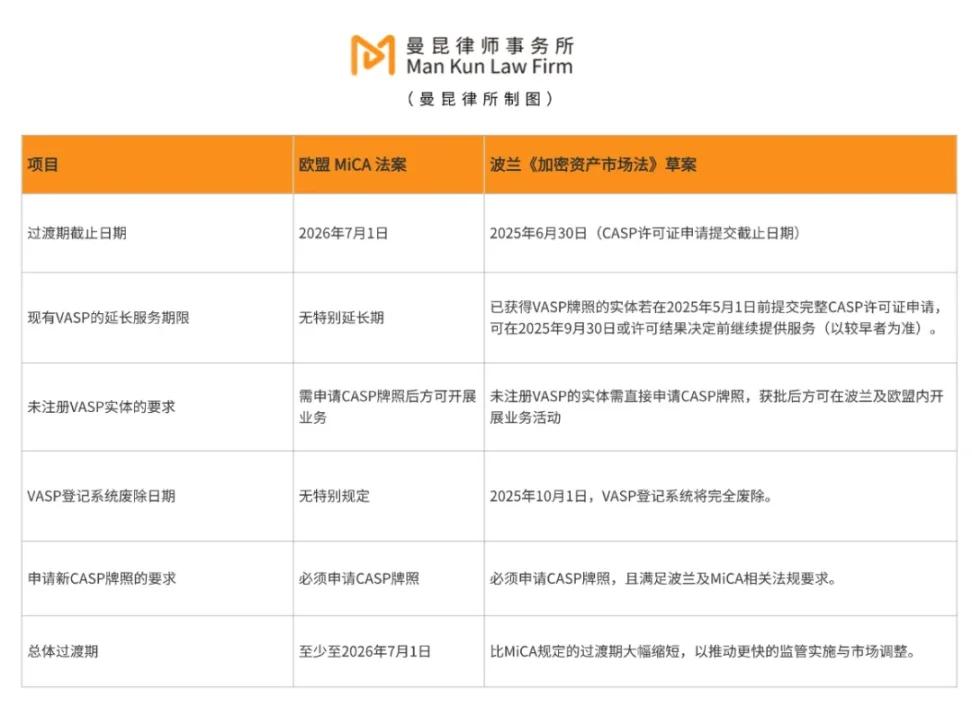
In summary, the draft of the "Polish Crypto-Assets Market Act" significantly shortens the transition period stipulated in the EU MiCA regulation, and sets an earlier application deadline for existing VASP entities, while also setting a clear deadline for the abolition of the VASP registration system. Poland intends to accelerate the implementation of regulations, promote market transparency and compliance, and align with MiCA as soon as possible.
Potential Penalties for Violating Statutory Obligations After Obtaining a Polish CASP License
After completing the license registration, cryptocurrency companies must comply with the MiCA regulation and Polish crypto-asset regulatory requirements, identify and assess money laundering and terrorist financing risks related to their activities, identify suspicious transactions, implement risk mitigation measures, and report periodically (usually quarterly) to the regulatory authorities through a designated portal. They must also comply with Financial Action Task Force standards and manage crypto transactions responsibly in the cryptocurrency field.
If the registered obligations are not properly fulfilled or not fulfilled, the Polish authorities may impose administrative penalties on the relevant entities and individuals. In addition, persons acting on behalf of the entity may also face criminal liability for violating certain regulations. These penalty measures include:
- Publishing information about the entity and its illegal activities on the website of the office serving the Minister of Finance,
- Orders to stop the specific actions of the entity,
- Removal from the register of virtual currency activities,
- Prohibiting persons responsible for the following matters from performing management duties for a period not exceeding one year:
Financial penalties, up to twice the amount of the benefit or loss avoided by the entity due to the infringement, or if the amount of such benefit or loss cannot be determined, up to the equivalent of 1,000,000 euros.
In addition, persons acting on behalf of the entity may face criminal liability if they fail to report suspected crimes to the Polish authorities or provide false or concealed information about transactions, accounts or persons, and may be subject to imprisonment from 3 months to 5 years.
How Does Poland Tax Crypto Assets?
The taxation regulations for virtual assets in Poland are very mature.
As early as November 2020, the Polish authorities released a new PIT-38 (personal income tax) form to facilitate the declaration of cryptocurrency taxes for Polish residents.
In Poland, the taxation of cryptocurrencies follows specific guidelines based on the country's tax laws. According to the Personal Income Tax Act, virtual currencies are defined as a digital representation of value that can be exchanged for legal tender and accepted as a means of exchange. However, it is important to note that virtual currencies exclude certain categories, such as legal tender issued by the central bank, international accounting units, electronic money, financial instruments, bills of exchange, and checks. These exclusions further clarify the definition of virtual currencies, making the tax treatment more targeted and consistent.
In terms of taxation, income generated from cryptocurrency transactions is considered capital income. Handling virtual currencies in exchange for payments involves different scenarios:
- Exchanging virtual currencies for legal tender (e.g., exchanging cryptocurrencies for legal tender)
- Exchanging virtual currencies for goods, services, or property rights
- Using virtual currencies to settle debts
- Mining and participating in initial token offerings (ICOs)
It is worth noting that not only the exchange of virtual currencies for legal tender creates a tax obligation, but also the exchange for goods, services, or property. However, the exchange of one cryptocurrency for another cryptocurrency or the exchange for a stablecoin does not create a tax obligation. Although certain transactions are not subject to taxation, taxpayers still need to keep relevant records for auditing or inquiry purposes.
Poland's tax rate for cryptocurrencies is 19%. In this case, there is no specific tax threshold, and all income from cryptocurrencies, regardless of the amount, is subject to a 19% tax rate. Investors must accurately report their income from virtual currencies and fulfill their tax obligations accordingly.
The Polish government does not consider cryptocurrencies as "currency units, means of payment or electronic money," so individuals engaged in cryptocurrency business in Poland must provide the financial statements of the cryptocurrency exchanges they use to buy and sell digital currencies in order to correctly report their profits from cryptocurrency transactions.
For example, Mr. Zhang purchased 1 Bitcoin on January 1, 2023, at a price of 10,000 PLN. On May 1, 2024, he sold this Bitcoin for 15,000 PLN.
- Revenue: 15,000 PLN
- Cost: 10,000 PLN
- Profit: 15,000 PLN - 10,000 PLN = 5,000 PLN
- Tax payable: 5,000 PLN * 19% = 950 PLN
Mr. Zhang needs to declare and pay this 950 PLN as personal income tax (PIT).
Conclusion by Mankun Law Firm
As an important economy in Central and Eastern Europe, Poland has an active Web3 user community and a continuously improving regulatory framework, which provides good development opportunities for Web3 companies, making Poland an increasingly attractive destination for Web3 entrepreneurs. However, the implementation of the EU's MiCA regulation and the future introduction of a local virtual asset regulatory framework in Poland will also bring new compliance challenges.
Mankun Law Firm has rich experience and a professional team in the field of Web3 legal services, and can provide comprehensive legal support for Web3 companies entering Poland, including:
- Company establishment and license application: Assisting companies in setting up entities in Poland and guiding them to apply for CASP licenses in accordance with MiCA and relevant Polish regulations to ensure compliant operations.
- Tax planning and compliance: Providing professional tax consulting and planning services for the complex cryptocurrency tax system in Poland to reduce tax risks.
- Compliance risk control system building: Helping companies establish a comprehensive anti-money laundering and know-your-customer system to effectively prevent legal risks.
- Dispute resolution and legal counsel: Providing timely legal advisory services during the company's operations, and representing the company in negotiations or litigation in case of disputes.
Mankun Law Firm is committed to becoming the most trustworthy partner for Web3 companies entering the European market. With our in-depth understanding of the MiCA regulation and local Polish laws, as well as rich practical experience, we help companies achieve stable development in the Polish market and seize the opportunities in the Web3 era.