In the foreseeable future, we will see larger-scale US debt on-chaining, and more projects based on tokenized US debt will emerge in the DeFi ecosystem, gaining user and market favor, gradually changing the on-chain wealth management and investment methods.
Author: HedyBi, JasonJiang
Source: OKGResearch
Trump's re-election will take the intertwining of politics and economics to an unprecedented level. This "Trump phenomenon" is not only a reflection of his leadership style, but also symbolizes a comprehensive reshaping of economic interests and political power. In the context of economics, this complex structural transformation is called "political economy intertwining". As the world's largest economy and the issuer of the reserve currency, every policy adjustment by the US will be a barometer of global capital flows. Looking ahead to 2025, with the Trump administration's acceptance of the crypto field, the chain reaction of "Trumponomics" will extend to the on-chain world more quickly, and the crypto market is rapidly rising from a marginal innovation to one of the important markets in global finance.
OKG Research has specially planned the "Trumponomics" series, in-depth analysis of the core logic and future trends of this process. The first article "Trump Re-election: Bitcoin, Oil and Gold in the New Political and Economic Era" focuses on the impact of Bit on the international financial pattern. This article, on the other hand, starts from the US debt, a core traditional financial asset, and delves into the US$36 trillion US debt market, how to further consolidate and expand the dominance of the US dollar in the global financial system through Blockchain technology and crypto tools.
Coinbase CEO Brian Armstrong recently said in an interview at the World Economic Forum in Davos, Switzerland, that the upcoming US stablecoin bill may require issuers to be fully backed by US Treasuries for dollar-denominated stablecoins. Although we believe that the possibility of a 100% US debt requirement is not high unless there is an excess reserve requirement, as the role of cash reserves, Armstrong's statement still reflects the crypto market's demand and preference for US debt.
The "growth rate" of the US debt market is amazing: it took more than 200 years to reach the first trillion US dollars, but only 40 years to grow from 1 trillion US dollars to 36 trillion US dollars. The root cause of this amazing change is that the Nixon government abandoned the gold standard in 1971, causing the US dollar to decouple from gold, ushering in an era of unlimited money printing, and the US debt problem also spiraled out of control.
At the same time as the rapid "expansion" of US debt, OKG Research has observed that the investment interest of the investors who have long been accustomed to "footing the bill" for this $36 trillion US debt market is gradually weakening, and the on-chain may be the new market to revitalize US debt in the future.
US Debt Enters "HARD" Mode in 2025
In 2025, the US debt market will enter the "HARD" mode, with nearly $3 trillion in government bonds maturing, most of which are short-term bonds. Meanwhile, the US Treasury's net issuance in 2024 has reached $26.7 trillion, up 28.5% year-on-year.
Especially against the backdrop of Trump's return to the political stage, his tendency towards loose monetary policy may exacerbate market uncertainty. Trump had repeatedly pressured the Federal Reserve to cut interest rates during his term, viewing interest rate policy as a core tool for stimulating the economy and boosting market confidence. If he succeeds in pushing for rate cuts, it may not only significantly lower the yield on US debt, reducing its attractiveness to overseas investors, but also exacerbate the pressure on the US dollar to depreciate, thereby impacting the global foreign exchange reserve allocation pattern. At the same time, Trump's policy tendency to focus on economic growth may drive the government to increase fiscal spending, further expanding the fiscal deficit, putting pressure on the supply side of US debt.
However, on the demand side, especially for foreign central banks, US Treasuries seem to be losing their appeal. According to the latest statistics from OKG Research, the growth rate of foreign central banks' holdings of US debt is only 11%, which has not exceeded the growth rate of US debt issuance (28.5%). Among the top 20 countries holding US debt, only France (35.5%), Singapore (31%), Norway (40%), and Mexico (33%) have increased their holdings of US debt at a rate faster than the 24-year issuance rate.
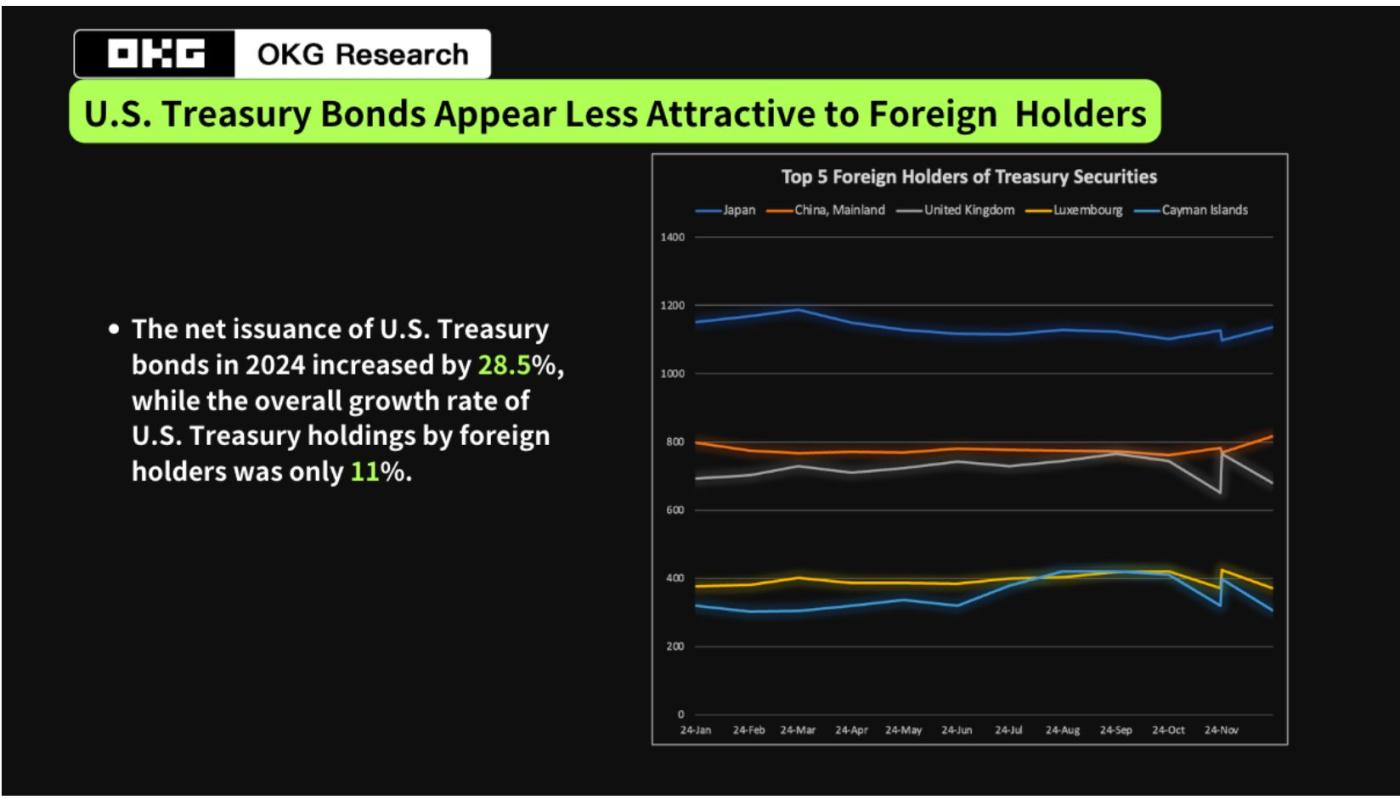
Furthermore, some foreign central banks are actively reducing their holdings of US debt. Since April 2022, China's holdings of US debt have remained below $1 trillion, and in September 2024, it further reduced its holdings by $26 billion to $772 billion. In the same month, Japan reduced its holdings by $59 billion to $1.123 trillion, although it remains the largest foreign holder of US debt, its holdings have declined again. With the rising demand for diversification of foreign exchange reserves, the overseas demand for US debt has weakened significantly.
The rapid growth in debt size and the persistent weakness in overseas demand will pose a dual challenge to the US debt market, and the rise in risk premiums is almost inevitable.In the future, if the market is unable to effectively absorb these debts, it may trigger larger-scale financial volatility.
The crypto market may be providing an innovative answer to effectively absorbing these debts.
Stablecoins May Become One of the Top 10 Holders of US Debt by 2025
As one of the safest assets globally, US debt is playing an increasingly important role in the crypto market. Stablecoins are the main vehicle for US debt to penetrate the crypto market. Currently, over 60% of on-chain activities are related to stablecoins, and most mainstream stablecoins have chosen US debt as their primary collateral.
Taking the world's two largest stablecoins, USDC and USDT, as examples, their issuance mechanisms require 1:1 collateralization with high-quality assets, with US debt occupying a major position. As of now, the scale of US debt collateralized by USDC has reached over $40 billion, while the scale of US debt collateralized by USDT has exceeded $100.7 billion.The existing scale of stablecoins alone has consumed about 3% of the upcoming short-term US debt, a proportion that has already surpassed Germany and Mexico, and is sufficient to rank 19th among the global rankings of foreign central bank holdings of US debt.
Although the Trump administration is expected to attract international capital inflows into Bit through government-backed Bit strategic reserves, thereby driving a sustained rise in Bit prices, and then profit from market operations to alleviate debt pressure, this method can only contribute to specific fiscal plans or interest payments. Even if the price rises to $200,000 in the future, with a total market capitalization of over $4 trillion, the US government's continuous purchase of 1 million Bit would only bring in about $100 billion in revenue.
Unlike the indirect debt relief through Bit, USDT and USDC are creating direct demand for US debt. The market capitalization of stablecoins reached a new high of over $210 billion on January 22.Driven by accelerated US legislation and the continued rise in global stablecoin adoption, OKG Research is optimistic that the stablecoin market value will surpass $400 billion by 2025, and the resulting new US debt demand will exceed $100 billion, potentially making stablecoins one of the top 10 holders of US debt by 2025.
If this development trend can be maintained, stablecoins will become the most important "invisible pillar" of the US debt market, and the direct US debt demand they create will exceed the indirect returns from investing in Bit. Bitwise's senior investment strategist has stated on social media that the US Treasury holdings of stablecoins may grow rapidly to 15%. The US Treasury Department's previous report also pointed out that the continued growth of stablecoins will create structural demand for US short-term debt.
With the implementation of Trump's economic stimulus policies,stablecoins and the small portion of US dollars and the majority of US Treasuries that back them will also become a new form of US dollar expansion.Since the US dollar is the global reserve currency, foreign central banks and institutions generally hold US Treasuries. The issuance of US Treasuries is essentially usingthe US's credit to "export inflation", indirectly making the world pay for its debt, thereby achieving a similar effect to "expanding the money supply".This will not only consolidate the status of the US dollar, but also pose challenges to the regulation and taxation of other countries.
Large-scale tokenization brings global liquidity to US Treasuries
In addition to becoming the preferred underlying asset for mainstream stablecoins,US Treasuries are also one of the most popular asset classes in the current wave of tokenization.According to data from RWA.xyz, the tokenized US Treasury market had a size of $769 million at the beginning of 2024, and by the beginning of 2025, the size had reached $3.4 billion, a growth of more than 4 times. This rapid growth not only reflects the potential of on-chain financial innovation, but also highlights the market's recognition and demand for the tokenized form of US Treasuries.

Through tokenization, US Treasuries are rapidly penetrating DeFi. Whether using US Treasuries as a risk-free yield-generating asset on-chain, or engaging in derivative transactions through pledging and lending, the DeFi ecosystem is becoming more "down-to-earth". These tokenized US Treasuries not only bring more reliable underlying assets, but also capture stable returns from the real world, and distribute the returns directly to on-chain investors. The short-term US Treasury fund (OUSG) previously launched by Ondo once yielded up to 5.5%.
More importantly, after US Treasuries are on-chain, they will provide traditional investors with a more familiar asset class, helping to attract institutional capital to continue flowing in and further accelerate the maturation and institutionalization of the DeFi ecosystem.Projects using tokenized US Treasuries are usually seen as "low-risk innovations" and will also be more likely to obtain regulatory approval.
For US Treasuries, tokenization provides a new tool to alleviate debt pressure. Not only can US Treasuries enter the on-chain world, realize convenient cross-border transactions and cross-chain liquidity, breaking the geographical restrictions of traditional financial markets; it also opens up a new buyer's market for US Treasuries, further enhancing the global liquidity and attractiveness of US Treasuries.This new wave of on-chain liquidity may drive US Treasuries to become a core asset in the global financial market.
As the market generally expects that the frequency of interest rate cuts by the Federal Reserve after Trump takes office in 2025 may slow down, this further pushes up the yield on US short-term Treasuries, while reducing market risk appetite, making investors more inclined to more stable investment targets. In the foreseeable future, we will see more large-scale on-chaining of US Treasuries, and more projects based on tokenized US Treasuries will emerge in the DeFi ecosystem, gaining user and market favor, gradually changing the way of wealth management and investment on-chain.