Have you ever worried that the money you've worked hard to earn will be eaten up by the bank? Have you also wondered if the bank will be able to pay you the money when you need to withdraw it?
Did you know that in the world of crypto, there is a technology called the Merkle Tree, which many large exchanges use to instantly prove the security of their users' assets? How does this technology work?
The following article will use simple and everyday examples to help you understand what a Merkle Tree is and how it is used to prove the security of user assets.
After the FTX exchange announced bankruptcy in November 2022, Binance founder CZ called on various exchanges to publicly share their Merkle Tree and Proof of Reserves (PoR) on Twitter.

Want to know how to choose an exchange? Recommended reading:
How to Choose a Crypto Exchange (Part Two): Three Key Indicators, Exchange Rankings and Reviews
Your New Year's Red Envelope Savings
Proof of Reserves may seem complicated, but it's easy to understand using the example of New Year's red envelopes: every New Year, when kids receive red envelopes, moms often say "Mom has saved it for you."
So how do you prove that Mom hasn't misused the money? Mom can show her bank account passbook, and if the money in it is more than the red envelopes, it means "when we want to withdraw the red envelope money, Mom can pay it out."
Exchange's Proof of Reserves
Similarly, we can think of the exchange's Proof of Reserves as Mom's bank account passbook: Mom shows you the money in her account to prove she has the money, and the exchange shows you how much reserve funds it has to prove the exchange has the money.
Easily Check an Exchange's Reserves!
So how do you check how much reserve funds each exchange has?
- Go directly to the CMC website
- Click on the exchange list
- If there is a "reserve" icon in the red circle, it means that exchange has provided proof of its reserves!
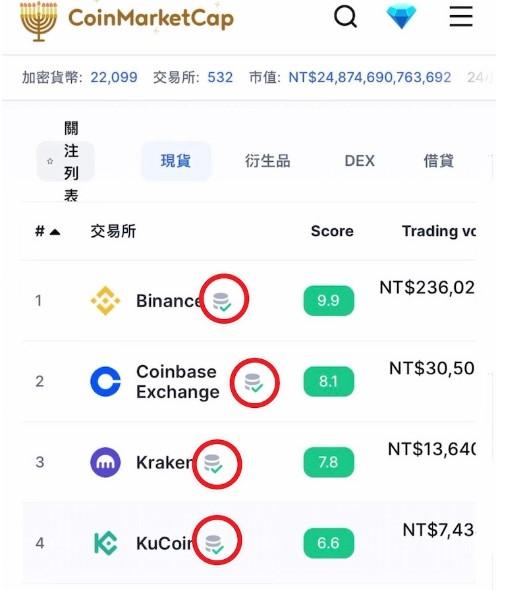
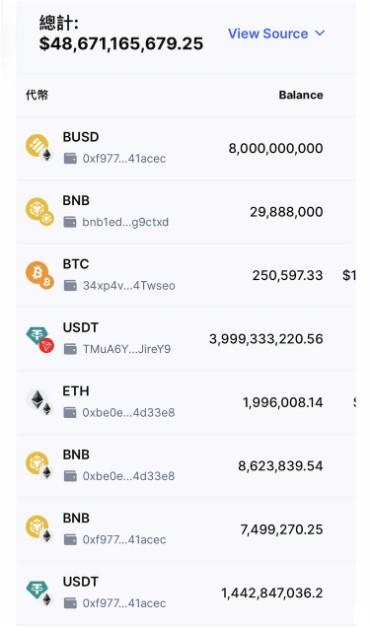
If we further click on the reserve icon, we can see how much money each exchange has and in what currencies (just like Mom showing you her bank account, which may have TWD, USD, JPY, etc.).
For example, the image below shows the details and total amount of Binance's reserves, indicating that Binance has 48.6 billion, of which 8 billion is BUSD, 29.88 million is BNB, 25,000 is BTC, 3.9 billion is USDT, and so on.
How does CMC know each exchange's reserves?
Since all on-chain information of the exchanges is publicly transparent, CMC can query the exchange's reserves in real-time through the following on-chain data query websites:
At this point, you may be wondering: I only see how much the reserves are, does having a lot of money mean it's enough? How do I know if it will be enough when everyone wants to withdraw their money?
That's right, this leads to another aspect of the problem: how many users are there, and how much money is deposited in the exchange?
Using Merkle Tree to Calculate User Funds
Let's go back to the "Mom saved your New Year's red envelope" analogy: although Mom has shown the money in her account, if there are siblings, and no one wants the others to know how much red envelope money they each have saved with Mom, how do we know that when everyone wants to withdraw the money from Mom, there will be enough?
From the Red Envelope Analogy to Merkle Tree
At this point, the smart older brother comes up with a trick, asking the siblings to encrypt their red envelope money into a calculable code.
Then, he adds the codes of the older brother and younger brother to get A, and the codes of the older sister and younger sister to get B, and then adds A+B to get C.
Finally, he decrypts C to get the amount, and that's how he knows the total amount of the siblings' red envelopes!

Finally, he compares the calculated amount C to the money in Mom's account:
- If the account has less money, it means Mom has misused the funds and didn't really save the money for us

- If the account has more money, it means there is enough for everyone to withdraw

The Exchange's Merkle Tree
Similarly, by encrypting all the users' money in the exchange and using Merkle Tree to add them up layer by layer, the total amount of user funds in the exchange can be obtained.
Finally, by comparing the total amount calculated with the exchange's proof of reserves, we can know whether the exchange's reserves are sufficient or not.
Why not just add directly?
Some may wonder why the exchange doesn't just add up all the user funds directly instead of using the complicated Merkle Tree method.
Have you ever had the experience of making a mistake when continuously adding a string of numbers on a calculator, and then having to start over from the beginning to find the error?
But if you use the Merkle Tree method of two-by-two addition, even if the final C is wrong, you can just check the data of the incorrect line going down, without having to recalculate everything from the beginning.
In other words, if there is a problem with the total amount of the exchange, by using the Merkle Tree, you only need to trace back from the erroneous part, and you don't need to withdraw all the users' funds and recalculate them.
Which exchanges have submitted Merkle Tree?
It is not easy to establish a Merkle Tree for exchanges, as there are people registering and depositing/withdrawing funds every day, and the cash flow is constantly changing.
More cautious exchanges will also submit to auditing agencies for review. As of the end of 2022, the ones that have been announced are: Coinbase, Kraken, Pionex, Gate, and Bitfinex.
Finally, a reminder to everyone that crypto assets are high-risk investments, and you must do your own research and risk management. Crypto information is updated quickly and has large fluctuations, so if you really don't understand it, please don't touch it!
This article is authorized to be reprinted from "Cryptoanny - Accompanying you to sort out the blockchain".
Original title: "[Term Explanation] Is the crypto exchange safe? Understand the proof of reserves and Merkle Tree from "Mom helps you save up"!"
〈Understanding the "Merkle Tree" from Mom helping you save the red envelope, is your fund really safe?〉 This article was first published on《NONE LAND》.