We have compared Sui and Aptos in terms of blockchain performance, scalability, ecosystem, and transaction advantages, and forecast that by the end of 2025, the price of SUI will reach $16 and APT will reach $22.
Please note that VanEck holds Sui (SUI) and Aptos (APT).
Sui and Aptos: Origins and Overview
Previously, we discussed the potential of Ethereum and Solana to attract tens of millions of users into the crypto realm. While these two ecosystems are highly attractive, they represent early blockchain technologies. Since their inception, a new generation of blockchains has emerged to break the limitations of these systems, including Aptos and Sui, founded by former members of the Facebook blockchain project Diem.
Diem had attempted to build a stablecoin payment system for the Facebook social media platform, but it was shelved due to regulatory pressure. However, its technical experiments have driven major breakthroughs in the blockchain field. Diem's most important legacy is the Move smart contract programming language - developed based on Rust, the third-fastest growing language used by 4.3 million developers globally, and optimized to address the shortcomings of early smart contract languages like Ethereum's Solidity and Cardano's Haskell. Both Aptos and Sui leverage Move to build a faster, more secure, and more intuitive development environment for developers. Move also helps their virtual machines (VMs) achieve faster transaction confirmation times (time for users to receive confirmation) and higher throughput (transaction volume processed per unit of time). The potential of Move is so great that the total market capitalization of blockchains based on Move has soared from around $5 billion to $22 billion in a year.
Core Comparison Dimensions
- Blockchain performance and scalability
- Ecosystem
- Transaction experience
- Token economics
- Valuation model
- 2025 price forecast
- Conclusion and investment risks
The size of the crypto developer community is only 1/1000 of that of JavaScript.
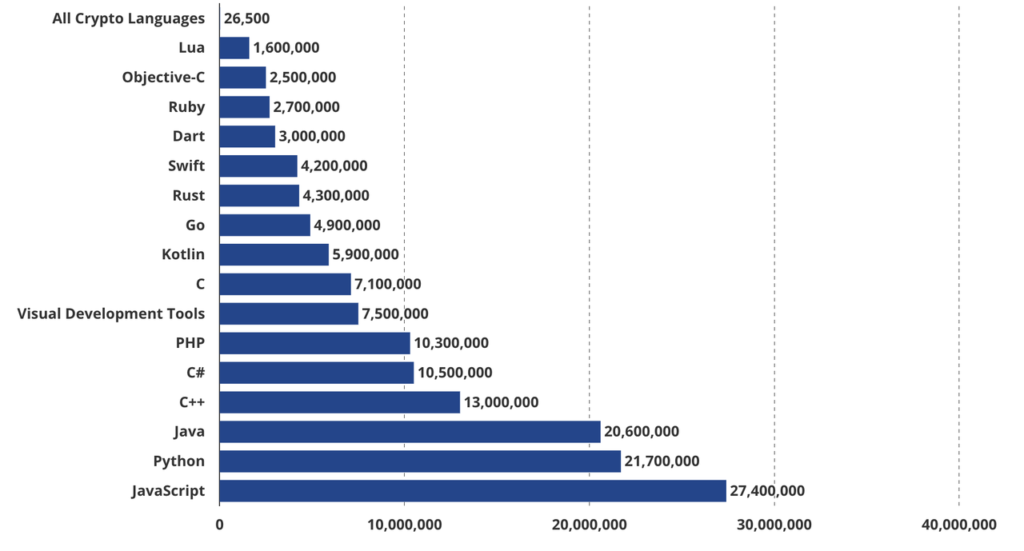
The importance of the Move language lies in providing developers with a more user-friendly entry point. The crypto developer community is extremely small - Meta (Facebook) has more full-time developers than the entire crypto industry. By providing a more usable and efficient language, Move has the potential to attract a wider developer community and promote experimentation and innovation. This innovation is crucial for discovering "killer applications" that drive mass adoption. We view blockchains as platforms for innovative experimentation, and their high valuations stem from their ability to nurture applications with billions of users. Since the next breakthrough application is unpredictable, attracting as many developers as possible to experiment is crucial.
Both Aptos and Sui combine the Move virtual machine with advanced consensus mechanisms to ensure high-efficiency transaction verification. This cutting-edge combination of virtual machine and consensus protocol forms their technical foundation, providing performance that surpasses previous blockchain systems. Before innovations like Solana's Firedancer demonstrate their limitations, Sui and Aptos represent the pinnacle of blockchain technology.
Aptos recorded a single-day transaction volume of 326 million (13,300 TPS) on 2024/10/18.
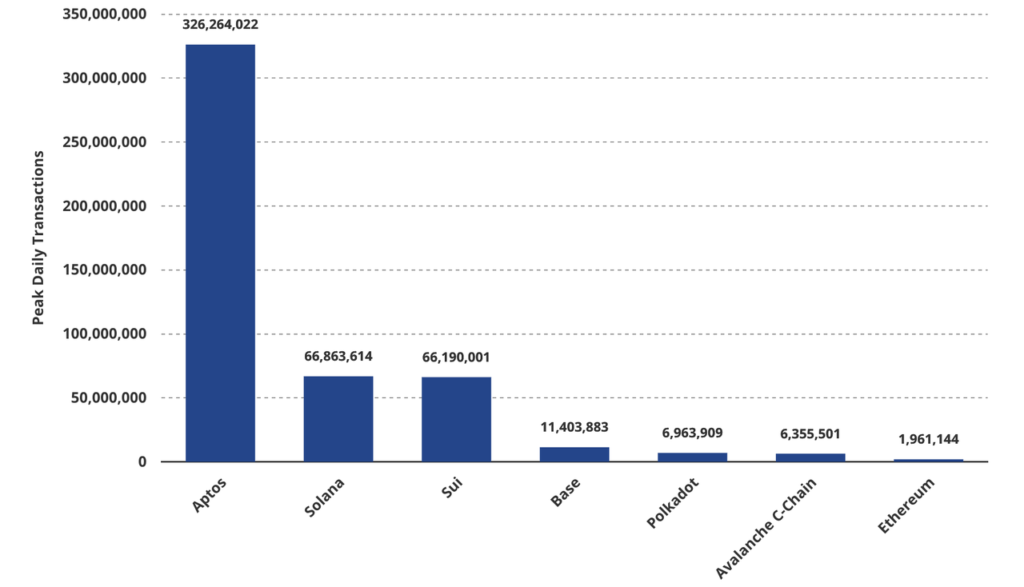
Sui and Aptos provide the key blockchain technologies to serve hundreds of millions of users. They outperform Solana (trading complexity for scalability) and Ethereum (trading rigid technical bureaucratic governance and outdated technology for a rich ecosystem) in simplifying the development process and ensuring security. Tactically, Sui and Aptos provide a better experience for current crypto core use cases (speculation and value transfer); strategically, they lay the foundation for non-speculative applications like AI agents, social media, and cloud services. While the form of the next killer application is unknown, Sui and Aptos have demonstrated strong potential to attract the next generation of blockchain users.
But what exactly makes these systems so exceptional? Which one is better?
Sui vs. Aptos: Blockchain Performance and Scalability
Although they share the Move language gene, the two blockchain architectures reflect different design philosophies. Each network has a customized version of the Move language, with unique optimizations for transaction processing.
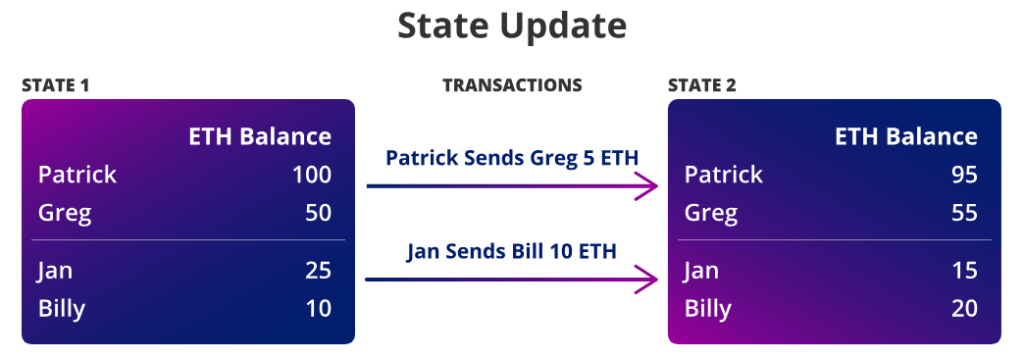
When a transaction is sent to the blockchain, it carries information about the database (i.e., "state") that needs to be modified. Blockchain engineers refer to these database updates as "state changes." Most blockchains use a hierarchical verification mechanism: a single verifier acts as a temporary "leader," responsible for receiving transactions, verifying their validity (checking signatures, preventing double-spending), ordering their execution, and updating the state, then broadcasting the resulting transaction block to other verifiers. When more than two-thirds (66%) of verifiers reach consensus, the blockchain moves on to the next block processing.
The blockchain architecture can be divided into two core components:
1. Transaction processing and block construction
- Verifying the authenticity of transactions
- Ensuring account balances are sufficient
- Executing smart contracts
- Updating the blockchain ledger
2. Network communication and state synchronization
- Broadcasting transaction blocks to the entire network
- Synchronizing ledger changes to ensure consistency across all verifiers
- Handling conflicts during ledger reconciliation
Increasing throughput requires either increasing block size or optimizing data processing efficiency. Sui and Aptos break through technical boundaries in different ways by customizing the Move language.
Blockchain transaction throughput = Block size × Block processing speed
Both are focused on optimizing data processing scale and propagation speed. By analyzing the design differences in their "transaction processing and block construction" components, we can reveal their respective strengths and trade-offs.
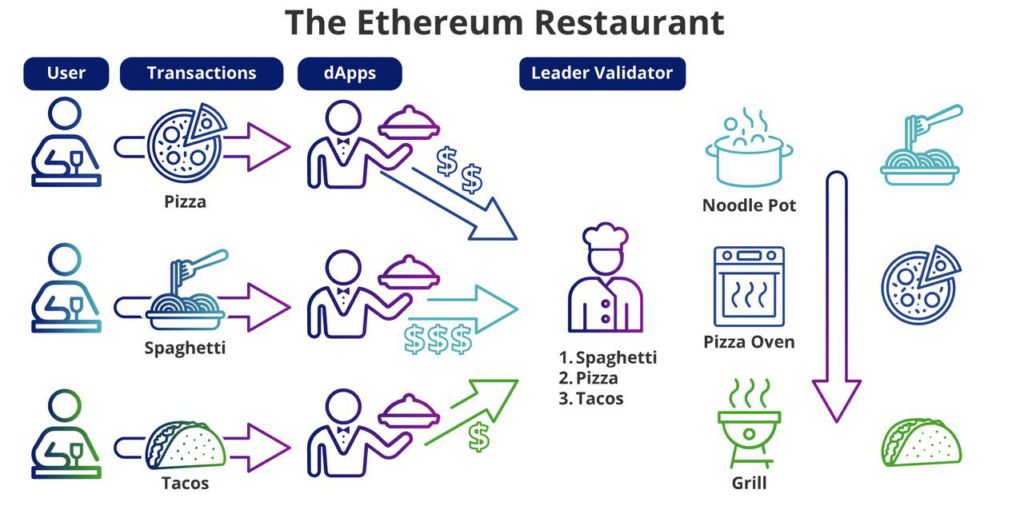
Blockchain Technology Analogy: Restaurant Operations Optimization
- Blockchain = Restaurant: Provides infrastructure and environment
- Users = Customers: Interact with the system through "ordering" (transactions)
- Transactions = Orders: Specific requests initiated by users
- On-chain applications = Waiters: Deliver orders to the kitchen (validators) and return the processing results
- Leader validators = Kitchen: Process orders (verify transaction execution) and produce results (state changes)
- State changes = Dishes: Completed transaction results
In this analogy, the technical improvements of Sui and Aptos are akin to optimizing restaurant operations -- accelerating kitchen efficiency, enhancing waiter coordination, and ensuring accurate and fast order processing.
Ethereum: Slow-paced Restaurant
Ethereum uses a single-threaded state update mechanism, requiring a longer time to accumulate transactions into blocks. Its block capacity is small, operations are limited, and transactions must be processed sequentially -- even if they involve different state parts, they need to queue up. This combination of small blocks, low update frequency, and sequential execution results in low throughput and severe scalability issues.
Analogy: Ethereum is like a restaurant with only one chef. Customers (users) submit orders through waiters (applications), and the orders are aggregated into a capacity-limited list. Orders without paying a high enough "tip" (Gas fee) will be excluded. About 12 seconds later, the order list is sent to the "head chef" (validator) to be processed in order of tip amount. Due to limited capacity, severe congestion is inevitable during peak hours. Users are frustrated by the long wait times and the high fees they have to pay without receiving the desired service.
Ethereum Restaurant: Even non-conflicting orders need to be processed one by one
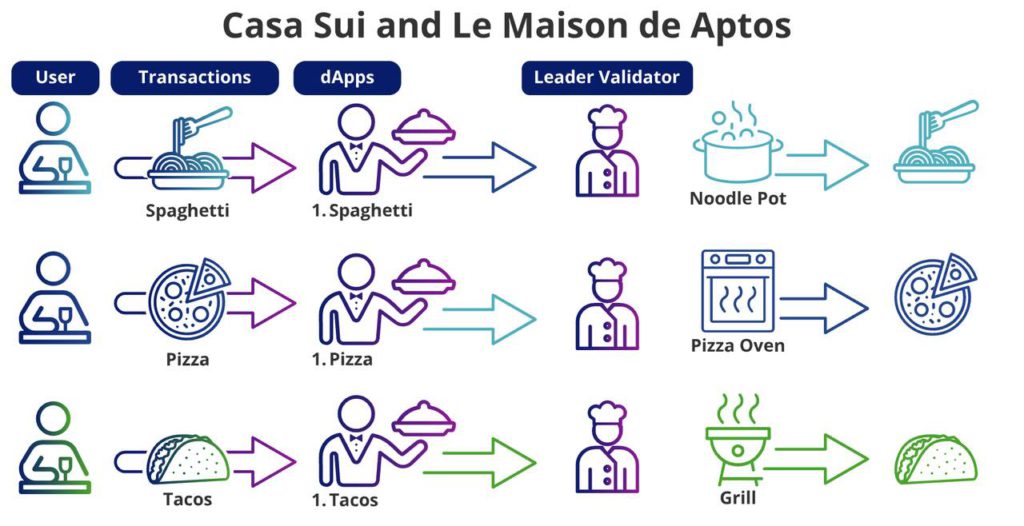
Sui and Aptos: Fast-food Restaurants with Parallel Processing
By allowing non-conflicting transactions to be processed in parallel, the two chains have achieved a significant breakthrough. For example, simple payments or transactions using different applications can be executed simultaneously. While chains like Solana and Monad also support parallelism, Sui and Aptos currently have the most advanced designs.
Analogy: Adding more chefs to the kitchen. But due to the limited number of ovens, when multiple tables order pizzas at the same time, the oven capacity will be insufficient, and some orders will still need to be queued. In the blockchain scenario, this is similar to users competing for the best prices on the same DEX -- conflicts must be resolved, and Sui and Aptos have adopted different approaches.
Parallel processing improves throughput
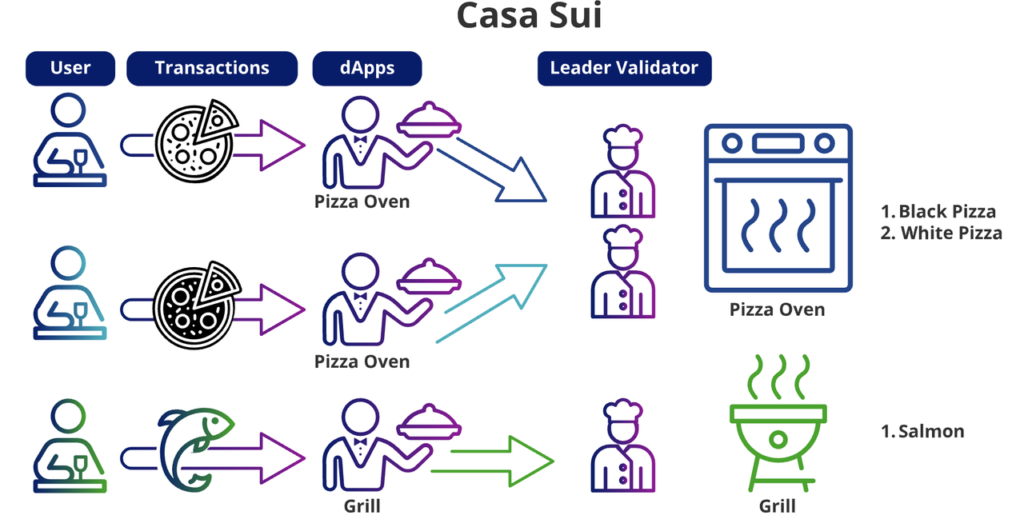
Sui: Static Parallelism "Fine Dining"
Adopting a "static parallelism" mechanism similar to Solana, transactions need to declare the state parts they will read and write in advance. Sui then determines conflicts and resolves them based on factors like fees and arrival time.
Analogy: In the "Sui Restaurant", the waiters (applications) decompose the order's kitchen equipment requirements. If two orders need the same equipment (like a pizza oven), the system will pre-determine the processing order. For example:
Table A orders white pizza
Table B orders black pizza (signature dish)
Table C orders salmon
Orders A and B conflict because they share the oven, so the system prioritizes order B, while order C can be processed immediately as it uses an available oven.
Sui Conflict Prediction Mechanism
Aptos: Dynamic Parallelism "French Cuisine"
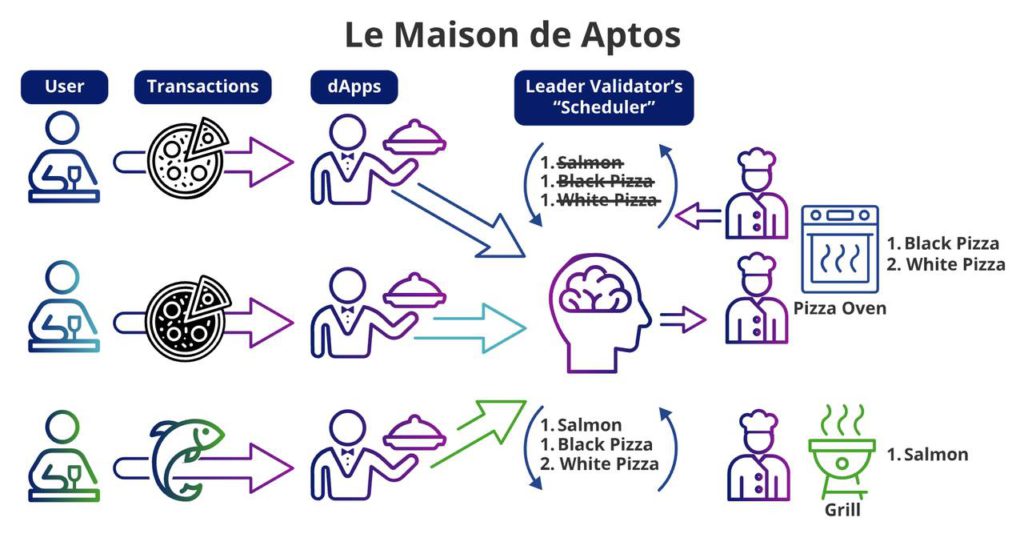
Adopting a "dynamic parallelism" similar to Monad, Aptos assumes conflicts are rare and detects conflicts in real-time during transaction processing. If a conflict is detected (e.g., multiple transactions competing for the same asset), it will roll back and re-order.
Analogy: In the "Aptos Restaurant", the waiters do not need to predict the kitchen equipment usage. Orders go directly to the "kitchen manager" (scheduler), who assumes no conflicts and processes them immediately. If a conflict actually occurs (e.g., multiple customers competing for the last Dover sole), the cooking must be stopped and rescheduled. Although this seems inefficient, the Aptos kitchen's extreme processing speed can usually absorb this overhead.
Aptos Dynamic Conflict Resolution
Deeper Implications of the Two Models
Aptos' Developer Friendliness
- No forced declaration of state dependencies, reducing development complexity
- Suitable for applications requiring flexibility (e.g., conditional order execution)
Sui's Execution Efficiency
- Resolves conflicts in advance, reducing computational resource consumption
- Performs well in high-competition scenarios (e.g., DEX arbitrage)
- But may lead to "write locks" and partial state being monopolized
Extreme Scenario Testing
Aptos may encounter scheduling bottlenecks in high-conflict situations (following Kingman's formula: as system load approaches saturation, small flow increases will lead to exponential delays)
Sui's write locks may result in inefficient resource utilization
Sui's Unique Advantages: Local Fee Market and Service-level Agreements
Local Fee Market
- Different applications can independently price Gas fees (e.g., the Aftermath Finance SUI/USDC pool can raise prices separately)
- Compared to Aptos/Ethereum's global fee market (congestion in a single application can cause Gas prices to rise across the network)
Analogy: In the Sui restaurant, each cooking area prices based on demand (the sea urchin pasta can raise prices without affecting the beef roulade), while Aptos has a globally unified pricing (the surge in demand for pickled fish ice cream causes the red snapper pizza fee to rise).
Service-level Agreements (SLA)
- Validators can commit to daily transaction latency and pricing
- Guarantees enterprise-level applications are not disrupted by other chain activities
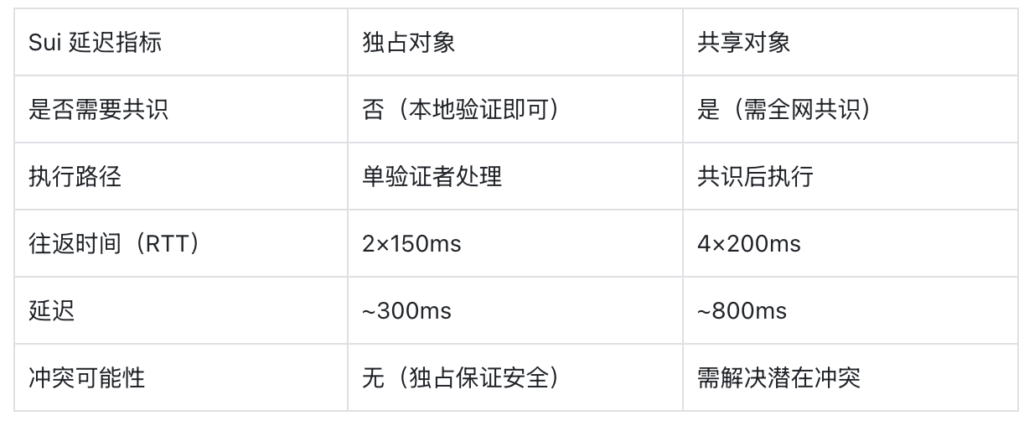
Finality Time: Sui Advantage
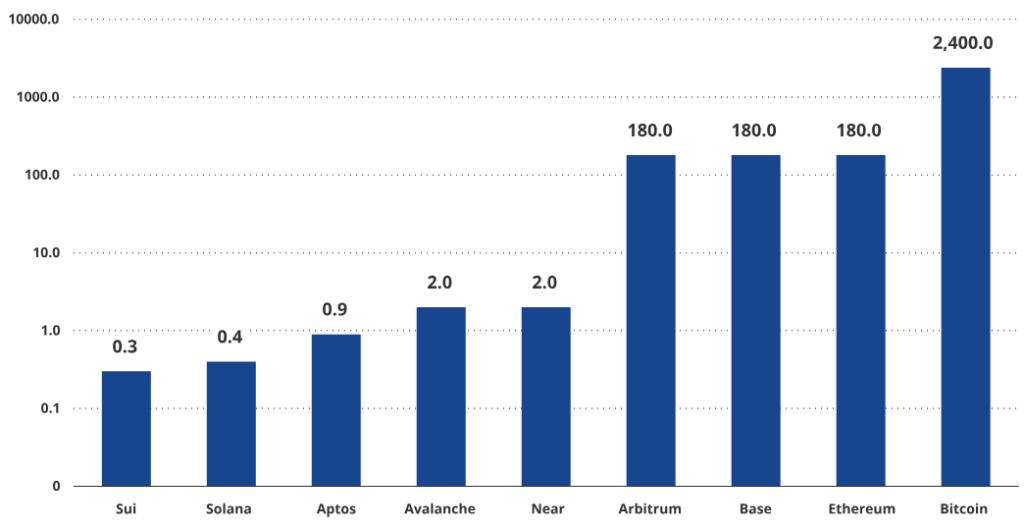
For simple payment-type transactions, Sui achieves ultra-low latency and high throughput through two key mechanisms:
- Fast Path: Bypass the consensus mechanism, with a latency as low as 300 milliseconds
- Pilot Fish: Validators can achieve near-infinite scalability by adding new servers
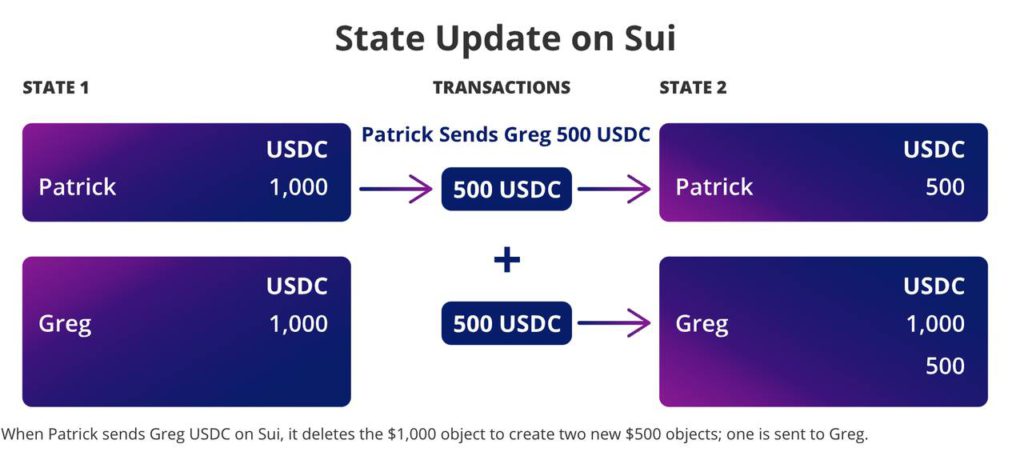
The technical foundation is based on an object-oriented state architecture - assets like USDC are held directly by users (rather than the Ethereum contract accounting model). When two users transfer at the same time, Sui can process them in parallel (modifying the ownership of their respective objects), while Aptos/Solana need to access the same smart contract sequentially.
Aptos' Response: Quorum Store
Improving throughput by optimizing the consensus process:
- Allow non-leader validators to participate in transaction propagation
- Leaders focus on block proposal and broadcast
- May exacerbate scheduling challenges in high-conflict scenarios
Security Tradeoffs
Sui omits the DAG verification step to improve speed, which may make it more susceptible to network packet loss (e.g., if 5/100 validators drop 1% of packets, it can significantly slow down). Additionally, the attack surface for malicious validators is larger than Aptos. While major attacks on PoS systems are still theoretical risks, as the ecosystem matures, this vulnerability may be amplified.
Ecosystem Status: Sui Temporarily Ahead
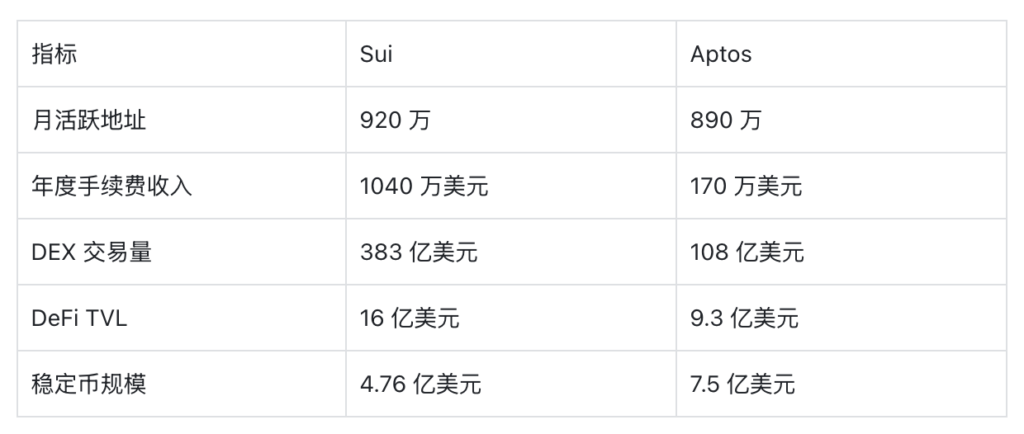
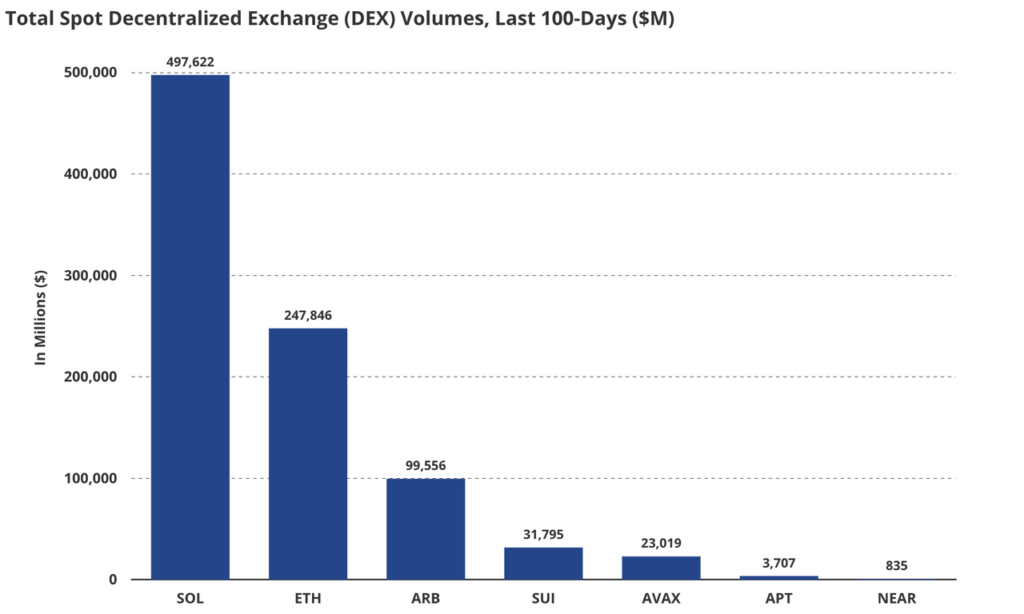
Key Applications
- Sui: Lending protocol Suilend/Navi (TVL over $450 million), perpetual contract BlueFin (daily trading volume $250 million, ranked 7th on the chain)
- Aptos: Stablecoin DEX protocol Thala (TVL $135 million)
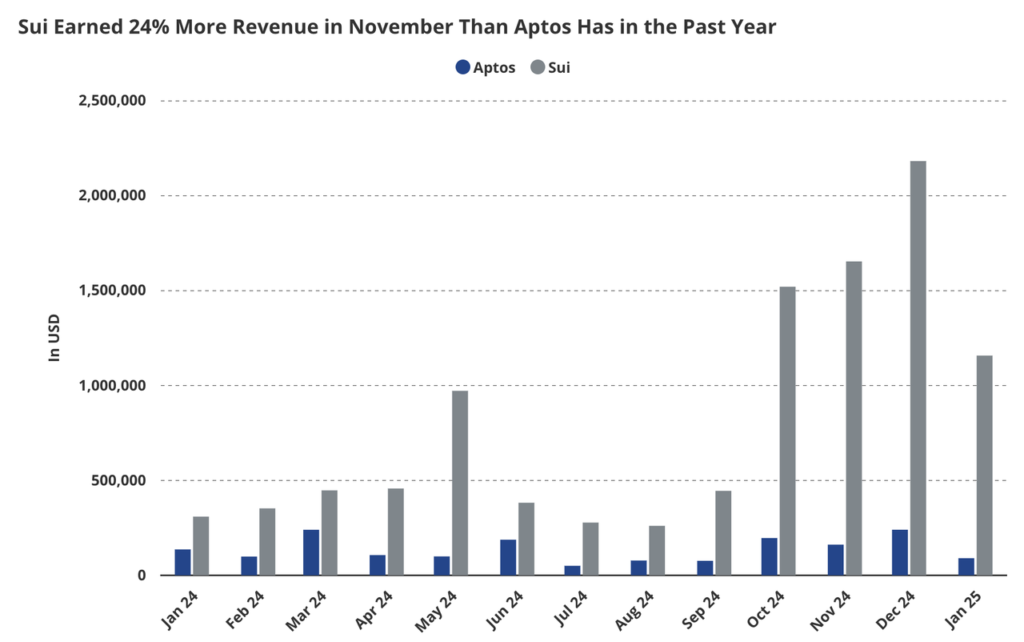
Incentive Strategies and "Hired Capital" Risks
- Sui: Promised 157 million SUI (worth about $300 million) in October 2023 to incentivize the ecosystem, estimated to increase annual yield by 5.2%-10%
- Aptos: Offers 6.5%-20% APT rewards to attract liquidity, estimated annual incentive spending of $100 million
Both face the "hired capital" problem - users come only for the arbitrage rewards, and the sustainability of the ecosystem is questionable.
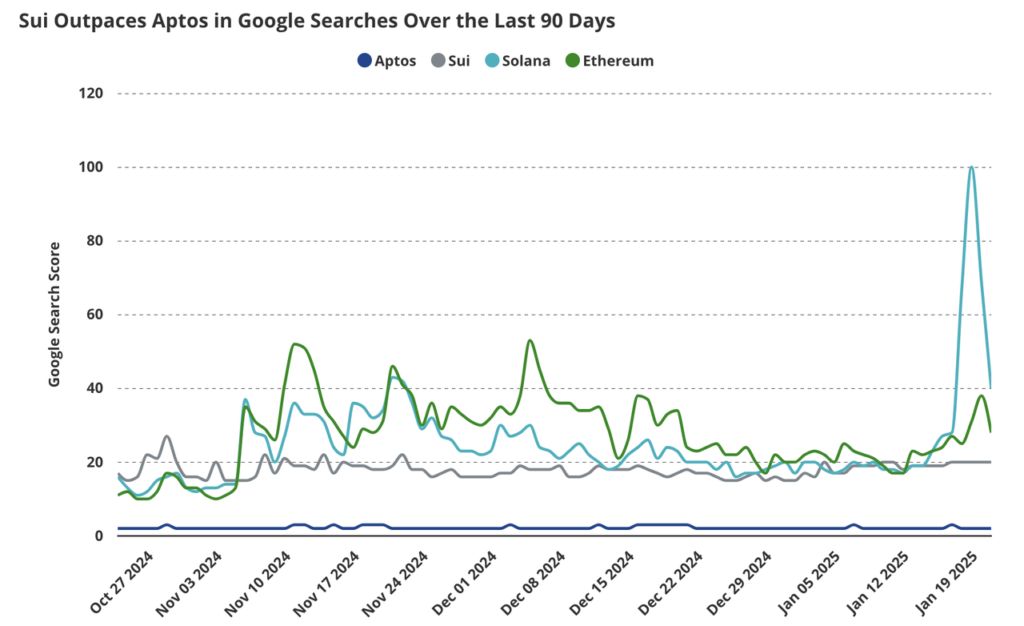
Developer and Community Hype
- Active Developers: Sui 280/week vs. Aptos 272/week (Ethereum 3300, Solana 1200)
- Google Search Trends: Sui 9x Aptos, surpassed Solana for 17 days and Ethereum for 16 days in the past 90 days
- No truly differentiated successful applications yet (e.g., Sui's FanTV, Birds have low user numbers)
Transaction Experience: Sui is Better
Sui has built a superior system for traders, specifically:
Programmable Transaction Blocks (PTB)
- A single transaction can dynamically call up to 1024 instructions, combining on-chain/off-chain data for decision-making (e.g., DEX aggregators using ASIC/GPU to calculate the optimal path).
- Surpassing Solana's account number limit (64 input accounts), supporting complex transactions (e.g., operating over 100 objects simultaneously).
Gas Fee Mechanism
- Sui: Validators set a baseline price, users can add priority fees to jump the queue. Uses a local fee market, high-demand applications can price independently (e.g., the SUI/USDC pool of Aftermath Finance can raise prices separately).
- Aptos: Governance sets a gas floor, fees globally fluctuate. No priority fee mechanism, high-demand scenarios see network-wide increases.
DeepBook Liquidity Layer
- An integrated central limit order book (CLOB) within the Sui chain, aggregating liquidity across the chain.
- Reduces DEX slippage, weakening the liquidity monopoly advantage of top applications.
Impact:
Market makers can update quotes on Sui at lower cost (batch updating thousands of orders per transaction).
Sui DEXs may have tighter spreads than Aptos, attracting more trading volume.
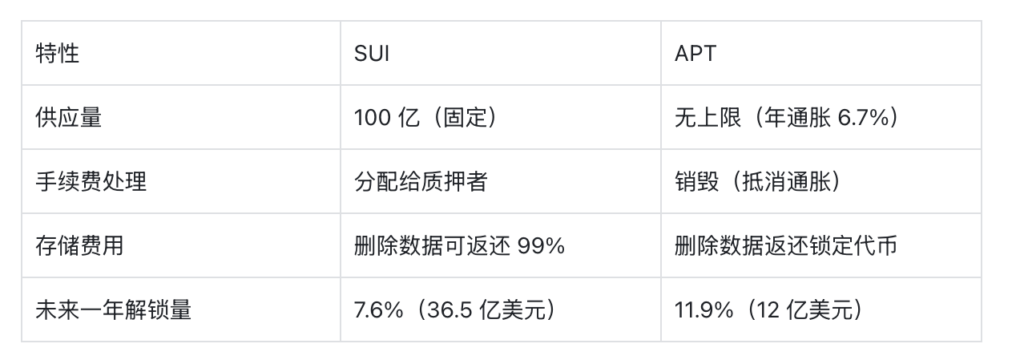
Token Economics Comparison
Unique Designs:
Sui Storage Fund: The network pays newly minted SUI to validators to compensate for long-term storage costs, creating deflationary pressure on the token.
APT Inflation and Burn Balance: High transaction volume may push APT into deflation, but current annual inflation still exceeds the burn rate.
Valuation Model and Price Forecast
Smart Contract Platform (SCP) Total Market Cap
Projected to reach $1.1 trillion by the end of 2025 (currently $770 billion, +43%)
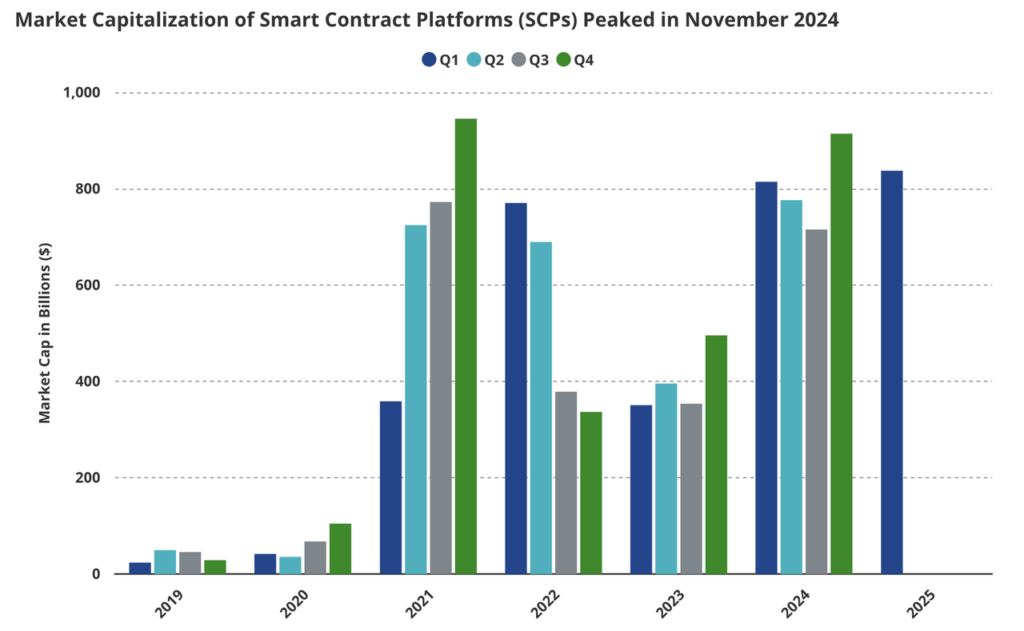
Based on a regression analysis (R²=0.36) of the US M2 money supply (projected to be $22.3 trillion in 2025, growing 3.2% annually)
Move Ecosystem Market Share
Current 2.7% (Sui 2% + Aptos 0.7%) → 2025 6.5%
Price Forecast
SUI: 5.5% share corresponds to $61 billion market cap, 30 billion circulating supply → $16 (current $3.75, +326%)
APT: 1% share corresponds to $11 billion market cap, 507 million circulating supply → $22 (current $7.3, +201%)
Conclusion and Investment Risks
Our Conclusion
The existing evidence suggests that Sui is more competitive due to its performance advantages and expansion suite potential. Its unique local fee market, Pilot Fish architecture, and fast-track design provide a better DeFi pricing environment for high-frequency traders. Combined with its strong community narrative capabilities, Sui has established a leading position in token performance and ecosystem activity.
However, the advantages of Aptos in development flexibility and chain robustness cannot be ignored. Although Sui currently leads significantly in economic indicators such as TVL and DEX trading volume, the dynamic changes in the crypto market may quickly reverse the situation. In the long run, the winner will depend on who can continuously innovate and translate technical advantages into ecosystem prosperity.
Five Core Risks
- Business expansion dilemma: Both have not formed a coordinated strategy for technical development and ecosystem expansion. If they fail to cultivate killer applications that truly leverage their technical characteristics, the prosperity of the ecosystem may be difficult to sustain.
- Lack of technical stress testing: Current transactions are mainly simple transfers, and have not experienced the extreme challenges of Solana-level DEX trading volumes. Innovative features like Pilot Fish may need to be compromised and adjusted under high-pressure scenarios.
- Intensified competition threats:
- Solana Firedancer upgrade: May surpass Sui/Aptos after the 2025 performance upgrade
- Emerging public chains: Monad's technical community dual advantages, Berachain's speculative momentum
- Historical lessons: High-performance chains are easily replaced by latecomers (such as the decline of EOS and Tezos)
- Macroeconomic fluctuations: Crypto assets are strongly correlated with M2 money supply (R²=0.36). If the Federal Reserve tightens liquidity or a global financial crisis erupts, the market capitalization of SCP may shrink significantly.
- Regulatory black swan: If the FIT 21 Act sets strict decentralization standards, Sui/Aptos may be classified as securities, restricting their circulation to qualified investors.
Disclaimer
The content mentioned in this article is only a research perspective and does not constitute investment advice. The price forecast is derived from hypothetical models, and the actual results may deviate significantly from the expectations. The risks of blockchain technology and market volatility are extremely high, and readers should make independent judgments and bear investment responsibility.