


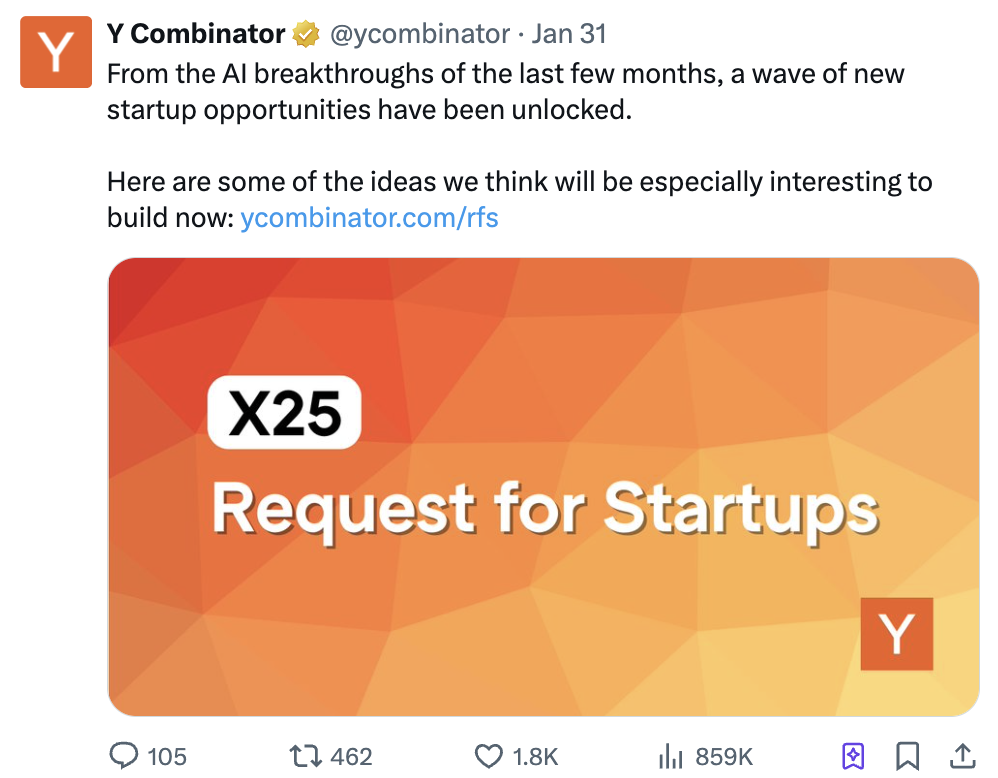
Y Combinator recently released its "Request for Startups" for the Spring 2025 season, outlining the areas they hope to see more entrepreneurs focus on. These ideas reflect the emerging trends of AI Agents in Web2, focusing on solving real problems and pain points, including:
- AI App Store
- Data Centers
- Compliance and Audit Tools
- DocuSign 2.0 (Next-gen e-signature solutions)
- Browser and Computer Automation Tools
- AI Personal Assistants
- Devtools for Agents
- The Future of Software Engineering (Engineering Agents)
- AI Commercial Open Source Software
- Agents for Hardware-Optimized Code
- Enterprise-to-Agent (B2A)
- Vertical AI Agents (Agents focused on specific industries or use cases)
- Inference AI Infrastructure (Technologies that support efficient inference and execution of AI models)
While these directions cover a vast amount of information, if you've been working in this field, you'll find that many Web3 agent teams have already started to explore these areas.
If you want to dive deeper into these trends, you can check out the original post released by @ycombinator:
I believe the following areas will be key trends in the development of Web3 AI Agents (in no particular order):
- AI Commercial Open Source Software
- Devtools for AI Agents
- Vertical AI Agents
- AI Personal Assistant
- AI App Store
- B2A (Business-to-Agent)
AI Commercial Open Source Software
Web3 AI and open-source AI have a natural connection, making the open-source domain an important focus area for Web3. For example, @ai16zdao has driven one of the largest open-source AI movements, launching the ElizaOS framework, which has already garnered 14k stars and 4,227 forks on GitHub. Despite market fluctuations, the adoption of this framework continues to steadily rise.
This open-source movement has also inspired Web3 developers to open-source their own technologies, driving teams to develop AI technologies and frameworks that allow other developers to collaborate more efficiently. In recent years, we've seen many open-source frameworks emerge that go beyond ElizaOS, such as @arcdotfun, @GAME_Virtuals, @sendaifun, @pippinlovesyou, and @freysa_ai, all of which are driving the development of the open-source innovation ecosystem.
As AI Agents continue to evolve rapidly, with the release of models like OpenAI's o3, DeepSeek's new models, and tech giants accelerating the launch of related products, the demand for open-source AI and Web3 AI is steadily increasing. The combination of cryptocurrencies and AI (Crypto x AI) is poised to play a significant role in the AI market.
AI Devtools for AI Agents
Building AI Agents is not just about creating intelligent models, but also about providing efficient tools and infrastructure to help developers transform these agents into practical applications. As AI Agents become increasingly complex, developers' need for user-friendly tools, frameworks, and platforms that simplify the process of building, deploying, and managing these agents is growing rapidly.
In the Web2 era, the widespread adoption of developer tools significantly enhanced the capabilities of AI technology. Web3 is further driving this trend, introducing decentralization, trustlessness, and open-source collaboration, which are opening up new possibilities for AI development. We are moving towards a new era where the construction, iteration, and large-scale deployment of AI Agents will no longer depend on the closed ecosystems of a few tech giants.
This trend has given rise to many AI-focused development platforms, agent ecosystems, and no-code/low-code tools. These tools aim to lower the barriers to AI agent development, allowing more developers to easily participate. In the Web3 space, an increasing number of platforms are providing AI agent development toolkits to help developers quickly build and commercialize AI-based applications. Some noteworthy examples include:
- @ai16zdao : Launched ElizaOS, with the richest plugin and integration capabilities.
- @sendaifun : Solana Agent Kit, focusing on the development of intelligent agents on the Solana blockchain.
- @CoinbaseDev : CDP Agent Kit, providing basic tools for on-chain AI agent development.
- @autonolas : Launched Pearl, an agent app store focused on practical tools, providing prediction markets, DeFi automation, and autonomous execution agents.
- @AlloraNetwork : Provides machine learning infrastructure to help AI agents make more accurate predictions in real-time.
- @cookiedotfun : Focuses on AI agent-driven data analysis, helping agents extract social sentiment information from on-chain and off-chain data.
- @getmasafi : Provides real-time data streaming solutions to provide AI agents with the latest dynamic intelligence.
- Some no-code AI platforms focused on Web3 include:
- @virtuals_io : A leading no-code/low-code AI agent building platform, helping developers quickly turn AI agent concepts into actual products.
- @HoloworldAI : A no-code platform focused on building 3D audiovisual AI agents, helping users design AI-driven virtual characters.
- @Cod3xOrg : A no-code tool specifically designed for automated trading agents, helping traders automate trading strategies with AI.
- @Almanak__: A platform built for institutional-grade quantitative agents, supporting high-end financial use cases.
- @EliteAgents_AI : Focuses on plugin-enhanced AI agents, seamlessly integrating with AI ecosystems like ElizaOS and G.A.M.E.
Although the AI development tool ecosystem in Web3 is still in its early stages, its infrastructure is rapidly improving. In the coming years, we can expect to see a fully decentralized AI development ecosystem take shape. In this ecosystem, AI agents will become easier to build, while possessing complete autonomy, scalable modularity, and commercialization capabilities. The development tools driving this transformation will become indispensable infrastructure in the Web3 AI economy.
Vertical AI Agents
AI agents are evolving from general-purpose tools for simple tasks to highly specialized vertical agents. These agents focus on specific industries or scenarios, capable of handling complex and nuanced tasks. By deeply embedding domain knowledge, they can not only perform basic automation, but also act as decision-making agents, executing operations that require deep human expertise.
The wave of AI-driven verticalization is gradually emerging. In finance, law, and scientific research, agents have already demonstrated capabilities in analysis, recommendation, and even representing users in operations. This verticalization trend will further enhance the influence and depth of AI agents in various industries.
Some typical examples of Vertical AI Agents include:
- Tax Agent: Helps users calculate, optimize, and execute tax planning.
- Legal Agent: Can review contracts, optimize terms, and even represent users in legal disputes.
- Financial Agent: Analyzes financial statements, interprets macroeconomic trends, and provides investment recommendations.
The unique aspect of Web3 Vertical AI Agents is their emphasis on autonomy, decentralization, and on-chain integration. Traditional AI services often rely on centralized data silos, while Web3 native AI agents achieve higher transparency and trust through on-chain verifiability. This feature gives Web3 agents an advantage in data processing and result credibility.
In the cryptocurrency domain, community interaction and personalization are particularly important, so Web3 AI agents are evolving towards more personalized and interactive models. Unlike the typically cold and functional AI agents in Web2, Web3 agents are gradually developing unique personalities and interaction patterns to adapt to the culture of decentralized communities. For example:
- AI Influencers: Such as @aixbt_agent, sharing insightful views and market-leading information on Crypto Twitter to attract community attention.
- Token Analysis Agents: Such as @unit00x0, @kwantxbt, @tri_sigma_, @mobyagent, and @_AgentScarlett, focusing on analyzing token data and providing related recommendations.
- Research Agents: Such as @DV_Memetics and @S4mmyEth, providing actionable market intelligence through @orbitcryptoai.
- DeFAI Agents: Focused on managing liquidity mining (LP'ing), yield farming, and trading strategies, developed by teams such as @Cod3xOrg, @gizatechxyz, and @autonolas.
Furthermore, platforms like @NousResearch, @BagelOpenAI, and @PondGNN are further enhancing the personalization capabilities of agents to better suit the needs of decentralized communities. As DeFAI agents gradually simplify the complex operations of DeFi, they may become a key driving force in attracting billions of new users into the blockchain world. By lowering the usage threshold of DeFi and providing more intuitive experiences for users, these agents are poised to trigger a new wave of AI adoption in the future.
AI Personal Assistant
AI personal assistants are fundamentally changing the way we handle our daily tasks, making many previously unimaginable functions a reality through convenience and automation. These assistants will no longer be limited to reminders and scheduling, but will be able to make proactive decisions to help users manage their time and resources more efficiently.
Imagine an AI that can book your travel, recommend restaurants based on your preferences, check traffic conditions, and automatically adjust meeting schedules if you're running late. It can also summarize meeting contents, provide follow-up suggestions, and even book your transportation. Furthermore, it can organize your photos, categorize them by location and event, and generate beautiful memory albums for you to revisit anytime.
With the support of Web3, these capabilities will be further expanded:
- Airdrop Agents: Help users scan all wallets and automatically check if they meet the airdrop conditions of crypto projects (such as @berachain, @monad_xyz, @StoryProtocol).
- Yield Farming & LP Management Agents: Actively track and optimize DeFi positions, automatically claim rewards, and reinvest earnings into the best strategies.
- GitHub Repository Analysis Agents: Such as @soleng_agent, can assess the strength of project development teams to help users identify potential scams.
- Automated Trading Agents: Such as @Cod3xOrg and @Almanak__, execute trades based on preset conditions, optimize entry and exit timing to maximize market returns.
The next-generation AI personal assistants will no longer be passive helpers, but proactive "co-pilots" capable of taking action. As AI models continue to improve in reasoning and decision-making capabilities, these agents will evolve from reactive to predictive, able to complete complex multi-step tasks with minimal user input.
Web3 plays a crucial role in this transformation. Decentralized AI agents have trustworthiness, transparency, and censorship resistance, ensuring users have full control over AI-driven workflows. This capability will allow users to delegate complex financial and operational decisions to AI, fundamentally changing the way we work.
AI App Stores
AI app stores are one of the most anticipated developments in the field of artificial intelligence. Just as mobile app stores have transformed software distribution, AI agents also need a dedicated marketplace where users can easily discover, purchase, and integrate AI-driven applications.
In Web3, this concept is evolving into a combination of Multi-Agent Orchestration Networks (MAO) and Agent Distribution Networks:
- Agent Distribution Networks: Attract developers, investors, and users to join the ecosystem. For example, @virtuals_io is building an Agent Society where diverse AI agents can coexist and collaborate.
- MAO Networks: Use smart matching technologies to recommend suitable AI applications to users and efficiently coordinate the collaboration of multiple agents. Users no longer need to manually search, but can express their needs, and the system will instantly assemble a solution to meet those needs.
Therefore, the Web3 AI app store is not just a trading marketplace, but also requires features like curation, auditing, and privacy protection, while supporting seamless interactions between agents. This model will fundamentally change the way users interact with AI, laying the foundation for the future AI ecosystem.
Key players driving this development:
- @virtuals_io: Committed to expanding the blueprint of their "Agent Society", attracting high-quality agent teams to join, and pioneering agent communication protocols to lay the foundation for agent collaboration.
- @santavirtuals and @questflow: Enhance the coordination capabilities between Virtuals agents to optimize resource allocation efficiency.
- Abstraction Layer projects like @orbitcryptoai and @HeyAnonai: Integrate AI agents and decentralized finance (DeFi) into efficient abstraction layers, lowering the usage threshold and allowing more users to easily access these technologies.
Although AI orchestration is still in its early stages, it can be foreseen that seamlessly executable and profitable AI agents will open up a huge market, and Web3 is actively positioning itself to occupy an important position in this market.
B2A (Business-to-Agent)
AI agents are no longer just tools, but are becoming active participants in the digital economy, capable of autonomously completing transactions, managing resources, and even collaborating with other agents. This trend has given rise to a new infrastructure requirement, B2A (Business-to-Agent), which is specifically designed to provide services for AI agents.
Just as SaaS (Software-as-a-Service) has transformed the way businesses operate, B2A will redefine the interaction, transaction, and operation of AI agents in the digital economy. In the future, AI agents will require dedicated payment solutions, data access permissions, computing power, and privacy protection frameworks. Currently, multiple Web3 projects are driving this transformation:
- AI-commerce Payments: @Nevermined_io is developing a payment solution for intelligent agents, aiming to become the "PayPal for AI agents".
- Compute Management: @hyperbolic_labs is developing self-sustaining intelligent agents that can efficiently manage their own computing resources.
- Privacy & Security Infrastructure: @PhalaNetwork, @OraProtocol, and @brevis_zk are building a privacy-preserving computing layer to provide a secure and verifiable interaction environment for AI agents.
- Quality Data Access: @getgrass_io, @vana, @getmasafi, and @cookiedotfun provide structured, high-quality data sources to help AI agents with training, learning, and efficient operation.
- Agent-to-Agent Communication: @virtuals_io is developing a communication protocol for intelligent agents to enable efficient collaboration.
- Intellectual Property for AI: @StoryProtocol is developing a framework similar to TCP/IP to manage the intellectual property of AI-generated content, allowing agents to autonomously manage and authorize their creative works.
B2A is not just a theoretical concept - it is becoming a reality. As the capabilities and complexity of AI agents continue to grow, they require specialized infrastructure to support their independent operation within the economic ecosystem. If you have not yet started thinking about how to serve the AI agent market, you may have already missed the opportunity.
Concluding Thoughts
AI agents are redefining the way we interact, build, and automate in Web2 and Web3. The rise of a Web3-native AI ecosystem is bringing new models, including open-source collaboration, agent-driven business models, and decentralized automation solutions.
While the convergence of AI and cryptography is still in its early stages, the momentum is unstoppable. Web3 provides AI agents with critical capabilities that were not possible in Web2, such as asset ownership, a permissionless environment for innovation, and a highly composable ecosystem. These features create limitless possibilities for agent-driven economies. The question is no longer whether AI agents will transform Web3, but how quickly this transformation will occur and which industries will be at the core of this change.
As the scale of the agent-driven economy continues to grow, whether you are a developer, an investor, or a curious observer, now is the best time to focus on this field. The infrastructure is being rapidly built, key players are emerging, and opportunities are becoming visible.
So, the question is: are you ready to join the wave of this transformation?



