1. How are the Rules of the Game Changed as Wall Street "Goes On-Chain"?
In the 19th century, early Wall Street financial transactions relied heavily on manual processes and face-to-face trading, with brokers and banks as crucial intermediaries. The emergence of electronic trading platforms and the internet in the 20th century democratized financial information access, reducing retail barriers and lowering transaction costs, and the flourishing of fintech has greatly improved the front-end user experience for investors. These advancements are heartening, but the fundamentals of the traditional financial market have not changed: centralized systems still dominate, data remains isolated in proprietary databases, and transaction processes still rely on intermediaries for coordination and settlement. Blockchain and tokenization technologies are now trying to change this: by making assets more accessible, transparent and interoperable, blockchain and tokenization have the potential to unlock real-time settlement, reduce costs and enable global accessibility, while retaining the integrity and trust that traditional systems have provided over the long term, potentially transforming the way traditional financial markets operate. However, as the Web3 technology wave sweeps the globe, the choices of traditional financial institutions are not converging, but rather showing clear signs of divergence. Behind the different technology choices is the balance between compliance requirements and liquidity requirements - prioritizing secure control, or pursuing open global market circulation? When Wall Street first embraced Web3, permissioned chains were the choice for more financial institutions. When JPMorgan Chase announced in 2024 that it had scaled its Onyx settlement volume to $300 billion per year, many realized that this century-old investment bank, which had publicly questioned cryptocurrencies, had already quietly used blockchain to rebuild its moat. The Onyx chain is like a meticulously designed "digital fortress" - with nodes controlled by a few institutions, counterparty information can be hidden, and every cross-border payment is stamped with a compliance label.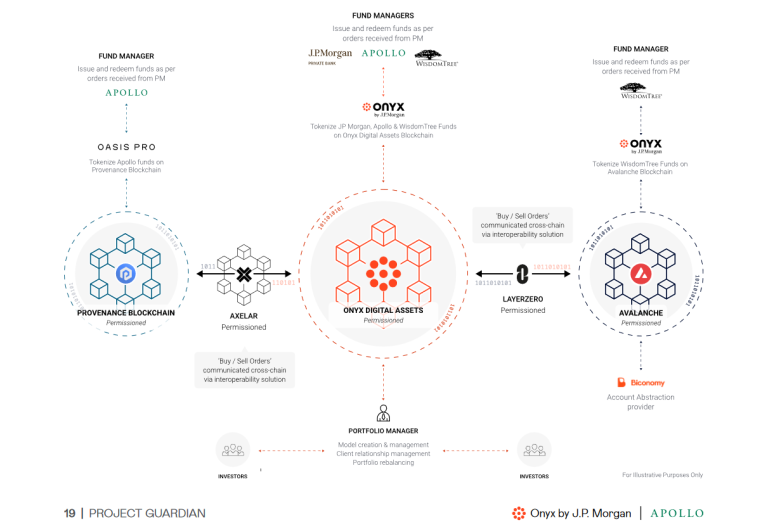 The execution architecture for JPM Coin's exploration of tokenized asset management
But the cost of this closed ecosystem is obvious. An anonymous banker involved in the JPM Coin project said, "Our on-chain US Treasury token can only circulate among cooperating institutions, its liquidity locked in a glass cabinet like an antique." The on-chain custody service of BNY Mellon is similarly trapped within high walls, although the tokenized assets it manages have exceeded $100 billion, it still cannot interoperate with DeFi protocols on Ethereum. The inertial logic of traditional finance is evident here: using control to mitigate risk, but also strangling openness in the process.
So, as the tokenization concept swept the globe and the battle for on-chain liquidity began, asset management giants like BlackRock and Goldman Sachs began a more aggressive choice: more and more tokenization practices are turning to public chains, with Ethereum becoming the preferred choice for institutional tokenization. BlackRock took the lead, launching the tokenized fund BUIDL on Ethereum: not only can it be automatically settled through smart contracts, but it can also be staked, borrowed and traded on-chain. This marks the first deep integration of traditional finance and Web3 finance, and also makes the public chain path a new focus of institutional attention.
The execution architecture for JPM Coin's exploration of tokenized asset management
But the cost of this closed ecosystem is obvious. An anonymous banker involved in the JPM Coin project said, "Our on-chain US Treasury token can only circulate among cooperating institutions, its liquidity locked in a glass cabinet like an antique." The on-chain custody service of BNY Mellon is similarly trapped within high walls, although the tokenized assets it manages have exceeded $100 billion, it still cannot interoperate with DeFi protocols on Ethereum. The inertial logic of traditional finance is evident here: using control to mitigate risk, but also strangling openness in the process.
So, as the tokenization concept swept the globe and the battle for on-chain liquidity began, asset management giants like BlackRock and Goldman Sachs began a more aggressive choice: more and more tokenization practices are turning to public chains, with Ethereum becoming the preferred choice for institutional tokenization. BlackRock took the lead, launching the tokenized fund BUIDL on Ethereum: not only can it be automatically settled through smart contracts, but it can also be staked, borrowed and traded on-chain. This marks the first deep integration of traditional finance and Web3 finance, and also makes the public chain path a new focus of institutional attention.
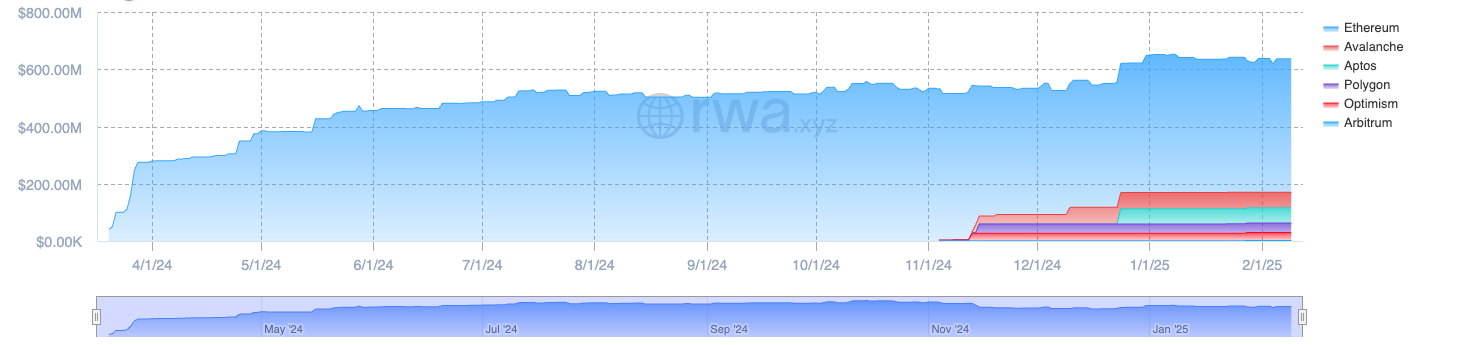 The BUIDL tokenized fund has a management scale of over $636 million
But this does not mean that Ethereum and other public chains can fully take on the demand for tokenization and other institutional-level Web3 innovations. Although Ethereum is currently the second safest public chain ecosystem after the Bitcoin network, the security required by institutions may differ greatly from what we understand as security. Just as no matter how the market touts the security of public clouds, many institutions still hope to deploy clouds locally when the budget is sufficient: technological security does not equal business and asset security.
Therefore, many institutions with sufficient technical reserves or business needs are exploring more possibilities on the basis of their previous routes, just as Ondo Finance is trying to break down the barriers between public chains and permissioned chains, exploring a hybrid architecture that is more in line with regulatory and market demands. The hybrid architecture of Ondo Chain emphasizes both the openness of public chains and the compliance of permissioned chains. Among them, the permissioned validator network is composed of large institutions such as Franklin Templeton and Wellington Management as nodes, to ensure compliance and security, but at the same time it opens up cross-chain interoperability, allowing assets to circulate freely among Ethereum, Solana and other mainstream public chains. Compared to direct deployment on Ethereum and other public chains, the emergence of Ondo Chain allows Ondo to have higher security control authority in RWA practices, while also solving liquidity problems through cross-chain interconnection.
However, whether the hybrid architecture can truly help Ondo find the best balance between efficiency improvement and compliance remains to be seen. In comparison, L2 may be the "better choice" to attract institutional participation at this stage.
The BUIDL tokenized fund has a management scale of over $636 million
But this does not mean that Ethereum and other public chains can fully take on the demand for tokenization and other institutional-level Web3 innovations. Although Ethereum is currently the second safest public chain ecosystem after the Bitcoin network, the security required by institutions may differ greatly from what we understand as security. Just as no matter how the market touts the security of public clouds, many institutions still hope to deploy clouds locally when the budget is sufficient: technological security does not equal business and asset security.
Therefore, many institutions with sufficient technical reserves or business needs are exploring more possibilities on the basis of their previous routes, just as Ondo Finance is trying to break down the barriers between public chains and permissioned chains, exploring a hybrid architecture that is more in line with regulatory and market demands. The hybrid architecture of Ondo Chain emphasizes both the openness of public chains and the compliance of permissioned chains. Among them, the permissioned validator network is composed of large institutions such as Franklin Templeton and Wellington Management as nodes, to ensure compliance and security, but at the same time it opens up cross-chain interoperability, allowing assets to circulate freely among Ethereum, Solana and other mainstream public chains. Compared to direct deployment on Ethereum and other public chains, the emergence of Ondo Chain allows Ondo to have higher security control authority in RWA practices, while also solving liquidity problems through cross-chain interconnection.
However, whether the hybrid architecture can truly help Ondo find the best balance between efficiency improvement and compliance remains to be seen. In comparison, L2 may be the "better choice" to attract institutional participation at this stage.
2. L2 to Web3, Perhaps Like DeepSeek to AI
The widespread application of any new technology is accompanied by a significant reduction in usage costs. The reason why DeepSeek attracted global attention in 2025 is that it has overturned the market's cost perception of AI, making people realize that high-performance AI does not necessarily have to rely on expensive computing resources. Take DeepSeek R1 as an example, the price per million tokens of this model has dropped from $60 for ChatGPT o1 to $2.19, a nearly 30-fold price difference, which is changing the trend of AI applications and allowing more companies to experiment and innovate with AI more freely without having to worry too much about budget issues.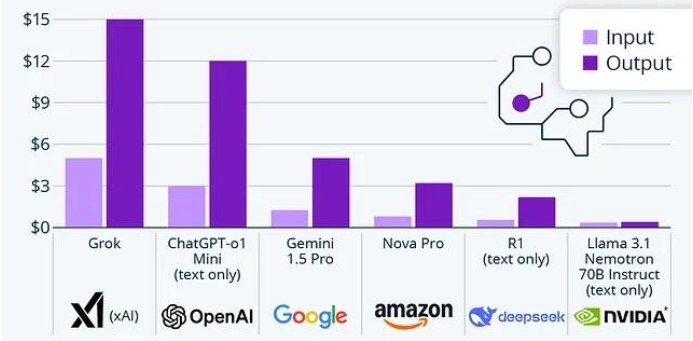 The significant cost advantage of DeepSeek-R1
Source: DoccBotHere is the English translation, with the content within <> tags preserved without translation:
The significant cost advantage of DeepSeek-R1
Source: DoccBotHere is the English translation, with the content within <> tags preserved without translation:
For Web3, L2 may be like DeepSeek for AI. Although not as direct in its short-term impact as DeepSeek, after the Cannes upgrade, L2 has indeed reduced on-chain costs: the average cost of many L2 networks, including OP Mainnet, Base, Arbitrum, and Starknet, has decreased by more than 97% in the past half year. The reduction in transaction costs directly improves the user experience, allowing more users to use L2 more frequently. According to OKG Research analysis, currently over 90% of Ethereum-related transaction activity occurs on L2 networks.
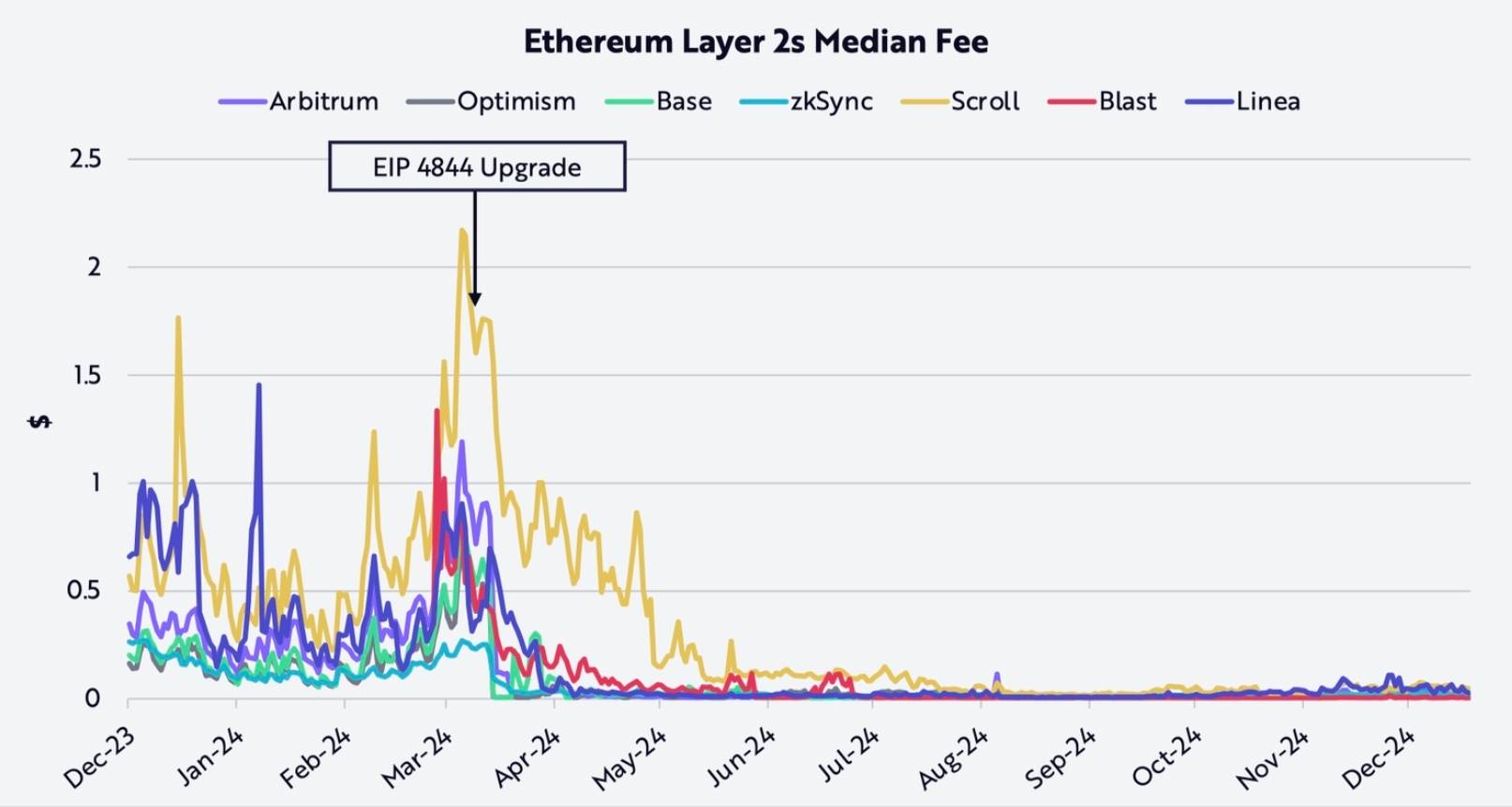
The Ethereum EIP-4844 upgrade significantly reduces the cost of Layer2 transactions
Source: ARK Investment Management LLC
Lower costs also reduce the technical threshold of blockchain technology, allowing more on-chain applications and services to migrate to L2 networks. Payment institutions like Visa and Stripe are launching a "payment lightning war" through L2: leveraging the high throughput networks of Polygon and Arbitrum, Visa's stablecoin payment channel has reduced cross-border transaction costs to 1/10 of traditional solutions, with a daily processing volume of over 500,000 transactions; Stripe is using L2 to build crypto deposit and withdrawal channels, allowing users to not even perceive the existence of the underlying public chain. "We don't care whether the chain is decentralized or not, we only care about whether we can seamlessly accept cryptocurrencies for 1 million merchants," said Stripe's Web3 executive.
This may also reveal the most realistic calculation of traditional institutions: when the security risks of public chains still exist, and the open barriers of consortium chains are difficult to break, Layer2 becomes a seemingly compromised but most cost-effective choice - it can obtain the efficiency and technical dividends of the blockchain network at a lower cost, without going beyond the controllable range. In addition, the modular rollup infrastructure has begun to show results, and platforms like OP Stack have greatly reduced the technical threshold for deploying L2, making one-click chain deployment a reality, and they can operate healthily without relying on the financial incentives of the token system, and have significant advantages over public chains in terms of compliance.
Many traditional institutions are deploying Web3 through L2. Coinbase's L2 chain Base, with its outstanding performance in the Meme and AI Agent craze, has become the "hot cake" in the current Web3 field, and in the future it may also become an important hub for tokenized asset issuance due to the traffic brought by Coinbase stock tokenization; traditional technology and financial institutions such as Sony and Deutsche Bank are also accelerating their deployment of L2, in order to occupy a place in the future wave of token innovation. For these institutions, if they want to choose the Ethereum ecosystem as the issuance market for RWA assets, issuing their own controllable L2 may be a wiser choice.
When the cost of innovation is greatly reduced, and technology applications become simple and efficient, we may see more institutions and users participate in Web3 innovation through L2.
Source: Ondo Finance
Conclusion
Today's "on-chain" race on Wall Street is no longer a simple competition of technological superiority. JPMorgan's private chain, BlackRock's public chain ETF, Visa's L2 payment exploration, and even Ondo Chain's hybrid experiment - each technological route is trying to define the power distribution rules of future finance.
But history is always full of irony: while traditional institutions are busy replicating the old world order on the chain, DeFi protocols have been quietly devouring their territory. The average daily trading volume of Tesla stock tokens on Uniswap has exceeded $100 million, and Aave's RWA lending pool is attracting more and more institutions to "violate the rules"... It may not be long before this battle of technological routes evolves into a more naked conflict: whose chain is it, and who is defining Wall Street?