Author: Web3 Farmer Frank
In the next 10 years, will the RWA narrative gradually enter the "Kingdom of Freedom"?
From the data, the current total market size of RWA is over $15 billion, and BlackRock predicts that the potential growth space in the next 7 years may be over 700 times, which is an incremental cake worth at least hundreds of billions of dollars. The only question is, who will take the lead and become the "singularity" that ignites this epic transformation.
Over the past decade, the entire crypto industry has witnessed every key node in the transition from the separation to the integration of traditional finance and DeFi, and has seen Wall Street and mainstream TradFi players successively write "tokenization" and other keywords into their financial reports and make a big bet on RWA. We are also increasingly aware of a powerful trend: the ultimate battlefield of RWA is not at the protocol layer, but at the infrastructure layer.
Objectively speaking, RWA needs not only to "move" assets onto the chain, but also to unlock their true value potential through liquidity reconstruction. This is why RWAfi will be the ultimate battlefield of the RWA narrative, and how to redefine the future of Crypto+RWA through the "superlinear growth function".

Why do we need an "RWA Hub"?
To truly understand and unleash the potential of RWAfi, we must first clarify a concept: the "RWA Hub".
As the core engine of the RWAfi asset liquidity center proposed and actively built by Plume, the "RWA Hub" is not just a technical solution, but the core of an ecosystem, which determines whether RWA assets and applications can truly achieve exponential growth.
As is well known, when investment banks on Wall Street began discussing the tokenization of RWA, they faced three major obstacles: high compliance thresholds, fragmented liquidity, and lack of developer tools. This also explains why a large number of RWA projects go dormant as soon as they are deployed on the chain, as moving RWA to the chain is actually just the first step in tokenization, far from enough to unleash its true potential:
To further realize the release of on-chain value, we need a more efficient technical underlying architecture, an open infrastructure tool set, and a sound ecosystem collaboration. This means that the industry needs a comprehensive service framework around the full life cycle of RWA assets, especially to safely and low-threshold introduce RWA assets into diverse on-chain DeFi scenarios.
Only in this way can the stock dividends of traditional assets be fully converted into incremental value on the chain. For example, a real estate token on the chain should not just be a static NFT, but an active cell in DeFi, such as rental income automatically distributed through smart contracts, collateralized lending without the need for intermediaries, and instantaneous transactions of fragmented property rights.
However, this "asset empowerment" requires not only protocols, but a whole set of public chain-level architectures that support liquidity and composability.
It is precisely for this reason that Plume, with the "RWA Hub" as the starting point, has launched a new approach of "grabbing with both hands" for the on-chain deployment of RWA and mainstream Web2 institutions - by deploying interoperability solutions SkyLink in 18 blockchain networks including Solana, Movement, Injective, and Omni Network, to provide them with permissionless access to institutional-grade RWA yields.
In this process, Plume acts as a bridge connecting Web2 and Web3, not only bringing new users and capital inflows to Web3, but also opening up a whole new growth logic: partnering with financial giants with massive user bases and traditional capital, to directly help their tens of billions of existing Web2 users and traditional capital to become incremental users and "New Money" for Web3.
Interestingly, Ondo has also recently announced that it will start to layout an RWA public chain, which in another dimension validates the foresight of Plume's RWAfi public chain. However, compared to Ondo's "Wall Street 2.0" route, I believe everyone will also find that Plume is more focused on the "Robinhood 2.0" concept - not just the influx of institutional capital, but gradually guiding and attracting a wider range of institutions and retail users to join the new financial ecosystem through the activation of underlying users.
According to publicly disclosed information, Plume has also collaborated with Elixir to launch a new institutional-grade RWA vault on Nest, to connect the RWA assets of BlackRock (BUIDL) and Hamilton Lane (SCOPE), and strive to expand from the "RWAfi infrastructure" to the protocol layer where institutional assets are deposited on-chain:
The current $28 million institutional vault that has been launched is just an experimental beginning - BlackRock's BUIDL scale has already exceeded $460 million, and the private equity assets managed by Hamilton Lane are even as high as $119 billion. Plume, through the Elixir stablecoin gateway, unlocks these assets into on-chain liquidity in the form of deUSD, which is essentially opening up a gradual on-chain path for trillions of dollars of RWA assets without disrupting the existing compliance framework.
In this context, users holding certificates like BUIDL can not only participate in the staking and interest earning of the Plume ecosystem, but also use them as collateral to mint stablecoins in DeFi protocols, realizing a "deposit-activate-recreate" cycle, which is expected to drive the Plume RWAfi vault to evolve from a custody tool to an on-chain liquidity hub.
Essentially, this provides an excellent buffer zone for the on-chain migration of traditional financial giants, and its long-term value will be released exponentially with the "trickle effect" of institutional assets going on-chain, which is expected to make Plume a testing ground for trillions of dollars of RWA assets on-chain. So this is not only a technical upgrade, but also a shift in financial discourse power:
When the assets of Wall Street giants are given new life on the chain through Plume, the boundary between traditional and crypto will be completely dissolved, and the ultimate significance of Plume's RWAfi goes far beyond the current narrative framework:
It is not only the liquidity infrastructure for on-chain DeFi players and RWA tokenization, but also a core channel that can attract the influx of new Web3 users and capital, extending the value of the RWAfi track to the entire Web3 world, and enabling the on-chain ecosystem to undergo qualitative changes in both capital and traffic.
From a modular toolbox to community resonance: building the "superlinear growth function" of RWA
From the technical framework perspective, Plume has built a "plug-and-play" modular arsenal for developers - by integrating multiple modular key tools, it has provided developers with a complete on-chain solution for RWA assets:
- Arc - Tokenization Engine: Arc simplifies the tokenization process by integrating compliance workflows and reducing barriers for asset issuers, providing an effective path to bring RWA onto the chain;
- Passport - Smart Wallet: Passport allows users to directly store contract code in their externally owned accounts (EOAs), supporting RWAFI composability, yield management and advanced account abstraction functions;
- Nexus - Data Superhighway: Nexus uses cutting-edge technologies like zkTLS to securely integrate real-world data into the blockchain, not only enhancing the security and transparency of on-chain assets, but also unlocking new opportunity scenarios.
This is essentially embedding "compliance as a service" into the public chain DNA - developers only need to focus on business innovation, while compliance, data, and liquidity are automatically handled by the Plume underlying, which is the "developer-friendly" philosophy that has quickly attracted over 180 ecosystem projects to join, covering a wide range of scenarios from fund tokenization to RWA asset trading.
In addition, many may have noticed that after the recent TGE, the initial circulating supply of the PLUME token was only 20%, mainly in the form of community airdrops and early supporter allocations, while the remaining tokens will be gradually unlocked over at least the next 5 years.
This design is on the one hand for the long-term safety of market participants, and on the other hand, it also meets the strategic needs of subsequently building a on-chain RWAfi ecosystem. The reason is simple: through the gradual unlocking of tokens, token distribution is no longer a one-time reward, but a continuous ecological incentive tool, which can provide long-term incentives for ecosystem participants through staking, liquidity rewards and governance rights.
This is not only to incentivize existing users, but also an invitation to more potential users and developers, attracting more high-quality projects and users to join, helping to build a long-term RWAfi prosperous ecosystem.
Some people interpret this as a "airdrop as a co-construction ticket" model, turning users into co-builders of the ecosystem rather than passers-by, breaking away from the traditional path of "mainnet launch → ecosystem subsidy → token issuance", and transforming the TGE into an accelerator for ecosystem construction. 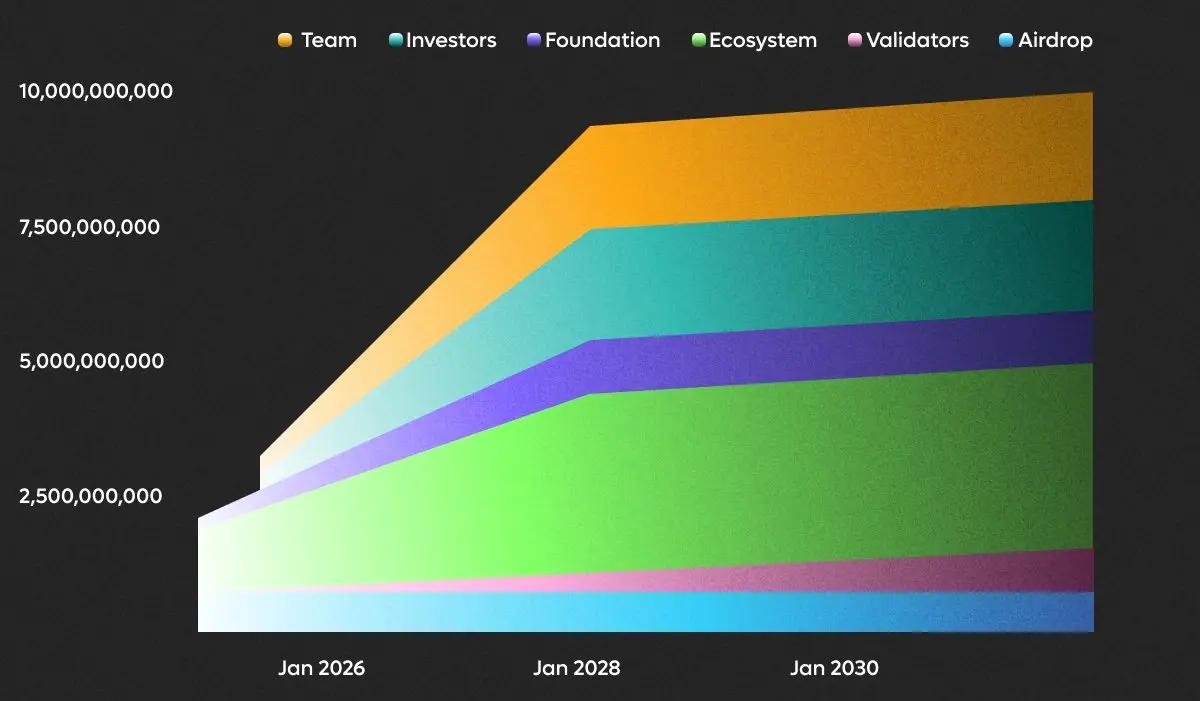 A public chain is not a pile of technology, but the crystallization of community consensus. Plume has cultivated more than 180 ecosystem projects and over 3.75 million real users on the testnet in the past year, generating hundreds of millions of transactions, forming an insurmountable moat.
To some extent, Plume has already strategically positioned the community as its core competitiveness, building a decentralized ecosystem - unlike Ondo's traditional finance background and institution-led construction path, Plume relies on the power of the community and user demand to drive the market, committed to breaking down the barriers between traditional finance and DeFi, so that this market not only depends on the capital inflow of large institutions, but has established a self-growing network effect.
So the more than 180 ecosystem projects and over 3.75 million real testnet users have already proven that its community-driven model has lasting vitality. In fact, relying solely on the inflow of institutional capital cannot provide long-term momentum for on-chain RWAs, as this is still a relatively closed model.
From this perspective, the ultimate RWAfi belongs to those architects who understand both Wall Street rules and the spirit of the crypto community, and the growth of RWAfi will lead us to witness a historic turning point: traditional giants like BlackRock will no longer be bystanders, but will actively participate in the on-chain ecosystem construction through Plume, and the community users and ecosystem previously accumulated by Plume will build an RWA protocol layer and a symbiotic network that other latecomers can never replicate.
In this model, the flow of assets and the formation of the market are driven by the "community" rather than pure institutional capital. This market mechanism based on community and user demand endows Plume with flexibility and sustainability that is different from traditional finance, enabling it to build a truly decentralized and vibrant financial ecosystem.
It is precisely for this reason that Plume is not just a chain to meet the needs of institutions, but a platform committed to breaking the old rules and empowering every individual with participation and decision-making rights. The future on-chain RWAs will no longer be dominated by the "seller", but a two-way flowing and mutually promoting market.
Final Simulation: Where is the Valuation Anchor of RWAfi and Plume?
Some people often discuss where the valuation anchor of RWAfi and Plume is, but the answer may be unique: when $100 trillion-level traditional assets begin to migrate on-chain, the existing valuation framework will be completely invalidated.
From the data dimension alone, there are some simple control groups for reference:
- The $119 billion in private equity assets managed by Hamilton Lane alone, if 5% are on-chain through Plume, the on-chain value will exceed the actual TVL of all RWAfi projects;
- If BlackRock's forecast of a $100 trillion RWA market by 2030 comes true, even if Plume only occupies 0.1% of the gateway share, its valuation will reach the $10 billion level, and if it can reach 1%, Plume's valuation will even directly point to the hundreds of billions of dollars;
This is equivalent to completely opening up the valuation ceiling for Plume as a core infrastructure hub, especially with the potential to directly access the $100 trillion-level traditional financial assets. Considering the potential market size of the RWAfi track, as the demand for traditional asset tokenization increases, the ecosystem value of RWAfi will be further released.
More importantly, we are witnessing a historic turning point: BlackRock's BUIDL fund is being converted into on-chain stablecoins through Plume's NEST vault, and traditional TradFi giants are beginning to evaluate Plume's compliance framework, this resonance between institutions and the community is building a "super-linear growth function" for RWAfi and Plume.
So Plume's sharpest edge is not in the short-term price, but in the technical and first-mover advantages for the subsequent construction of the RWAfi ecosystem - Plume's modular tools have lowered the development threshold, attracting a large number of developers and institutional users.
Especially as the RWAfi ecosystem continues to expand, each new project will bring synergistic benefits to the overall value network of Plume.
The wind rises from the end of the green reed, and under the drive of the RWAfi narrative, the most exciting growth story of RWA is just beginning.
As more and more RWA players follow in Plume's footsteps, it will not just be a simple zero-sum competition, but a signal of the rise of the RWA ecosystem, after all, the world of RWAfi does not need lone heroes, but an irreplaceable hub - a core engine that can connect traditional finance and on-chain ecosystems, and carry the flow of trillions of dollars in assets.