Author: Alan Draper
Compiled by: Bai Hua Blockchain
The financial world has remained relatively stable until the emergence of Decentralized Finance (DeFi), which has brought about significant changes. DeFi has redefined finance through decentralized lending and ownership, and has the potential to change various aspects of everyday life.
Today, we will explore leading DeFi platforms such as Aave, Lido, Compound, and Uniswap, analyzing their service offerings, the basic principles of DeFi, security, and how to choose the DeFi platform most suitable for your needs.
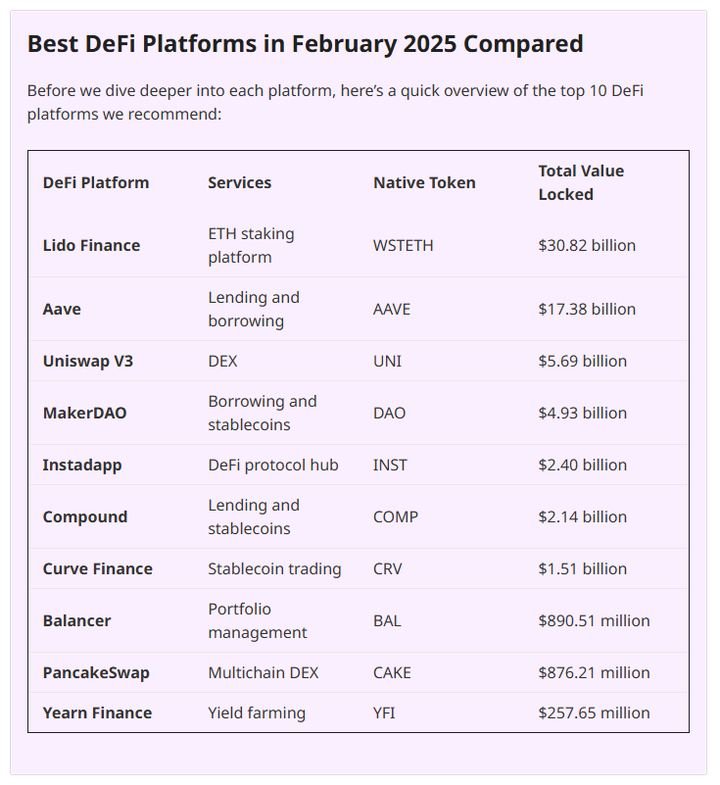
Best DeFi Platform Review - In-Depth Understanding. In this section, we will briefly review each DeFi platform to help you understand their services and advantages. Our goal is to allow you to better judge whether it is suitable for you after understanding the characteristics of each platform.
1. Lido Finance - Best DeFi Staking Platform, Connecting Over 100 Applications
Lido Finance is a decentralized finance platform focused on staking, operated by a mission-driven Decentralized Autonomous Organization (DAO), with all decisions made by public voting of LDO (the platform's native Token) holders.
The platform is known for its high security and cutting-edge technology applications. Lido focuses on Ethereum staking, specifically stETH (Lido's version of Ethereum), a Token used to pay rewards to users who stake ETH. You can unstake any stETH at any time and redeem it 1:1 for ETH.
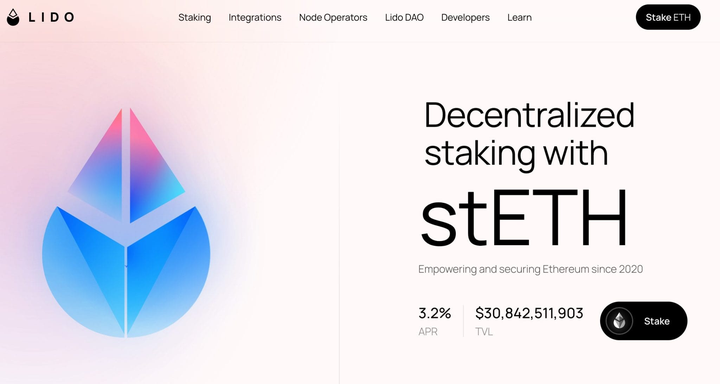
Lido also now allows users to stake MATIC through stMATIC in the same system. Staking ETH or MATIC does not require locking up assets, and the entire service is completely non-custodial.
If you want to hold stETH, note that Lido is connected to over 100 applications, where you can use it for lending, as collateral, and more. Recently, Lido is expanding its service scope beyond ETH staking, potentially including other assets, further enriching its staking ecosystem to attract more users.
DeFi Services: Staking Total Value Locked: $30.82 billion
2. Aave - Best DeFi Lending Platform, One of the Longest Operating Histories
Aave is one of the leading players in the DeFi space, providing cryptocurrency lending services. It also allows you to earn passive income by staking the AAVE native Token (4.60% APY), GHO (5.30% APY), and ABPT (11.70% APY).
In terms of lending services, Aave supports around 30 cryptocurrencies, including ETH, WBTC, wstETH, USDT, USDC, AAVE, DAI, and LINK.
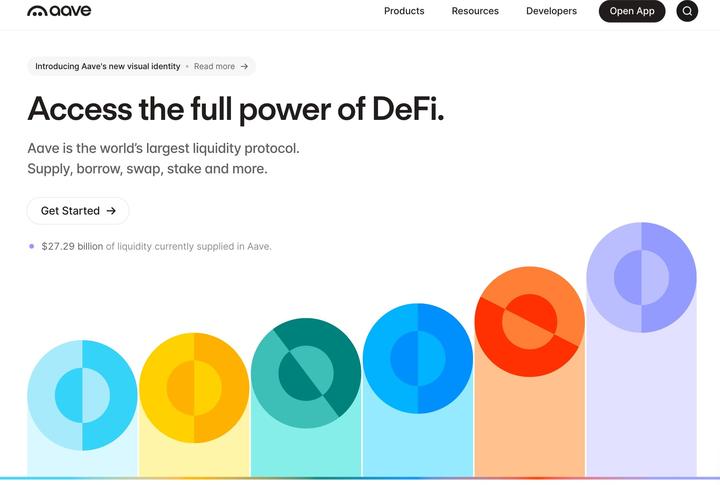
Additionally, Aave is known for its innovativeness in the DeFi space. Since its launch in 2017, it has achieved significant expansion and is one of the longest-running DeFi platforms. Although Aave's Total Value Locked (TVL) is not the highest, its trading volume is the largest in the entire DeFi space.
Aave is fully non-custodial, open-source, and community-governed. Furthermore, borrowers and lenders can independently set and execute loan terms through smart contracts. By the end of 2024, Aave will launch Aave V3 on the zkSync Era mainnet, improving transaction efficiency.
If you want to learn more, you can read our Aave user guide.
DeFi Services: Lending, Staking Total Value Locked: $17.38 billion
3. Uniswap - Largest Decentralized Exchange and Best DeFi Trading Platform
Uniswap is currently the largest decentralized exchange (DEX) in the market and the top DeFi trading platform, with over 1,500 trading pairs.
More importantly, Uniswap's powerful DeFi platform offers multiple services, including Token swapping, earning yield by providing liquidity, and building dApps using the Uniswap protocol. It is also integrated with over 300 applications, such as wallets, dApps, and aggregators.
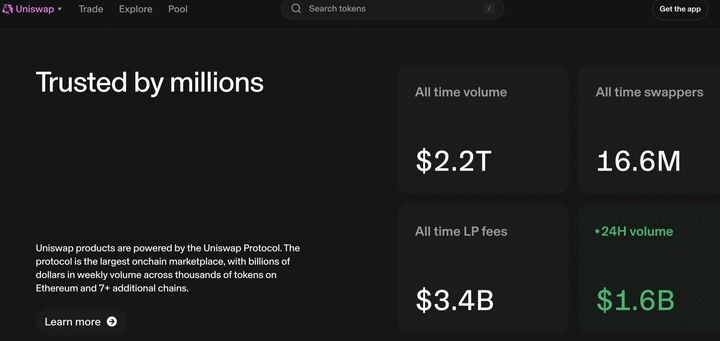
While Uniswap may not be the largest DeFi platform overall, it is unrivaled in the decentralized exchange (DEX) space. Users can trade on a fully transparent, decentralized platform without any intermediaries, with transactions completed through smart contracts. Recently, the platform has focused on improving liquidity provision and user experience, particularly through its V3 model, which allows the use of concentrated liquidity pools.
For a DEX, learning how to trade on Uniswap is relatively simple, as the website has a user-friendly and concise design. Uniswap is known for constantly introducing new Tokens, so if you're interested in trading the latest cryptocurrencies, be sure to check out the popular new listings on Uniswap to diversify your portfolio.
DeFi Services: Trading and Lending Total Value Locked: $5.69 billion
4. MakerDAO - Lending Platform Providing the DAI Stablecoin
MakerDAO is a large, Ethereum-based decentralized collateralized debt position (CDP) platform. In other words, it allows users to borrow cryptocurrencies. Users can initiate a CDP by using ETH or other Ethereum-based assets as collateral.
MakerDAO's primary goal is to ensure its stablecoin DAI - one of the most popular and widely used stablecoins in the world - maintains its peg to the US dollar.
MKR is Maker's native Token, used to facilitate user interest payments. Whenever a CDP is settled on the platform, the paid DAI and MKR are burned. The community actively discusses governance changes to improve risk management and collateral strategies.
In addition to its secure and transparent operations, MakerDAO makes this list due to its close association with DAI and its long-term stability in the market. It has withstood all market fluctuations.
DeFi Services: Lending Total Value Locked: $4.93 billion
5. Instadapp - Easily Access DeFi Protocols
Instadapp is an Ethereum-based decentralized finance application aimed at providing users with a convenient way to interact with other DeFi protocols.
Its DeFi Smart Layer allows users to utilize various DeFi platforms in one place. In other words, through Instadapp, you don't need to download multiple standalone applications for staking, lending, or any other activity.
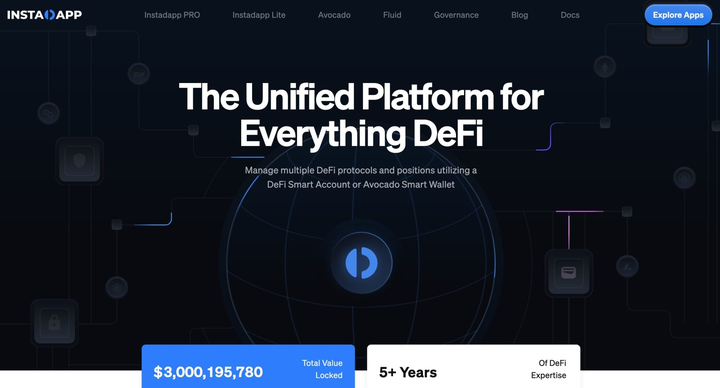
Instadapp offers a comprehensive suite of DeFi tools, including Instadapp Lite and Instadapp Pro, as well as the Web3 Avocado smart wallet and Fluid lending platform. Although it may sound less intuitive, Instadapp Pro is actually completely free.
Despite this, the platform has yet to attract a wide DeFi user base, but it is working to improve the user interface and functionalities to simplify multi-protocol interactions. Its lower popularity may be the reason for its relatively low TVL.
DeFi Services: Lending, Staking Total Value Locked: $2.85 billion
6. Compound - Lending Platform with Strong Stablecoin Support
Compound.finance is a decentralized cryptocurrency lending market. According to the latest data, it covers 16 markets, including cryptocurrencies such as ETH, USDT, USDC, OP, and MATIC.
With the addition of USDT and USDC, the platform clearly has excellent support for lending stablecoins.
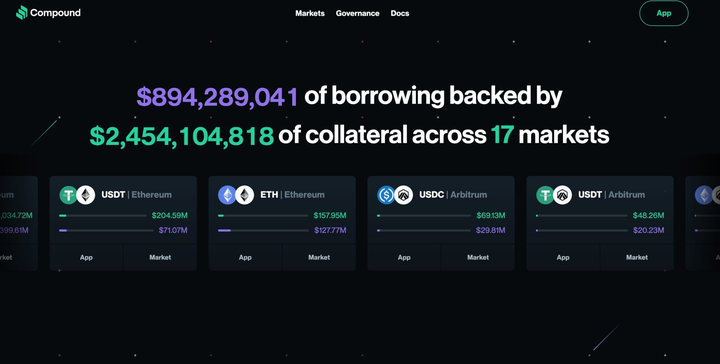
Compound is Ethereum-based and fully supports borrowing or lending against collateral. Interest rates are generally very favorable but still subject to supply and demand dynamics. While the platform's scale may not be as large as Curve or Maker, it provides considerable value to most cryptocurrency users.
Compound has a native Token (COMP) that users can hold and participate in the governance of the decentralized protocol. Proposal changes are published on the Compound website, where users can vote.
DeFi Services: Lending Total Value Locked: $2.45 billion
7. Curve Finance - A DEX Focused on Stablecoin Trading
Curve Finance is a decentralized finance platform that provides trading, lending, and borrowing services. This DEX has quickly become one of the leaders in the DeFi space, focusing on stablecoin trading, which sets it apart from the competition. If you are looking for low-cost and low-slippage trading, Curve is an ideal choice.
The Curve platform uses an Automated Market Maker (AMM) to help maintain the peg of stablecoins. This allows users to trade with almost no impact on the price. Curve maintains market liquidity by automatically buying and selling digital assets and profiting from the bid-ask spread.
Curve currently has over $1.78 billion in total deposits, with daily trading volumes typically exceeding $100 million, still firmly leading the stablecoin trading space and with a significant TVL. For a platform launched only in 2020, this is no small feat.
Another unique selling point of this DeFi platform is its outstanding website design, which gives an old-school feel but with advanced Web3 functionality.
DeFi Services: Lending, Trading
Total Value Locked: $1.84 billion
8. Balancer - A DeFi and DEX Platform Providing Automated Portfolio Management
Balancer is a suite of Automated Market Maker (AMM) products, a type of decentralized exchange (DEX) that uses algorithms to facilitate Token trading. Unlike trading with other traders, you can handle all trades through the AMM.
Additionally, Balancer allows users to earn passive income through the platform's liquidity pools. Currently, Balancer has over 240,000 liquidity providers, a number that, while not massive, is still growing rapidly for this DeFi platform.
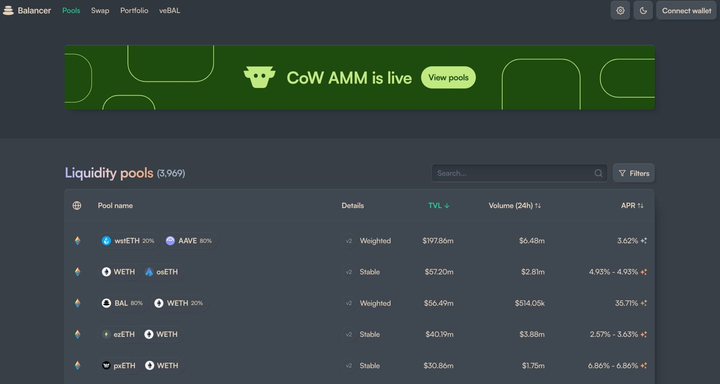
Balancer creates and manages various liquidity pools, each composed of multiple Tokens, enabling portfolio management. Recently, the platform has focused on enhancing its Automated Market Maker (AMM) capabilities and expanding liquidity incentives.
Similar to other DeFi platforms, Balancer also allows users to purchase and hold the native Token BAL to participate in the protocol's governance.
DeFi Services: Automated Portfolio Management, Trading, Yield Farming
Total Value Locked: $890.51 million
9. PancakeSwap - An All-in-One DEX Providing DeFi Services Including Staking
PancakeSwap is one of the most unique DEXs you'll encounter, standing out with its distinctive design and vibrant colors. But don't let its quirky appearance distract you - it is still one of the leading global decentralized trading platforms.
PancakeSwap is an all-in-one DEX, providing services including trading, staking, yield farming, and even a game marketplace launched in late 2023.
PancakeSwap's popularity is attributed to its operation on the BNB Chain, which enables fast confirmation times and low user fees.
The earning potential is rich and diverse - you can trade, stake the platform's native Token CAKE for an APY as high as 25.63%, join liquidity pools and farming pools, and more, including gaming options through the game marketplace and NFTs.
While not a long-standing platform, PancakeSwap has already established a dominant position in the BSC DEX market. Furthermore, its connection to the BNB Chain makes it particularly ideal for BNB users.
DeFi Services: Trading, Yield Farming, Staking
Total Value Locked: $876.21 million
10. Yearn Finance - A Yield Farming Platform with Automated Strategies
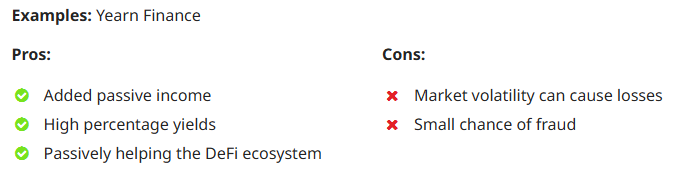
Yearn Finance is a suite of products focused on helping individuals and decentralized autonomous organizations (DAOs) earn yield from digital assets. This yield aggregator aims to simplify yield farming and help you optimize returns.
By leveraging the many options provided by Yearn, you can maximize interest rates. Additionally, you can participate in the platform's development and network governance by holding the native Token YFI.
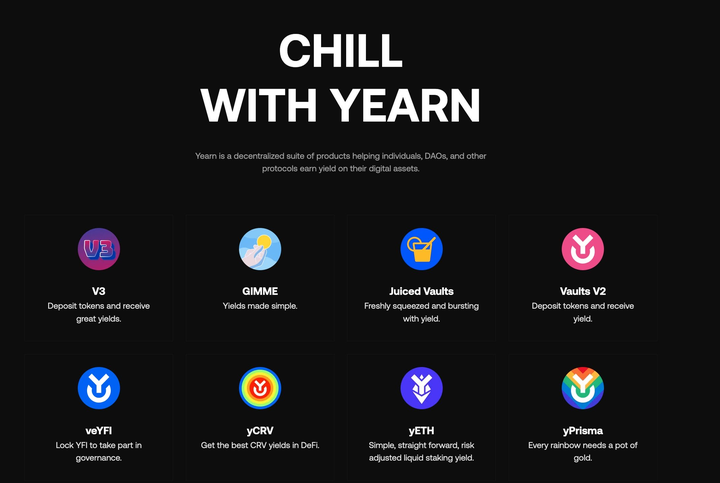
The protocol can automatically adjust your assets and shift them between various high-yield options to provide you with the best asset returns. In other words, you don't need to do much portfolio management, as the platform will handle most of the work. Furthermore, the development team is working to create new vaults and strategies to optimize user yield generation.
DeFi Services: Yield Aggregator
Total Value Locked: $221.97 million
11. What are DeFi Platforms?
DeFi platforms utilize blockchain technology and cryptocurrencies to provide financial services. While this definition is broad, DeFi itself is comprehensive, effectively covering various aspects of decentralized finance.
DeFi platforms are typically decentralized cryptocurrency exchange platforms, liquidity provision platforms, lending platforms, yield farming applications, prediction markets, or NFT marketplaces.
A key premise of DeFi platforms is peer-to-peer financial transactions. They typically aim to provide:
Wider accessibility
High interest rates
Low fees
Strong security
Near or complete transparency
Autonomy from centralized institutions
While DeFi has many advantages, it is not without its drawbacks. The DeFi ecosystem remains unregulated, allowing some bad actors to enter the market. Additionally, programming vulnerabilities in DeFi applications can lead to hacks and scams.
DeFi platforms are relatively new, but their popularity has been steadily increasing. In recent years, the number of DeFi users has grown consistently. Research by Statista shows that the market is expected to have around 22.09 million users by 2028, a massive leap from the 7.5 million users at the end of 2021.
12. Types of DeFi Platforms
As mentioned above, DeFi platforms come in various forms. We'll explain the most common types we recommend.
1) Decentralized Exchange (DEXs)
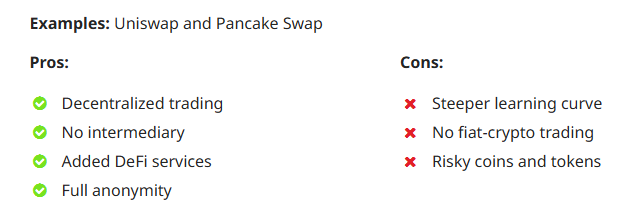
Decentralized exchanges are peer-to-peer cryptocurrency trading markets. Unlike centralized exchange platforms, which act as intermediaries, DEXs merely facilitate the exchange between traders, who independently conduct the trades and can freely determine the terms. The entire process is typically facilitated through smart contracts.
DEXs facilitate cryptocurrency trading, so they lack the fiat currency purchase options that centralized exchange platforms offer, nor can they convert crypto assets to cash. To use a DEX, you need a crypto wallet containing digital assets.
2) Lending Platforms
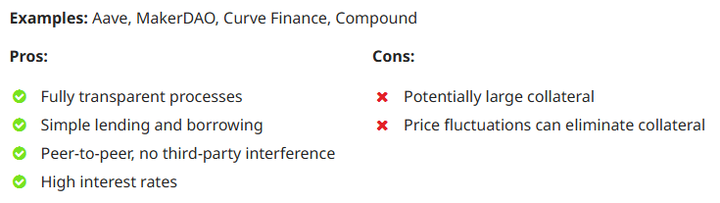
As the name suggests, these platforms allow users to lend cryptocurrencies. Those who want to lend out their crypto assets can deposit them on the platform and earn interest by letting others borrow them. Borrowers, in turn, need to provide collateral and pay a certain interest rate to borrow the cryptocurrencies.
In a sense, this system is similar to banking, but it's a completely decentralized, peer-to-peer model. And the platforms have no oversight, with everything handled by smart contracts, ensuring security and transparency.
3) Liquidity Mining Platforms
These platforms allow cryptocurrency holders to profit from holding digital assets through liquidity mining. They enable users to lend their crypto assets to various decentralized applications (dApps) to provide liquidity and earn corresponding rewards. These rewards are typically expressed as Annual Percentage Rates (APRs), based on the interest rates paid by borrowers.
Liquidity mining is key to the realization of decentralized finance (DeFi). Unlike staking, liquidity mining involves earning rewards by lending assets, rather than participating in network governance. Many decentralized exchanges (DEXs) offer liquidity mining services, but there are also dedicated liquidity aggregation platforms.
4) Stablecoins and Synthetic Assets
Stablecoins and synthetic assets are services of decentralized finance (DeFi) platforms, not the platforms themselves. Stablecoins play a crucial role in DeFi, as they are widely used in decentralized exchange (DEX) platforms, lending platforms, and liquidity mining platforms. In this guide, you have already learned about MakerDAO - a platform focused on stablecoin trading.
Synthetic assets, on the other hand, are crypto derivatives whose value is derived from the value of other assets. Top DeFi platforms offer synthetic products like options, swaps, and futures. This allows investors to gain exposure to assets, configurable risk, and cash flow models from these products.

5) Asset Management Platforms
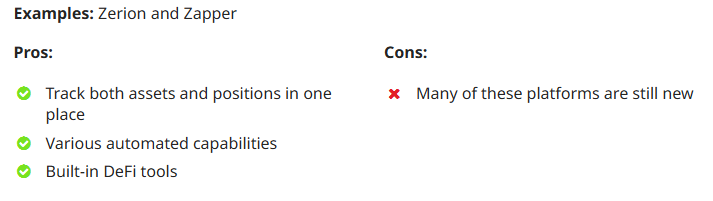
The DeFi landscape has become increasingly diversified, and traditional Web3 wallets are no longer effective in tracking various digital assets, whether Tokens, cryptocurrencies, Non-Fungible Tokens (NFTs), or DeFi positions. This is where DeFi asset management platforms like Yearn Finance, Zerion, and Zapper come in handy.
These platforms have multi-chain compatibility, can detect DeFi positions beyond just the assets in your crypto wallet, and most of their features are automated. Using these platforms, you can track all your assets and positions through a single dashboard.
6) How to Choose a DeFi Platform - Our Criteria
Selecting the right DeFi platform, whether it's a DeFi staking platform or any other type, requires careful consideration of some important criteria. Let's take a look at these criteria.
Clarify Your Objectives First, determine your objectives on the DeFi platform (e.g., the amount you hope to earn through the platform). Then, evaluate whether the platform can meet these objectives. In this regard, you should check the platform's Annual Percentage Yields (APYs).
Assess Security Measures As the DeFi space lacks regulation, checking the security measures provided by the platform is crucial. If the platform's security measures do not meet current standards, you may face potential risks of cyber attacks. Look for platforms that offer features like multi-signature wallets, end-to-end encryption, and regular audits.
Check Platform Reputation In addition to security, you need to look into the platform's reputation. If the platform itself is not trustworthy, the security measures will be of little use. The DeFi space is rife with scams due to the lack of regulation, so it is essential to choose a verified, secure, and trustworthy platform.
Explore Platform Features and Offerings After ensuring the platform's security, you should focus on the most important aspect - the platform's features. If you are looking for yield farming, the platform should offer a diverse range of liquidity pools. If you want to earn through staking, the platform should provide good APYs and a variety of Token options. Additionally, the platform needs to be interoperable with other DeFi protocols, as you may want to use other decentralized applications (dApps) and DeFi platforms.
7) Are DeFi Platforms Safe for Beginners?
If you are using a reputable platform with excellent security measures, DeFi can be safe for both beginners and advanced users.
However, beginners need to understand what they are participating in and how DeFi services operate. The DeFi space can be highly risky for new investors, primarily due to the high volatility of cryptocurrencies and the associated uncertainty of related products.
Profit opportunities from options like staking and lending in DeFi can be very high. However, if you make some wrong decisions or invest in underperforming Tokens or failed projects, you could also lose your entire investment.
The most important thing is to maintain control over your private keys throughout the process. Finally, avoid letting the crowd's opinion sway your decision-making.
8) DeFi vs. CeFi Platforms: Which One is Better?
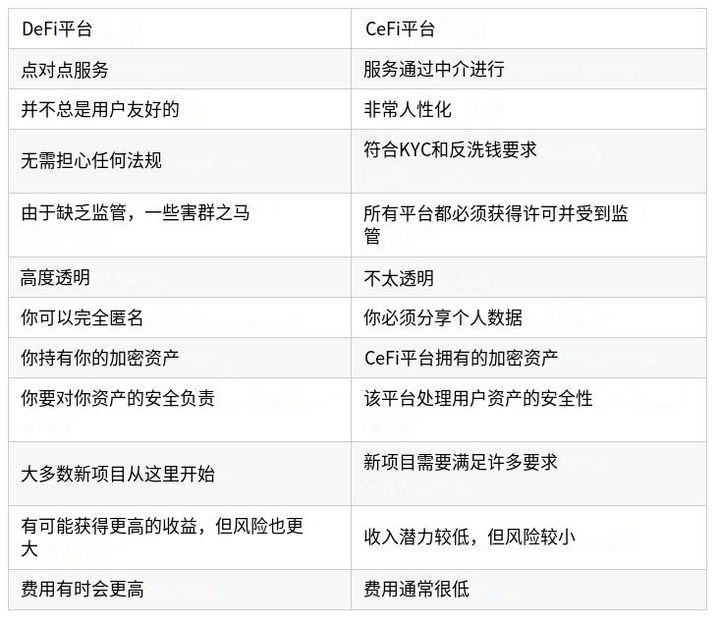
As you might have guessed, decentralized finance (DeFi) and centralized finance (CeFi) are two opposing concepts. DeFi relies on decentralized networks, focuses on innovative and fully transparent financial services, and utilizes smart contracts for operations, while CeFi leverages traditional intermediaries, with platforms in this space following all regulations and prioritizing user experience.
To better understand the differences between the two and decide which financial platform is better, let's look at the pros and cons of each:
13. Conclusion
The DeFi space is vibrant and continuously evolving, which is why you will encounter a variety of platforms offering one or more DeFi products.
Given the vastness of the market, finding the most suitable platform for your needs can be challenging. However, by following the steps in this guide and considering our recommendations, the search process should become more manageable.