Author: kiki,Silicon Research Lab

Image source: Generated by Boundless AI
The much-anticipated Apple "China AI partner" has finally fallen to Alibaba.
According to the latest report from The Information, Apple has recently partnered with Alibaba Group to bring Apple's "Apple Intelligence" to China. The report indicates that the two parties have already submitted their jointly developed AI functions to the Chinese cyberspace regulatory authorities for approval.
The current relevant policies and regulations on the filing and approval of AI products in China include the "Interim Measures for the Administration of Generative AI Services", the "Regulations on the Management of Algorithm Recommendation for Internet Information Services", and the "Regulations on the Management of Deep Synthesis of Internet Information Services". A person familiar with the filing and approval of large models told the "Silicon Research Lab" that before the AI products and services are launched, the company mainly needs to file the algorithm and pass the security assessment. From the approval process, it needs to go through the local preliminary review and the central final review.
If this progress is followed, Apple and Alibaba's cooperation has already achieved a critical landing. In addition, according to Cook's previous disclosure in a conference call, "AI is expected to land in China in April this year", which also means that the timeline for the AI-powered iPhone equipped with a domestic AI large model to enter the market is foreseeable.
It seems to be a kind of coincidence.
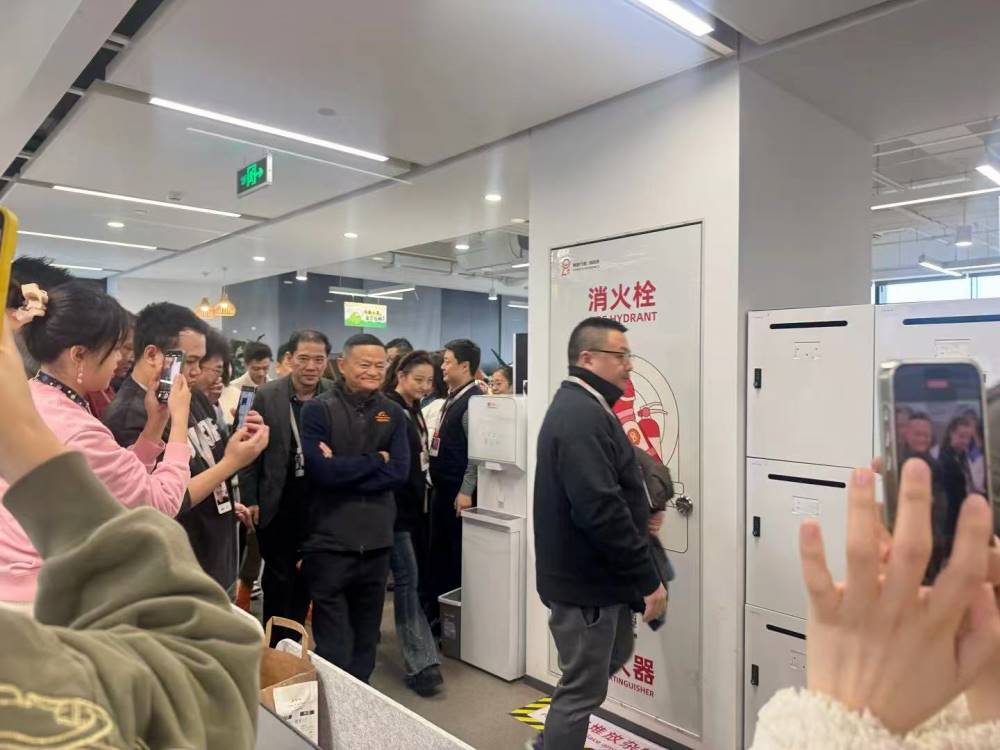
Before the news broke out, the low-key Alibaba founder Jack Ma suddenly "appeared" at the Alibaba Hangzhou campus. Going back in time, his most critical judgment on Alibaba and future business changes is still "AI" - "AI will change everything, but that doesn't mean AI can decide everything. Technology is certainly important, but what really determines the outcome in the future is what we have truly done of value and different for this coming era." Ma said.
Apple's choice of Alibaba is not accidental.
In fact, since 2023, Apple has started testing different domestic models, and the companies that have been rumored to "marry" Apple are not less than 7, including not only tech giants like Baidu and ByteDance, but also large model startups like Baichuan Intelligence, Yuezhianmo, and Deepseek. However, none of them materialized. Before the news broke out, industry insiders mentioned that Apple's choices were already limited.
Alibaba's partnership with Apple is not a so-called "snatch victory from the jaws of defeat" - in the competition for large models in China, Alibaba has almost not missed any key node with the logic of "cloud + model + application", whether it is the underlying model capability, the open-source ecosystem construction, or external investment.

Apple's cooperation with Alibaba is not surprising.
According to a previous report by The Information, Apple had chosen Baidu as its main partner last year, but due to Baidu's progress in developing models for "Apple Intelligence" not meeting Apple's standards, the cooperation encountered challenges, and Apple also considered Deepseek, but eventually abandoned the cooperation with the Deepseek team.
To understand why Apple chose "Alibaba is not surprising", we need to first understand what the so-called "Apple standard" is.
First, it is the underlying model capability. When evaluating multiple domestic AI models, Apple's goal is to find a large model that better understands the user intent of Apple's edge devices - the large model can provide personalized answers based on the user's iPhone usage and provide customized services, which poses greater challenges to the development and engineering capabilities (such as building high-quality datasets) of domestic model vendors.
For Alibaba, on the one hand, it is familiar with users' shopping and payment habits and has richer data in the consumer market; on the other hand, Alibaba's Tongyi large model has also attracted attention for its basic model capabilities among domestic large models.
Secondly, the response speed and experience in serving large customers, which is also the advantage of large companies, and the weakness of startups like Deepseek.
Furthermore, the good reputation and brand image among users and developers, which is thanks to Alibaba Cloud's insistence on open source and the group's "return to user value".
Finally, there is also the understanding of the ecosystem, which may also be the reason why Apple did not partner with Tencent, as the two closed ecosystems are bound to face more competition. In comparison, Apple and Alibaba's relationship is much "simply friendly".
Model capability, large company advantages, good reputation, and ecosystem understanding, Alibaba is the best choice for Apple.

In terms of the impact of the cooperation, the biggest beneficiary is undoubtedly Alibaba, whose US-listed stock price soared after the announcement of the cooperation.
For Alibaba, the "marriage" with Apple has three opportunities: first, to endorse its technology and brand; second, to collaborate with Alibaba Cloud to drive the growth of cloud computing market share; and third, the value of the entry point, by leveraging Apple's hardware entry point and scenarios to further optimize model performance, with the potential to spawn new business models.
For Apple, cooperating with Alibaba to deal with the competition from domestic smartphone brands like HUAWEI is also a way to address the more intense localization war, using the uncastrated AI-powered iPhone to alleviate the pressure on its China market.
We mentioned in 《Cook's Snake Year Didn't Start with a Bang》 that the first task Cook needs to clarify is to hold on to the China market.
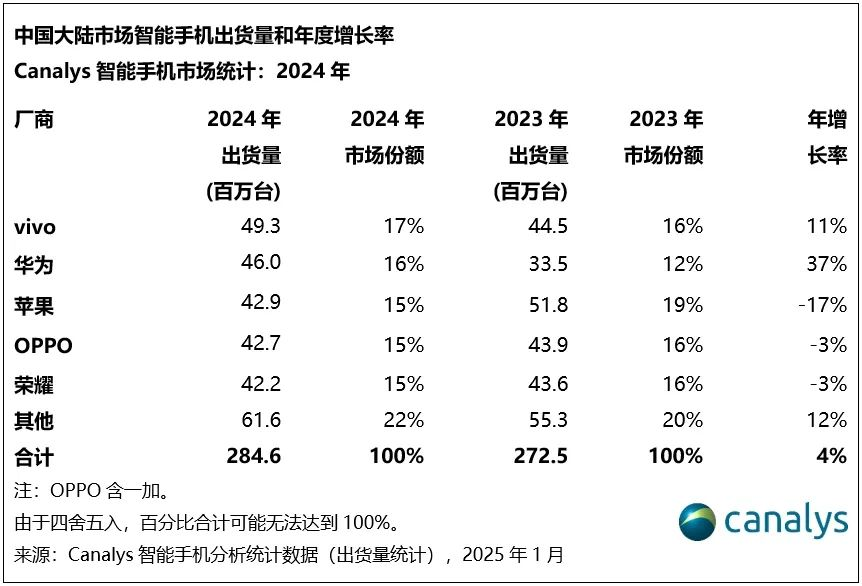
According to data released by the research firm Canalys, in the Chinese mainland market, over the past year, in terms of shipment volume, vivo ranked first with a 17% share, followed closely by HUAWEI, while Apple only ranked third. Using the localized "Apple Intelligence" to leverage the Chinese market is undoubtedly what Cook wants to see.
With the entry of the "Apple + Alibaba" duo, domestic AI-powered smartphones are expected to see a new round of "camp battle" in 2025, with Samsung previously announcing that its latest Galaxy S25 will feature the AI model capabilities of Agentic's GLM, and Xiaomi previously partnering with ByteDance's Douban.

Although Apple and Alibaba's cooperation seems to be a perfect match, the deep integration of the two ecosystems may also face many challenges.
For example, Apple's requirements for edge AI are extremely stringent. According to Alibaba Cloud's technical white paper in March 2024, Tongyi Qianwen has compressed the parameter size from 7B to 2.2B (a 68% reduction) through structured pruning. However, according to the test data of Geek Park, its FP16 precision model occupies 2.1GB of memory on the iPhone 15 Pro, and the Machine Intelligence test shows that the first round of inference latency is 0.62 seconds, still higher than Apple's Core ML recommended standard (≤1.5GB/≤0.4 seconds).
For example, how to balance the respective ecosystems of the Alibaba system and the Apple system. When you want to turn on the lights with voice commands, Tmall Genie and Siri may still "compete for the job" - for example, if you say "turn on the living room light", the phone has to decide within half a second whether to listen to Tmall Genie or Siri, and this "whoever responds faster, listen to them" battle can also be seen as a technical race between the two companies to compete for smart home control.
Going back to 2014, when talking about his first meeting with Cook, Ma commented: "I have a good impression, I think Cook is not arrogant." When talking about the cooperation with Apple at the time, Ma said: "We must find ways to cooperate more and compete less, when two big elephants fight, the other animals around them will definitely be affected."
Ten years later, in the ever-changing AI world, this statement is still gaining in value.