Author: Lin Zhijia,TechFlow Post AGI

Image source: Generated by Boundless AI
After Tencent's WeChat began internal testing of "AI Search" and integrated the DeepSeek model, Baidu immediately responded.
TechFlow Post AGI has learned that on the evening of February 16, Baidu Search released a message saying that Baidu Search will fully integrate the latest deep search capabilities of DeepSeek and Wenxin large models. At the same time, to serve the vast developer community in calling the capabilities of various models to create and optimize intelligent agents, the Wenxin Intelligent Agent Platform will be fully integrated with DeepSeek.
Meanwhile, Tencent confirmed on the 16th that WeChat has launched the "AI Search" function and is officially conducting a gray-scale test of the DeepSeek-R1 model, providing "deep thinking" services.
Tencent said that some users who have obtained the test qualification can see the "AI Search" entry at the top of the WeChat chat box, and after clicking on it, they can use the full-powered DeepSeek-R1 model for free and enjoy a more diversified search experience. If the entry is not displayed, it means that this gray-scale test has not yet covered the user account, and the WeChat team is gradually expanding the test scope, and everyone can wait patiently for the subsequent opening. In addition, Tencent Yuanbao, QQ Browser, QQ Music and other Tencent products have also integrated the DeepSeek model.
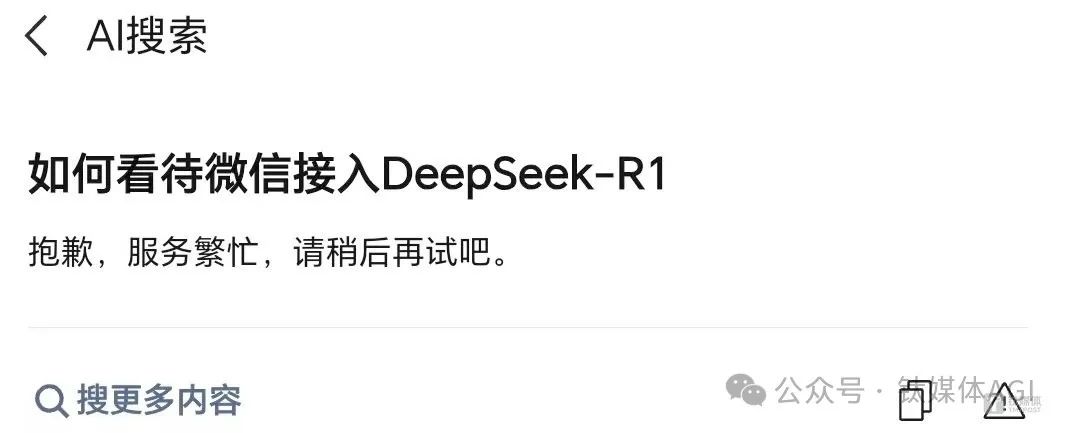
However, less than a day after the launch, WeChat began to be "overloaded". Around 11 pm on February 16, TechFlow Post AGI learned that when users use WeChat's "AI Search", the final interface begins to display "Sorry, the service is busy, please try again later".
The latest research report from Goldman Sachs points out that Tencent is the first Chinese CSP (Cloud Service Provider) company to deeply integrate the DeepSeek-R1-671B model's deep thinking mode and realize search functionality. Utilizing Tencent's unique WeChat content enhancement reasoning capabilities, and supported by Tencent Cloud AI's inference infrastructure, Goldman Sachs believes that this highlights Tencent's multiplier strategy on the AI open platform, using internal (Metaverse) and external models (such as DeepSeek), hoping to build an AI ToC "killer" application and AI Agent intelligent agent ecosystem in China.
But at the same time, the DeepSeek craze has also made other companies feel "low tide".
Among them, ByteDance CEO Liang Rubo recently reflected on DeepSeek, believing that one of the innovations of DeepSeek R1, the long-chain thinking mode, is not the industry's first creation. After OpenAI released the long-chain thinking model last September and became an industry hotspot, ByteDance realized the major technological changes, but the follow-up speed was not fast enough. If they had paid attention to it in time then, they might have had the opportunity to realize it earlier; and the "Big Model Six Tigers" (Zhipu AI, Baichuan Intelligence, Jieyu Xingchen, Yiwan, Yuezhi Anxiang, MiniMax) are gradually differentiating and making different development choices.
Two years after the ChatGPT craze, China's AI industry has entered a new "changing landscape".
The Second Half of the Big Model: The "Six Tigers" Accelerate Differentiation
Entering 2025, a new round of DeepSeek craze has arrived. Recent Bloomberg data surveys of 7 AI industry experts show that the valuation of DeepSeek is expected to be between $1 billion and over $150 billion, with a midpoint valuation of $20 billion to $30 billion.
According to the Bloomberg Billionaires Index, if the above valuation data is used, Liang Wenfen, who holds an 84% stake, will have a net worth of $126 billion, making him one of the wealthiest tech tycoons in Asia, possibly even surpassing Nvidia CEO Jensen Huang, who has a net worth of $118 billion.
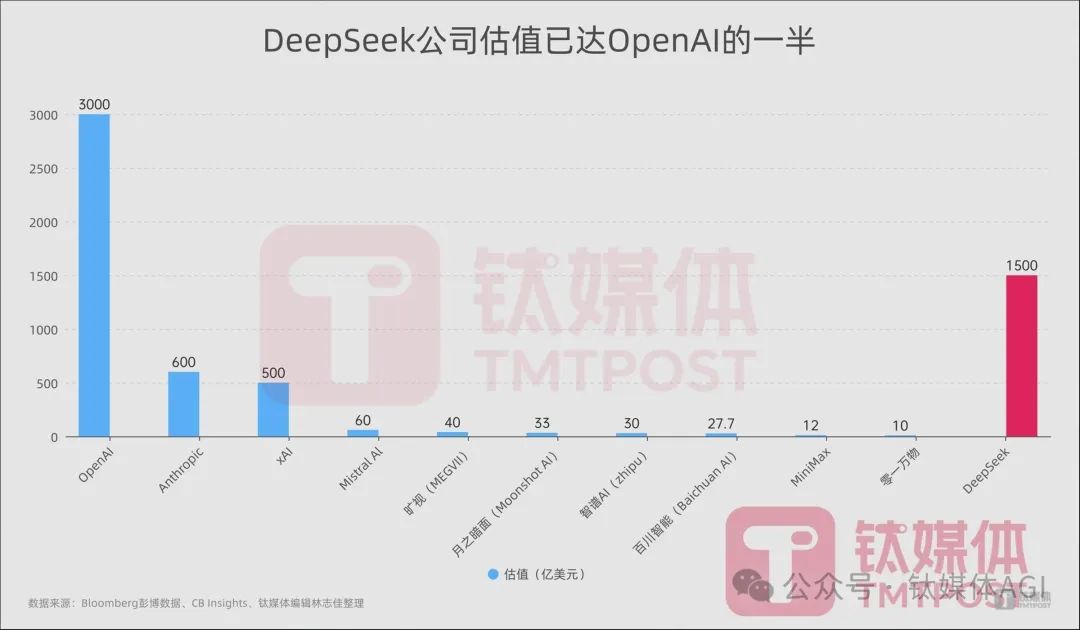
According to TechFlow Post AGI statistics, Anthropic, founded by former OpenAI employees and invested by Google and Amazon, has a valuation of $60 billion; Mistral AI, founded by researchers from Google and Meta, has a valuation of $6 billion. Domestically, Zhipu AI completed a new round of 3 billion yuan financing last year, with a pre-investment valuation of 20 billion yuan. But DeepSeek is far ahead, with a company valuation higher than the total of the "Big Model Six Tigers".
Now, under the impact of DeepSeek, the "Big Model Six Tigers" with a valuation of up to 20 billion yuan are standing at a new crossroads, making different development choices: some choose to continue to invest in the research and development of new models and explore more possibilities for industrial application; others choose to embrace the DeepSeek model, leveraging its advantages to explore new business territories.
First is Yiwan.
Before the launch of DeepSeek-R1, Yiwan CEO and Innovation Works Chairman Li Kaifu had publicly stated that the company will no longer pursue the training of super-large models, and that lightweight models with moderate parameters, superior performance, faster reasoning speed, and lower reasoning cost are more suitable for commercial scenarios and "will become the catalyst for the explosion of AI-First applications". Yiwan's overseas AI application PopAi has integrated the DeepSeek model.
On February 14, the Industrial Large Model Base jointly established by Yiwan and Suzhou High-tech Zone was officially inaugurated. Yiwan revealed that the base will focus on building industry-specific large model solutions in areas such as manufacturing, finance, healthcare, and government affairs, and will work with industry chain partners such as Zhongxi Software Group, Super Media Group (formerly Modern Communication Group), Chuangxin Qizhi, Beiyong Quantification, Chengyuan Technology, Qiongche Technology, and Suirui Technology to explore the path of large model technology from the laboratory to the production line.
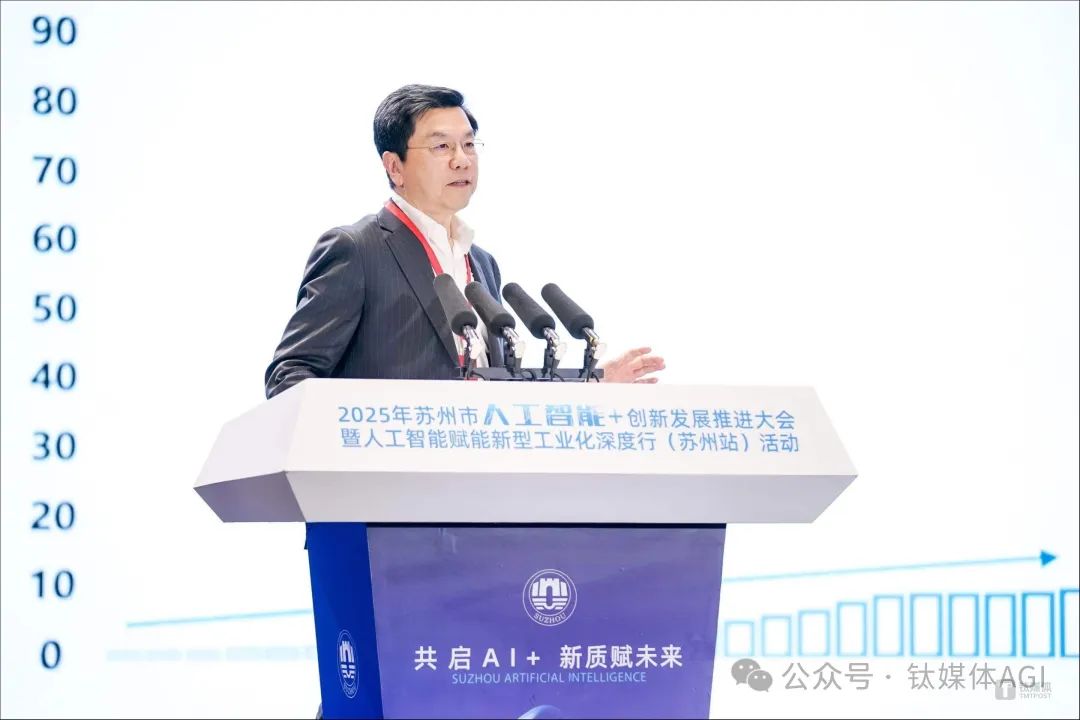
Li Kaifu said that at the critical juncture of AI technology restructuring industries, large models are not "castles in the air", but the core engine driving the real economy. As the performance of the base model continues to improve, applications will flourish, providing an unprecedented era of opportunity for Chinese teams. 2025 will be the year of the explosion of AI-First applications, and Suzhou, with a solid industrial foundation and rich application scenarios, is the best test field for the landing of industrial large models.
Currently, Yiwan has begun to explore the industrialization of large model capabilities in retail, finance, gaming, energy and other fields, and has carried out in-depth cooperation with leading enterprises including Fortune 500 companies. The large model ToB solutions have also been recognized by customers such as China Mobile, Alibaba Cloud, Huawei, Yum China, Shunfeng Technology, Kidswant, Meitu, and Feishu.
Earlier this year, Yiwan announced the establishment of a "Joint Industrial Large Model Laboratory" with Alibaba Cloud: the Alibaba Tongyi series of large models will serve as a powerful general-purpose "teacher model"; Yiwan has the international leading high-performance-cost ratio model capabilities, and can agilely batch-train vertically-oriented industrial large models, working together to accelerate the industrial application of large models and expand the prospects of the large model ecosystem.
Alibaba Cloud CTO Zhou Jingren said that the deep integration of large models and industries is the necessary path for China to usher in the era of comprehensive intelligence. The cooperation between Alibaba Cloud and Yiwan to establish the "Joint Industrial Large Model Laboratory" is to hope that through the co-evolution of large and small models, they can accelerate the empowerment of the real industry, and prosper the large model application ecosystem in thousands of industries. Suzhou has a solid industrial foundation and rich application scenarios in manufacturing, finance, and healthcare, which is an excellent base for incubating innovative applications of industrial large models.
Secondly, on the Jieyu Xingchen and MiniMax side, the two companies have also started to integrate the DeepSeek model.
On February 16, Jieyu Xingchen's latest "Yue Wen" App integrated the DeepSeek-R1 model; at the same time, the overseas version of MiniMax 01 has launched the DeepSeek-R1 deep thinking mode.
MiniMax founder and CEO Yan Junjie said that MiniMax's plan for 2025 is to "open source". "If I had to choose again, I should have open sourced on the first day. Because open sourcing can accelerate technological evolution."
As for Baichuan Intelligence, it has recently continued to "add fuel" to the AI medical track. On January 25, it released a new model Baichuan-M1-preview, with language, vision and search reasoning capabilities. On February 13, the "AI Pediatrician" built on the Baichuan-M1 base was "on duty" in Beijing after nearly a month of internal testing.
It is reported that on that day, Beijing Children's Hospital conducted the country's first "AI Pediatrician + Multi-Disciplinary Experts" dual-doctor and multi-disciplinary consultation. In addition to 13 experts from multiple departments, there was also the "AI Pediatrician" co-developed by the hospital, Baichuan Intelligence, and Xiaoe Fang Health Technology (a medical data company invested by Baichuan).
Here is the English translation of the text, with the specified terms preserved:Participants conducted a multidisciplinary consultation on a pediatric patient with a cranial tumor accompanied by tic symptoms, while on the other side, engineers inputted the patient's chief complaints and medical records into the model. "The AI pediatrician also provided recommendations highly consistent with the expert group consultation results."
Finally, Lunar Dark Side and Wisdom AI continue to focus on model and Agent intelligence application development.
Hours after the release of the DeepSeek-R1 model on January 25th, Lunar Dark Side released the Kimi k1.5 multimodal reasoning model, attracting attention. Meanwhile, there are reports that Lunar Dark Side will soon launch a "consistently achieving SOTA results" large model.
In early February, the latest paper from OpenAI, "Competitive Programming with Large Reasoning Models", stated that two Chinese AI companies independently discovered the secret of o1, citing the DeepSeek-R1 and Kimi k1.5 models in the introduction, claiming that these two Chinese AI companies independently discovered the secret of o1. Furthermore, OpenAI pointed out that DeepSeek-R1 and Kimi k1.5 respectively improved the performance of large models in mathematics and programming through CoT.
As a counterpart to OpenAI's AI unicorn company, Wisdom AI will not integrate the DeepSeek model for the time being, but instead choose to strengthen Agent intelligence. The latest release of Agentic GLM (Wisdom AI's system-level large model developed specifically for mobile phones) has been launched on the latest Samsung Galaxy S25 series smartphones, providing AI-based real-time voice and video calls, as well as visual understanding, system function calling, AI search, and content writing capabilities. In addition, Wisdom AI is also collaborating with the AI drawing application "Pinch Ta".
The latest report from the international investment bank Morgan Stanley predicts that the AI market is heading towards differentiation. DeepSeek has changed the narrative of the AI industry, demonstrating the returns of taking an unconventional path, and the notion that only a few companies in the world can meet the conditions and provide the powerful chips and infrastructure to drive the development of AI is no longer a fact, as companies with the ability to pay the entry cost are no longer limited to a few industry leaders.
Morgan Stanley pointed out that the DeepSeek craze has prompted some companies to be willing to pay high prices to maintain their leading position; but for the other camp, AI is a cost center, and these companies are pursuing cheaper Tokens.
"We believe the market winners will ultimately be the companies that can quickly scale up and commercialize new technological breakthroughs. As the market enters the reasoning stage, we are increasingly optimistic about the participants of AI large models, and believe that there will be better opportunities from the recovery of edge devices starting in the second half of 2025." Morgan Stanley believes that the current AI craze is a bit like the widespread adoption of the Internet in 1995, when everyone expected Cisco or AltaVista and Hotmail to win the race, but Amazon ended up providing the cheapest service Token per second and became the ultimate winner.
Traditional search to be revolutionized by AI
With Baidu's core and flagship product - Baidu Search, as well as Tencent's core WeChat, successively integrating the DeepSeek model, this may mean that the traditional search market will be reshuffled, and people's search methods and experiences will undergo a complete transformation in the near future.
According to the Securities Times, Tencent has provided further clarification on some relevant details.
1. Does the data source for AI search include public accounts? The WeChat AI search that integrates DeepSeek supports online search (users do not need to manually select), based on the rich WeChat ecosystem content such as public accounts, as well as high-quality content across the web, to provide users with more comprehensive and higher-quality answers.
2. Has the AI search been fully implemented? The capability is currently in a gray-scale test phase and will be continuously optimized based on user experience and feedback.
3. Why does WeChat's search scenario need to integrate the large model? The large model can improve the intelligence and accuracy of search, such as better understanding user search intent, analyzing and processing complex query content, etc. Combining user needs, Tencent has integrated large models including Hunyuan and DeepSeek in the search scenario to further enrich the user's search experience.
4. Will the AI search use my WeChat personal information such as Moments and chats? The AI search only integrates public account and other public internet information, and will not use users' personal information and related privacy information.
According to the Shanghai Securities News, renowned economist and member of the Information and Communication Economics Expert Committee of the Ministry of Industry and Information Technology, Pan Helin, said that for WeChat, integrating DeepSeek is not difficult, especially since Tencent has sufficient computing power to support larger traffic volumes. "Recently, DeepSeek itself has often encountered server busy issues due to excessive traffic, and WeChat's move provides consumers with an alternative solution."
Public information shows that according to a survey, 59% of netizens have mainly used AI search tools, while traditional search engines like Baidu only account for 22%. WeChat's integration may accelerate this trend, especially more attractive to younger users.
Pan Helin believes that WeChat's integration is also beneficial for DeepSeek, as WeChat expands DeepSeek's user reach and also reduces DeepSeek's computing power burden.
Fusion Fund founding partner and Silicon Valley investor Zhang Lu recently wrote that today's college students, especially freshmen and sophomores, and even some high school students, spend a lot of time using AI tools. They spend about 70% to 80% of their time using AI applications on their phones. For example, many students no longer use traditional Google search, but turn to platforms like ChatGPT and You.com for their searches. This indicates that the relationship between humans and AI may be changing faster than we imagine. From initial unfamiliarity and resistance, to gradual cooperation, and now to dependence, in the future, AI may become a part of daily life like a mobile phone, and people will also form new habits.
IDC China Research Manager Cheng Yin stated that for AI applications, the update and upgrade of large models will help accelerate the innovation and commercialization of application scenarios. In the future, whether it is applications aimed at improving personal productivity, such as content writing and generation, online meeting summaries, AI assistants, and search, or scenarios targeting service, marketing, and other business functions, or the commercialization of industry-specific scenarios, they will all be the focus of market attention this year.
Cheng Yin emphasized that DeepSeek has led the basic large model to open up a new development paradigm. By 2025, the industry will also pay more attention to the landing of large models and generative AI, and the entire ecosystem should work together to accelerate the innovation and commercialization of application scenarios.