There has been a small resurgence in GPU mining, and the PoW public chain launched in 2022 will activate its TGE (Token Generation Event) tomorrow morning, attracting nearly 2 million GPUs to join the mining.
GPU mining fever is gradually warming up. The PoW high-performance public chain Quai Network launched in 2022 will welcome its TGE (Token Generation Event) at dawn on the 20th in Taiwan time. Two weeks ago (2/5), it opened user mining on the mainnet, attracting an estimated over 2 million GPUs (according to herominer data) to join the mining. This article will introduce what features of Quai have attracted so many GPU miners, and when will it be listed on exchanges? What about the design of the energy token QI, and what impact will the TPS of up to 50,000 bring?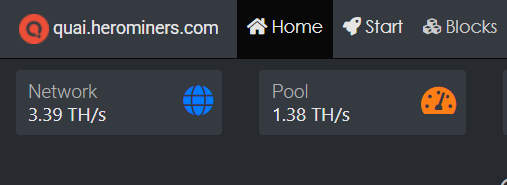
Continuing the spirit of Ethereum PoW, block generation improved by Satoshi consensus
The mining algorithm used by Quai is ProgPow, which was developed by Ethereum in 2019. Unfortunately, this algorithm was abandoned due to the Ethereum community's strong but mistaken expectation that it would "migrate to PoS consensus soon". Ethereum did not complete the transition until September 2022, and Quai, born in the same year, aims to use the ProgPow algorithm that Ethereum never got to use to continue the Ethereum mining spirit.
In terms of block generation synchronization, Quai has adopted a very advanced approach using the "Minimizing Entropy Proof" paper from Cornell University targeting Bitcoin. According to the whitepaper, the Proof-of-Entropy-Minima (PoEM) has improved the trilemma faced by Ethereum and past Bitcoin in terms of node synchronization and block generation speed, allowing Quai to achieve 5 seconds per block and up to 50,000 TPS. In terms of performance, it is 771 times that of Ethereum Layer 1.
PoEM also has very high sharding scalability, allowing Quai to operate two tokens, Quai and Qi, on the mainnet using a single PoW mining method, representing different value storage standards.
The value based on energy and deflation
The Quai Network is mainly composed of two tokens: the EVM token Quai, which represents deflationary value, and the energy token QI, which represents UTXO. We will first introduce that the issuance of both is determined by the mining difficulty at the time, and we will elaborate on the meaning later:
Quai token economics and issuance
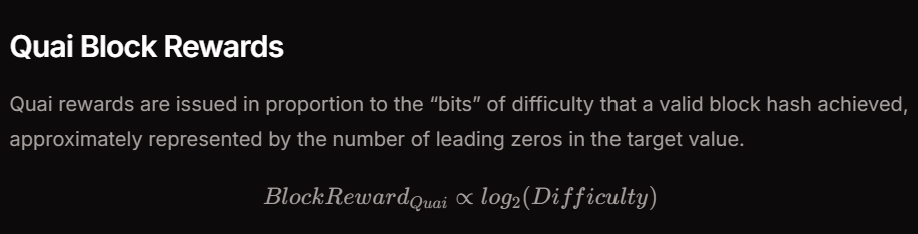
First, the issuance of Quai is proportional to the LOG2 (difficulty) function. This means that unlike Bitcoin and Ethereum PoW, when the difficulty increases 4 times, the reward for miners with the same computing power will not decrease to 1/4, but to 1/2. This effectively reduces the impact of drastic changes in computing power, mitigating the impact on small miners. In the long run, the log2 function is an extremely limited positive growth function, and the additional issuance will approach 0 as the computing power continues to increase to a certain extent.
Given that the EVM token is a platform for deploying smart contracts, long-term token issuance is necessary for circulation and application usage, but it cannot become an obstacle to value storage. Quai has found a more suitable ecology between the limited issuance of ETC and the unlimited issuance of ETH, maintaining long-term limited issuance and a path towards long-term deflation.
QI token economics and issuance
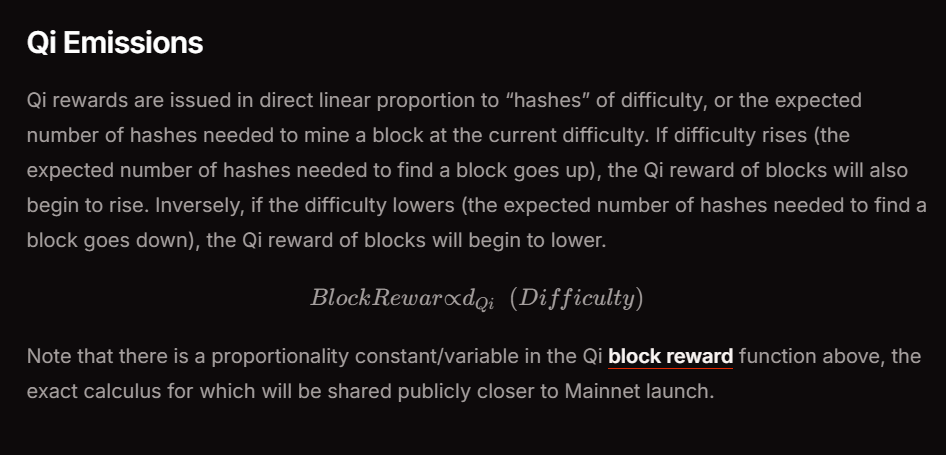
The second is the energy token QI, which adopts the UTXO design and is more like Bitcoin. It is designed for fast payments. Interestingly, the issuance of QI is proportional to the mining difficulty, which means that when the mining difficulty increases, the amount of QI each miner receives will remain the same without any chip or GPU iterations. Therefore, QI is known as the "energy token", as it will be produced as long as there is power consumption, and the total amount of QI can also reflect a portion of the cost value of the Quai Network, making QI more like an average currency with the energy inflation factor eliminated.
Here is the English translation:As for Quai and Qi, the official has also promised to open the conversion function. The Discord community revealed that during the testnet period, the exchange rate of Quai : QI was close to 1:21, but this figure is for reference only and cannot be guaranteed to be related to the TGE.
Financing, Token Distribution and Miner Strategy
According to Quai's official information, Quai will generate 3 billion tokens in the Genesis Block, and these 3 billion will be locked and distributed as follows:
| Team and Investors | 1 year lock-up, monthly unlocking in years 1-4 |
| Other Investors | 25% prepayment, monthly unlocking starting from years 1-4 |
| Testnet Incentives | No lock-up period |
| Community Incentives and Foundation | Monthly unlocking within 6 years |
| Builder Grants | 1 year lock-up, monthly unlocking in years 1-4 |
According to the community's calculation on Discord, there will be 400 million in circulation on the first day of launch, while the total daily output of Quai miners is only close to 300,000, so many Chinese community members suspect that Quai will conduct a large-scale dump in the days before the listing.
However, the official has previously responded on the YouTube channel that most of these are for financing, EVM ecosystem development, and market maker use, and there will be no dumping.
According to the official documents, the mining emission of Quai will be close to 1:1 with the pre-mining in four years, and in ten years it will become a mainnet where mining accounts for 71.6%, indicating that if miners want to enter, they may need considerable patience to get through the early stage dominated by the foundation.
Viable Strategies for Miners
Although it seems unfair to miners, the design of the energy token Qi may be the only advantage for miners, because Quai did not pre-mine any Qi tokens at the Genesis. This means that Qi will be fully mined by GPU miners from the beginning, adopting a Fair Launch model. This means that if early miners invest in mining machines to mine Qi and exchange it for the large amount of Quai that may be dumped in the early stage, it may be a very effective policy, and the exchange rate between Quai and Qi will also appear with the emission design, resulting in a large devaluation of Qi.
Will it be listed on exchanges? How to mine? What about the price?
It is currently confirmed that the exchanges it will be listed on are MEXC and Gate.io, but the official personnel are still previewing on Discord that a large exchange will be listed, the details of which have not yet been disclosed. Please pay close attention to the community, and you can see the AMA-related activities on the MEXC official channel in the near future, but the details of the activities need to be verified carefully.
The mining method is also very simple. Windows or Linux users can use AMD and Nvidia graphics cards for mining, and the overclocking parameters can be found in detail on the Hashrate.no website. If necessary, BlockTempo will also write a mining tutorial article in the next few days.
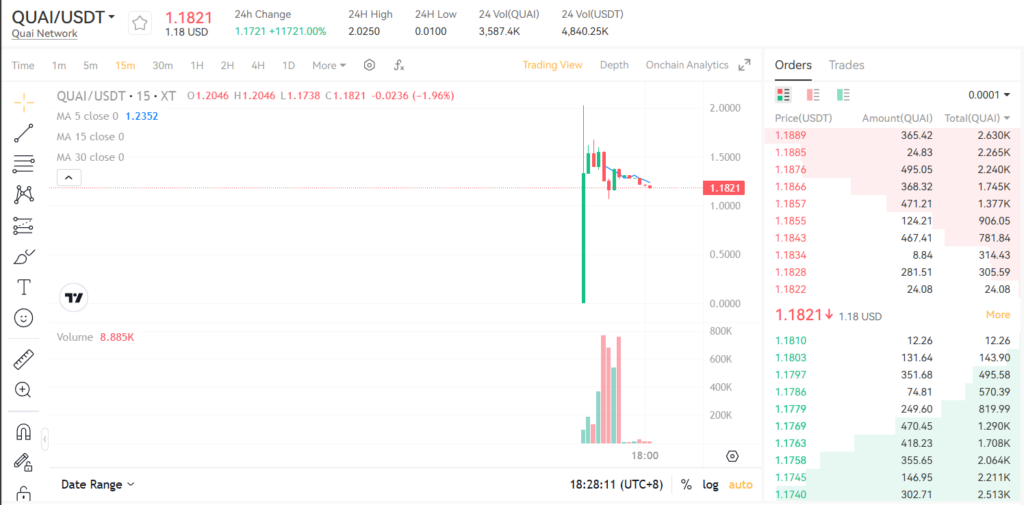
Quai has also been listed on a few exchanges in advance, with XT temporarily reporting $1.1825, but the token price is for reference only and may experience a large price fluctuation after the TGE.