Author: TechFlow
"For to everyone who has, more will be given, and he will have abundance; but from him who does not have, even what he has will be taken away."
---Matthew
On the chain, the Matthew effect of the strong getting stronger has never stopped.
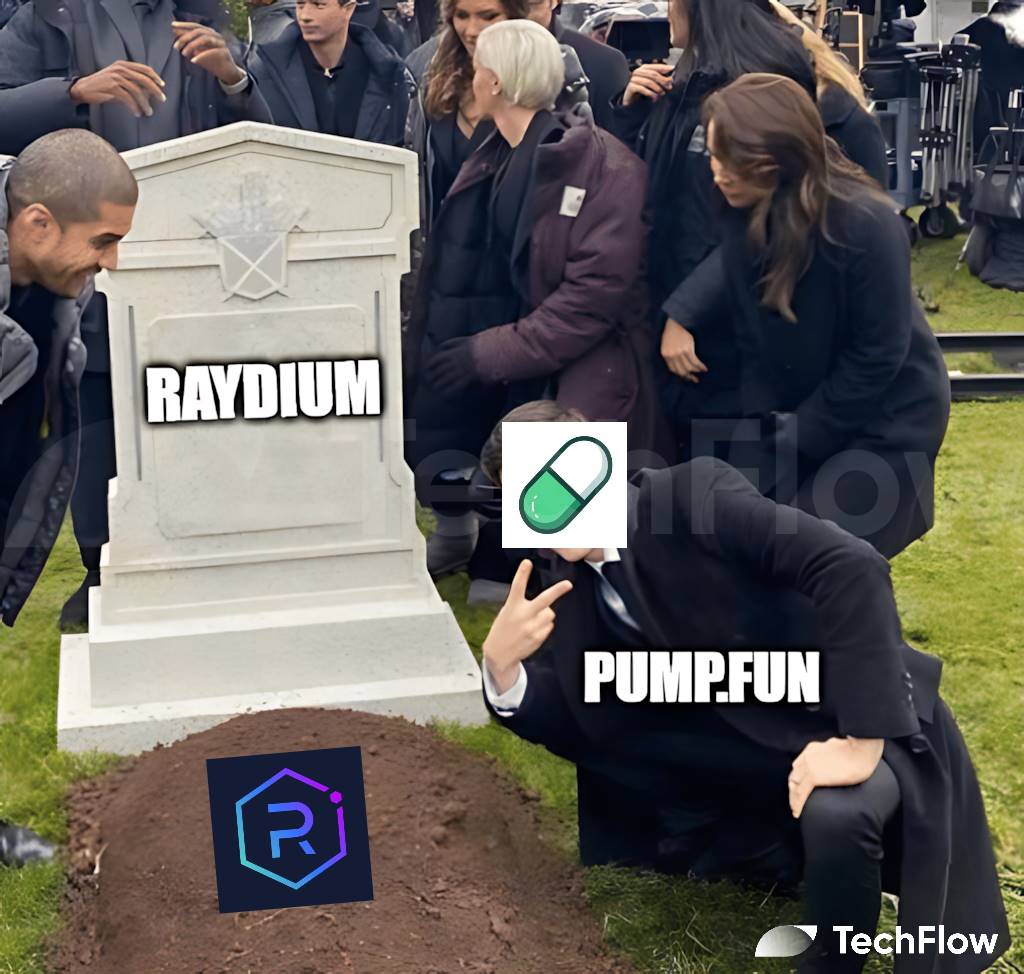
For example, Pump.fun has quietly started doing Raydium's business: today it has quietly launched a self-built AMM pool, trying to divert the liquidity income originally belonging to Raydium.
Currently, this self-built AMM (http://amm.pump.fun) page is very simple, and you can swap any token like other DeFi products.
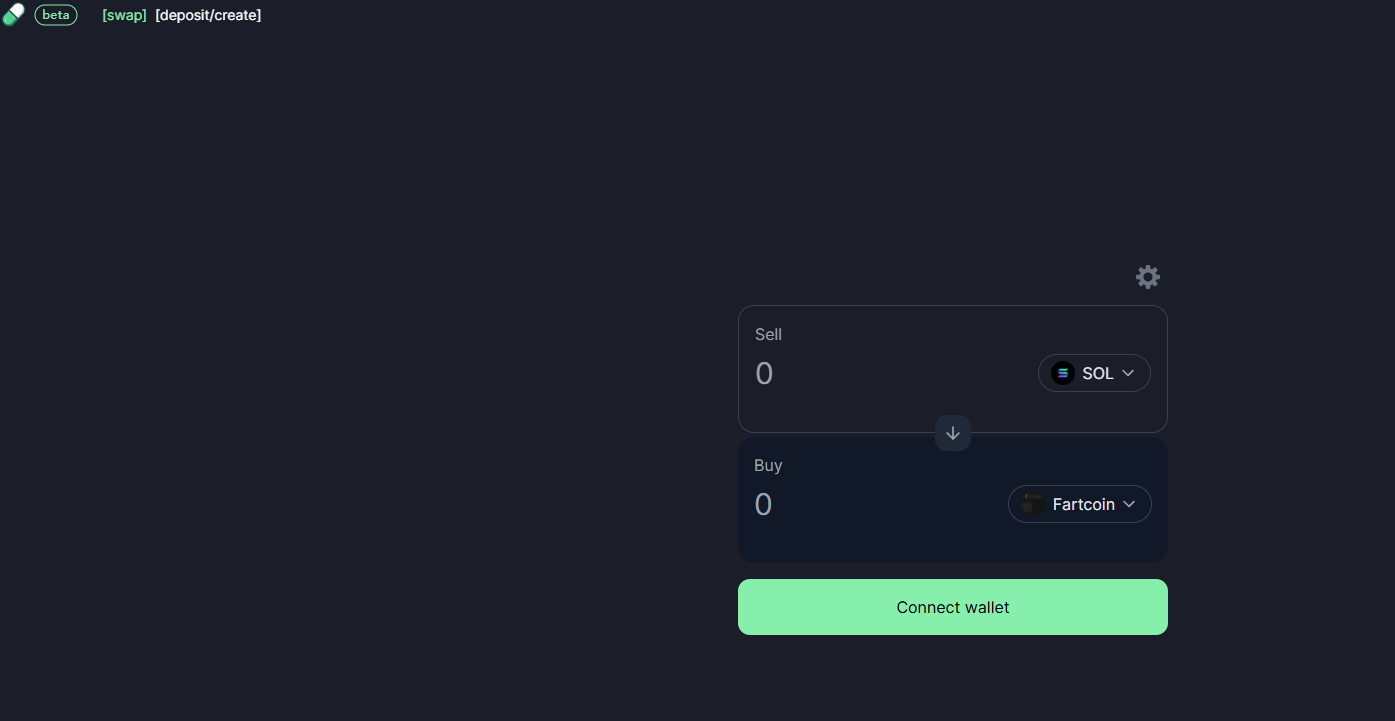
However, the thoughts behind this product may not be simple.
Everyone knows that Pump.fun has attracted a large number of Degens with its unique internal and external trading mechanism and meme coin culture.
User transactions are first matched on Pump.fun's internal order book, relying on the platform's liquidity to complete the transactions; when the internal order book is full, the transactions will be routed to the external order book, which actually relies on Raydium's liquidity pool.
Under this model, Pump.fun has always been a "traffic provider" for Raydium, but has also been subject to Raydium's rules. Whenever the transaction flow goes to the external order book, Pump.fun needs to pay a portion of the transaction fee, and this part of the profit ultimately flows to Raydium's liquidity providers (LPs).
Raydium itself is one of the most important AMM platforms in the Solana ecosystem, and is an important infrastructure for DeFi users to obtain liquidity. It also provides liquidity pool services for many projects on Solana, and its TVL (total locked value) has long been at the forefront of Solana.
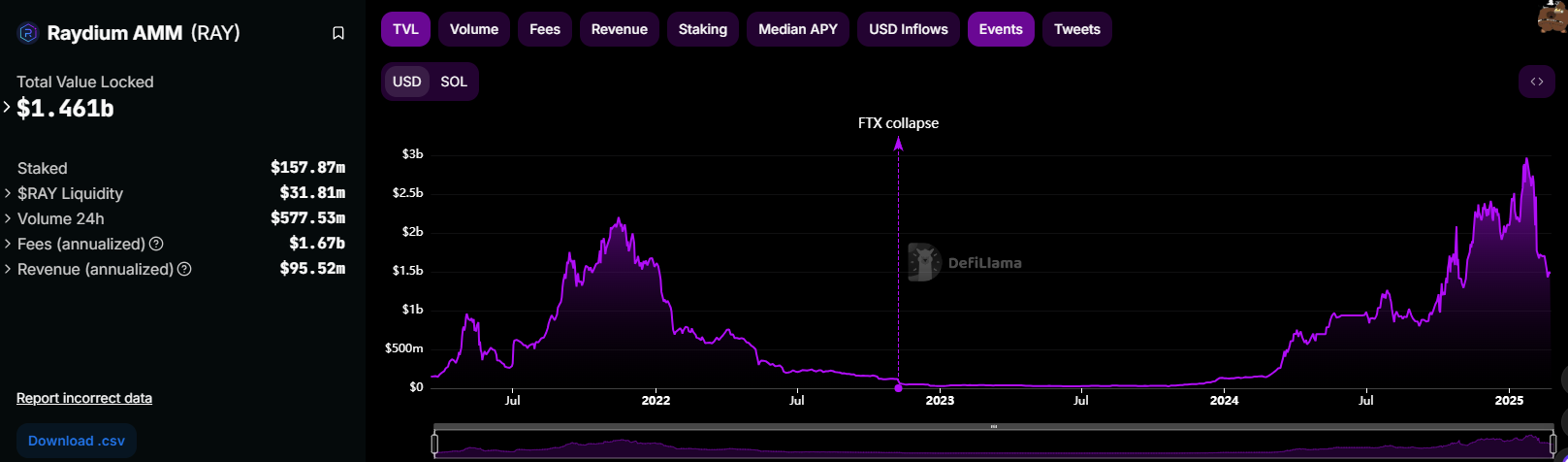
As the "liquidity center" of Solana, Raydium occupies a pivotal position in the ecosystem. However, Pump.fun's new move is challenging this pattern:
Pump.fun is no longer satisfied with being Raydium's "traffic provider", but is trying to become the "controller" of liquidity.
The business behind the self-built AMM pool
By building its own AMM, Pump.fun can transfer the external order book liquidity from Raydium to its own platform, thereby completely controlling the distribution of transaction fees.
If Pump.fun's strategy succeeds, Raydium will not only lose a portion of its liquidity source, but its revenue model and ecosystem position will also be impacted.
So, how does this account work?
Raydium's revenue model: Pump.fun's "hidden cost"
In the current model, Pump.fun's external order book transactions rely on Raydium's liquidity pool, and each transaction generates a certain amount of transaction fee, which ultimately flows to Raydium's ecosystem.
Raydium's standard fee: 0.25% of each transaction, of which:
0.22% is allocated to Raydium's liquidity providers (LPs).
0.03% is used for $RAY buyback and ecosystem support.
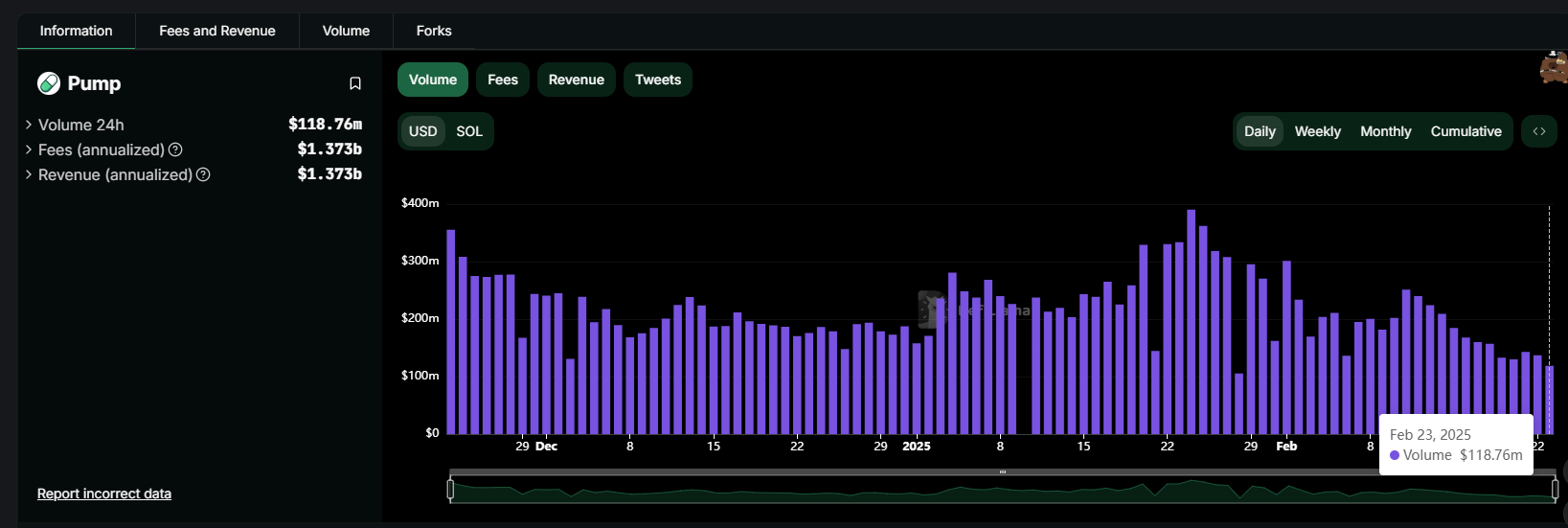
Pump.fun's trading volume: Assuming Pump.fun's daily trading volume is $100 million, of which 5% (about $5 million) is routed to Raydium's external order book.
Pump.fun's hidden cost: Calculated at a 0.25% fee, Pump.fun needs to pay $12,500 to Raydium every day, which is about $4.5625 million per year.
For a rapidly growing platform, this cost, although lower than before, is still a dependence on an external platform.
Potential benefits of building its own AMM
By building its own AMM, Pump.fun can transfer the external order book liquidity from Raydium to its own platform, thereby completely controlling the distribution of transaction fees. So, how much potential revenue can this move bring?
New revenue model: Assuming Pump.fun's self-built AMM has the same fee standard as Raydium (0.25%), but all fees belong to the platform:
The daily external order book trading volume is still $5 million.
Calculated at a 0.25% fee, Pump.fun can directly obtain $12,500 in revenue per day.
The annual cumulative revenue is about $4.5625 million.
Net profit after removing LP costs: If Pump.fun's AMM does not rely on external LPs, but is provided with liquidity by the platform itself, then this revenue will belong entirely to the platform, without the need to distribute to other liquidity providers.
In addition to money, what else is Pump.fun looking at?
Building an AMM not only brings direct revenue growth, but also significantly enhances Pump.fun's control over the ecosystem, laying the foundation for future development.
In the current model, Pump.fun's external order book transactions rely on Raydium's liquidity pool, which means that Raydium controls the user's trading experience and liquidity stability.
After building its own AMM, Pump.fun will have complete control over the rules and fee distribution of the liquidity pool, thereby enhancing its control over users.
With control over liquidity, Pump.fun can further launch more DeFi products (such as perpetual contracts, lending protocols, etc.), thereby building a closed-loop ecosystem.
For example, Pump.fun can directly support the issuance and trading of memecoins through its AMM pool, providing more gameplay for its community.
Related token price changes
After Pump.fun announced the launch of its self-built AMM, the token $RAY of Raydium plummeted, with a daily drop of 20% currently.
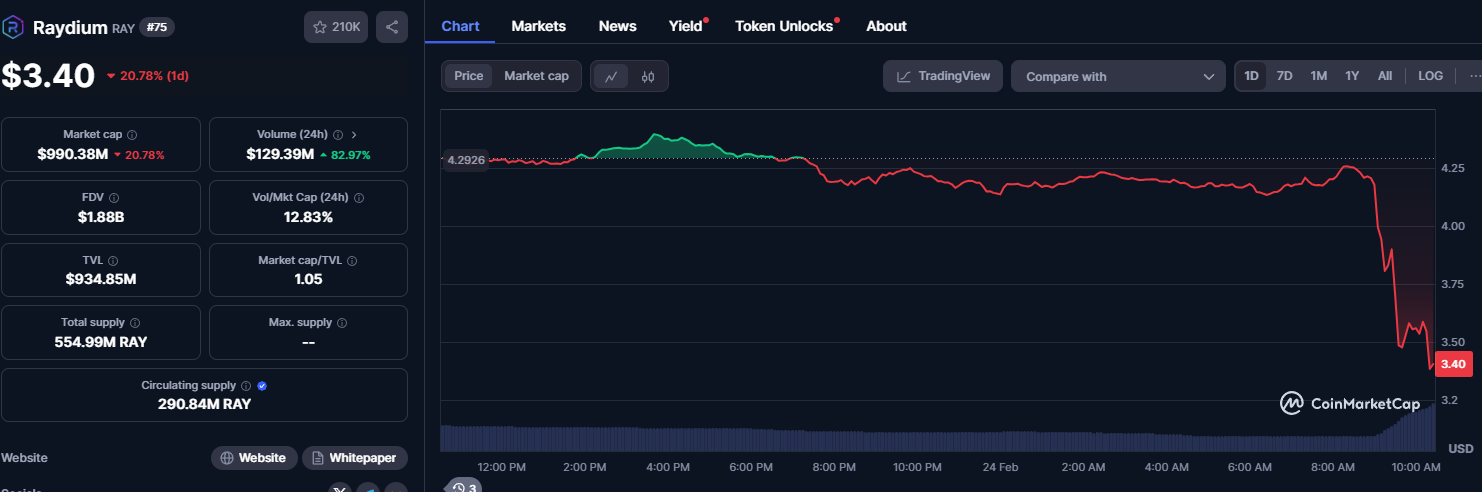
This phenomenon may reflect the market's concerns about Raydium's future revenue and position.
Pump.fun's strategy may pose a long-term threat to Raydium, especially in terms of liquidity migration and transaction fee revenue.
But on the other side, after Pump.fun built the AMM pool, the price of the MEME token Crack used for testing this liquidity pool quickly soared, with a market capitalization reaching as high as $4 million at one point.
CA:
CitRGsrgU7NjaXsxdMFc7sfsxtSnPdtkhHJqbPvhpump
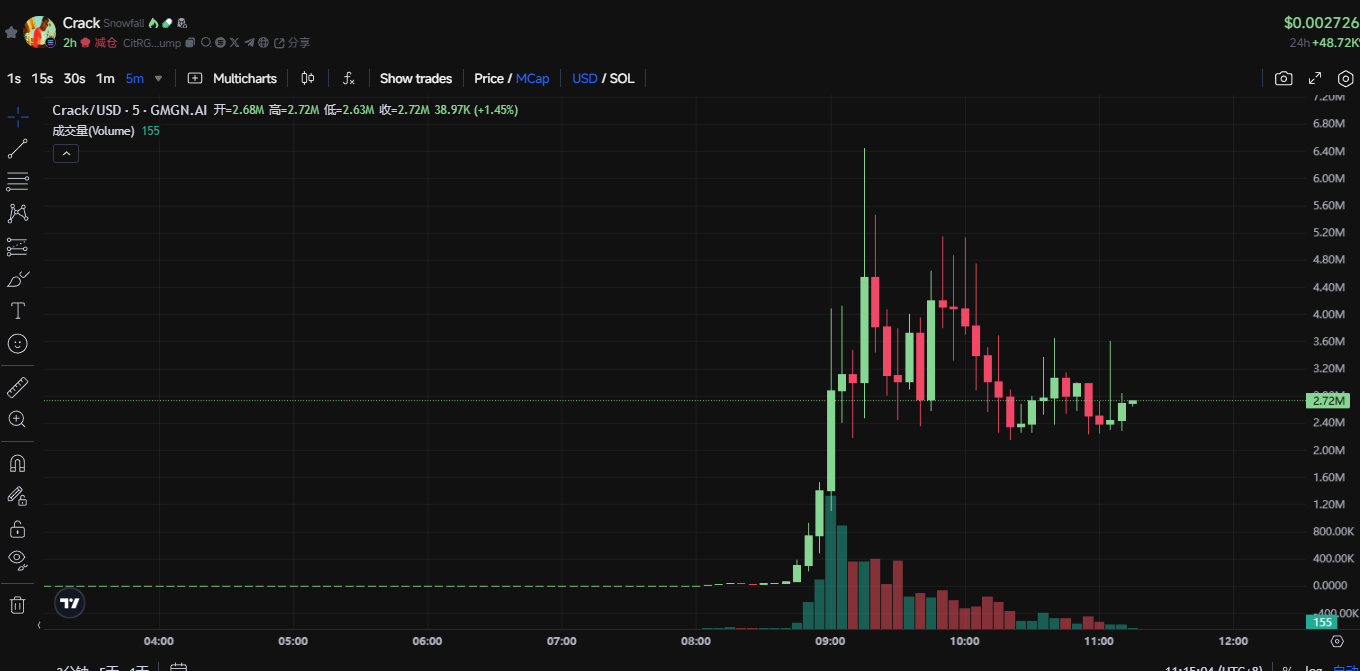
Among the few market hotspots, the test tokens of the AMM pool may still fly for a while.
The challenge is obvious
If the operation goes smoothly after building the AMM, Pump.fun will have complete control over the external order book liquidity, significantly increasing its revenue.
By integrating internal and external order book liquidity, Pump.fun can build a completely self-sufficient on-chain Meme DeFi ecosystem.
From grabbing attention flow to grabbing the destination of funds, Pump.fun is clearly transforming from "relying on external liquidity" to "having its own liquidity".
After a platform has a larger user base, it naturally has the opportunity to shake up the position of traditional DeFi and the on-chain ecosystem pattern through strategic adjustments.
However, whether Pump.fun can truly shake Raydium's position in the future will depend on its balance between liquidity strategy and user growth; more importantly, it will depend on whether the bull market is still ongoing.
Time and tide wait for no man.
It's not just the retail investors in PVP, the projects' fierce competition and rivalry are also on display.