Author: Stephen Katte, CoinTelegraph; Compiled by Wuzhu, Jinse Finance
Chip manufacturing giant Nvidia's latest financial report exceeded Wall Street's expectations, thanks to the sale of AI-centric microchips, with revenue up nearly 80% year-over-year.
Nvidia announced in its fiscal year 2025 and fourth quarter financial report released on February 26 that revenue for the quarter was $39.3 billion, up 12% from the previous quarter and 78% from the same period last year.
Zacks Investment Research said Wall Street had expected revenue of only $37.72 billion and earnings per share of 89 cents, higher than the expected 84 cents.
Nvidia founder and CEO Jensen Huang said on the earnings call that the profit growth was due to the "amazing" demand for its Blackwell microchips, which are designed specifically for artificial intelligence, machine learning and high-performance computing.
"Artificial intelligence is advancing at lightning speed, as agent AI and physical AI are laying the foundation for the next wave of the AI revolution to fundamentally transform the largest industries."
Nvidia's data center revenue accounted for more than 90% of the company's total revenue, reaching $35.6 billion, up 93% from the same period last year.
According to Google Finance, Nvidia Corp (NVDA) stock closed up 3.67% on February 26 to $131.28.
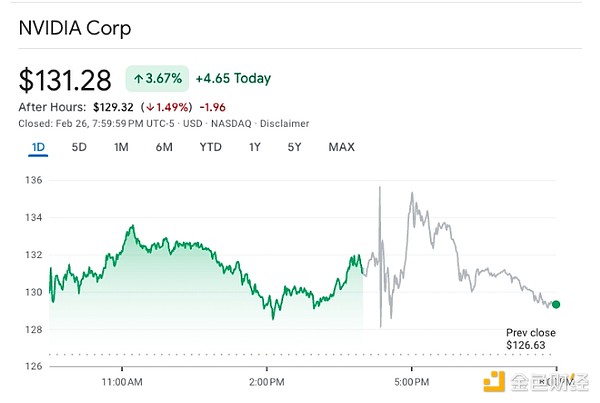
NVDA stock fell 1.49% after hours to $129.32. Source: Google Finance
The stock is still below its all-time high of over $147 set in November last year.
At the end of last month, on January 27, Nvidia's stock price fell nearly 17%, the largest single-day drop in U.S. stock market history, with the company's market value evaporating nearly $600 billion as investors panicked, after Chinese AI company DeepSeek released a model it claimed could rival OpenAI's ChatGPT.
Huang had previously said that with the intensifying technology competition, his company is focused on staying at the forefront of agent AI.
Other U.S. companies are also stepping up their AI expansion efforts. Microsoft said in September that it will establish two AI centers in Abu Dhabi, one of its major AI investments for the full year 2024.
Meanwhile, bitcoin mining companies have been diversifying their revenue sources, including artificial intelligence, converting some of their crypto mining business to help run computationally intensive large language models.
In August, asset manager VanEck estimated that if listed bitcoin mining companies shift 20% of their energy capacity to AI and high-performance computing by 2027, they could generate an additional $13.9 billion in annual profits over 13 years.
According to a January 27 report by research firm 10x Research, the decline in Nvidia's valuation is seen as a "positive development" for bitcoin.
The company said that reducing spending on artificial intelligence could help ease inflation, which could lead the Federal Reserve to implement more favorable monetary policies.