Author: World Economic Forum; Source: Blockchain Review
The report "Digital Assets Regulation: Insights from Jurisdictional Approaches" published by the World Economic Forum analyzes the digital asset regulatory landscape in the European Union, Gibraltar, Hong Kong, Japan, Singapore, Switzerland, the United Arab Emirates, the United Kingdom, and the United States, focusing on anti-money laundering (AML) and know-your-customer (KYC), regulatory and technology sandboxes, DeFi, and privacy and security, providing insights and recommendations for policymakers and industry participants.
The Current State of Digital Asset Regulation
Digital assets continue to hold a significant position in the global economy, as evidenced by their substantial market capitalization. However, the legal status of cryptocurrencies varies significantly across countries. According to the Atlantic Council's analysis, cryptocurrencies are legal in 33 countries, partially banned in 17 countries, and generally banned in 10 countries. In its assessment of the global digital asset regulatory landscape, the Bank for International Settlements (BIS) noted that over 60% of respondents indicated that their jurisdictions have or are creating regulatory frameworks for digital assets.
Most jurisdictions are introducing dedicated regulatory provisions (48%) as their existing regulatory frameworks do not cover digital assets. Jurisdictions that have established or are developing dedicated regulatory frameworks for stablecoins include the United Kingdom, Hong Kong, and Singapore, while the European Union is in the process of drafting a more comprehensive digital asset regulatory framework. Only 9% of jurisdictions have incorporated digital assets into their existing financial regulations. As of now, approximately 33% of jurisdictions lack relevant regulatory frameworks and are not currently working on them.
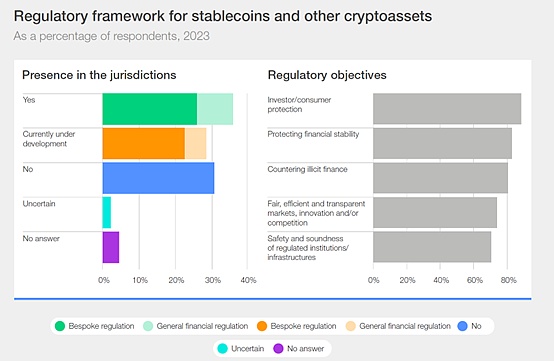
Central Bank Responses to the Digital Asset Regulation Survey
An Analysis of Nine Regulatory Models
To examine the lessons learned in the digital asset regulatory domain, a comprehensive review of the current approaches is necessary. The nine selected jurisdictions are major economies in terms of digital asset activities and regulatory implementation: the European Union, Gibraltar, Hong Kong, Japan, Singapore, Switzerland, the United Arab Emirates, the United Kingdom, and the United States. For each jurisdiction, the report examines four key industry issues: AML and KYC; regulatory and technology sandboxes; DeFi; and privacy and security. These topics were considered the most pressing issues and have emerged as the prominent themes in the current industry.
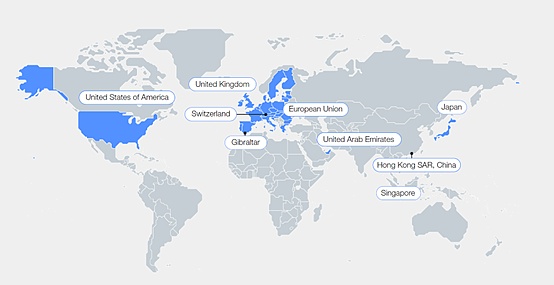
The Nine Jurisdictions Evaluated
1 European Union
The European Union is one of the largest markets with an advanced digital asset regulatory system. In 2023, the EU established a comprehensive Markets in Crypto-Assets (MiCA) regulation. MiCA requires all issuers to create a whitepaper for their assets, which need to be approved and licensed, with non-compliance leading to fines. The regulation will take effect for stablecoins on June 30, 2023, and will be fully implemented by the end of 2024. MiCA focuses on investor protection and market integrity, primarily targeting crypto-asset service providers (CASPs) and certain types of tokens. The intention of MiCA is to harmonize regulation across the EU, as the law is binding and directly applicable in all EU member states.
2 Gibraltar
Gibraltar has emerged as a significant hub for blockchain and digital assets. In January 2018, the territory became the first jurisdiction globally to introduce legislation for distributed ledger technology (DLT), emphasizing regulation, reputation, and rapid market implementation. Cryptocurrency companies operating in Gibraltar must obtain a license from the Gibraltar Financial Services Commission (GFSC) under the 2019 Financial Services Act. According to the 2014 Gibraltar Companies Act, income from dividends, capital gains, and digital asset transactions originating outside Gibraltar is tax-exempt. Due to its favorable regulatory environment, a large number of companies have flocked to Gibraltar's digital asset ecosystem.
3 Hong Kong
The Financial Services and the Treasury Bureau (FSTB) of the Hong Kong Special Administrative Region government issued a "Policy Statement on the Development of Virtual Assets in Hong Kong" in October 2022, outlining the regulatory vision and policy direction for virtual/digital asset activities under the principle of "same business, same risk, same regulation". In June 2023, the Hong Kong government further established a high-level task force to drive the development of Web3.
4 Japan
The Financial Services Agency (FSA) of Japan plays a key role in policymaking and regulatory enforcement, while the Japan Virtual Currency Exchange Association (JVCEA) and the Japan Security Token Offering Association (JSTOA) are dedicated to developing rules and policies suitable for their respective regulatory domains. The Japanese FSA, as the primary point of contact for digital asset regulation, ensures consistency and coherence in regulatory oversight. It has led the revisions to the Payment Services Act (PSA), which determines the legal status of tokens based on their function and use.
5 Singapore
In recent years, Singapore has emerged as a digital asset hub in Asia, leveraging its reputation as a leading fintech center. The Monetary Authority of Singapore (MAS) is the primary regulator for digital assets. Key legislation includes the 2019 Payment Services Act (PSAct) and the 2022 Financial Services and Markets Act. The MAS has issued a proposed regulatory framework for digital payment token (DPT) service providers (such as cryptocurrency exchanges) under the Payment Services Act, which implements various operational requirements and customer protection measures. The proposal was revised in April 2024 and will be phased in. Under the proposal, DPT service providers will need to be licensed to operate in Singapore. Platforms are prohibited from offering margin trading or any trading incentives to retail clients. As a condition for listing crypto-assets, platforms must disclose potential conflicts of interest, publish standards for managing listings, and establish customer dispute resolution procedures. With its regulatory transparency, Singapore is seen as an emerging leader in digital asset regulation and has attracted numerous companies seeking to expand their business in the country.
6 Switzerland
Since Swiss legislation is principle-based and technology-neutral, most of its existing legal provisions can also be applied to virtual assets. Switzerland does not provide a comprehensive, standalone virtual asset regulation. Therefore, dedicated regulatory tools for virtual assets are very limited, primarily addressing the transfer of such assets from a civil law perspective. The Swiss legislature has introduced a specific framework for distributed ledger technology trading facilities. Additionally, the Swiss Financial Market Supervisory Authority (FINMA) has issued guidance on how to handle virtual assets within the existing legal framework. Switzerland's proactive initiatives under the guidance of FINMA and the Swiss Federal Council highlight the country's commitment to maintaining a secure and transparent financial ecosystem.
7 United Arab Emirates
Here is the English translation of the text, with the specified terms retained:The United Arab Emirates has created a business-friendly environment to promote the development of digital assets. The country's central bank does not issue licenses for cryptocurrencies, and cryptocurrencies cannot be used as legal tender; however, people can hold and trade cryptocurrencies. In Dubai, the Dubai Financial Services Authority (DFSA) is the long-term regulator for the Dubai International Financial Centre (DIFC), and has created a new regulatory body - the Virtual Assets Regulatory Authority (VARA). In 2022, UAE Law No. 4 established VARA to regulate virtual assets in the Emirate of Dubai, with the aim of positioning the country as a pioneer in the digital asset space. VARA's ultimate goal is to balance growth and security to foster sustainable growth of the digital asset ecosystem.
8 United Kingdom
The United Kingdom is currently developing a regulatory framework for digital assets, primarily focused on creating stable market conditions, enhancing investor protection, and providing an environment that fosters innovation. The regulatory framework distinguishes between digital securities and crypto-assets without physical backing, and most of the new regulations are being implemented in these areas. The Financial Conduct Authority (FCA) regulates digital assets under the broader financial services legislation. Notably, the Financial Services and Markets Act 2023 provides extensive guidance on financial matters, including provisions for the handling of digital asset settlements.
9 United States
The United States has taken a fragmented approach to digital asset regulation, involving multiple different regulatory agencies, such as the Securities and Exchange Commission (SEC), the Commodity Futures Trading Commission (CFTC), the Federal Deposit Insurance Corporation (FDIC), and the Department of the Treasury. Various federal legislative proposals have been put forward in recent years, aiming to establish jurisdictional boundaries and provide clear guidance to regulators on how to oversee digital assets. Recent legislative efforts have focused on two main aspects of digital assets: stablecoins and market structure. Due to the lack of federal-level regulatory guidance, individual states have played a leading role in developing and implementing policies, which has helped businesses achieve growth in these regions.
Regulatory Recommendations
1 Anti-Money Laundering (AML) and Know-Your-Customer (KYC) Recommendations
Technology-Enabled Solutions: Policymakers, regulators, and private sector stakeholders should explore the adoption of technology-enabled solutions to meet AML and KYC requirements within their jurisdictions.Global Cooperation: Given the increasing internationalization of digital asset participants and the borderless nature of blockchain, global public sector leaders must strengthen international cooperation in this area.Training and Compliance Programs: Effective AML and KYC policies have often emphasized comprehensive training and compliance programs.
2 Regulatory and Technological Sandbox Recommendations
Clear Sandbox Objectives and Support Mechanisms: Effective sandboxes in different jurisdictions are designed based on specific objectives and participation criteria, helping to ensure that sandbox initiatives are focused on clear goals and provide high-value engagement for public and private sector participants.Collaborative Ecosystem: Effective sandboxes facilitate the sharing of insights, challenges, and feedback between public sector officials and innovators.Diverse and Extensive Networks: The analyzed jurisdictions' sandboxes typically have mechanisms for sharing insights and feedback, leading to tangible policy and regulatory outcomes.
3 Decentralized Finance (DeFi) Recommendations
Sandbox-First Approach: Jurisdictions that have shown progress in addressing the rapidly evolving DeFi ecosystem have adopted a flexible, sandbox-first approach to address its complexity.Risk Mitigation: DeFi policies should be tailored to the specific risks posed by particular DeFi applications.Parameter Definition: Policymakers and regulators should explore ways to achieve key objectives of consumer protection, market integrity, and innovation promotion by adjusting the requirements and parameter definitions for decentralized networks.
4 Privacy and Security Policy Recommendations
Consumer-Centric: Effective security and privacy-related policies often reflect a consumer-centric approach.Clear and Integrated: A common feature of successful security and privacy policies is the establishment of a central regulatory authority within the jurisdiction to oversee digital asset affairs, which can help clarify guidelines and minimize the potential for regulatory arbitrage.Technology-Driven: Forward-looking policies often leverage enhanced analytical tools that can provide data to policymakers for monitoring and enforcing rules.