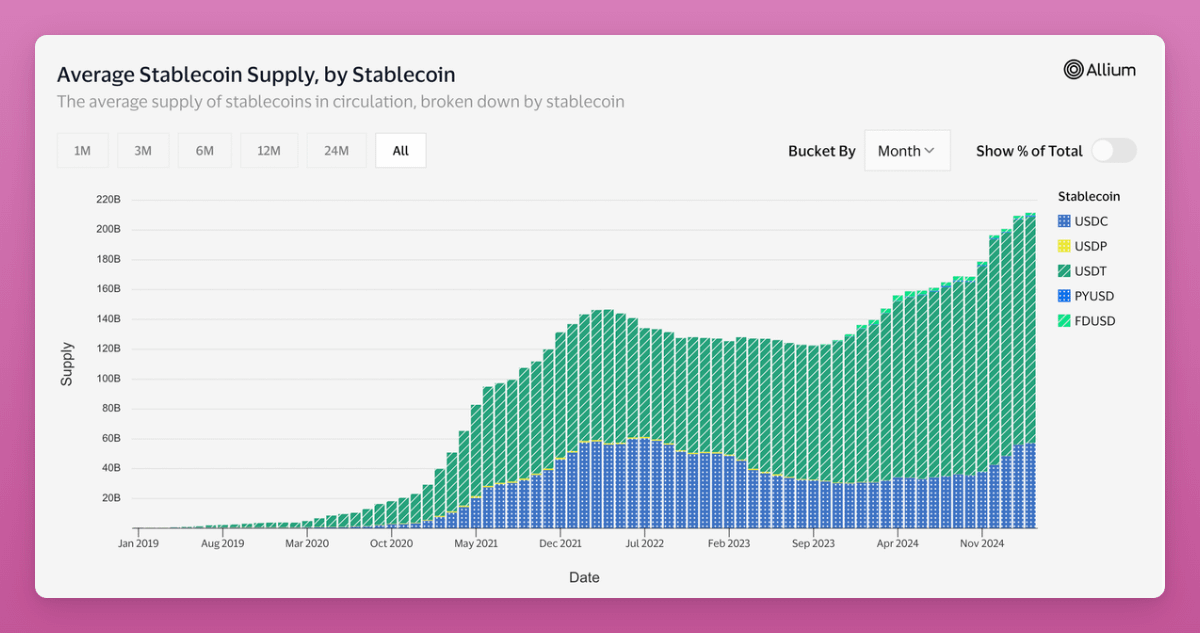
The stablecoin market is in a phase of rapid growth, with the supply increasing by 44% in the past two years, reaching a new historical high, indicating a significant transformation in the cryptocurrency ecosystem. As the Trump administration in the US sets August as the deadline for stablecoin legislation, traditional financial (TradFi) institutions are ramping up their involvement, signaling that stablecoins are shifting from speculative tools to practical applications in payments and decentralized finance (DeFi).
Table of Contents
ToggleThe transformation of the stablecoin market: from crypto speculation to practical application
DeFi researcher Ignas points out that stablecoins have shifted from short-term trading and settlement tools to payments, remittances, and DeFi applications. This includes SpaceX using stablecoins to collect sales revenue for Starlink services in Argentina and Nigeria, and ScaleAI paying overseas business expenses with stablecoins, demonstrating their growing practical use in the global economy.
Meanwhile, the US Congress has announced that it will pass a stablecoin bill within 100 days of the Trump administration, which is expected to accelerate the entry of traditional financial institutions. Currently, the total market capitalization of stablecoins has reached $226.9 billion, and competition is expected to intensify by 2025.
Traditional finance giants rush into the stablecoin market
In this regard, major financial institutions are actively positioning themselves to embrace the stablecoin era:
Bank of America: Intends to issue its own stablecoin after regulations are in place.
Standard Chartered: Plans to launch a stablecoin pegged to the Hong Kong dollar.
PayPal: Expanding the application of its stablecoin PYUSD, integrating it into more business payment scenarios.
Stripe: Acquired the stablecoin platform Bridge for $110 million, demonstrating confidence in the future of digital payments.
Revolut: Exploring the issuance of its own stablecoin.
Visa: Expected to launch a euro stablecoin next year in partnership with European banking giant BBVA, and provide stablecoin issuance services to banks.
These actions indicate that stablecoins are becoming a bridge between traditional finance and the crypto world, and are expected to disrupt cross-border payments and corporate transactions.
Investment opportunities brought by stablecoins
1. Stock trading
Stablecoins primarily operate on blockchains such as Ethereum, Base, TRON, and Solana. Ignas suggests that investors can focus on the following targets:
Coinbase ($COIN): As Base does not issue its own token, Coinbase stock may be the biggest beneficiary.
Circle IPO: Circle, the issuer of USDC, plans to go public, and the growth of stablecoins may drive up the stock price.
Visa and PayPal stocks: The two payment giants are deeply involved in stablecoin payments, and their future growth is promising.
2. Growth Opportunities for DeFi Protocols
The increase in stablecoin supply will drive up the total value locked (TVL) of DeFi protocols, thereby increasing their revenue and token value. The beneficiaries include:
Lending platforms: Aave, Morpho, Euler, Fluid.
Decentralized exchanges: Uniswap, Curve.
Stablecoin protocols: Maker, Ethena.
3. Cross-Chain Technology and Oracle Platforms
As stablecoins develop across multiple chains, the volume and cost of cross-chain transactions will increase, driving the growth of related infrastructure, including Chainlink, LayerZero, Socket, Debridge, and Across.
4. Emerging Infrastructure and Consumer Applications
By 2025, there may be more consumer and revenue applications, as well as emerging infrastructure, which often have strong market appeal or may lead to a new wave of investment.
5. Long-term Potential of Public Chains
The widespread adoption of stablecoins will further drive the demand for blockchains such as Ethereum, Solana, and Base. Long-term investment in these public chains may be a sound strategy.
DeFi Yield Products and Payment Applications to Benefit
However, a user commented that in the past, the growth of stablecoins often led to capital flowing into Bitcoin and Ethereum, but currently, the capital seems to be staying in stablecoins to earn DeFi yields.
Ignas believes that this is a positive development for the current DeFi yield products and payment applications. Additionally, an investor is optimistic about TRON due to its undervalued stablecoin ecosystem, but Ignas is skeptical about whether traditional finance will choose TRON over Ethereum or Base.
Will Stablecoins Drive the 2025 Bullish Narrative?
The record-high stablecoin supply provides investors with diverse trading opportunities. From the active involvement of traditional finance to the rise of DeFi protocols, cross-chain technologies, and emerging applications, stablecoins are driving the crypto market into a new phase. Their continued growth is expected to bring a bullish sentiment to the 2025 market and may lead to the outperformance of certain products.
Risk Warning
Cryptocurrency investment is highly risky, and its price may fluctuate significantly. You may lose your entire principal. Please carefully evaluate the risks.