Compilation: The Heart of the Metaverse
Artificial intelligence is developing at an unprecedented rate. Among the many AI models that have attracted attention, DeepSeek stands out.
The number of installations of DeepSeek on Android phones has surged, which is enough to prove that in some key niche areas, DeepSeek has user experiences that other products cannot match. Compared to Google Gemini, DeepSeek has shown unique features and significant advantages in multiple aspects.
01.DeepSeek's Content Summary is More Organized
Both DeepSeek and Gemini have the ability to summarize, but the summaries generated by DeepSeek are more readable.
When tested with instructions like "Summarize the recent AI innovation achievements in 150 words", DeepSeek provided key conclusions in a clear bullet point form, although slightly exceeding the word limit. Moreover, DeepSeek's analysis covered more information and included references, making it easier for users to further explore.
Gemini's summary was concise and accurate, but it used a paragraph format, which was less user-friendly than DeepSeek.
02.DeepSeek's Free Model Outperforms Gemini's Paid Plan
DeepSeek is a free, open-source AI model, requiring no subscription fees. In contrast, Gemini uses a freemium model. Its basic functions are free, but advanced tools like the experimental 2.0 professional version, in-depth research, and large file uploads require a Gemini premium subscription.
03.DeepSeek's Local Processing Outperforms Gemini's Cloud Latency Issues
The cloud-based Gemini sends each request to an external server for remote processing, which leads to latency issues, with the delay varying depending on network speed, server load, and geographical distance. During high server traffic, this can result in longer waiting times, slower responses, and even temporary unavailability.
By running DeepSeek on a local computer or server, all computations are performed locally, eliminating the latency of cloud communication and avoiding these problems.
04.DeepSeek Has Lower Training Costs
DeepSeek R1's training method uses reinforcement learning with a structured reward system to optimize accuracy and formatting, outperforming traditional neural reward models.
It is reported to have used 2,048 NVIDIA H800 GPUs and completed training in just 55 days, with a cost of $5.5 million, much lower than Gemini's estimated $191 million. However, experts caution that DeepSeek's claims about costs lack sufficient transparency and may not be entirely accurate.
05.DeepSeek Can Work Even Without an Internet Connection
When users most need AI assistance but cannot connect to the internet, they will be unable to access the support of artificial intelligence. Cloud-based AI requires a stable network connection to answer questions, summarize documents, or generate creative content.
While Gemini Nano supports offline functionality, it cannot fully realize the potential of the cloud-based version. This gives DeepSeek an advantage in scenarios where offline AI usage is required, as self-hosting DeepSeek can provide users with offline AI services anytime, anywhere.
06.DeepSeek Allows Self-Hosting to Maintain Full Privacy in AI Interactions
Most people want their search history, notes, and interaction records to remain private. Cloud-based AI models transmit data to remote servers for processing.
Although providers like Google and OpenAI use encryption and data retention policies, using cloud-based AI means trusting third parties to handle their information.
This poses a risk for users dealing with confidential or proprietary content, as they have little control over the storage and use of their data. For example, Google may store, analyze, and leverage users' personal financial data, private thoughts, or creative projects to improve its models.
DeepSeek provides a local AI solution, where all queries, responses, and processing are kept on the user's device. This eliminates concerns about data leaks, unauthorized access, or server breaches.
07.DeepSeek Supports Deeper AI Customization Than Gemini
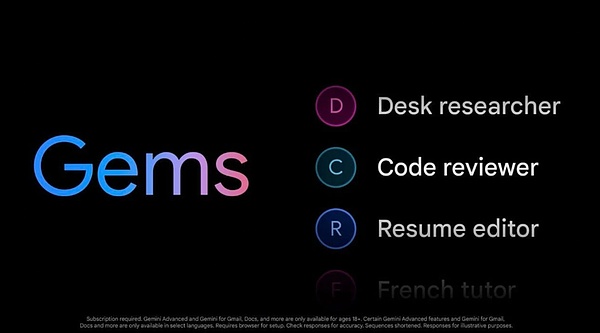
Gemini allows users to create custom AI experts using the "Gems" feature, but users cannot access the source code or model parameters. This means users can only make pre-set adjustments and cannot fundamentally change the model's processing. As a result, users cannot integrate specialized datasets or optimize performance for specific application scenarios.
DeepSeek's open-source framework fully opens access to its core architecture, providing a powerful choice for researchers, enterprises, and AI enthusiasts. Users can adjust the model based on specific industries, specialized applications, and unique language requirements.
For example, medical researchers can train DeepSeek using industry-specific terminology and case studies to improve its understanding of symptoms, test results, and medical literature. Similarly, businesses can integrate proprietary data to customize AI workflows, optimize automation, and enhance customer interactions.
08.DeepSeek Supports Open-Source Collaboration
Unlike proprietary models that follow a corporate development roadmap, DeepSeek benefits from collective contributions, which can accelerate the release of bug fixes and security patches. Therefore, compared to closed-source models, DeepSeek can identify and resolve vulnerabilities, biases, and performance bottlenecks more quickly.
The open-source ecosystem also accelerates the expansion of features. Developers can add missing functionality options without waiting for official updates, leading to a thriving ecosystem of third-party plugins, API integrations, and performance improvements. This also allows developers to embed DeepSeek into various applications without proprietary constraints.
09.DeepSeek's Self-Hosted Model Reduces AI Censorship
Closed-source models implement pre-set content moderation policies for ethical, legal, or risk-reduction reasons, which can restrict discussions on sensitive topics.
While content filtering can prevent abuse, it may lead to unexpected censorship when AI refuses to address legitimate research topics or critical social issues. This is similar to the limitations in Western AI models, where filters block dialogues on controversial or legally sensitive subjects.
The DeepSeek R1 Uncensored version provides a unique solution. When users install or self-host the model, they can use the uncensored version. This is achieved through a "debiasing" process, which modifies the model's internal mechanisms to eliminate the rejection behavior.
10.DeepSeek AI Is Not a "Black Box" Like Gemini
Open-source access allows users, researchers, and regulators to independently audit DeepSeek. This enables a thorough examination of biases, security vulnerabilities, and ethical issues.
The operation of closed-source models is like a "black box", where users must rely entirely on the provider's assurances. Without access to the code and training data, users cannot fully understand how these models make decisions, nor can they confirm the absence of biases, errors, or malicious manipulation.
In healthcare, AI models are used for disease diagnosis, treatment recommendations, and patient data management. A biased or unreliable AI system could lead to misdiagnosis and unfair outcomes.
By accessing DeepSeek's training data, medical professionals and AI ethicists can verify that the model uses diverse and representative datasets, reducing systemic biases.
In finance, AI models influence loan approvals, fraud detection, and algorithmic trading. Lack of transparency prevents users from evaluating whether an AI system is unreasonably denying loans to certain groups or making investment decisions based on flawed data.
Finally, the emergence of DeepSeek has sounded an alarm for the West.
As a large-scale language model with lower costs, open-source, and high efficiency, it challenges the dominance of proprietary artificial intelligence solutions. If all goes well, the algorithms that underlie DeepSeek's success may provide inspiration for the West, driving them to develop more cost-effective artificial intelligence products.