


The decentralized AI network leader Bittensor launched its native token TAO in 2023 amid the rise of generative AI (AI) hype. TAO surged from $49 in October to $757.6 in March 2024, a 15.46-fold increase in just half a year, with a market capitalization of over billions of dollars, becoming a leader in the AI + Blockchain track.
Now, as the demand for decentralized AI (DeAI) heats up, another potential dark horse, Allora, is gradually emerging - if you missed out on TAO, this may be your second chance.
Allora: The Self-Evolving AI Network
Allora Network is a Layer 1 Blockchain AI network built on the Cosmos stack, aiming to solve the problem of "AI intelligence islands" in the current era: traditional machine learning models operate in isolation, unable to learn from each other.
Allora, through a collective intelligence mechanism, allows multiple AI models to collaborate within the network, predict each other's performance in the current situation, and adjust their outputs accordingly to generate more accurate results. In addition, Allora combines reinforcement learning and regret minimization techniques to ensure that the models continuously evolve and improve.
- Reinforcement Learning: Through a reward and punishment mechanism, the model learns and adjusts its strategy by constantly trial and error in the process of interacting with the environment, in order to maximize long-term returns.
- Regret Minimization: The algorithm learns in an uncertain environment, and continuously optimizes its decisions to reduce the opportunity loss (regret) caused by choosing suboptimal strategies.
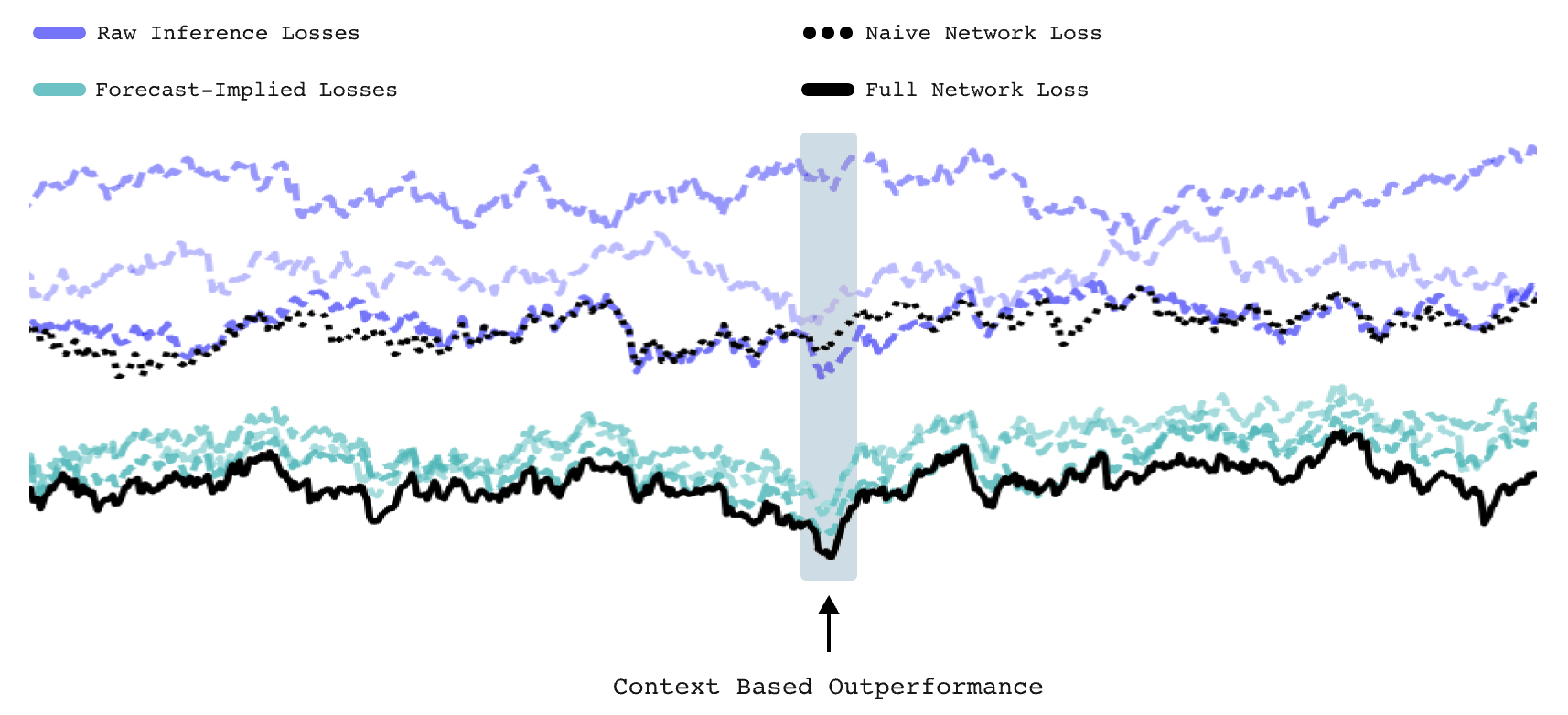
This "collective reasoning + mutual prediction" architecture makes Allora network's error rate (black solid line in the figure below) lower than traditional single models (black dashed line), by building a decentralized collective intelligence platform that allows dispersed models to learn from each other, creating an intelligence system that exceeds the individual.
Applicable Scenarios
Allora is committed to becoming a universal "intelligence layer" to popularize advanced AI capabilities across various industries, such as financial market forecasting, medical health analysis, environmental science, and corporate decision-making, while ensuring data privacy and security.
The Allora team points out that the open network architecture allows anyone with valuable data or models to participate, supporting a wide range of use cases. The most prominent application so far is in the blockchain finance field: Allora has collaborated with teams developing AI-driven DeFi agents, decentralized prediction markets, smart lending, and perpetual contracts. Through the high-precision price forecasting and strategy recommendations provided by Allora, DeFi applications can achieve higher levels of automated trading and risk management. For example:
- Allora has partnered with the DeFAI agent @Symp_AI to provide BTC and ETH price forecasts to improve the performance of its cross-chain perpetual contract trading.
- The AI-driven hedge fund @KiraKuruAI will integrate Allora's price forecasts to further optimize its neutral trading strategy and enhance its risk management capabilities.
In addition to finance, Allora also has potential in areas such as healthcare (e.g., disease risk prediction), gaming (e.g., improving NPC intelligent behavior), new energy scheduling, and decentralized social networking. In short, any AI task that requires multi-model collaboration to improve AI performance and wants to avoid centralizing the training data in a single institution is suitable to run on a network like Allora.
Key Roles and Divisions of Labor
Like Bittensor, Allora divides model collaboration into different "topic" sub-networks, with each topic focusing on a specific task, such as asset price forecasting, social trend analysis, and natural language generation. The Allora ecosystem is maintained and operated by multiple roles, forming a complete decentralized AI market:
- AI Providers (Workers): In a specific "topic" subnetwork, they contribute computing power and machine learning models, generate inference results based on task requests, and predict the inference quality of other workers to help the network integrate the inference results. The rewards for workers will be proportionally distributed based on their inference quality.
- Validators: The verification-related roles in Allora include Reputors and Blockchain Validators.
- Reputors are primarily responsible for evaluating the quality of the inference results provided by workers, providing economic security to the network. They score by comparing the workers' inferences with the true results, and quantify their contribution to the overall network inference. Reputors need to stake ALLO tokens as collateral, and receive rewards based on the accuracy of their assessments and the staking amount.
- Validators maintain the operation of the Allora network by serving as validators on the Cosmos network. The rewards for validators will be distributed proportionally based on their staking amount. Allora has already introduced the first batch of validators on the testnet.
- AI Consumers (Users): Refers to developers, enterprises, or applications that require AI services. They use ALLO tokens to pay for inference fees.
Token Economics
Allora's native token ALLO will serve as the medium of value exchange and the core of the incentive mechanism on the mainnet. According to the official design, the ALLO token has the following functions and economic model:
- Payment and Fees: Consumers of AI services use ALLO to pay for inference results, and the network has introduced a "Pay-What-You-Want (PWYW)" model, allowing users to independently decide how much ALLO to pay for obtaining inference results on a particular topic. This flexible pricing encourages the market to discover the equilibrium price, thereby promoting healthy competition between topics and forming reasonable prices.
- Staking and Economic Security: ALLO is used for internal staking and delegation within the network. Reputors need to stake ALLO as a deposit to fulfill their evaluation responsibilities, and blockchain validators also need to stake ALLO to participate in the consensus. Regular token holders can delegate their ALLO to a Repuror or Validator to share their staking rewards.
- Topic Participation and Governance: Creating a new topic or joining as a worker or Repuror requires paying a certain ALLO fee. This prevents the creation of excessive topics or the arbitrary inclusion of low-quality models, introducing a reasonable economic barrier to entry for the network. At the same time, ALLO token holders can participate in network governance decisions, including adjustments to topic parameters, to collectively shape the direction of the network's evolution. The tokens may also be used for community incentives, developer funding, and other initiatives to drive ecosystem development.
- Issuance Mechanism: Allora has designed a Bitcoin-like token issuance mechanism: a cap on the total supply, with a decreasing rate of new token emissions over time. To stabilize the token value, Allora also plans to maintain a stable annualized yield during the token unlocking period, to mitigate the selling pressure from large token releases.
- Reward Distribution: Allora's network distributes the new token rewards for each block to the various participants, following the standards described in the "Key Roles and Responsibilities" section. Furthermore, if a particular topic has high payment activity, the workers and Reputors in that topic will receive proportionally more rewards, thereby guiding resource allocation to high-value subnetworks.
Overall, Allora has designed a token economic model that combines usage fees, market pricing, staking mechanisms, and halving deflation to balance the growth of the network ecosystem and the token value, and it will be worth observing the performance of ALLO after its mainnet launch.
The Team Originated from Upshot
Allora was founded and developed by the original team from Upshot. Upshot was an AI + blockchain company established in 2019, focusing on NFT valuation prediction. In February 2024, Upshot officially rebranded to Allora Labs, shifting its strategic focus from the NFT valuation platform to the development of a decentralized AI network. The two co-founders of Allora Labs are Nick Emmons and Kenny Peluso.
- Nick Emmons: Co-founder and CEO of Allora Labs. Emmons previously served as the Chief Blockchain Engineer at financial institutions like John Hancock and Manulife.
- Kenny Peluso: Co-founder and CTO of Allora Labs. Peluso holds a Bachelor's degree in Applied Mathematics from Brown University and previously worked as a full-stack developer at John Hancock.
- Other Core Members: Other notable team members include: Head of Strategic Marketing Tayeb Kenzari, Head of Growth Keenan Olsen, Head of Finance and Operations Brian Chen, Backend and Blockchain Engineer Guilherme Brandão, and Blockchain and Data Engineer Kjetil Vaagen.
Total Fundraising of $35 Million
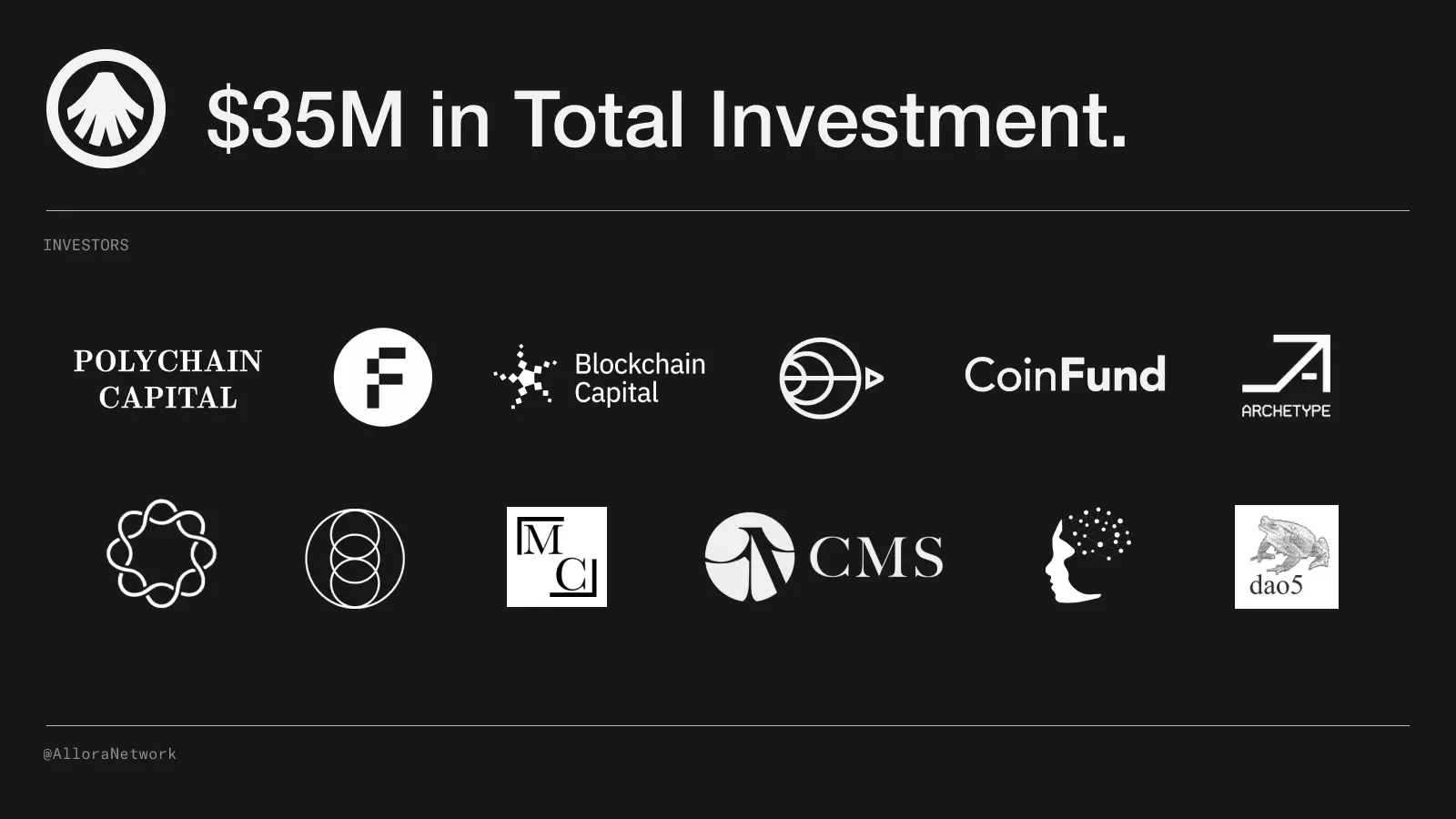
Allora has raised multiple rounds of funding since the Upshot era, with a total of approximately $35 million raised:
February 2020: Raised pre-seed funding of $1.25 million (during the Upshot era).
March 2021: Completed Series A funding of $7.5 million (Upshot).
March 2022: Completed Series A2 (or Series A extension) funding of $23.3 million, led by Polychain Capital.
June 2024: Completed a strategic funding round of $3 million, bringing in strategic partners. Investors in this round include Archetype, Delphi Ventures, CMS Holdings, ID Theory, DCF God, and other crypto investors.
It's worth noting that Allora's fundraising has been in the form of equity (rather than direct token issuance), indicating that the team is not under pressure to issue tokens, and is supported by multiple leading crypto venture capital funds, including Polychain Capital, Framework Ventures, CoinFund, and Delphi Digital.
Conclusion: Allora Valuation Analysis
Allora's design integrates the decentralized AI market of Bittensor, and emulates the token economic model of Bitcoin, while also introducing zkML (zero-knowledge machine learning) to ensure privacy. Combined with strong capital and team support, Allora can be considered one of the most competitive challengers to Bittensor.
If the mainnet is successfully launched and Allora manages to attract AI providers and consumers, it has the potential to reach a valuation in the billions of dollars, and even challenging Bittensor's current $2.1 billion market cap is not an unrealistic scenario.
However, Bittensor has established a first-mover advantage and community effect, the TAO token market consensus is stable, and the ASI alliance (Fetch/SingularityNET/Ocean) is also on the rise, with the competitive landscape becoming increasingly intense.
Allora's winning hand lies in the speed and effectiveness of its application landing. The good news is that Allora's core competitiveness is its high-accuracy AI prediction model, and the standard for evaluating its effectiveness is relatively clear. If it can demonstrate superior performance and attract more partners to adopt it, and successfully enter core tracks such as DeFi and prediction markets, it will help the market assign it a higher valuation.
However, market performance will still be affected by multiple factors such as cryptocurrency market conditions, project delivery progress, and speculative sentiment, and when Allora will issue tokens (TGE) will also become a key variable in determining its valuation trend. For investors who missed out on TAO, Allora may be the next opportunity not to be missed.




